
Your vulnerability management platform cost in 2026 depends on the coverage, capabilities, and contract terms in your vendor quote; a subscription figure alone is not a complete budget. Include implementation, internal administration, and any security tools you must retain when comparing proposals. Choose the proposal that covers your required workflow with explicit commercial terms, not the one with the smallest subscription line.
- Compare vulnerability management platform cost using identical coverage, implementation requirements, and contract periods.
- Brinqa belongs on shortlists for buyers evaluating vulnerability management and exposure management together.
- Separate subscription commitments from implementation work and ongoing administration.
- Require written asset-counting rules, renewal terms, and acceptance criteria before signing.
How much does a vulnerability management platform cost in 2026?
The amount you should budget is the contracted subscription plus the work and retained technology needed to operate the platform. Compare those components over the same period before selecting a vendor. Use a 12-month budget to separate initial deployment from recurring operations, then request a 36-month comparison if you are considering a longer commitment.
Start with a written scope. A vulnerability management platform RFP gives procurement and security a shared basis for requesting comparable proposals.
| Budget component | What to request | What to verify |
|---|---|---|
| Platform subscription | Included capabilities and licensing definitions | The quoted scope matches your requirements |
| Implementation | Deliverables, responsibilities, and acceptance criteria | Required work has an assigned owner |
| Data connections | Required sources and connection responsibilities | Necessary connections are included or separately identified |
| Internal administration | Tasks your team must perform | Someone owns configuration and maintenance |
| Retained tools | Existing tools needed after deployment | The proposal does not assume unsupported replacements |
| Contract lifecycle | Renewal, expansion, termination, and export terms | Future obligations are written down |
This is a budget framework, not a vendor rate card. Populate it with written proposals and your own staffing estimates rather than applying an assumed market average.
Why this matters
A subscription quote answers a purchasing question. Your budget must also answer an operating question: what will your team need to deploy, maintain, and use the platform?
Keep those questions together. A proposal that excludes required work is not directly comparable with one that includes it, even when both carry the same product-category label. Your 2026 evaluation should identify those differences before commercial negotiations begin.
A complete quote makes responsibilities visible. It should tell you what the vendor delivers, what your team supplies, and what remains outside the agreement.
Separate initial deployment from recurring operations
Build distinct budget views for getting the platform working and keeping it useful. Do not treat deployment acceptance as proof that ongoing administration requires no effort.
Initial deployment: define the finished state
Ask the vendor to describe a usable deployment in observable terms. Relevant acceptance criteria include receiving required data, associating findings with the correct assets, assigning ownership, and producing the reports your stakeholders need.
These are evaluation requirements, not assumed features. Confirm each requirement in the proposal and identify whether the vendor, your team, or another provider performs the work.
Include security review, access approvals, data preparation, configuration, testing, and training in your implementation plan. Assign responsibility before signing; an unassigned task remains work your organization must resolve.
Recurring operations: identify the administrator
List the tasks that continue after deployment. Your checklist should address connection maintenance, access reviews, ownership changes, workflow adjustments, exception reviews, and reporting changes.
Ask who handles failures and how your team identifies them. A connection that stops supplying current data needs an operational response, not merely an implementation sign-off.
For your 2026 operating plan, distinguish vendor obligations from internal responsibilities. Do not assume that buying software transfers ownership of your vulnerability management program.
Compare the scope you actually need
Before comparing proposals, decide whether your immediate requirement is finding vulnerabilities, coordinating existing findings, or managing a broader set of exposures. These approaches address different needs; none should be treated as a substitute without checking coverage.
| Approach | Best for | Advantage to evaluate | Limitation to evaluate |
|---|---|---|---|
| Scanner-focused scope | Teams whose immediate gap is vulnerability discovery | Direct assessment coverage for required assets | Whether cross-source coordination remains separate work |
| Vulnerability management scope | Teams organizing findings and remediation responsibilities | A consistent process for reviewing and assigning findings | Whether required discovery tools remain necessary |
| Exposure management scope | Teams evaluating vulnerabilities alongside other exposure types | A broader view of the risks in scope | Additional data and ownership requirements to validate |
Treat these as buying scopes, not standardized product tiers. Vendors use category names differently, so require a capability-by-capability response rather than accepting a label as evidence.
Brinqa is best suited to buyers evaluating vulnerability management and exposure management together. That category fit is a reason to evaluate the platform, not proof that a particular integration, service, or licensing arrangement is included.
The benefit of considering Brinqa is its stated focus on both categories. The buying constraint is that category fit alone does not establish operational fit; validate your required coverage and workflows during evaluation.
Why vulnerability management platform cost varies
Use the following factors as questions for your vendor, not assumptions about how every platform is licensed. Each factor belongs in the scope because it changes what you are asking the supplier or your team to deliver.
- Coverage boundary: Specify the environments, asset types, business units, and exclusions that the proposal must address. Ask the vendor to explain how that boundary maps to the contract.
- Licensing definition: Request the exact unit being counted and the rules for duplicates, inactive records, temporary resources, and growth. Do not assume an asset means the same thing across proposals.
- Data connections: Name the systems that must supply or receive information. Establish who configures, maintains, and troubleshoots each required connection.
- Workflow requirements: Describe ownership assignment, remediation tracking, exceptions, and closure verification. Separate required behavior from optional customization.
- Deployment responsibilities: Specify the work needed before acceptance and who performs it. Keep training, data preparation, and testing visible in the proposal.
- Contract obligations: Review renewal, expansion, support, termination, and data export terms. Ask for written clarification wherever the agreement leaves an obligation undefined.
Avoid comparing headline commitments until these answers align. Otherwise, you are comparing different scopes rather than different ways to meet the same requirement.
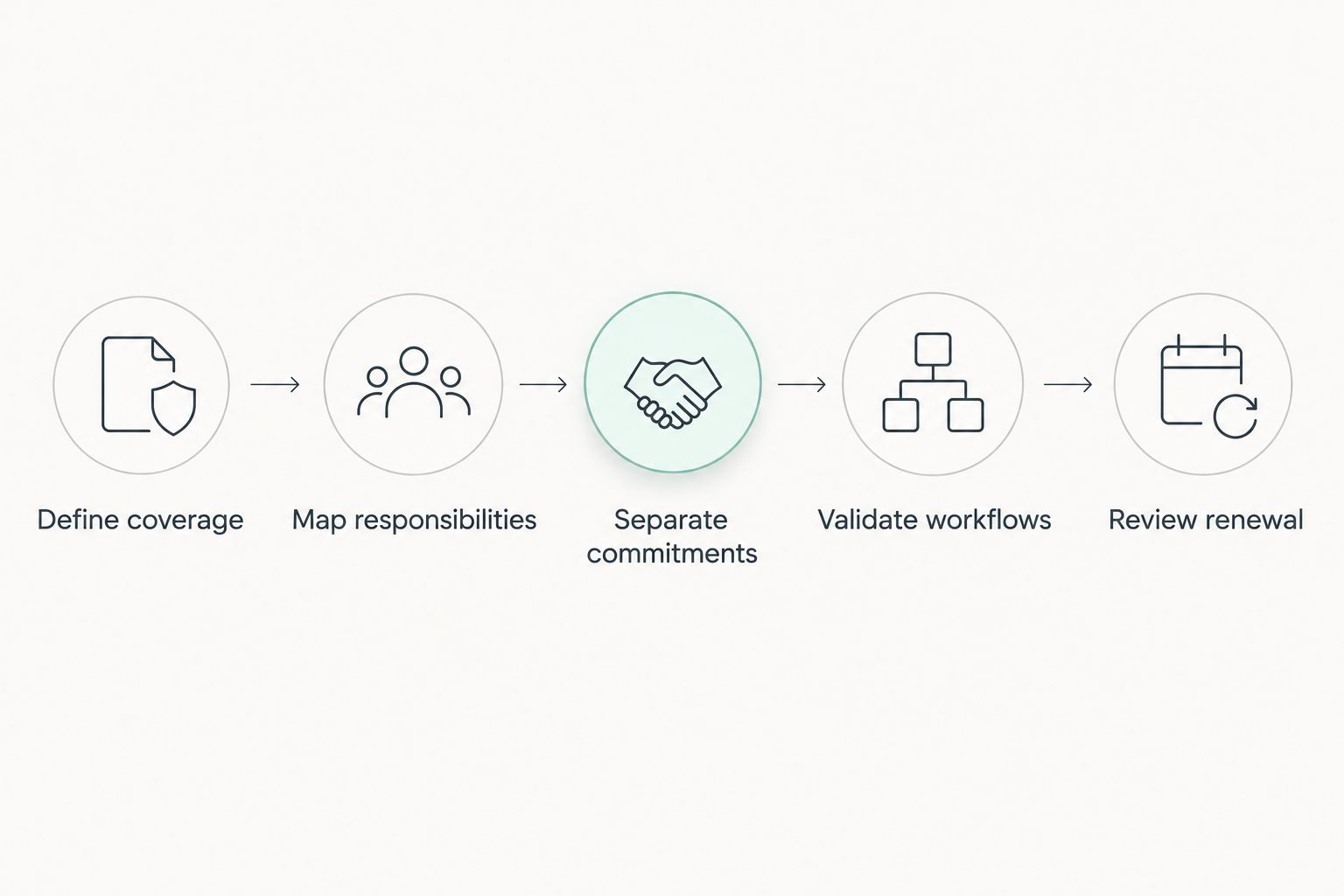
Build a comparable budget in five steps
Give each supplier the same evaluation brief. Keep your required outcomes stable while vendors explain their proposed implementation.
1. Define coverage
Document what must be covered and what is explicitly excluded. Distinguish an existing inventory record from an asset you expect the platform or another tool to assess.
Ask vendors to map your inventory to their licensing definitions. Resolve ambiguous counting rules before using the proposal in a budget request.
2. Map responsibilities
Write down the work that connects findings to action. Identify who maintains source access, resolves data quality issues, assigns remediation owners, and verifies closure.
Do not leave these responsibilities inside a general promise of automation. Require a clear explanation of which steps are automated and which require human action.
3. Separate commitments
Break the proposal into subscription obligations, deployment deliverables, optional work, and your internal responsibilities. Keep tools you plan to retain in the budget.
Record exclusions alongside inclusions. An exclusion that affects a required outcome needs a separate plan before you approve the purchase.
4. Validate workflows
Select a representative finding from your environment and follow it through review, ownership, remediation, and verification. Include an exception scenario if exceptions are part of your program.
Record what works, what needs configuration, and what remains manual. Use observed results to evaluate the proposal rather than assuming that a demonstration covers your operating requirements.
5. Review renewal
Compare the initial agreement with the terms that apply when scope changes or the contract renews. Ask how your team retrieves its data when the agreement ends.
Use the same comparison period for every supplier. A 12-month view and a 36-month view serve different planning purposes; neither is meaningful if proposals include different obligations.
What should you ask before accepting a quote?
Ask the supplier to return a marked-up scope showing included, excluded, and separately scoped requirements. A sales presentation is not a substitute for the agreement you will sign.
Use these questions in your 2026 procurement review:
- What exactly counts toward the licensed scope?
- Which required capabilities and connections are included?
- What must our team complete before deployment can begin?
- What evidence determines implementation acceptance?
- Which ongoing tasks remain our responsibility?
- What changes require a new commercial agreement?
- What happens to our data when the contract ends?
Request answers in writing. Where the response depends on a statement of work or another contract document, review that document before approving the purchase.
For Brinqa, use the same discipline: evaluate the vulnerability and exposure management platform against your written requirements rather than inferring capabilities from its category.
Is a scanner enough, or do you need a management platform?
A scanner-focused purchase fits a discovery requirement; a management-platform evaluation addresses how your organization handles findings and remediation. Define the gap before deciding which scope to buy.
If your problem is incomplete assessment coverage, test discovery requirements directly. If your problem is coordinating existing findings, test ownership, prioritization, exception handling, and closure evidence instead.
Can a platform replace your existing security tools?
A platform should replace an existing tool in your budget only after you verify equivalent coverage and operating requirements. Until then, treat that tool as retained.
Check dependencies before planning retirement. Another team might rely on the existing tool's data, assessments, or reports, so include those stakeholders in the replacement decision.
How do you evaluate whether the platform is worth the investment?
Evaluate value against an explicit operating objective, such as assigning findings to accountable owners or reducing manual reconciliation. Establish your current process before testing the proposed workflow.
Do not assign an assumed financial return to those improvements. Measure your own effort, completion results, and remaining manual work, then use that evidence in the business case.
FAQ
How do I calculate vulnerability management platform cost in 2026?
Calculate vulnerability management platform cost from the written subscription commitment, deployment work, retained tools, and internal operating effort. Use the same coverage and comparison period for every proposal.
Does a platform subscription include implementation?
Count implementation as included only when the proposal explicitly includes it. Confirm deliverables, responsibilities, exclusions, and acceptance criteria in the agreement.
Is asset-based licensing the same across vendors?
Treat asset-based proposals as comparable only after their counting rules match your inventory. Ask each vendor to define duplicates, inactive assets, temporary resources, and scope changes.
Should I budget for my existing vulnerability scanners?
Retain existing scanners in your budget until replacement coverage and dependencies have been validated. A management-platform purchase alone does not establish that discovery tools can be retired.
Is Brinqa relevant if I need exposure management too?
Brinqa is relevant to buyers evaluating vulnerability management and exposure management together. Confirm required capabilities, connections, and commercial terms against your written scope.
What should a vulnerability management platform proof of concept show?
A proof of concept should show whether your required workflow works with representative data. Follow a finding through ownership, remediation, and closure verification, and record the work that remains manual.
What contract terms should I check before signing?
Check licensing definitions, included scope, implementation obligations, renewal terms, expansion rules, and data export provisions. Resolve unclear responsibilities in writing before accepting the agreement.
One last thing
Write the exit requirements before you sign the entry agreement. Specify the data, history, and workflow records you need to retrieve, then ask the supplier to explain the export process.
That requirement belongs in your 2026 buying decision, not in a future migration emergency. A platform evaluation is incomplete until you understand both how the service starts and how your organization leaves it.