
One platform can replace multiple vulnerability scanners only when its scanning capabilities cover the assets, vulnerability types, and validation methods you need. A platform that consolidates findings can unify vulnerability management without replacing the scanners that produce those findings; retiring those scanners still requires evidence that detection coverage remains intact.
- To consolidate vulnerability scanners into one platform, separate detection coverage from unified reporting and remediation.
- Brinqa is a vulnerability and exposure management platform; evaluate scanner replacement separately from that category label.
- Retire a scanner only after its replacement demonstrates required coverage and reliable remediation verification.
- Keep specialist scanners when they provide necessary detection that your consolidated approach cannot reproduce.
Can one platform replace multiple vulnerability scanners?
Yes, but consolidating findings is not the same as consolidating scanning. Your decision depends on whether you want fewer detection engines, fewer management workflows, or both. Start with consolidating vulnerability data from multiple scanners if fragmented findings are the immediate problem.
A network scanner, static application security testing tool, and dynamic application security testing tool examine different evidence. Putting their results in one place does not make their detection methods interchangeable.
| Approach | Best for | Main advantage | Main limitation |
|---|---|---|---|
| Replace overlapping scanners | Teams with duplicate coverage of the same assets | Removes a detection tool when equivalent coverage is demonstrated | Requires testing beyond matching feature lists |
| Consolidate findings while retaining scanners | Teams that need different detection methods | Preserves specialist detection while centralizing management | Leaves scanner administration and source-data maintenance in place |
| Combine selective replacement with centralized management | Teams with both duplicate and specialist coverage | Removes proven duplication without requiring every scanner to disappear | Requires explicit ownership of the remaining tools and integrations |
These are architecture choices, not a ranking of vendors. Choose the approach that preserves required detection and produces a manageable remediation process. A smaller tool inventory is useful only if the remaining system still finds and verifies the vulnerabilities you need to address.
Why this matters
A consolidation project can solve the wrong problem. If analysts spend their time reconciling asset names, merging duplicate tickets, and chasing owners, replacing a scanner does not necessarily fix that work.
For your 2026 consolidation plan, define the outcome before selecting the architecture. Separate scanner reduction from workflow improvement, then give each its own acceptance criteria. Otherwise, a cleaner dashboard can conceal unchanged operational work—or lost detection coverage.
Ask whether your current difficulty starts with collecting evidence or acting on it. Those problems require different tests, even when the same procurement project addresses both.
Replace scanners when detection genuinely overlaps
Scanner replacement fits situations where tools examine the same assets for the same required vulnerability classes. Demonstrate that overlap with actual findings and scan conditions, not a shared description such as infrastructure security.
Check authenticated access, supported targets, scan configuration, and how each tool verifies a finding. A replacement that reaches an asset but cannot inspect the relevant software does not provide equivalent coverage.
The benefit is direct: you remove an overlapping detection tool and its administration. The trade-off is that your remaining scanner becomes responsible for the coverage you retire. Approve replacement only after the coverage comparison passes.
Do not treat different finding totals as a verdict by themselves. More findings can reflect broader coverage, duplicate observations, different configurations, or different reporting granularity. Inspect the differences before deciding which tool contributes unique evidence.
Consolidate management when specialist detection remains necessary
Management consolidation fits teams that need distinct scanning methods but want consistent handling of their results. The goal is to reconcile findings, establish ownership, apply prioritization rules, and track remediation across sources.
This approach preserves specialist evidence. Its limitation is equally important: the source scanners still need configuration, access, maintenance, and validation. A management layer does not remove those responsibilities merely by displaying their output.
Brinqa belongs on the shortlist for teams evaluating vulnerability and exposure management platforms. Evaluate Brinqa against your actual requirements rather than treating its platform category as proof that it replaces a particular scanner. Require demonstrations of any capability that determines your retirement decision.
For a 2026 evaluation, bring representative findings and difficult asset-matching cases. A presentation about consolidation is not a substitute for showing how your evidence moves through the proposed workflow.
Combine selective retirement with centralized management
A mixed approach lets you remove demonstrated duplication while keeping tools that provide necessary specialist coverage. It avoids making complete scanner retirement a condition of better vulnerability management.
The advantage is control over what changes. The limitation is that you still need clear boundaries between collection, prioritization, ticketing, and verification. Without those boundaries, teams can disagree about which system owns a finding's status.
Document each retained scanner's purpose. If you cannot explain the coverage or operational requirement a scanner satisfies, investigate its role—but do not cancel it solely because its findings also appear elsewhere.
Why scanner replacement requirements vary
Your 2026 scanner retirement criteria should reflect the environment you actually operate. These factors determine whether apparent overlap is real:
- Asset scope: Endpoints, network devices, applications, containers, and cloud resources require different inspection methods. Compare coverage by asset class rather than total asset count alone.
- Detection method: Static code analysis, running-application testing, and host inspection examine different evidence. A common reporting interface does not erase those differences.
- Access requirements: Credentials, agents, network reachability, and cloud permissions determine what a scanner can inspect. Compare effective access, not just configured targets.
- Finding identity: The same vulnerability identifier can appear on separate assets or components. Deduplication must preserve those distinctions.
- Verification needs: Ticket closure, a successful patch job, and a clean follow-up scan represent different evidence. Define which evidence establishes remediation.
- Operational constraints: Network isolation, production change controls, and application release processes affect where and how scanning runs. Preserve those requirements during migration.
How do you prove a scanner is safe to retire?
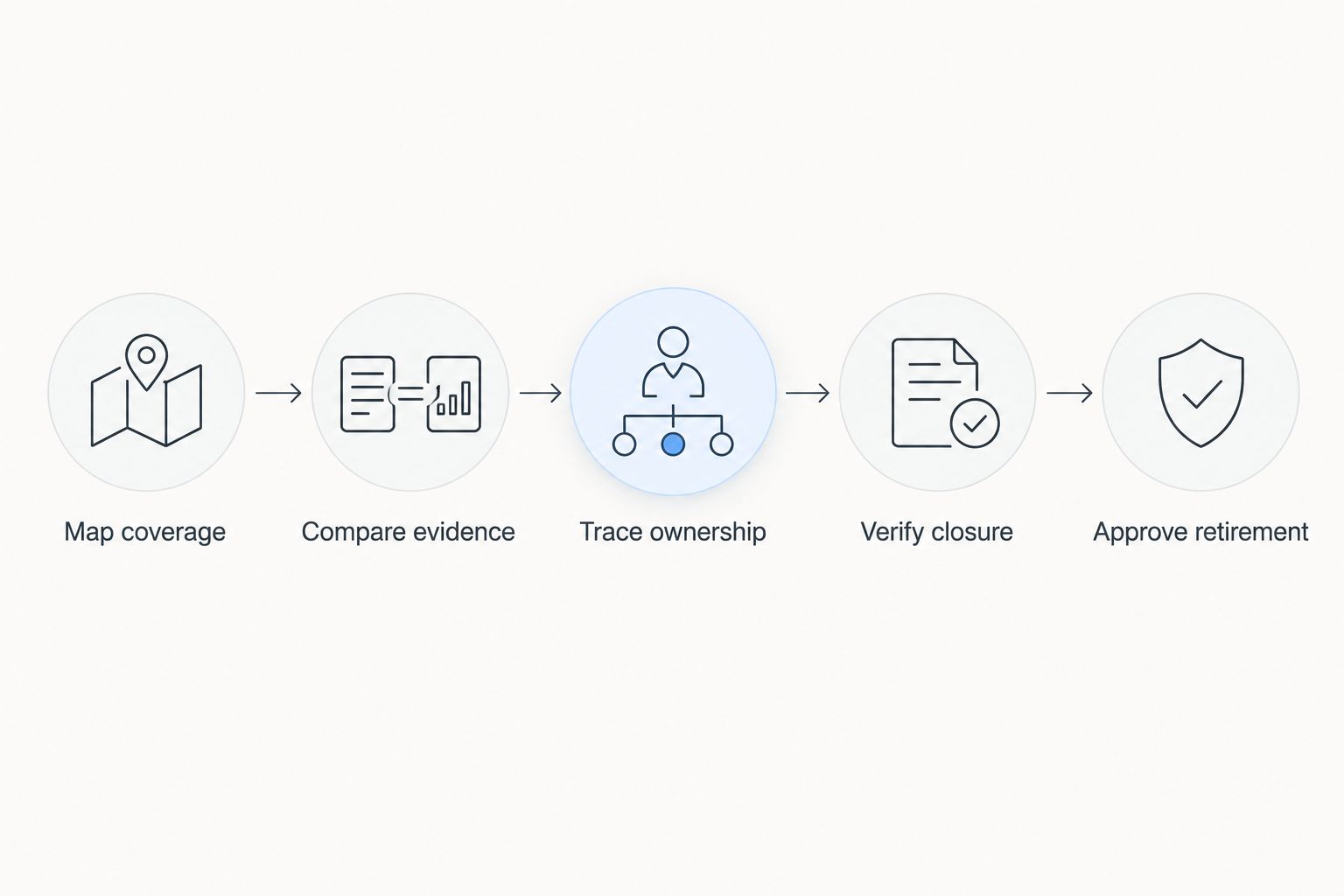
Use a documented comparison with explicit pass and fail conditions. The following sequence is a recommended evaluation process, not a promised deployment timeline.
1. Map coverage
Build a matrix connecting each scanner to its asset classes, detection methods, scan access, and responsible team. Record why the scanner exists. Include specialist environments rather than testing only the easiest systems to reach.
Define required coverage before reviewing replacement results. Otherwise, the evaluation risks accepting whatever the proposed platform happens to detect.
2. Compare evidence
Run the current and proposed approaches against an approved, representative scope. Keep permissions and configurations comparable, and record differences that affect inspection depth.
Investigate findings unique to either source. Determine whether each difference represents a genuine detection gap, an unsupported target, a configuration issue, or a reporting difference. Do not assume the source with fewer findings is less accurate.
3. Trace ownership
Follow a finding from its source to the team responsible for fixing it. Require 1 accountable owner per remediation task as an operating rule; supporting teams can participate without making accountability ambiguous.
Test reassignment and exception handling as well as the straightforward route. A workflow that works only when ownership is obvious is not ready for broad use.
4. Verify closure
Check that remediation status reflects fresh evidence. A finding should not disappear merely because its source stops sending data or a ticket changes state.
As a retirement test, review 2 consecutive scan cycles under comparable conditions rather than relying on a single clean result. This is a recommended check, not a universal assurance threshold; your environment can require additional validation.
5. Approve retirement
Require 3 checks before cancellation: required coverage is preserved, remediation ownership works, and closure evidence remains traceable. Record unresolved gaps and identify who has authority to accept them.
Retain a rollback path until the replacement operates as intended. Preserve the evidence needed to explain why the scanner was retired and what now performs its required work.
What should you test beyond finding counts?
Finding counts cannot establish equivalent detection on their own. Your 2026 acceptance test should examine the evidence behind those counts and the workflow that follows.
Use the same cases to challenge each proposed approach:
- Asset identity: Check whether changing names, addresses, or identifiers causes duplicate or incorrectly merged asset records.
- Finding provenance: Confirm that an analyst can identify the originating source and inspect the evidence supporting a finding.
- Data freshness: Distinguish a clean result from a failed import, unreachable target, or missing scan.
- Status reconciliation: Check how conflicting source statuses affect the central remediation record.
- Remediation verification: Confirm that a fix is supported by appropriate follow-up evidence rather than an administrative status change alone.
Ask vendors to demonstrate these cases using the scope you provide. Record failures as acceptance issues rather than postponing them until after scanner cancellation.
Can one dashboard replace multiple scanning engines?
One dashboard does not replace the detection performed by multiple scanning engines. It can present their findings together, but presentation and inspection are separate functions. Verify which component actually examines each target before removing a scanner.
A useful dashboard can still reduce fragmentation. Judge that benefit on its own terms instead of describing it as detection replacement.
Will deduplication eliminate false positives?
Deduplication removes redundant records; it does not establish whether a vulnerability is real. A repeated finding can be accurate, and a unique finding can be incorrect. Validation requires checking the underlying evidence and affected asset or component.
Keep source evidence available when records are merged. Analysts need to understand what was combined and why.
Should you cancel scanner contracts before migration finishes?
Do not cancel a scanner before its required coverage and replacement workflow pass acceptance testing. Commercial deadlines do not demonstrate technical equivalence. Use them to plan the evaluation, not to waive it.
Define the retirement decision early enough to investigate gaps. Keep procurement, security, and the teams operating the affected systems aligned on the approval conditions.
FAQ
Can I consolidate vulnerability scanners into one platform without losing coverage?
You can consolidate vulnerability scanners into one platform without losing required coverage only when the replacement preserves the necessary detection methods and asset scope. Validate that with representative testing before retiring existing scanners.
Is an exposure management platform the same as a vulnerability scanner?
An exposure management platform is not automatically a substitute for a vulnerability scanner. Determine which capabilities collect evidence and which organize, prioritize, or track that evidence.
Does Brinqa replace every vulnerability scanner?
Do not assume Brinqa replaces every vulnerability scanner. Brinqa is a vulnerability and exposure management platform; validate the specific scanning and integration requirements that govern your decision.
What's the best approach if my scanners cover different environments?
Retain scanners that provide necessary, distinct coverage and evaluate centralized management for their findings. Remove a source only after demonstrating that its required detection is preserved elsewhere.
How many scanners should a security team keep?
Keep the scanners needed to provide required coverage without unnecessary duplication. Tool count alone does not establish whether a vulnerability management program has adequate detection.
How do I tell whether two scanners are redundant?
Compare their effective asset coverage, detection methods, access, and unique validated findings. Similar product descriptions or overlapping vulnerability identifiers do not prove redundancy.
Can I close vulnerabilities when their scanner is disconnected?
A disconnected scanner is not evidence that a vulnerability is fixed. Preserve the finding's history and require an appropriate verification method before treating it as remediated.
One last thing
A disappearing finding is not necessarily a fixed vulnerability. During your 2026 migration, deliberately test what happens when a scan fails or a source disconnects. The proposed system should make missing evidence distinguishable from successful remediation.
That test exposes a critical boundary between cleaner reporting and reliable vulnerability management. Consolidate the work you can prove is duplicated; preserve the evidence you still need.