
Cyber risk quantification is accurate enough for board reporting when you present it as a conditional estimate, document the evidence, and test how assumptions change the decision. It is not an exact forecast: a financial loss figure without a defined scenario, time horizon, and uncertainty range creates false precision.
- Cyber risk quantification accuracy for board reporting depends on traceable evidence, explicit assumptions, and validation.
- Use financial loss estimates to support decisions, not to promise what the next incident will cost.
- Brinqa is a vulnerability and exposure management platform; evaluate financial modeling separately from that category fit.
- Show uncertainty, distinguish risk reduction from model changes, and assign an owner to every material assumption.
Why this matters
A board needs to decide which risks to accept, which controls to fund, and which business activities need closer oversight. A precise-looking estimate does not answer those questions unless directors understand what the estimate includes and what would change it.
For your 2026 board pack, make the decision visible before the methodology. The guide to cyber risk quantification for boards provides a related starting point; the test here is whether your evidence supports the decision you are asking directors to make.
A defensible estimate explains its limits rather than concealing them. If uncertainty changes the preferred action, your board needs that information alongside the headline result.
Is cyber risk quantification accurate for board reporting?
Yes, provided you distinguish a useful decision estimate from a prediction of the next loss. Accuracy requires checking the inputs, the model's treatment of those inputs, and the interpretation presented to directors. A calculation can be internally correct while describing the wrong business scenario.
Use the following comparison to choose what belongs in the board pack. These reporting approaches answer different questions; none should stand in for all the others.
| Reporting approach | Best for | Strength | Limitation |
|---|---|---|---|
| Single expected-loss estimate | Summarizing modeled average loss | Gives directors a compact reference | Conceals the spread of possible outcomes when shown alone |
| Loss distribution | Showing uncertainty and tail exposure | Separates central outcomes from more severe outcomes | Requires explanation of probabilities and assumptions |
| Scenario comparison | Evaluating a specific control decision | Connects an action to a modeled change | Depends on evidence for the control's effect |
| Qualitative risk rating | Communicating an initial assessment | Makes an incomplete assessment visible | Does not express financial loss or probability |
Use a scenario comparison supported by a loss distribution for a financial risk decision. Retain the central estimate as a summary, not as the entire argument. Use a qualitative rating when your evidence does not support a financial estimate, and explain the evidence needed to progress.
Do not translate a vulnerability severity score directly into currency. Technical severity, exploitation likelihood, business interruption, and financial loss are different quantities.
What does accuracy mean in a board report?
Separate accuracy into input quality, model behavior, and decision usefulness. Treating these as interchangeable lets a correct formula conceal weak evidence.
- Input quality: Check whether asset ownership, business dependencies, control status, and loss assumptions describe the scenario being assessed.
- Model behavior: Check whether the calculation handles units, dependencies, and uncertainty consistently.
- Decision usefulness: Check whether plausible changes to assumptions reverse the recommended action.
For a 2026 assessment, record when each material input was observed and when the model was approved. Those dates are not interchangeable. A recently approved report can still depend on outdated evidence.
An observed incident loss is also not a complete validation test. A probabilistic model describes possible outcomes; it does not promise that a particular incident will equal its average. Review the event against the scenario scope before treating the difference as a model error.
How do you validate an estimate before presenting it?
Use a repeatable review sequence. Keep the supporting detail outside the main board narrative, but make it available for challenge.
Define the scenario
Name the business service, initiating event, affected assets, and loss boundary. For example, assess disruption to a named service rather than an undefined organization-wide cyber event. Identify whether the estimate includes response expenses, interrupted operations, recovery work, and other applicable consequences.
Trace the evidence
Record the source, owner, observation date, and limitations of each material input. Label expert judgment as judgment. External loss information needs its publication date and scope, including whether the underlying organizations and events resemble your scenario.
Check the model
Verify units and calculation logic. An event frequency expressed per year must not be combined with a loss duration expressed in days without the necessary conversion. Check for duplicated assets, overlapping loss categories, and assumptions that incorrectly treat connected events as independent.
Test sensitivity
Vary material assumptions across their supported bounds and observe what changes. Identify which inputs drive the result and whether the recommended decision survives those changes. If the recommendation reverses under plausible assumptions, present the choice as unresolved rather than settled.
Assign ownership
Have security review the technical scenario, finance review the loss logic, and the business owner review operational consequences. Record who accepts the remaining uncertainty. Model approval should identify responsibility, not imply that uncertainty has disappeared.
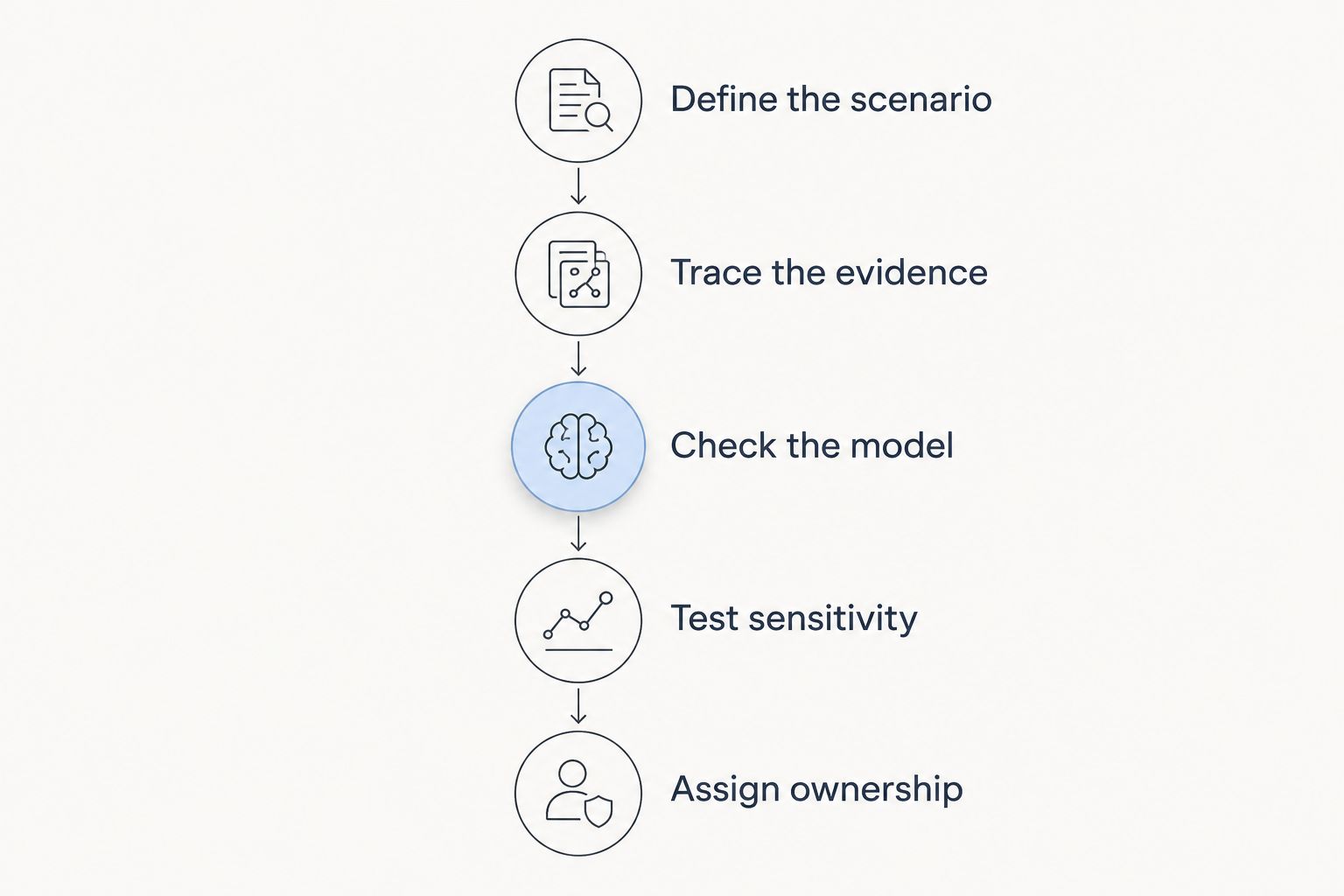
Keep the validation record with the model version. When directors revisit the decision, the record should show what was known at approval rather than silently substituting newer assumptions.
Why cyber risk quantification accuracy varies
The reliability of a financial estimate depends on the evidence and assumptions beneath it. Review these factors explicitly rather than assigning a blanket confidence label to the whole report.
- Scenario scope: A service disruption and a data disclosure involve different consequences. Combining them without a clear boundary makes the result difficult to interpret.
- Evidence relevance: External incident information needs a documented connection to your environment. A large dataset does not automatically represent your business.
- Asset and dependency coverage: Missing service dependencies leave consequences outside the model. Duplicate records create a different problem by overstating the assessed population.
- Control evidence: A documented control is not the same as a tested control. Explain whether the assumed effect rests on observation, testing, or judgment.
- Loss accounting: Overlapping interruption, recovery, and revenue assumptions risk counting the same consequence more than once.
- Changing conditions: Changes to services, exposures, threats, or controls alter the scenario. Keep those changes separate from revisions to the calculation method.
For your 2026 reporting cycle, assign a review trigger to each material assumption. A business acquisition, a changed recovery dependency, or a failed control test deserves reassessment when it affects the scenario—not merely when the next presentation is due.
How should you present uncertainty to directors?
Present a central estimate with a clearly labeled distribution or interval. Explain whether the interval describes variability in possible losses, uncertainty about the estimate, or both. Those are different concepts, and a generic confidence label does not resolve the distinction.
If you use a 12-month horizon, state that the modeled exposure covers 12 months. Do not compare that result directly with a multi-year exposure estimate without explaining the difference in scope.
A 90th-percentile loss means 90% of modeled outcomes fall at or below that value. A 95th-percentile loss means 95% fall at or below it. Neither percentile is a guarantee, and neither says the model itself is 90% or 95% accurate.
Describe the decision consequence in ordinary language. Tell directors whether the proposed action remains justified across the supported assumptions, which uncertain input deserves further investigation, and what evidence would change the recommendation.
Show the uncertainty that affects the decision, not every detail the software can calculate. Keep technical detail available without allowing it to displace the business question.
What belongs in the board pack?
A 2026 board pack should distinguish the current assessment, the proposed action, and the residual exposure after that action. Use the same scenario boundary and time horizon for the comparison.
Include these fields:
- Decision requested: State what directors are being asked to approve, reject, or accept.
- Business consequence: Identify the service and the operational outcome being assessed.
- Estimate and uncertainty: Label the central measure, interval, and horizon.
- Evidence quality: Identify the assumptions that most affect the recommendation.
- Proposed treatment: Explain how the action changes the scenario and what evidence supports that effect.
- Accountability: Name the risk owner, action owner, and reassessment trigger.
Do not describe modeled risk reduction as a realized financial saving. The before-and-after comparison estimates a change in exposure under stated assumptions; it does not establish that an avoided incident would otherwise have occurred.
Similarly, distinguish gross loss from retained loss when insurance is part of the assessment. Document the coverage assumptions rather than subtracting a headline policy limit from every modeled outcome.
Where does vulnerability and exposure management fit?
Brinqa is best for teams seeking a vulnerability and exposure management platform, not a substitute for validating a financial risk model. That category fit follows its stated platform focus; financial-model suitability requires a separate assessment.
When evaluating Brinqa, ask how your proposed workflow connects technical findings to the assets, business services, and owners used in your risk scenarios. Request evidence for the capabilities your assessment needs rather than inferring them from the platform category.
The benefit of vulnerability and exposure management in this process is its focus on the technical conditions behind a scenario. The limitation is equally important: technical findings alone do not establish event frequency, business loss, or the financial effect of a proposed control.
Evaluate Brinqa against your exposure-management requirements. Evaluate any financial modeling component against its documented assumptions, validation process, and treatment of uncertainty. Neither evaluation replaces the other.
Can a lower risk estimate prove remediation worked?
A lower modeled estimate does not, by itself, prove that remediation reduced risk. The result also changes when you revise asset coverage, loss assumptions, dependencies, or the modeling method.
Compare results using consistent definitions, then explain each material change. Separate verified control improvements from better information and methodology revisions. If the model changes substantially, recalculate the earlier assessment where practical or label the results as not directly comparable.
Should you delay board reporting until the data is complete?
No. Report the decision and the evidence limits rather than waiting for an undefined state of completeness. Where a financial estimate is not defensible, use a clearly labeled qualitative assessment and identify what would support quantification.
Do not fill evidence gaps with unexplained precision. A documented assumption that directors can challenge is more useful than a decimal figure whose basis nobody can explain.
FAQ
Is cyber risk quantification accurate enough for a board presentation?
Cyber risk quantification is suitable for board reporting when the estimate has a defined scenario, traceable evidence, explicit uncertainty, and validation. Present it as decision support, not an exact forecast of the next incident.
What accuracy percentage should a cyber risk model achieve?
There is no meaningful accuracy percentage without a defined prediction target, validation method, and evidence base. Assess input quality, model behavior, and whether supported assumptions change the recommended decision.
Is a financial risk estimate better than a red, amber, or green rating?
A financial estimate is better suited to comparing financial consequences when its evidence supports the calculation. A qualitative rating remains appropriate when financial assumptions cannot yet be defended.
Does a 95th-percentile loss mean the model is 95% accurate?
A 95th-percentile loss means 95% of modeled outcomes fall at or below that loss value. It does not measure the accuracy of the model or guarantee a maximum loss.
Can vulnerability scores be converted directly into financial risk?
Vulnerability scores cannot directly establish financial risk. You also need a defined event scenario, business consequences, likelihood assumptions, and evidence about relevant controls.
How often should a board risk estimate be updated?
Update a board risk estimate when material scenario inputs change and review it before the reporting decision. Use documented reassessment triggers for changes to business services, dependencies, exposures, and control evidence.
Can a board use cyber risk estimates to justify security investment?
A board can use cyber risk estimates to compare proposed security actions when the scenarios and assumptions are consistent. Show the residual exposure and test whether the recommendation holds across supported uncertainty.
One last thing
Before approving your 2026 board pack, ask the model owner: What evidence would make us choose a different action? If the answer is unclear, the report has not yet connected its calculations to the decision.
Do not mistake an unchanged headline for an unchanged risk. Record what changed beneath it, including improvements in evidence that offset newly identified exposure.