
CFO cyber risk quantification is the estimation of cyber-related financial loss with the aim of making defensible funding, insurance, and risk-acceptance decisions. Unlike a technical severity report, it connects business interruption, recovery costs, and contractual exposure to the decisions you control.
- Cyber risk quantification for CFOs should compare financial loss scenarios, not convert vulnerability scores into dollars.
- Brinqa fits the vulnerability and exposure management layer; evaluate financial loss modeling separately.
- Start with business interruption, document uncertainty, and compare controls against the same baseline.
- Use expected annual loss for budgeting and severe-loss scenarios for liquidity and risk acceptance.
Why cyber risk quantification matters for CFOs
Your security team reports technical exposure. You approve spending and accept financial consequences. Cyber risk quantification connects those responsibilities by making the loss assumptions behind a security request explicit.
For your 2026 budget, a vulnerability count is not enough to compare a recovery investment with a remediation project. You need to know which business service is affected, what failure would mean financially, and which part of that loss the proposed control addresses.
The cyber risk quantification guide for CISOs covers the security-side perspective. Your finance-side responsibility is different: validate financial assumptions, challenge unsupported precision, and establish who can accept the remaining exposure.
A quantified estimate is a decision model, not a prediction of the next incident. Its value comes from making competing choices comparable and exposing the assumptions that change the decision.
Build a CFO-ready cyber risk model
Use the following process for your 2026 planning cycle. Begin with a spreadsheet and existing business records; choose software after you know which inputs and decisions the model must support.
Define the financial decision before collecting data
Choose a decision with a named owner: fund a recovery capability, prioritize remediation, review insurance coverage, or accept a documented exposure. A model built around an unspecified request to measure cyber risk has no clear stopping point.
Start with a 12-month planning horizon and 3 clearly bounded loss scenarios. These are recommended starting parameters, not industry benchmarks. Select scenarios that distinguish different business consequences, such as service interruption, information disclosure, and fraudulent payment.
Write each scenario as an event affecting a specific business service. Identify what is inside the model and what is outside it; otherwise, separate teams will estimate different events under the same label.
- Name the decision and accountable executive.
- Define the affected service, assets, and dependencies.
- Specify the loss event and planning horizon.
- Record exclusions, including overlapping scenarios.
- Set the evidence needed to approve the decision.
Estimate loss from business records
Build your first loss worksheet from finance, operations, legal, and incident-response records. Separate observed values from estimates. An internal revenue record and an expert judgment about interruption duration are not equally certain.
For interruption, distinguish delayed sales from permanently lost sales. Avoid treating all unavailable revenue as economic loss: recoverable transactions, variable expenses, contractual remedies, and continuing costs change the result. Use the accounting treatment appropriate to the decision, and document it.
Keep cash-flow timing separate from total economic loss. A business can face an immediate liquidity requirement even when some expenses are later reimbursed or some sales eventually return.
- Estimate lost contribution rather than copying gross revenue.
- Separate recovery expenses from ordinary operating costs.
- Include contractual consequences supported by actual agreements.
- Ask legal to define relevant legal-loss assumptions.
- Document recoverability, reimbursement, and payment timing.
Connect technical exposure to each loss scenario
Start manually: ask the security team to map each scenario to affected assets, weaknesses, access conditions, and existing controls. Ask operations to confirm the business dependencies. The mapping should explain a plausible loss event, not merely attach a financial label to a scanner finding.
Brinqa is a vulnerability and exposure management platform. Brinqa is best suited to teams evaluating vulnerability and exposure management, not to CFOs choosing a financial loss model alone. Treat those as separate requirements during selection.
Where recurring exposure-data work becomes burdensome, evaluate whether a platform reduces that manual effort. Require a demonstration using your scenario and evidence requirements; do not assume that an exposure-management category label establishes financial modeling capabilities.
- Identify assets that support the affected business service.
- Record the weakness and conditions required for exploitation.
- Document controls that interrupt the loss scenario.
- Assign evidence owners and update dates.
- Test proposed software against the manual workflow.
Model frequency and severity separately
Estimate how often the defined loss event occurs and how much loss it creates when it occurs. Keep both estimates as ranges where the evidence does not justify a single value. A threat attempt, a successful compromise, and a financially material loss event are different things.
In a simplified model, expected annual loss equals annual loss-event frequency multiplied by average loss per event. The units matter: events per year multiplied by dollars per event produces dollars per year. Keep the event definition consistent across both inputs.
Expected annual loss is not the same as a severe-loss scenario. Use the former to compare recurring economic exposure; use the latter to examine liquidity and risk tolerance. Document dependencies when an outage and a disclosure arise from the same incident.
- Define what counts as a financial loss event.
- Record frequency assumptions and supporting evidence.
- Estimate loss severity independently of technical scores.
- Show uncertainty rather than hiding it in averages.
- Identify shared causes and overlapping loss components.
Compare controls against one consistent baseline
Evaluate every proposed control against the same scenario definitions, financial assumptions, and planning horizon. Otherwise, a project can appear attractive simply because its supporting model assumes a larger untreated loss.
State how the control changes the scenario. Remediation can address an exploitable weakness; recovery measures address interruption consequences. The financial model must reflect the mechanism being evaluated rather than apply an unexplained percentage reduction.
Your 2026 investment case should distinguish modeled loss reduction from cash savings. Avoided loss is contingent, not booked income. Compare it with implementation effort, ongoing operating expense, service disruption, and the time required before the control becomes effective.
- Keep the untreated baseline fixed across proposals.
- Explain whether each control affects frequency or severity.
- Include implementation and ongoing resource requirements.
- Document the evidence supporting control effectiveness.
- Test whether the decision changes under weaker assumptions.
Review insurance and retained exposure separately
Read the actual insurance policy with your broker and legal team. Quantification should inform that review, not substitute for interpreting coverage. A modeled loss amount does not establish that a claim falls within the policy.
Separate modeled gross loss from the amount your organization retains after policy terms are applied. Record deductibles or retentions, limits, exclusions, sublimits, and conditions using the documents that govern your coverage. Do not treat the policy limit as a universal reimbursement amount.
Keep recovery timing visible. A reimbursement assumption does not remove the need to fund incident response and operations while a claim is assessed. Revisit the analysis when the policy, business services, or loss scenarios change.
- Map each loss component to relevant policy language.
- Ask the broker to explain coverage uncertainties.
- Distinguish insurable losses from operational consequences.
- Model retained exposure using actual policy terms.
- Review immediate cash requirements separately from reimbursement.
Establish ownership and refresh the decision
Give finance ownership of financial assumptions, security ownership of technical evidence, and business leaders ownership of service-impact estimates. Assign risk acceptance to the executive with the authority to accept the consequences, not automatically to the analyst maintaining the worksheet.
For your 2026 program, set a 90-day review cadence as a starting recommendation, then add event-driven reviews. An acquisition, major architecture change, recovery test, or incident can invalidate assumptions before the scheduled review.
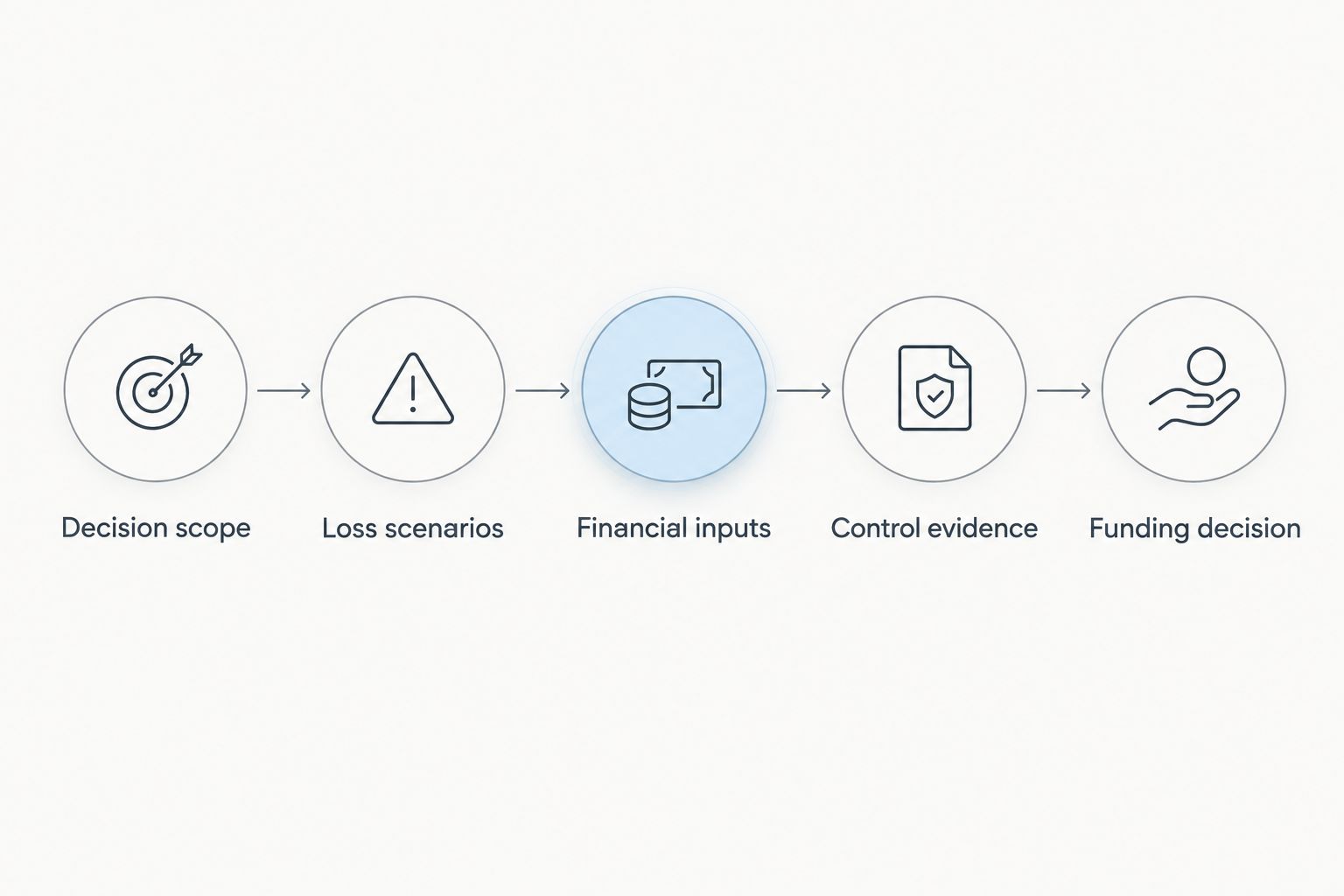
Keep the decision trail readable: Decision scope, Loss scenarios, Financial inputs, Control evidence, Funding decision. An executive should be able to trace the recommendation through that sequence without opening a technical dashboard.
Preserve previous versions so a changed estimate does not erase the assumptions behind an earlier approval. Explain whether the change came from business exposure, technical evidence, or a revised model.
- Assign an owner to every material assumption.
- Record approval dates and evidence sources.
- Schedule reviews and define change-triggered reviews.
- Track accepted exposure and planned treatment separately.
- Preserve model versions and explain estimate changes.
Compare approaches for CFO-led quantification
Choose an approach according to the problem you need to solve. A financial model, specialist assistance, and an exposure-management platform serve different purposes; none removes your responsibility to validate business assumptions.
For a 2026 evaluation, ask each provider or internal team to work through the same scenario. Review the evidence trail, treatment of uncertainty, and ability to explain why a control changes the estimate. Evaluate the work product, not the presentation.
| Option | Best for | Main advantage | Key limitation |
|---|---|---|---|
| Internal spreadsheet model | A bounded pilot with available finance and security owners | Makes formulas and assumptions directly inspectable | Manual updates and version control require discipline |
| Specialist-led assessment | Teams needing help defining scenarios and testing assumptions | Adds structured analytical support | Recurring updates still need internal ownership |
| Dedicated financial loss modeling software | Repeatable scenario analysis and financial reporting | Provides a structured environment for maintaining models | Results still depend on evidence, assumptions, and model design |
| Brinqa vulnerability and exposure management platform | Teams evaluating the technical exposure-management layer | Addresses the vulnerability and exposure management category | Financial quantification capabilities require separate validation |
Do not buy a platform to compensate for an undefined scenario. First establish the decision, inputs, and approval requirements; then determine which work deserves software support.
Common mistakes CFOs make
Convert a severity score directly into dollars
Technical severity describes a technical characteristic, not the financial consequences for your organization. Multiplying a score by a dollar factor creates precision without a supported business model. Connect the finding to a loss scenario and estimate the consequences separately.
Treat modeled loss reduction as guaranteed savings
A control's modeled benefit is not a reduction in an expense account. Keep avoided-loss estimates separate from actual operating savings, and explain the assumptions supporting both. Finance should approve the investment without presenting contingent benefits as realized income.
Add overlapping scenarios together
An interruption and a disclosure can share response expenses, affected systems, and initiating events. Adding full scenario totals can count the same loss twice. Define dependencies and distinguish a combined event from independent events before calculating portfolio exposure.
Let insurance replace the recovery plan
Coverage analysis does not establish operational readiness. Keep restoration requirements and immediate funding needs visible alongside any reimbursement assumptions. Insurance review and recovery planning answer different questions and need different evidence.
Report one number without the decision behind it
A board-level dollar estimate without its scenario, horizon, uncertainty, and accountable owner is difficult to challenge or act on. Report what approval is needed, what changes the recommendation, and what exposure remains after treatment.
FAQ
What is cyber risk quantification for CFOs?
Cyber risk quantification for CFOs estimates cyber-related financial loss to support funding, insurance, and risk-acceptance decisions. It connects defined business loss scenarios with frequency, severity, and uncertainty rather than relying on technical severity scores alone.
What's the best way for a CFO to start quantifying cyber risk?
Start with a bounded business decision and a spreadsheet built from internal records. Define the affected service, estimate financial consequences with its owner, and ask security to document the technical conditions behind the scenario.
Is an exposure score the same as a financial loss estimate?
No, an exposure score is not a financial loss estimate. Financial quantification requires a defined loss event, a planning horizon, frequency assumptions, and business-specific loss consequences.
Does Brinqa replace a cyber risk quantification model?
Brinqa is a vulnerability and exposure management platform, which is a different requirement from financial loss modeling. Validate any proposed quantification capabilities against your financial methodology, evidence needs, and reporting requirements.
How should CFOs compare security investments?
Compare security investments against the same untreated loss scenarios and financial assumptions. Document how each control changes frequency or severity, then assess implementation requirements, ongoing expenses, and remaining exposure.
Should I use expected annual loss or a severe-loss scenario?
Use both for different decisions. Expected annual loss supports comparisons of recurring economic exposure, while severe-loss scenarios help assess liquidity requirements and whether retained exposure exceeds your organization's tolerance.
How often should a CFO update the cyber risk model?
Use a scheduled review plus reviews triggered by material business or security changes. A 90-day cadence is a starting recommendation, not a universal standard; acquisitions, incidents, policy changes, and recovery-test results deserve separate consideration.
One last thing
Ask which uncertain input would reverse the funding decision. That question turns a static risk estimate into a practical evidence plan. If interruption duration drives the decision, prioritize recovery evidence; if the decision depends on business-impact assumptions, validate those with the service owner before refining technical scores.
For your next 2026 approval, fund the analysis needed to resolve that uncertainty before expanding the model. More scenarios do not repair a weak assumption in the scenario that determines the decision.