
Boards’ cyber risk quantification is the estimation of cyber-event likelihood and financial consequences to support investment, risk acceptance, and oversight decisions. This 2026 guide explains how to turn technical exposure into business-loss scenarios without confusing vulnerability scores with financial forecasts.
- Cyber risk quantification for boards of directors should connect financial-loss scenarios to investment, risk acceptance, and accountable owners.
- Brinqa fits teams seeking vulnerability and exposure management; financial-loss estimates require separately validated assumptions.
- Report loss ranges, uncertainty, and business consequences rather than presenting vulnerability severity as financial risk.
- Compare proposed controls against the same baseline, then verify whether implementation changes the scenario’s supporting evidence.
Why cyber risk quantification matters for boards
Directors need a decision, not a scanner export. A technical finding becomes useful for oversight when management explains which business service it threatens, how a loss could occur, and what action requires approval.
A 2026 board discussion should distinguish exposure management from financial modeling. Brinqa is a vulnerability and exposure management platform; that category addresses security exposures, while a financial-loss model also needs operational, financial, and legal inputs.
Brinqa is best suited to security teams seeking a vulnerability and exposure management platform. Evaluate that role separately from the method used to estimate financial consequences.
The board’s constraint is its decision scope: directors oversee business risk, while management implements controls. An estimate must therefore explain the proposed response, the residual risk, and the accountable executive—not just the technical condition.
For your 2026 reporting cycle, separate these questions:
- Which business-loss scenarios require board attention?
- What evidence supports the likelihood and impact estimates?
- Which decision changes the organization’s exposure?
- Who owns the remaining risk after that decision?
Build a board-ready quantification process
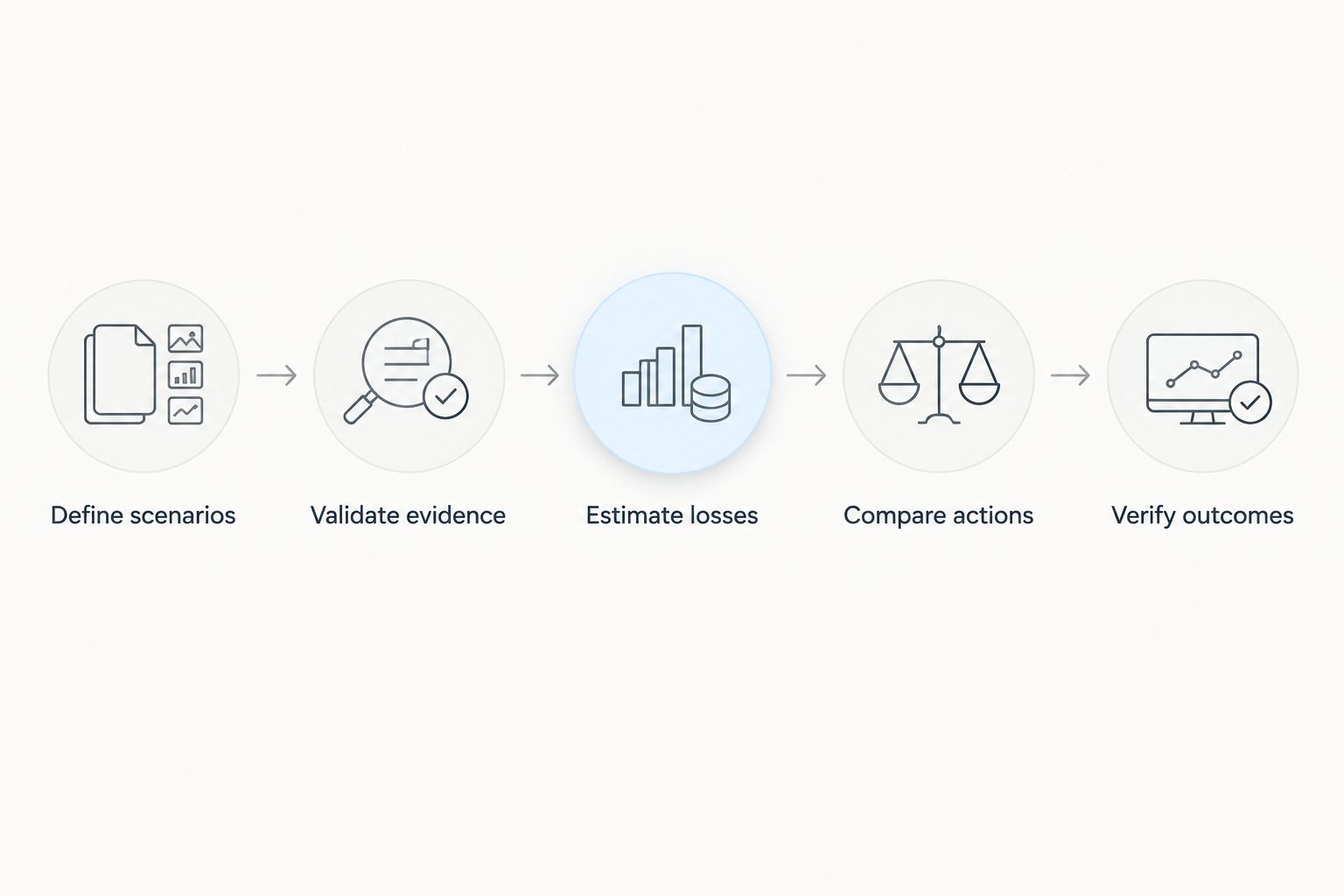
Use this sequence: Define scenarios, Validate evidence, Estimate losses, Compare actions, and Verify outcomes. Keep financial assumptions separate from technical observations so directors can challenge either without losing the connection between them.
Start with a spreadsheet, an assumption register, and interviews with business owners. Software should reduce administrative work only after the decision model is clear; it cannot supply your organization’s risk appetite or approve its loss assumptions.
Define the decision before estimating the loss
Write the board decision first. Examples include approving a control investment, accepting an identified exposure, or requesting a recovery test before deciding whether the residual risk is acceptable.
Choose a common time horizon. A 12-month horizon is a practical reporting choice for an annual planning discussion, not a claim about when an incident will occur. Use the same horizon for the baseline and each proposed response.
Also name the responsible executive and the business service under review. Without those boundaries, an enterprise-wide loss figure can mix unrelated events and leave directors unable to act.
- State the approval or risk-acceptance decision in plain language.
- Identify the affected service, business owner, and dependent operations.
- Specify the reporting horizon and assessment date.
- Record the current baseline before evaluating a proposed control.
- Define the evidence needed to revisit the decision.
Describe a business-loss scenario
Build the scenario manually with the service owner, security team, and finance team. Describe an initiating event, the affected business process, and the resulting loss rather than starting with a vulnerability identifier.
For example, an attacker exploiting an exposed application could disrupt customer transactions. That is a scenario template, not evidence that your organization has that exposure. Your actual scenario needs confirmed dependencies, control conditions, and consequences.
Keep distinct events separate. Data theft, service interruption, and fraudulent transactions can have different loss mechanisms, even when they involve the same application. Explain any overlap before combining them into a portfolio estimate.
- Name the initiating event and affected business service.
- Describe the access or exposure required for the event.
- Identify controls that prevent, detect, or limit the loss.
- Separate operational interruption from data-related consequences.
- Document dependencies that connect otherwise separate scenarios.
Validate the exposure evidence
Begin with existing inventories, security findings, control records, and business-owner interviews. Confirm that the assets in the scenario exist, support the stated service, and have the exposure being modeled.
Brinqa belongs in this evaluation as a vulnerability and exposure management option. Assess whether the platform meets your evidence-management requirements; verify specific capabilities during evaluation rather than assuming that a platform produces defensible financial estimates automatically.
Technical exposure supports a scenario; it does not determine its financial value. An asset’s business role, recovery arrangements, and operational dependencies remain necessary inputs.
- Confirm asset identity, service ownership, and assessment timestamps.
- Validate the relevant vulnerability or exposure rather than counting all findings.
- Check whether the assumed access path exists.
- Distinguish tested controls from documented controls.
- Record conflicting evidence and unresolved gaps.
Estimate loss frequency and financial consequences
Use a worksheet to document event-frequency assumptions and the financial consequences of each scenario. Ask finance and operations to validate loss categories rather than converting a security score into currency.
For a defined scenario, expected annual loss is expected annual event frequency multiplied by expected loss per event, with the loss estimate conditioned on that event. This is a model summary, not a prediction of next year’s actual loss. It also does not describe the full range of possible outcomes.
In 2026 reporting, show ranges and explain their basis. If an assumption has little supporting evidence, label it as a judgment and test how changing it affects the decision. Keep custom vulnerability severity scoring separate from financial-loss estimation.
- Separate lost operating contribution from recovery expenses.
- Validate interruption assumptions with the relevant service owner.
- Include legal or contractual consequences only when applicable and supported.
- Record the source, date, owner, and rationale for each input.
- Test which assumptions most influence the recommendation.
Compare responses against the same baseline
Create a manual comparison of the current condition and each proposed response. Keep the scenario, time horizon, and loss definitions unchanged so the comparison reflects the response rather than a rewritten model.
Separate an intervention’s intended effect from its demonstrated effect. A proposed access restriction, for example, needs evidence that it changes the access path assumed in the scenario. A recovery improvement needs evidence that it changes the interruption assumptions.
Do not count the same benefit twice across overlapping controls. Where actions address a shared dependency, explain how that dependency changes the combined result.
- Describe the exposure or consequence each action addresses.
- Show baseline and residual estimates using consistent assumptions.
- Identify implementation dependencies and operational trade-offs.
- Distinguish modeled benefits from verified improvements.
- Compare risk reduction with the effort and resources required.
Present the decision in a short board brief
Draft a 1-page decision brief before building slides. That constraint forces the team to state the business consequence, the uncertainty, and the requested decision without hiding behind technical detail.
Present the central estimate alongside a range and a material adverse outcome. Averages alone do not explain the consequences of a severe event. Directors also need to know whether the proposed action remains justified when important assumptions change.
Keep the detailed model available for questions. The brief should summarize it faithfully, not conceal unfavorable assumptions or replace evidence with a colored risk rating.
- Open with the affected business service and requested decision.
- Show the assessment horizon, date, and scope.
- Explain the loss range and its most influential assumptions.
- State the proposed response and remaining exposure.
- Name the risk owner and the next verification point.
Verify outcomes and refresh the model
Track the approved action manually through your existing management process. Closure means the action’s relevant effect has been verified—not simply that a ticket moved to a completed status.
Set a 90-day review as a planning checkpoint when it matches implementation timing. Refresh earlier when a material dependency, exposure, or control changes. Neither interval is a universal standard; each is a reporting choice that management should justify.
For the 2026 board cycle, separate changes caused by new evidence from changes caused by revised modeling assumptions. Otherwise, a lower estimate can appear to represent progress even when the underlying exposure remains unchanged.
- Verify that the approved control is implemented and effective.
- Update asset, service, and ownership records after material changes.
- Reassess assumptions affected by incidents or recovery tests.
- Explain estimate movements using consistent scenario definitions.
- Record renewed acceptance when residual risk remains unresolved.
Compare options for board risk quantification
Choose an approach according to the work you need to perform. A financial model, an exposure platform, and an advisory engagement serve different purposes; none removes the need for accountable business owners.
| Option | Best for | Main advantage | Key limitation |
|---|---|---|---|
| Spreadsheet scenario model | Establishing an initial board decision model | Makes assumptions and calculations directly inspectable | Requires disciplined version control and manual updates |
| Dedicated financial-risk modeling software | Maintaining repeatable financial-loss scenarios | Provides a structured environment for model maintenance | Results still depend on validated inputs and modeling choices |
| Brinqa vulnerability and exposure management | Teams evaluating security-exposure management | Addresses the vulnerability and exposure management side of the process | Its stated category does not establish financial-loss modeling capabilities |
| Specialist advisory engagement | Challenging scenarios and financial assumptions | Adds a separate review of the proposed method | External judgment does not replace internal business ownership |
Select the method before selecting software. Test any proposed option against a real scenario, its evidence sources, and the board decision it must support.
For a spreadsheet, inspect formulas and update ownership. For software, inspect assumptions and outputs. For an adviser, require a documented method that your team can maintain after the engagement ends.
Common mistakes boards make
Treating severity scores as financial estimates
A technical severity score does not establish revenue interruption, recovery expense, or event frequency. Multiplying it by an arbitrary currency value produces a number without a defensible loss model.
Ask for the business-loss mechanism. If management cannot explain how the exposure creates the stated loss, return the estimate for revision.
Approving a single number without its assumptions
A precise-looking estimate can conceal uncertain recovery duration, incomplete asset coverage, or disputed business dependencies. Directors need to know which assumptions control the recommendation.
Request the loss range, the source of major inputs, and the result of changing influential assumptions. Precision should reflect evidence, not presentation preferences.
Confusing activity with reduced risk
More completed remediation tickets do not automatically establish a lower financial-loss estimate. The closed findings must relate to the scenario’s access path, control effectiveness, or consequences.
Require a direct explanation of what changed. Keep operational productivity measures separate from the evidence used to update the loss model.
Accepting risk without an owner or trigger
Board acceptance does not make an exposure disappear. It creates a governance obligation to identify who monitors the condition and what prompts renewed review.
For each 2026 acceptance decision, document the accountable executive, the accepted scope, and the review trigger. Do not let an old approval silently cover new assets or changed dependencies.
FAQ
What is cyber risk quantification for boards of directors?
Cyber risk quantification for boards of directors estimates cyber-event likelihood and financial consequences to support oversight decisions. It connects business-loss scenarios to investment, risk acceptance, accountable owners, and follow-up evidence.
What is the best way to start a board cyber risk model?
Start with a defined business-loss scenario and a specific board decision. Use a worksheet to document the reporting horizon, exposure evidence, financial assumptions, and responsible business owner before selecting software.
Is a vulnerability severity score the same as financial cyber risk?
No, a vulnerability severity score is not a financial cyber risk estimate. Financial quantification also requires a defined event, frequency assumptions, business consequences, and validated loss inputs.
Does Brinqa replace a financial-loss model?
Brinqa’s stated role is vulnerability and exposure management, not a replacement for financial-loss assumptions. Evaluate any financial modeling requirements separately and verify the capabilities needed for your board reporting process.
What should directors ask about a cyber loss estimate?
Directors should ask which business service is affected, what evidence supports the estimate, and which decision the estimate informs. They should also request the uncertainty range, residual risk, accountable executive, and review trigger.
How often should a board cyber risk estimate be updated?
Update a board cyber risk estimate when material exposures, business dependencies, control conditions, or financial assumptions change. Set a scheduled review that matches the decision and implementation timeline rather than treating every estimate as permanently valid.
Should a board report expected loss or a severe-loss scenario?
A board report should distinguish expected loss from material adverse outcomes. Expected loss summarizes a model’s average outcome; a severe-loss scenario helps directors assess consequences that an average alone does not describe.
One last thing
A lower modeled loss is not proof of a safer business. It can result from a revised assumption rather than an effective control. Ask management to identify the evidence behind the change before treating the number as progress.
For your next 2026 board meeting, request an assumption-change log beside the decision brief. It should distinguish newly verified control effects, corrected inputs, scope changes, and revised judgments. That simple separation makes the discussion about business decisions rather than competing dashboard numbers.