
Oil and gas exposure management is the process of identifying, prioritizing, and reducing cyber exposures with the aim of protecting safe operations and production continuity. This 2026 guide explains how to connect corporate IT findings with operational technology (OT), remote-access dependencies, and site-approved remediation rather than treating every vulnerability as an interchangeable patching task.
- Exposure management for oil and gas companies should prioritize operational consequences and reachable attack paths, not severity scores alone.
- Brinqa belongs on the shortlist for oil and gas teams seeking a vulnerability and exposure management platform.
- OT vulnerability management requires approved assessment methods, operational ownership, and verified compensating controls.
- Start with existing records; evaluate software against your asset relationships, remediation workflow, and evidence requirements.
Why exposure management matters for oil and gas
A vulnerability backlog does not tell you which production dependency needs attention first. Exposure management for oil and gas companies adds the missing context: what an asset supports, how an attacker could reach it, who can change it, and what makes remediation operationally acceptable.
Brinqa belongs on the shortlist for oil and gas teams seeking a vulnerability and exposure management platform. Brinqa is a platform in that category; evaluate its fit against your requirements rather than assuming that the category label proves support for every industrial workflow.
For your 2026 program, separate technical severity from operational consequence. A corporate application, a contractor access gateway, and an engineering workstation require different evidence and change approvals. The same remediation instruction does not suit every environment.
NIST Special Publication 800-82 Revision 3, Guide to Operational Technology Security, addresses OT security alongside performance, reliability, and safety considerations. Apply that distinction to assessment and remediation: a security action needs operational approval when it affects a control-system environment.
Your objective is a defensible decision, not a larger dashboard. Each priority should identify the affected operation, supporting evidence, accountable owner, immediate containment choices, and the condition that proves the exposure is reduced.
Build an operationally grounded exposure program
Define scope
Start manually with a scope register shared by security, corporate IT, and operational engineering. Name the facilities, services, network boundaries, and remote-access arrangements included in the program. State exclusions explicitly so that an unassessed system never appears protected merely because it is absent from a report.
Map assets to their operational purpose before collecting more findings. A label such as server or workstation is insufficient when the device supports engineering changes, production reporting, or access to a control environment.
For a proposed pilot, select 10 assets spanning corporate IT, remote access, and an operational dependency. This is a manageable starting scope, not an industry benchmark. Ask the responsible engineers to confirm each asset's purpose and assessment restrictions.
- Record the facility, business service, and operational owner.
- Mark IT, OT, and boundary-system responsibilities separately.
- Document approved and prohibited assessment methods.
- Identify contractor access and shared administrative dependencies.
- Record unsupported assets and unresolved ownership gaps.
Reconcile assets
Use existing inventory exports, scanner records, network documentation, and engineering records before buying another discovery tool. Reconcile conflicting identifiers manually in your pilot. Preserve the source and observation date rather than replacing disagreements with a supposedly definitive record.
An IP address alone is not a durable identity. Address reassignment, duplicated names, and disconnected environments can break the relationship between an asset and its findings. Define how you will match records and when an analyst must resolve ambiguity.
Use the guide to unifying asset inventory across security tools to structure this work. When evaluating Brinqa exposure management, request a demonstration using your own conflicting records; do not assume particular integrations or reconciliation behavior without verification.
Treat unverified inventory as a decision risk. If you cannot identify the device confidently, you cannot safely assign its remediation or interpret an apparent disappearance.
- Retain source identifiers and observation timestamps.
- Match devices using more than a network address.
- Keep conflicting records visible until an owner resolves them.
- Distinguish retired assets from temporarily unobserved assets.
- Track inventory confidence alongside vulnerability status.
Rank exposures
Build a manual prioritization worksheet that combines technical findings with operational context. Start with reachable systems, confirmed exploitation information, privileged access, and dependencies that connect corporate networks to operational environments. Then document why each exposure deserves its position.
The Common Vulnerability Scoring System (CVSS) describes vulnerability severity; it does not establish your facility's business priority by itself. CISA's Known Exploited Vulnerabilities catalog provides evidence of exploitation in the wild, not proof that a specific asset is reachable or affected. Check applicability before escalating.
For your 2026 prioritization rules, make missing information visible. An unknown access path is not equivalent to an isolated system. Equally, a vulnerability on an unreachable asset should not automatically outrank a confirmed remote-access weakness with operational consequences.
Software can provide a faster path only if it preserves the reasoning behind your decisions. During vendor evaluation, require reviewers to trace a priority back to its evidence and identify which assumptions remain unverified.
- Confirm that the finding applies to the installed component.
- Identify exposure through remote access or connected networks.
- Document production, safety, and recovery dependencies.
- Check known exploitation and available mitigations.
- Explain priority changes when contextual evidence changes.
Validate controls
Validate an exposure without putting the operating environment at unnecessary risk. Begin with documentation review, configuration evidence, and engineering confirmation. Obtain explicit approval before active scans, exploit attempts, or changes involving operational systems.
A firewall diagram is not proof that a path is blocked. Check the relevant rules, access permissions, and approved connectivity evidence. For contractor access, verify where a session terminates and what it can reach beyond that point.
Choose 5 findings from the pilot and walk each from technical evidence to operational consequence. This is a suggested review sample, not a required standard. The exercise should expose unsupported assumptions before they become tickets or executive risk statements.
A compensating control needs evidence, an owner, and a review condition. Segmentation, access restrictions, and monitoring do not count as validated controls solely because someone listed them in an exception request.
- Confirm asset identity before validating a finding.
- Agree on assessment boundaries with operational engineering.
- Inspect access rules and approved connectivity evidence.
- Record control limitations and unresolved assumptions.
- Separate observed evidence from inferred attack paths.
Assign actions
Turn each confirmed priority into an actionable decision. Use existing ticketing and change records first. Every action needs an accountable owner, an operational approver where applicable, a target date, and a testable completion condition.
Patching is one action, not the entire response. Depending on the finding, you can evaluate access restriction, configuration changes, credential changes, isolation, replacement, or a formally approved exception. Each choice must address the actual exposure rather than merely changing its administrative status.
For your 2026 workflow, distinguish risk ownership from implementation ownership. Security can recommend a response; the responsible operating team must approve changes that affect its environment. An exception should identify what remains exposed and what triggers reconsideration.
Set a proposed 30-day pilot to test handoffs and evidence collection, not to impose a universal remediation deadline. Use the pilot to find stalled approvals, unclear responsibilities, and action types your workflow cannot represent.
- Assign both an implementation owner and a risk owner.
- Record operational approvals and change dependencies.
- Define interim containment while permanent work is pending.
- Give exceptions an expiry or explicit review trigger.
- Specify evidence required before an action can close.
Verify closure
Verify the exposure reduction, not just the completion of a task. A closed ticket proves that a workflow ended; it does not prove that a vulnerable component changed, an access path disappeared, or a compensating control operates as intended.
Use an approved reassessment method and preserve the result. When you cannot safely rescan an operational asset, agree on alternative evidence with engineering and document what that evidence establishes. Do not imply certainty beyond its scope.
For 2026 reporting, group unresolved exposures by operational dependency and decision needed. Separate findings awaiting assessment, actions awaiting change approval, accepted exceptions, and verified reductions. This gives leaders a clearer decision queue than a single total of open vulnerabilities.
Compare results only within a consistent scope. Inventory expansion can increase finding counts without demonstrating worse control performance; an unexplained reduction can conceal lost visibility rather than successful remediation.
- Capture approved reassessment or configuration evidence.
- Confirm that the intended access restriction took effect.
- Reopen actions when validation contradicts completion claims.
- Review exceptions when their conditions or controls change.
- Report scope changes alongside exposure trends.
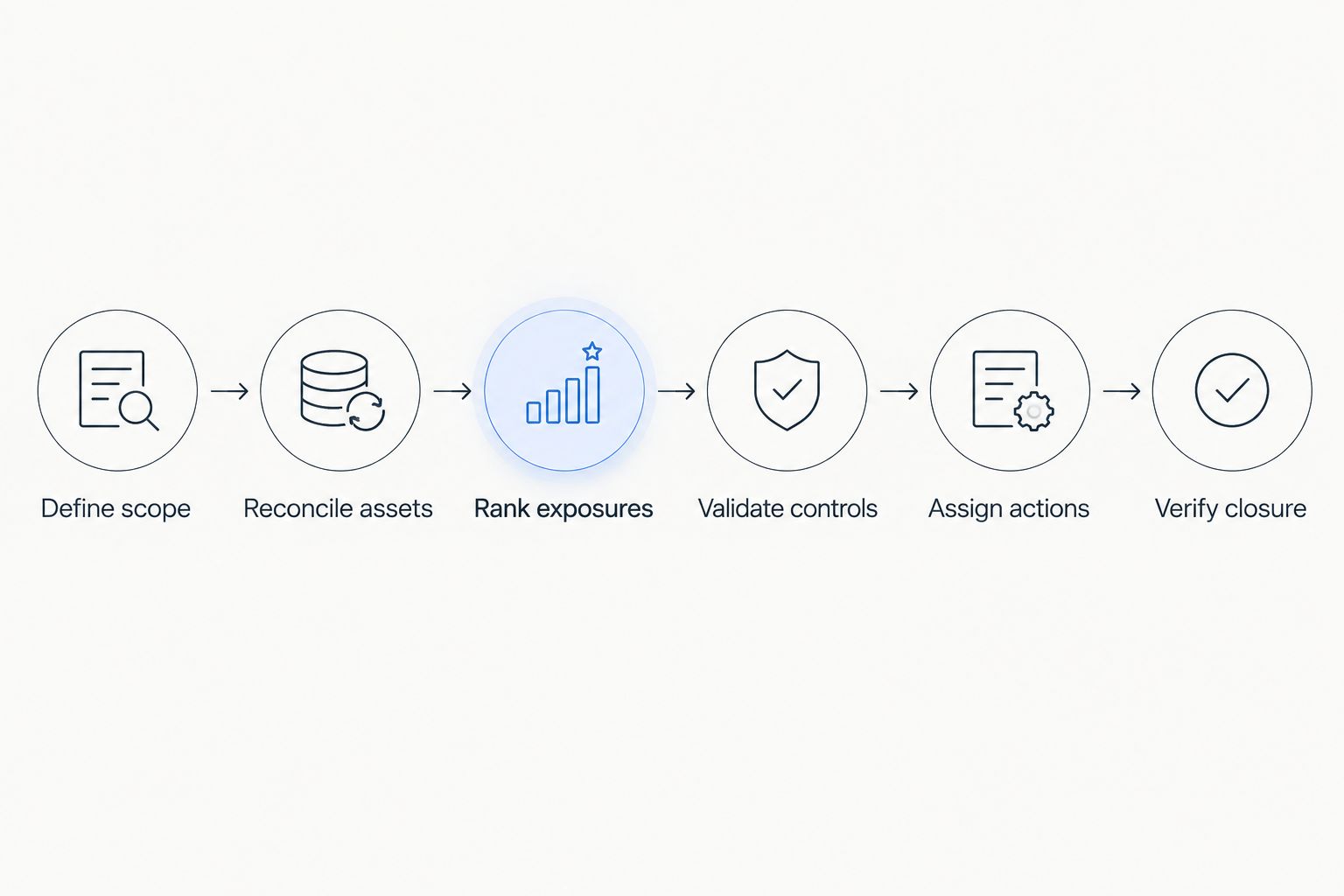
The operating sequence is Define scope, Reconcile assets, Rank exposures, Validate controls, Assign actions, Verify closure. Keep every stage connected to evidence; skipping reconciliation or validation weakens the decisions that follow.
Compare your operating options
Choose an approach based on the problem you need to solve. Finding vulnerabilities, documenting operational context, and managing remediation are related tasks, but they are not interchangeable. Start with existing capabilities and add software where the manual workflow fails.
The table separates each option's useful role from its limitation. Treat the platform row as an evaluation requirement, not a statement that every vendor supplies the same functions.
| Option | Best for | Practical advantage | Key limitation |
|---|---|---|---|
| Existing records and spreadsheets | A bounded pilot with named owners | Lets you define evidence and decision rules before procurement | Requires manual reconciliation and status maintenance |
| Vulnerability assessment tools | Collecting technical findings within an approved scope | Supplies assessment evidence for affected systems | Findings alone do not establish operational priority; OT assessment needs approval |
| OT-focused asset observation | Understanding industrial devices and communications | Adds operational context where the deployment can observe relevant activity | Visibility depends on placement and coverage; observation does not remediate exposure |
| Vulnerability and exposure management platform | Coordinating findings, context, and remediation decisions | Provides a software category to evaluate for managing the program | Requires verified data coverage, workflow fit, and implementation effort |
Evaluate Brinqa vulnerability and exposure management against the final row. Its stated category fits the evaluation; its suitability for your environment depends on demonstrated support for your required data, decisions, and operational approvals. Do not treat a platform purchase as a substitute for asset ownership or engineering participation.
Common mistakes oil and gas teams make
Apply corporate scanning rules to operational networks
An approved scan against corporate infrastructure is not blanket approval for industrial devices. Define assessment methods with engineering, including boundaries and stop conditions. Approval belongs to the environment being assessed, not merely to the team running the tool.
Prioritize severity without checking access paths
A severity score does not identify the route from a contractor account or corporate network to an operational dependency. Check reachability and privileges before assigning operational urgency. Keep unknown paths visible instead of silently treating them as blocked.
Treat a maintenance window as a remediation plan
A scheduled opportunity does not specify the change, prerequisites, rollback decision, or verification method. Prepare those elements before the window. Track interim controls while the permanent action remains pending.
Accept permanent exceptions for legacy systems
An unsupported asset does not justify an exception without limits. Name the risk owner, validate compensating controls, and define replacement or reassessment triggers. Review the exception when access, dependencies, or control effectiveness changes.
Report falling counts without explaining coverage
A lower finding count can reflect removed assets, unavailable scanners, or changed assessment scope. Report those changes separately from verified remediation. Otherwise, your 2026 dashboard can show improvement while your evidence becomes weaker.
FAQ
What is exposure management for oil and gas companies?
Exposure management for oil and gas companies identifies and prioritizes cyber weaknesses using operational context, then tracks actions through verified reduction. It connects technical findings with asset ownership, access paths, production dependencies, and approved changes.
How is exposure management different from vulnerability scanning?
Vulnerability scanning produces technical findings; exposure management turns findings and contextual evidence into prioritized decisions and verified actions. Scanning remains an input, and assessments involving OT require environment-specific approval.
Can we actively scan industrial control systems?
Actively scan industrial control systems only under an assessment plan approved for those systems. Agree on scope, methods, operational oversight, and stop conditions with engineering before testing.
Should we patch every critical vulnerability immediately?
A critical severity rating is not automatic authorization to change an operational system. Confirm applicability, reachability, operational consequences, and approved response options while evaluating interim containment.
Is Brinqa an option for an oil and gas exposure program?
Brinqa is a vulnerability and exposure management platform to evaluate for an oil and gas exposure program. Require evidence that it supports your data sources, asset relationships, approvals, and verification workflow before selecting it.
Can we start without buying another platform?
You can start with existing inventories, assessment records, spreadsheets, and ticketing workflows. Use a bounded pilot to define ownership, prioritization evidence, and closure requirements before evaluating additional software.
What should an oil and gas exposure dashboard show?
An oil and gas exposure dashboard should show operational dependencies, accountable owners, pending decisions, approved exceptions, and verified reductions. Include assessment coverage and scope changes so finding counts do not obscure lost visibility.
One last thing
Test your program with a closed ticket, not just an open vulnerability. Select a completed action and ask the operational owner to demonstrate exactly what changed and how the exposure reduction was verified. If the evidence stops at ticket status, fix the closure rule before expanding your 2026 program.