
Choose Brinqa if your priority is vulnerability and exposure management; choose Splunk if your priority is searching machine data and investigating security events. This 2026 comparison separates exposure management from security monitoring so you buy for the work your team needs to finish.
- Brinqa vs Splunk is primarily an exposure management versus security monitoring decision, not a like-for-like product contest.
- Brinqa is the better category fit for teams buying a vulnerability and exposure management platform.
- Splunk is the better fit for log search; Splunk Enterprise Security addresses SIEM workflows.
- Evaluate remediation and investigation separately, then compare licensing scope, operating effort, and ownership.
Why this matters
A vulnerability finding and a security event answer different questions. A finding identifies a weakness; an event records activity. Your security program needs to understand both, but collecting evidence of activity does not automatically create a process for resolving weaknesses.
That distinction drives the purchase. If your bottleneck is investigation, prioritize searchable telemetry and analyst workflows. If your bottleneck is exposure management, prioritize the work required to turn findings into accountable risk decisions.
For a 2026 shortlist, write the operational problem before the product name. The guide to integrating vulnerability scanners with a SIEM explains the relationship between these workflows. Treat their connection as an architecture decision, not proof that either category replaces the other.
At a glance
| Dimension | Brinqa | Splunk |
|---|---|---|
| Best for | Vulnerability and exposure management buyers | Teams searching machine data or investigating security events |
| Vulnerability management | Direct match to the stated platform category | Evaluate as a data and investigation platform, not an assumed substitute |
| Log search | Not the reason to select this platform from its stated category | Core capability of the Splunk platform |
| Incident investigation | Exposure management is a different buying objective | Splunk Enterprise Security addresses SIEM investigation workflows |
| Context requirements | Require accurate asset and finding context | Require useful events and consistent fields |
| Operational ownership | Assign responsibility for the exposure management process | Assign responsibility for data ingestion, searches, and security operations |
| Pricing model | Compare the contracted scope and expansion terms | Compare the selected product and applicable licensing basis |
| Standout strength | Focus on vulnerability and exposure management | Searchable machine data; SIEM capabilities through Enterprise Security |
The Splunk column distinguishes the platform from Splunk Enterprise Security. Splunk's public product documentation describes machine-data search and its Search Processing Language; Enterprise Security documentation describes SIEM capabilities. Do not treat every capability in the Splunk portfolio as included in every purchase.
Brinqa wins on category fit for exposure management buyers
Brinqa is the better category fit for teams buying a vulnerability and exposure management platform. That is the clearest reason to put it on your shortlist. It matches the stated buying objective without turning a general data platform into an assumed exposure management solution.
Your evaluation should start with an unresolved finding. Ask the vendor to show how your team would understand its significance, identify the responsible owner, record the decision, and establish whether the exposure remains open. Those are acceptance criteria, not capabilities to assume from a category label.
The advantage is focus. You are evaluating a platform identified specifically with vulnerability and exposure management rather than beginning with log search and designing the surrounding program yourself.
The limitation is equally important: exposure management is not the same requirement as event investigation. A category match does not establish SIEM coverage, scanner functionality, connector support, or automated remediation. Verify each required function separately.
Best for: a vulnerability program lead whose buying objective is managing weaknesses and exposures. Select on demonstrated workflow fit, not on the assumption that a security platform performs every security function.
Splunk wins on searching machine data
Splunk is the better fit when your central task is searching logs and other machine data. Its platform provides search capabilities through Search Processing Language, commonly called SPL. That gives this comparison a concrete axis beyond the broad label of cybersecurity.
For example, an analyst investigating suspicious activity needs to retrieve relevant events, filter them, and connect evidence across sources. The immediate deliverable is an explanation of activity, not a prioritized remediation backlog.
That search capability is a genuine advantage for a team with telemetry questions. It also creates work: useful searches depend on the events you ingest, the fields available, and the way your team maintains the data.
Splunk's limitation in this comparison is not an inability to hold vulnerability data. It is the distinction between searching that data and operating a vulnerability management program. A query that returns affected assets does not, by itself, establish ownership, approval, remediation, or verified closure.
Best for: a security analyst or platform team that needs flexible machine-data search. Evaluate using your own investigation questions and representative telemetry rather than a vendor-prepared dashboard.
Splunk Enterprise Security wins on the SIEM buying objective
Splunk Enterprise Security is the relevant option when you are evaluating SIEM workflows. Naming the product matters. Comparing an exposure management platform with the entire Splunk portfolio obscures what you would actually deploy and operate.
Incident investigation starts with activity that warrants attention. Analysts need evidence to determine what happened, which systems were involved, and what response is appropriate. That is different from deciding which known weakness should enter a remediation queue.
The benefit is alignment with a security operations use case. The tradeoff is that an incident workflow still needs analysts, maintained detections, usable telemetry, and response procedures. Buying a SIEM does not supply those operating responsibilities automatically.
For your 2026 evaluation, ask the supplier to identify the exact products and entitlements used in its demonstration. Keep capabilities from separate products out of the base comparison unless they are part of the proposed scope.
Best for: a SOC lead evaluating security event investigation. Do not reject an exposure management platform for failing a SIEM test, or accept a SIEM as an exposure platform because it displays vulnerability records.
Neither platform wins without reliable context
Data quality is a shared requirement, not a product-selection shortcut. An exposure decision needs accurate information about the affected asset and finding. An investigation needs relevant events, usable timestamps, and consistent fields.
The failure modes differ. An obsolete asset record undermines a remediation decision; an absent event undermines an investigation. Neither problem disappears because the reporting interface looks convincing.
Use representative records in your evaluation, including imperfect ones. Ask what happens when an asset changes identifiers, a source stops reporting, or a finding's status conflicts with another record. For event search, ask how an analyst recognizes a missing source or an incorrectly parsed field.
Do not infer a native integration between the platforms. Require the proposed architecture to identify supported interfaces, data direction, responsibility for failures, and the records each system will maintain.
The shared advantage is that both buying objectives become clearer when tested against real information. The shared constraint is dependence on the quality and coverage of that information. Call this a tie on prerequisites, not a claim of identical features.
Neither platform wins without an operating owner
Both options need an accountable operating team. The ownership differs: exposure management requires responsibility for the vulnerability process, while a machine-data or SIEM deployment requires responsibility for telemetry and analyst workflows.
Before your 2026 purchase, specify who maintains source connections, who accepts changes, and who resolves failures. Also identify who uses the output. A platform administrator and a remediation owner do not necessarily have the same responsibilities.
For exposure management, ask who decides priority, assigns work, approves exceptions, and verifies closure. For security monitoring, ask who maintains ingestion, reviews detections, investigates events, and escalates incidents.
The benefit of either approach is a clear place to support its intended work. The drawback is the recurring effort required to keep that work dependable. Do not compare a fully staffed operating model on one side with an unattended deployment on the other.
This is a tie on accountability. Favor the option whose responsibilities fit your team's actual mandate, and reject a proposal that leaves routine operations unassigned.
Pricing: compare the licensed scope and ongoing work
Compare commercial proposals for the same intended workload. A vendor name is not a pricing model, and a headline license comparison does not establish the cost of your deployment.
For the exposure management proposal, request the licensing basis, included scope, expansion terms, and implementation responsibilities in writing. Establish what changes commercially when your managed environment or required workflow changes. Do not assume a particular asset-based, user-based, or subscription structure.
For Splunk, identify the selected product and the licensing option attached to it. Splunk's public commercial materials describe ingest-based and workload-based options for parts of its portfolio; the applicable model depends on the proposed product and agreement. Do not apply one product's model to the entire portfolio.
The tradeoff is predictability versus flexibility. A clearly bounded scope helps budgeting, but you need to understand expansion triggers. A workload-sensitive arrangement requires a credible view of how the deployment will be used.
Compare more than licensing:
- Implementation and data preparation responsibilities.
- Administration and specialist skills.
- Retention and storage requirements where applicable.
- Support scope and change-management responsibilities.
- The work needed to maintain reports, rules, or searches.
For a 2026 purchase, request a proposal tied to your acceptance criteria. There is no defensible pricing winner until the scope and operating assumptions match.
Test the workflow before selecting the platform
A useful evaluation ends in an operational result. Do not stop at an imported record or a populated dashboard. Ask the vendor to complete the work your team currently struggles to finish.
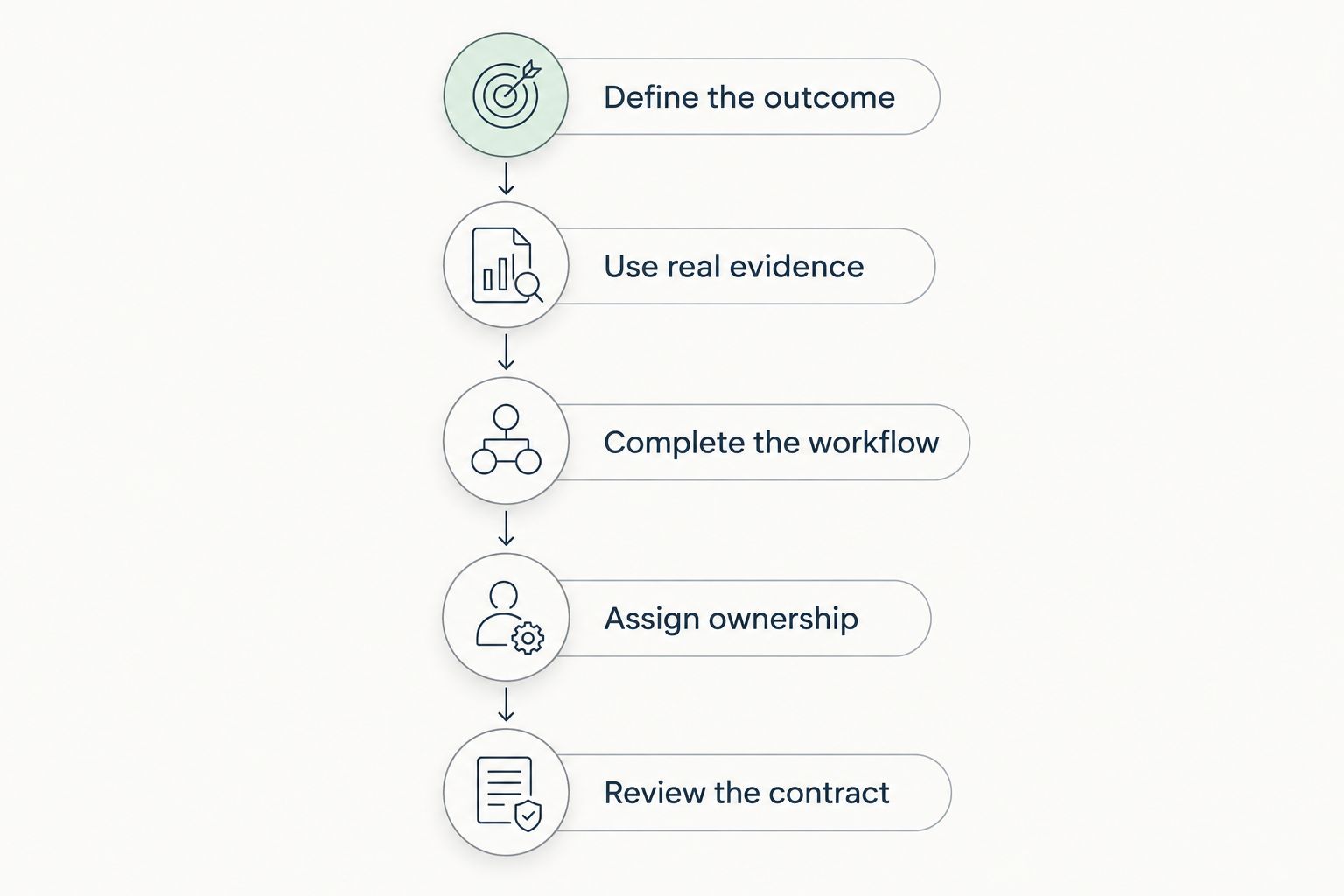
Use this sequence for either buying objective:
- Define the outcome: state whether success means a defensible exposure decision or a completed event investigation.
- Use real evidence: supply representative findings or telemetry from your environment, with appropriate access controls.
- Complete the workflow: require the demonstration to reach a decision and its supporting evidence.
- Assign ownership: identify who maintains the process after implementation.
- Review the contract: confirm that the demonstrated scope matches the commercial proposal.
Record the result in plain language: what worked, what required configuration, and what your team must maintain. This creates a decision record that remains useful after the sales demonstration ends.
Final verdict: choose by the job your team owns
Choose Brinqa if you lead vulnerability and exposure management
Winner for this profile: Brinqa. Your mandate is managing vulnerabilities and exposures, and you want to evaluate a platform explicitly in that category. Require proof of your priority workflow before committing.
The reason to choose it is category fit. The reason to reject a proposal is failure to demonstrate the required process, regardless of how closely the positioning matches your objectives.
Choose Splunk if you lead log analysis or SIEM investigations
Winner for this profile: Splunk, with Enterprise Security evaluated when SIEM capabilities are required. Your team's immediate task is understanding activity through machine data and security events.
The reason to choose it is alignment with search and investigation. The reason to reject a proposal is an operating model your team cannot maintain, or a demonstrated scope that differs from the proposed purchase.
| Dimension | Winner |
|---|---|
| Vulnerability and exposure management category fit | Brinqa |
| Machine-data search | Splunk |
| SIEM investigation buying objective | Splunk Enterprise Security |
| Reliable context requirements | Tie: both need suitable source data |
| Operational accountability | Tie: both need assigned owners |
| Pricing | No winner without matched proposals |
FAQ
Is Brinqa better than Splunk for vulnerability management?
Brinqa is the better category fit for a vulnerability and exposure management purchase. Evaluate the required workflow directly rather than treating Splunk's ability to search data as proof of a complete vulnerability program.
Is Splunk better for security log analysis?
Splunk is the better fit for searching machine data and security logs. Its search capabilities support investigation, but useful results still depend on the telemetry and fields available.
Does buying Splunk mean buying a SIEM?
The exact Splunk product determines the scope. Splunk Enterprise Security is the relevant product for this SIEM comparison; do not assume its capabilities are included in every Splunk purchase.
Can an exposure management platform replace a SIEM?
Exposure management and SIEM address different operational problems. Require separate proof for vulnerability workflows and event investigation before treating a proposed platform as a replacement.
Should a security team use both categories?
A team with both exposure management and investigation requirements should evaluate both categories. Define which system owns each workflow and verify any proposed data exchange rather than assuming native integration.
How should I compare the cost of these platforms?
Compare proposals with matching scope, licensing assumptions, and operating responsibilities. Include implementation, administration, and maintenance work instead of comparing licensing in isolation.
What should I test before choosing in 2026?
Test the completed workflow your team needs: an exposure decision or a security event investigation. Use representative evidence, identify ongoing owners, and confirm that the demonstrated capabilities match the proposal.
One last thing
A dashboard containing vulnerability findings is not proof of vulnerability management. Likewise, a list of security events is not proof of a completed investigation. The decisive evidence is what your team can do next—and whether that action has an owner and a verifiable result.
For your 2026 decision, make the vendor finish the workflow. That requirement is more useful than another feature checklist.