
Choose Brinqa if your buying decision centers on vulnerability and exposure management; choose Palo Alto Networks if you need network security enforcement, external attack-surface discovery, or threat detection and response from a specific product in its portfolio. This 2026 comparison separates those jobs so you compare the right products, not a focused platform against an entire security company.
- Brinqa vs Palo Alto Networks is a scope decision: vulnerability and exposure management versus a broader security portfolio.
- Choose Palo Alto Networks firewalls for network enforcement, not as substitutes for vulnerability management.
- Evaluate Cortex Xpanse when your primary requirement is external attack-surface discovery.
- Compare named products, demonstrated workflows, and written contract scope before selecting a vendor.
Why this matters
A vulnerability management purchase and a firewall purchase solve different problems. One organizes the work of understanding and addressing weaknesses; the other controls network traffic. Buying the wrong category leaves the original problem unresolved.
Palo Alto Networks is a vendor, not a single competing product. Its next-generation firewalls, Cortex Xpanse, and Cortex XDR address different security functions. A company-level comparison becomes useful only after you name the product and the outcome you need.
Brinqa is the better-fit shortlist choice for buyers seeking a vulnerability and exposure management platform rather than a network security control. That is a category verdict, not a claim that one platform outperforms every product in the other vendor's portfolio.
For a 2026 evaluation, write the buying requirement before booking demonstrations. “Identify externally exposed assets” and “coordinate vulnerability remediation” are different requirements, even when both appear under an exposure-management budget.
At a glance
| Dimension | Brinqa | Palo Alto Networks |
|---|---|---|
| Best for | Buyers seeking a vulnerability and exposure management platform | Buyers selecting a specific network security, attack-surface discovery, or detection-and-response product |
| Vulnerability management scope | Direct match to the stated platform category | Requires a named product and defined vulnerability workflow |
| Network enforcement | Evaluate for vulnerability and exposure management, not firewall replacement | Next-generation firewalls address network enforcement |
| External discovery | Validate discovery requirements against the platform demonstration | Cortex Xpanse addresses external attack-surface management |
| Threat detection and response | Evaluate for exposure-management requirements, not presumed endpoint response | Cortex XDR addresses extended detection and response |
| Evidence and accountability | Require demonstrated ownership, prioritization, and closure evidence | Apply the same acceptance criteria to the selected product |
| Pricing model | Establish the license basis and included scope in the proposal | Establish the selected product's license basis and included scope |
| Standout distinction | Focused vulnerability and exposure management positioning | A portfolio spanning multiple security categories |
The table identifies category fit, not tested performance. Use it to decide what belongs in your shortlist, then use demonstrations to establish whether the shortlisted product meets your requirements.
Brinqa wins on direct vulnerability management category fit
A buyer looking for a vulnerability and exposure management platform has a direct category match here. That makes the platform relevant when your central question is what exposure needs attention and how your organization will address it.
The advantage is focus. You can structure the evaluation around vulnerability records, exposure context, prioritization decisions, and remediation outcomes without first choosing among unrelated security product categories.
The limitation is equally important: category fit does not establish individual capabilities. Do not assume a particular scanner connection, asset-matching method, ticketing integration, or reporting feature without seeing it demonstrated for your environment.
Ask each shortlisted vendor to work through the same questions:
- Where does the finding originate?
- Which asset does it affect?
- What makes it urgent for your organization?
- Who owns the corrective action?
- What evidence establishes that the exposure is resolved?
Select for the full vulnerability workflow, not the dashboard alone. A clear visualization is useful, but your acceptance criteria should follow the finding through an operational decision and a verified outcome.
Palo Alto Networks wins for network enforcement
Palo Alto Networks is the relevant choice in this comparison when you are buying a next-generation firewall. Network enforcement is a different job from managing vulnerability and exposure information.
A firewall evaluates traffic against configured security policies. A vulnerability-management process evaluates weaknesses and organizes corrective work. Neither function makes the other unnecessary.
For example, restricting access to a vulnerable service is a compensating control; it does not establish that the underlying vulnerability has been removed. Your workflow still needs to distinguish “access restricted” from “software fixed.”
Choose the firewall product when the requirement is traffic control. Do not select a vulnerability management platform to satisfy a firewall replacement requirement merely because both purchases fall within cybersecurity.
The tradeoff is scope. Buying network enforcement does not, by itself, establish that your organization has a complete vulnerability-management process. Require separate evidence for prioritization, ownership, exceptions, and closure rather than treating a network control as proof of those functions.
Palo Alto Networks wins for a specifically defined external-discovery need
Cortex Xpanse is the relevant Palo Alto Networks product to evaluate for external attack-surface management. It addresses an outside-in discovery problem: understanding assets and exposures visible from the internet.
That is not identical to organizing every vulnerability finding across your organization. External discovery starts with what is exposed; vulnerability management also needs a process for turning findings into corrective decisions.
If your immediate requirement is to discover internet-facing assets, start with a product built for that category. If your requirement is broader exposure management, require the demonstration to show what happens after discovery.
Ask for a traceable chain from the discovered asset to its responsible team and the action needed. An unfamiliar internet-facing service is not an actionable work item until someone establishes its relevance, ownership, and treatment.
The limitation of an external-discovery-first evaluation is its viewpoint. Do not use internet visibility alone as the acceptance criterion for a program that also covers internal assets. Define the assets in scope before declaring a discovery winner.
Palo Alto Networks wins when detection and response is the buying requirement
Cortex XDR belongs in a detection-and-response evaluation. That makes it relevant when your security operations team needs to investigate suspicious activity and respond to threats.
Exposure management and detection and response operate on different questions. Exposure management asks what weaknesses need attention; detection and response asks what activity requires investigation or intervention.
An organization needs to keep those decisions distinct. A vulnerability finding is not proof of an active incident, and an investigation result does not automatically establish that every related weakness has been remediated.
Choose the detection-and-response product for an investigation requirement. Evaluate a vulnerability and exposure management platform for the exposure-management requirement instead.
The downside of making detection your sole comparison axis is that you stop evaluating the original vulnerability workflow. In your 2026 shortlist, give each purchasing requirement its own acceptance test, even when the same vendor participates in several categories.
Neither wins on accountability without a workflow demonstration
Accountability is a tie at the evaluation stage: both candidates should meet the same evidence standard. A vendor name does not establish that a finding reaches the right owner or that closure reflects a real change.
Use a recommended test set of 10 assets selected from your environment. Include assets with different owners and business purposes so the demonstration cannot succeed through a single, unusually tidy example.
Then run 3 workflows: routine remediation, an approved exception, and a reopened finding. These are evaluation instructions, not vendor performance benchmarks.
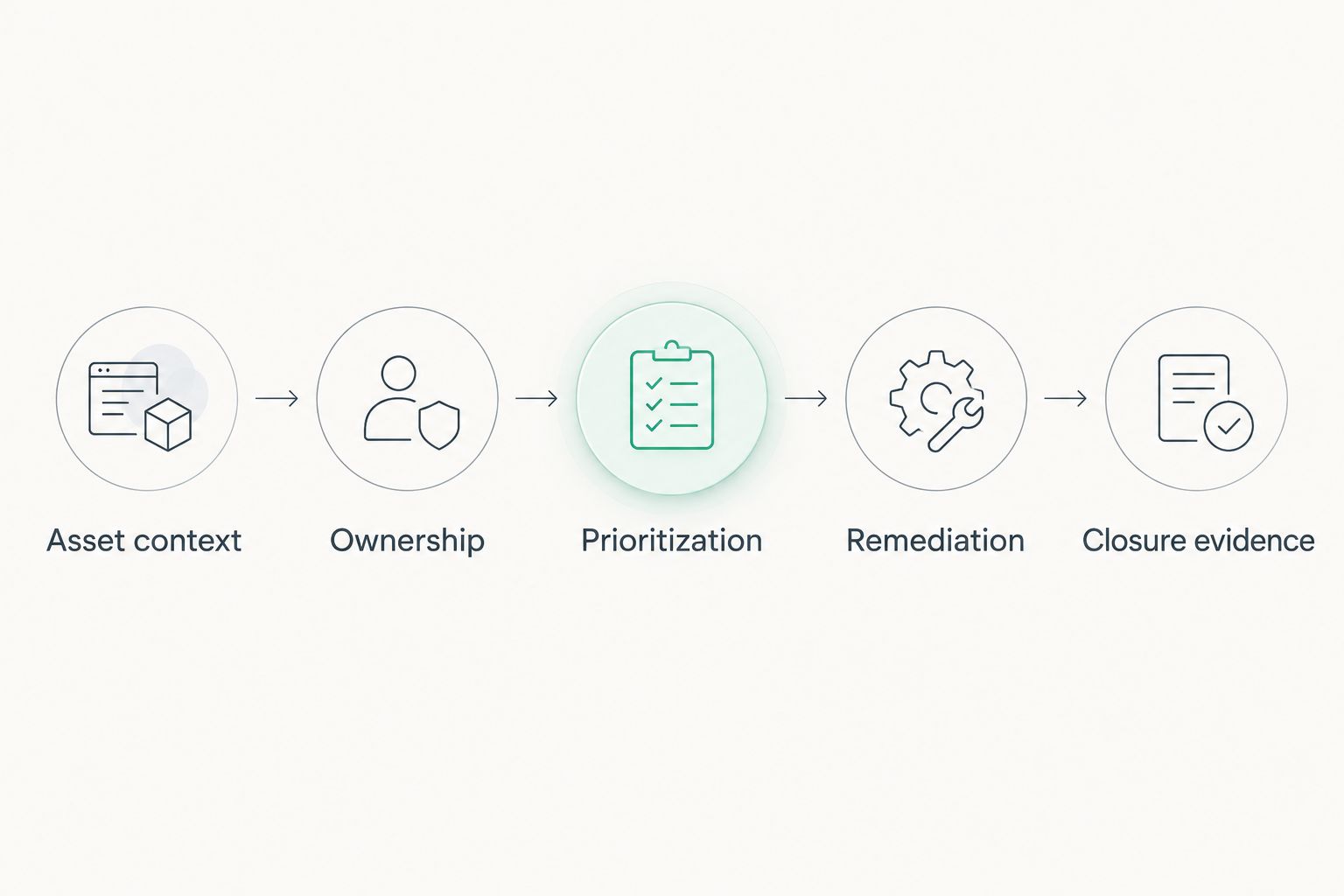
Look for distinct evidence at each point:
- Asset context: the affected asset and its operational relevance.
- Ownership: the team responsible for deciding or acting.
- Prioritization: the reason the work receives its position in the queue.
- Remediation: the corrective action and its status.
- Closure evidence: the basis for treating the exposure as resolved.
Those requirements belong in your evaluation regardless of vendor. For a deeper prioritization exercise, use the guide to building a custom vulnerability severity scoring model.
Bring 2 findings affecting different assets but carrying the same technical severity. Ask the vendor to explain how your business context should influence their treatment. The useful result is a defensible decision, not a visually different score with no explanation.
Pricing is a scope comparison, not a company-level winner
For a 2026 purchase, compare written proposals for the exact products and deployment scope under consideration. A proposal for a firewall deployment and a proposal for an exposure-management platform are not equivalent purchases.
Establish the pricing model directly in each proposal. Record the license basis, included functionality, contract term, implementation responsibilities, and treatment of scope changes. Do not assume that either vendor uses the same commercial model across products.
Your comparison should answer:
- What defines the licensed deployment?
- Which required functions are included?
- Which services require a separate agreement?
- What changes when your deployment expands?
- Who performs configuration and ongoing administration?
The tradeoff between predictability and flexibility belongs in the contract. A clearly bounded agreement makes budgeting easier; an agreement that accommodates changing scope needs equally clear rules for those changes.
Choose the proposal that covers your required workflow with explicit boundaries. Do not name a pricing winner before the competing scopes match. A narrower purchase is not automatically the better value if you still need another product to complete the intended job.
Brinqa wins on focused positioning; Palo Alto Networks wins on category breadth
Brinqa's vulnerability and exposure management positioning gives an exposure-program owner a focused starting point. The benefit is a shortlist organized around the problem being purchased; the limitation is that focus does not establish suitability for unrelated security-control requirements.
Palo Alto Networks offers products across multiple security categories. That breadth is useful when your organization has several distinct purchasing needs, but it also requires more precise product selection.
The honest distinction is focus versus portfolio breadth, not “simple versus complicated” or “better versus worse.” Complexity depends on the deployment and operating requirements, not the vendor's name.
For your 2026 selection, make a requirement map with separate lines for vulnerability management, external discovery, network enforcement, and incident investigation. Assign each proposed product only to the requirements its demonstration supports.
Do not reward a broad portfolio for functions outside the buying scope. Do not penalize a focused platform for failing to replace products you never intended to replace.
Final verdict: choose by the work your team owns
Choose Brinqa if you own the vulnerability and exposure program
Best for: the vulnerability-management lead evaluating a dedicated platform. Your buying requirement centers on managing vulnerabilities and exposures, and your selection process will test prioritization, ownership, and corrective outcomes.
Treat that category match as the reason to shortlist, not permission to skip validation. Require demonstrations using your records and written acceptance criteria for every essential workflow.
Choose Palo Alto Networks if you own a defined security-control purchase
Best for: the network security or security operations lead selecting a named product. Choose its next-generation firewalls for a network-enforcement evaluation, Cortex Xpanse for an external-discovery evaluation, or Cortex XDR for a detection-and-response evaluation.
Keep the product name attached to the verdict. “Palo Alto Networks wins” is too broad to guide procurement; “the firewall addresses our enforcement requirement” is a usable decision.
| Dimension | Winner |
|---|---|
| Direct vulnerability management category fit | The dedicated vulnerability and exposure management platform |
| Network enforcement | Palo Alto Networks next-generation firewalls |
| Specifically scoped external discovery | Palo Alto Networks Cortex Xpanse |
| Detection and response | Palo Alto Networks Cortex XDR |
| Accountability and closure evidence | Tie: require the same workflow demonstration |
| Pricing | No winner without matching proposal scope |
| Focused exposure-management positioning | The dedicated vulnerability and exposure management platform |
| Breadth across security categories | Palo Alto Networks |
FAQ
Is Brinqa better than Palo Alto Networks?
Brinqa is the better-fit shortlist choice when you specifically need a vulnerability and exposure management platform. Palo Alto Networks is the relevant choice for a named network-enforcement, external-discovery, or detection-and-response product; compare products against the same requirement before deciding.
Which Palo Alto Networks product should I compare for external attack-surface discovery?
Cortex Xpanse is the relevant Palo Alto Networks product for an external attack-surface management evaluation. Define the internet-facing assets in scope and test how discovered exposures become actionable work.
Can a firewall replace vulnerability management?
No, a firewall does not replace the vulnerability-management process. Restricting traffic is a security control; identifying weaknesses, assigning corrective work, and verifying remediation are separate requirements.
Is Cortex XDR the same thing as an exposure management platform?
No, Cortex XDR addresses detection and response rather than the same buying requirement as a dedicated exposure-management platform. Evaluate investigation workflows separately from vulnerability prioritization and remediation workflows.
How should I compare pricing in 2026?
Compare written proposals with matching requirements and explicit deployment scope. Record the licensing basis, included functions, implementation responsibilities, and rules for scope changes before choosing a commercial winner.
What should I ask vendors to demonstrate?
Ask vendors to carry a real finding from asset identification through ownership, prioritization, corrective action, and closure evidence. Include an exception and a reopened finding so the evaluation covers more than routine ticket creation.
Should I replace existing security tools during this evaluation?
Replace an existing tool only when the proposed product demonstrably meets that tool's required functions. A vulnerability-management purchase is not automatically a firewall, discovery, or detection-and-response replacement.
One last thing
Ask what happens when a ticket closes but the next observation still shows the vulnerability. That single scenario tests whether your operating process confuses completed administrative work with a resolved exposure.
For your 2026 decision, make the rule explicit: ticket closure is workflow evidence, not proof that the vulnerability is gone. Require a defined verification step and a clear response when the finding persists.