
Choose Brinqa if your 2026 purchase is for a vulnerability and exposure management platform; choose Rapid7 InsightVM if your immediate requirement is vulnerability assessment and scanning. The useful comparison is platform scope versus assessment capability—not a blanket ranking of two cybersecurity vendors.
- Brinqa vs Rapid7 starts with scope: exposure management platform or vulnerability assessment tool.
- Rapid7 InsightVM is the better fit when vulnerability scanning is your immediate buying requirement.
- Compare prioritization, remediation evidence, and reporting using your own assets and findings.
- Evaluate named products and contracted capabilities, not the entire Rapid7 portfolio.
Why this matters
A vulnerability assessment tool identifies weaknesses. An exposure management program uses security evidence to decide what needs attention and track whether the organization addresses it. Those activities overlap, but they are not interchangeable purchasing requirements.
Buying another assessment tool does not automatically solve ownership, inconsistent asset records, or competing remediation queues. Buying a management platform does not remove the need for reliable assessment evidence. Start with the gap you need to close.
For this 2026 comparison, Rapid7 means InsightVM, its vulnerability management product—not every product or service Rapid7 sells. Keep the same boundary in your procurement documents. A capability elsewhere in a vendor's portfolio is not automatically part of the product you are evaluating.
At a glance
| Dimension | Brinqa | Rapid7 InsightVM |
|---|---|---|
| Best for | Buyers seeking a vulnerability and exposure management platform | Buyers seeking vulnerability assessment and scanning |
| Native vulnerability assessment | Validate the proposed assessment architecture | Established vulnerability assessment capability |
| Platform scope | Vulnerability and exposure management | Vulnerability assessment, prioritization, and remediation management |
| Existing security tools | Evaluate against the sources your exposure program needs | Evaluate assessment coverage and the surrounding toolchain |
| Prioritization | Test the proposed approach against business requirements | Includes risk-based vulnerability prioritization |
| Remediation evidence | Require proof of assignment, verification, and closure | Includes remediation projects; test your closure process |
| Reporting | Evaluate against exposure-management decisions | Evaluate against assessment and remediation decisions |
| Pricing model | Request licensing units and implementation scope in writing | Request licensing units and assessment scope in writing |
| Standout feature | Exposure management is part of the stated platform remit | Vulnerability scanning is an established product capability |
The table separates product positioning from capabilities you need to demonstrate. It is not a performance benchmark. Use Rapid7's InsightVM product documentation as the reference for assessment and remediation functions, then make the vendor demonstrate the functions included in your proposed deployment.
Rapid7 InsightVM wins when you need vulnerability scanning
Rapid7 InsightVM is the clearer choice when the purchasing requirement is to identify vulnerabilities through assessment. InsightVM provides vulnerability scanning, including authenticated assessment. That gives a network security team a concrete starting point when its immediate problem is discovering weaknesses in covered systems.
Assessment quality still depends on deployment. Credentials, network reachability, asset coverage, and scan configuration affect the evidence you receive. A scanner name alone does not establish that your production environment is adequately assessed.
Ask the evaluator to demonstrate:
- How the assessment reaches the systems you need to cover.
- How the team identifies failed authentication or incomplete assessment.
- How findings retain enough detail for an administrator to investigate.
- How a subsequent assessment verifies that a weakness is resolved.
The tradeoff is scope. A strong assessment workflow does not, by itself, prove that every application, cloud, identity, or business-context requirement belongs in the same product. Test those requirements separately rather than extending a scanning verdict to the entire exposure program.
Brinqa fits the broader exposure-management buying brief
Brinqa is the better starting point for buyers seeking a vulnerability and exposure management platform. That is its stated product category. Use that scope to frame the evaluation, not to assume a particular connector, scoring method, or automation capability.
The platform-level question is different from the scanner question: can your team make and execute defensible exposure decisions using the proposed deployment? Define what the decision requires before asking for a demonstration.
For example, a remediation decision needs an affected asset, supporting evidence, an accountable owner, and a reason to act. Your business might also require service context, exception handling, or a record of approval. Put each requirement into the acceptance criteria.
The benefit of this buying brief is that it evaluates the management problem directly. The constraint is that a broad category label does not establish coverage. Require the vendor to demonstrate the exact sources, relationships, and workflows your program needs.
Do not treat an exposure-management purchase as a scanner replacement unless the proposed architecture explicitly covers assessment. Management scope and detection coverage are separate acceptance decisions.
Rapid7 InsightVM is easier to evaluate against an assessment brief
An assessment-first brief gives Rapid7 InsightVM a narrower, concrete test: reach the intended assets, collect vulnerability evidence, and make the results usable for remediation. That is easier to define than an open-ended request to improve exposure management.
This is an evaluation advantage, not a claim about deployment speed. Your environment determines the work required.
Use 3 asset cohorts in the assessment exercise: systems with working credentials, systems without working credentials, and systems with restricted connectivity. These are test groups, not performance statistics. The separation prevents successful scans of accessible systems from hiding gaps elsewhere.
For each cohort, inspect the assessment status as well as the vulnerability results. A system with no reported findings and a system that was not adequately assessed are different outcomes. Your reporting needs to preserve that distinction.
The limitation is equally clear: a successful assessment exercise establishes assessment fit. It does not establish cross-tool asset reconciliation, business ownership, or enterprise-wide reporting fit. Keep those questions in the evaluation instead of declaring the procurement complete after a scan demonstration.
Exposure management needs a cross-tool test, not a connector list
A platform-oriented evaluation needs evidence from the tools you intend to retain. Test the proposed deployment against your existing security stack before choosing a winner. Neither a vendor logo nor a long integration list proves that the records you need will arrive with the fields you need.
Compare 2 source systems that describe the same asset differently. Inspect how the proposed workflow handles identifiers, conflicting attributes, stale records, and findings that refer to different representations of that asset.
The goal is a usable decision record—not merely successful data ingestion. Ask which source supplied each important field and what happens when a source stops updating.
Use the same questions for both proposals:
- Which exact source versions and deployment methods are supported?
- Which fields are imported, and which are excluded?
- How are updates, deletions, and duplicate records handled?
- Who investigates a failed import or conflicting asset identity?
For a detailed evaluation brief, see how to consolidate vulnerability data from multiple scanners. Keep consolidation separate from discovery: collecting more records is not the same as establishing reliable coverage.
Prioritization is a tie until the evidence explains the decision
Rapid7 InsightVM includes risk-based vulnerability prioritization. An exposure-management evaluation should also examine how the proposed platform supports remediation decisions. Do not award a prioritization winner because one dashboard displays a more elaborate score.
Use an internet-facing system and an internal system with similar vulnerability severity. Ask the evaluator to explain the resulting priority using the evidence available in your environment. The point is not to force different rankings; it is to determine whether the ranking has a defensible explanation.
Check whether an analyst can answer these questions without reconstructing the decision in a spreadsheet:
- What evidence made this finding urgent?
- Which business context affected the decision?
- What changed since the previous review?
- Which missing information limits confidence in the ranking?
A technically severe finding and a business-critical exposure are related concepts, not synonyms. Your 2026 acceptance criteria should require an explanation that both security analysts and remediation owners can follow.
This dimension remains a tie until the proposed configurations face the same evidence. A documented product function establishes that prioritization exists; a demonstrated decision establishes whether it fits your program.
Remediation and reporting require the same closure test
InsightVM includes remediation projects. That supports remediation planning, but your evaluation still needs to establish what happens between assignment and verified resolution. Apply the same standard to the exposure-management proposal.
Trace 1 finding from detection through assignment to verification. Include a case where an owner disputes the finding or cannot remediate immediately. This exposes workflow requirements that a clean demonstration often skips.
Structure the exercise around these stages:
- Scope: Identify the affected asset, finding, and accountable owner.
- Evidence: Record the remediation action or approved exception.
- Closure: Verify the security outcome and preserve the supporting record.
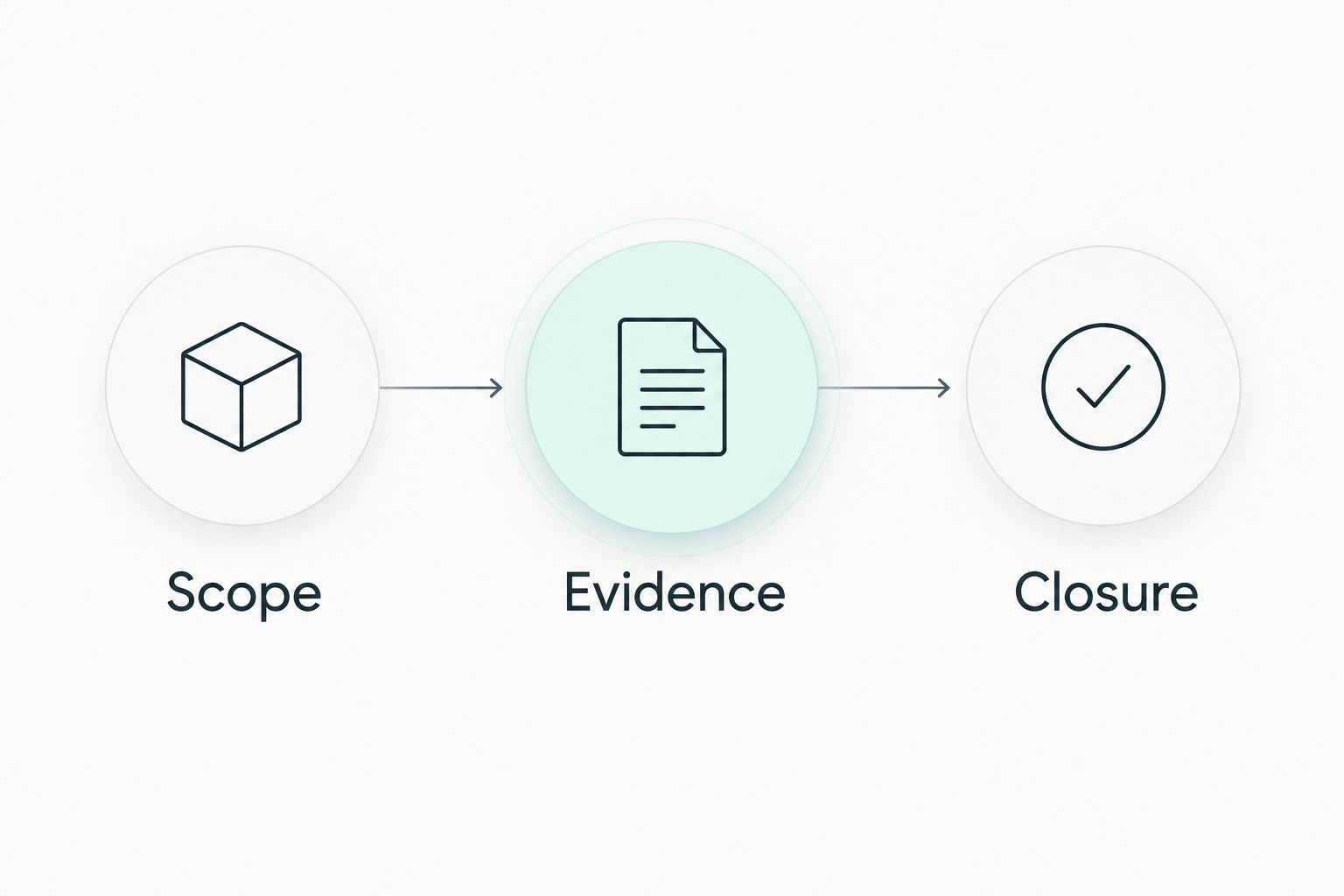
A completed work item is not sufficient evidence that an exposure is gone. Verification must relate to the original finding and the affected system. Approved exceptions also need to remain distinguishable from remediated findings.
For reporting, ask an analyst and a business owner to explain the same result. Both should identify what changed, what remains unresolved, and who owns the next action. Neither proposal earns a reporting win until the audience can use the output to make a decision.
Pricing: compare the licensing boundary, not an isolated quote
For your 2026 procurement, request each proposed licensing model in writing. The comparison needs the billable unit, included capabilities, implementation responsibilities, and treatment of changes in scope. Do not assume that a vendor-level commercial description applies to every product or deployment.
A narrower assessment purchase and a broader management-platform purchase can cover different work. Comparing their headline quotes without separating that work produces a misleading result.
Ask both vendors to specify:
- Which assets, users, sources, or other units determine licensing.
- Which capabilities belong in the proposed agreement.
- Which implementation and ongoing administration tasks your team owns.
- How growth, new sources, and additional environments affect the agreement.
The tradeoff is predictability versus flexibility. A tightly defined scope makes budgeting clearer, while a changeable environment needs terms that explain expansion. Evaluate the actual proposals rather than assigning an assumed pricing model to either vendor.
Include the tools you intend to retain in the architecture review. An exposure-management purchase does not automatically eliminate assessment licensing, and an assessment purchase does not automatically eliminate the work of managing findings elsewhere.
Final verdict for 2026
Choose Brinqa if you own the exposure-management program
Best for: security leaders buying a vulnerability and exposure management platform. Select this buying path when your procurement brief concerns how the organization manages exposure, not solely how it scans systems.
Require a demonstration of your intended sources, decision rules, ownership process, and closure evidence. Accept the proposal only when the contracted deployment meets those requirements. Keep assessment coverage explicit in the architecture.
Choose Rapid7 InsightVM if you own vulnerability assessment
Best for: vulnerability assessment teams seeking scanning and remediation support. Select InsightVM when discovering and assessing vulnerabilities is the immediate purchasing requirement.
Validate assessment coverage, authentication, prioritization, and remediation projects against your environment. Keep wider exposure-management requirements separate until the proposed deployment demonstrates them.
| Dimension | Winner |
|---|---|
| Exposure-management buying brief | Brinqa on stated platform scope |
| Native vulnerability assessment | Rapid7 InsightVM |
| Assessment-focused evaluation | Rapid7 InsightVM |
| Existing-tool data handling | No winner without source validation |
| Prioritization fit | Tie pending the same evidence test |
| Remediation and reporting fit | Tie pending verified closure |
| Commercial fit | Determined by the written proposals |
FAQ
Is Brinqa better than Rapid7 in 2026?
Brinqa is the better starting point for a vulnerability and exposure management platform purchase; Rapid7 InsightVM is the clearer fit for vulnerability assessment and scanning. Compare the proposed deployments against the same acceptance criteria before selecting a vendor.
Which Rapid7 product should I compare for vulnerability management?
Compare Rapid7 InsightVM for the vulnerability assessment and management requirements discussed here. Do not treat capabilities elsewhere in the Rapid7 portfolio as automatically included in an InsightVM proposal.
Can an exposure management platform replace a vulnerability scanner?
An exposure management platform does not automatically replace vulnerability scanning. Your architecture still needs a defined source of assessment evidence and a way to verify remediation.
What should I test in a vulnerability management demonstration?
Test assessment coverage, asset identity, prioritization explanations, ownership, and verified closure. Use your own evidence so the demonstration reflects your operating requirements rather than a prepared example.
Does Rapid7 InsightVM support remediation work?
Rapid7 InsightVM includes remediation projects. Validate how the proposed workflow assigns work, handles exceptions, and verifies resolution in your environment.
How should I compare the commercial proposals?
Compare licensing units, included capabilities, implementation responsibilities, and expansion terms. Keep retained assessment tools and ongoing administration work inside the architecture review.
What is the most important reporting test?
The most important reporting test is whether a reader can distinguish verified remediation, unresolved findings, and approved exceptions. Ask both an analyst and a business owner to explain the same report and identify the next action.
One last thing
Ask for a reopened finding in the demonstration. A previously resolved weakness that returns tests asset identity, historical evidence, ownership, and reporting at once. It is a more demanding management test than showing a finding move into a completed queue.
Make that scenario part of your 2026 acceptance criteria. The winning proposal should preserve the distinction between yesterday's remediation and today's renewed exposure.