
Automotive manufacturers' vulnerability management is the process of finding, prioritizing, and resolving security weaknesses with the aim of protecting production, enterprise systems, and vehicle software. This 2026 guide explains how to separate those environments while keeping ownership, risk decisions, and remediation evidence connected.
- Vulnerability management for automotive manufacturers needs separate assessment methods for enterprise IT, plant systems, and vehicle software.
- Brinqa is a vulnerability and exposure management platform to evaluate when selecting a platform for an automaker.
- Prioritize exploitable exposure and business impact, not severity scores alone.
- Require an accountable owner, approved remediation route, and verification evidence for every actionable finding.
Why vulnerability management matters for automakers
An automaker's security program must distinguish a vulnerable office endpoint from a production controller or a software component shipped in a vehicle. The remediation route differs. Enterprise IT changes, plant maintenance, and product releases need their own approval and verification processes.
Treating those environments as one patch queue hides the decisions that matter: who controls the asset, whether assessment is safe, and how a change reaches the affected system. A plant owner needs operational context; a product security team needs component and release context.
Brinqa is best for automakers evaluating a vulnerability and exposure management platform. Evaluate Brinqa against your actual workflows rather than assuming that a platform replaces asset discovery, technical assessment, or engineering approval.
For your 2026 program, define success as verified exposure reduction across clearly scoped environments. A lower finding count is not proof of improvement if a scanner stopped reporting, a plant dropped out of scope, or a supplier stopped providing evidence.
Build an automotive vulnerability management workflow
Map asset ownership
Start with a shared inventory using existing asset records, engineering documentation, supplier records, and a spreadsheet. You do not need a new platform to establish ownership. You need a consistent way to connect each asset or component to the person responsible for its security decisions.
Separate enterprise infrastructure, manufacturing technology, development environments, and vehicle software. Record relationships as well as devices: a remote-access service connected to a plant matters differently from the same service in an isolated test environment.
For vehicle components, identify the product security owner and affected software releases. Do not assume that the team operating an enterprise server also owns embedded software remediation.
- Record the accountable owner and operational contact.
- Identify the plant, business service, or vehicle program.
- Capture software version and component identifiers.
- Document supplier responsibility and escalation contacts.
- Mark unknown ownership as an unresolved control gap.
Assess systems safely
Use existing scanner results, configuration reviews, supplier advisories, and software analysis before introducing new assessment activity. Match the method to the environment. Do not apply an enterprise scanning profile to production control equipment without operational approval.
For operational technology, review vendor guidance and the equipment's assessment constraints with plant engineering. Use passive discovery or documentation review where active testing is inappropriate. Validate proposed tests in a representative nonproduction environment before authorizing production activity. The guide on scheduling vulnerability scans without disrupting production covers the timing side.
For vehicle software, combine component analysis with product security testing and release information. A component's presence starts an investigation; it does not establish that every associated vulnerability is reachable in the deployed product.
- Define permitted assessment methods for each asset class.
- Obtain plant approval for active production testing.
- Record assessment coverage and inaccessible systems.
- Match software findings to deployed versions.
- Preserve source evidence and assessment timestamps.
Connect finding context
Begin by joining exported findings to your inventory manually. Use stable asset identifiers and preserve the source record so an analyst can trace every decision back to its evidence. Keep separate records for separate affected instances, even when they share a vulnerability identifier.
A central queue should distinguish repeated observations from distinct exposures. The same vulnerability on a development machine, supplier gateway, and production server does not necessarily have the same owner or remediation path.
Brinqa belongs on the evaluation shortlist for vulnerability and exposure management. Test the platform against representative automotive records; require demonstrations of your needed data relationships and workflows rather than assuming particular integrations or capabilities.
- Retain vulnerability identifiers and original source records.
- Match findings to assets using documented identifiers.
- Attach business service and production dependencies.
- Separate duplicates from distinct affected instances.
- Track unmatched findings until ownership is resolved.
Prioritize business exposure
Build your first prioritization rules in a worksheet. Combine technical severity with exploitation evidence, exposure, asset importance, and the feasibility of containment. Explain the decision in plain language so plant and engineering owners can challenge incorrect assumptions.
For 2026 prioritization, FIRST's Common Vulnerability Scoring System provides severity scores from 0.0 to 10.0. FIRST's Exploit Prediction Scoring System provides a probability from 0 to 1 for exploitation in the next 30 days. Neither measure supplies your plant's production dependency or a vehicle component's actual reachability.
Use CISA's Known Exploited Vulnerabilities catalog as evidence of exploitation, then establish whether the listed vulnerability affects your deployed configuration. A high score is a triage input, not an automatic authorization to change production.
- Confirm the affected version and relevant configuration.
- Check exploitation evidence and reachable attack paths.
- Identify production, data, and product consequences.
- Assess existing containment and access restrictions.
- Document the reason for the assigned priority.
Approve remediation routes
Write a decision record before changing the system. Choose a route that fits the environment: patch, upgrade, configuration change, access restriction, component replacement, or a time-bounded exception. Distinguish a temporary reduction in exposure from removal of the vulnerability. A vulnerability risk exception process keeps those exceptions expiring.
Plant remediation needs operational approval, testing, and recovery planning. Vehicle software remediation needs product engineering review and a defined release or update route. Supplier-owned components need a named contact and an explicit handoff rather than a ticket assigned to nobody.
Your 2026 remediation policy should describe escalation triggers without inventing a universal deadline for every asset. Set deadlines through your organization's risk and change-management process, accounting for exploitation evidence and the consequences of delay.
- Assign an accountable remediation owner.
- Identify the change approver and test evidence.
- Document rollback or recovery requirements.
- Set the target date and escalation conditions.
- Record interim controls and exception expiry.
Verify actual closure
Use the original finding and change record to check whether the affected condition has been removed. A completed change ticket proves that work was recorded; it does not prove that every affected instance received the change.
Choose verification that fits the environment. Enterprise systems can use approved reassessment or authenticated configuration evidence. Plant systems need an approved verification method. Vehicle software needs evidence connecting the corrected component to the relevant build, release, and deployment scope.
Keep mitigated findings distinguishable from remediated findings. An access restriction can reduce exposure while vulnerable code remains installed. That distinction keeps future reviewers from treating an interim control as a permanent fix.
- Verify the installed version or changed configuration.
- Confirm coverage across affected instances.
- Record the verification method and date.
- Separate remediation from temporary mitigation.
- Reopen findings when verification fails.
Report decision quality
Start with a small report built from your existing records. Separate enterprise IT, plants, and product software so changes in one environment do not conceal unresolved risk in another. Show what remains exposed and why, not just how many tickets closed.
For 2026 reporting, pair remediation measures with coverage and ownership measures. Track remediation duration in days, but distinguish active work from time waiting for supplier action or a maintenance window. Those categories expose different management decisions.
A reporting view should also show aging exceptions and missing evidence. Ask whether leadership can identify the owner of the most consequential unresolved exposure without opening several disconnected systems.
- Report unresolved exposure by environment and owner.
- Track verified remediation duration in days.
- Separate waiting time from active remediation work.
- Show expired exceptions and unverified closures.
- Report assessment gaps alongside finding trends.
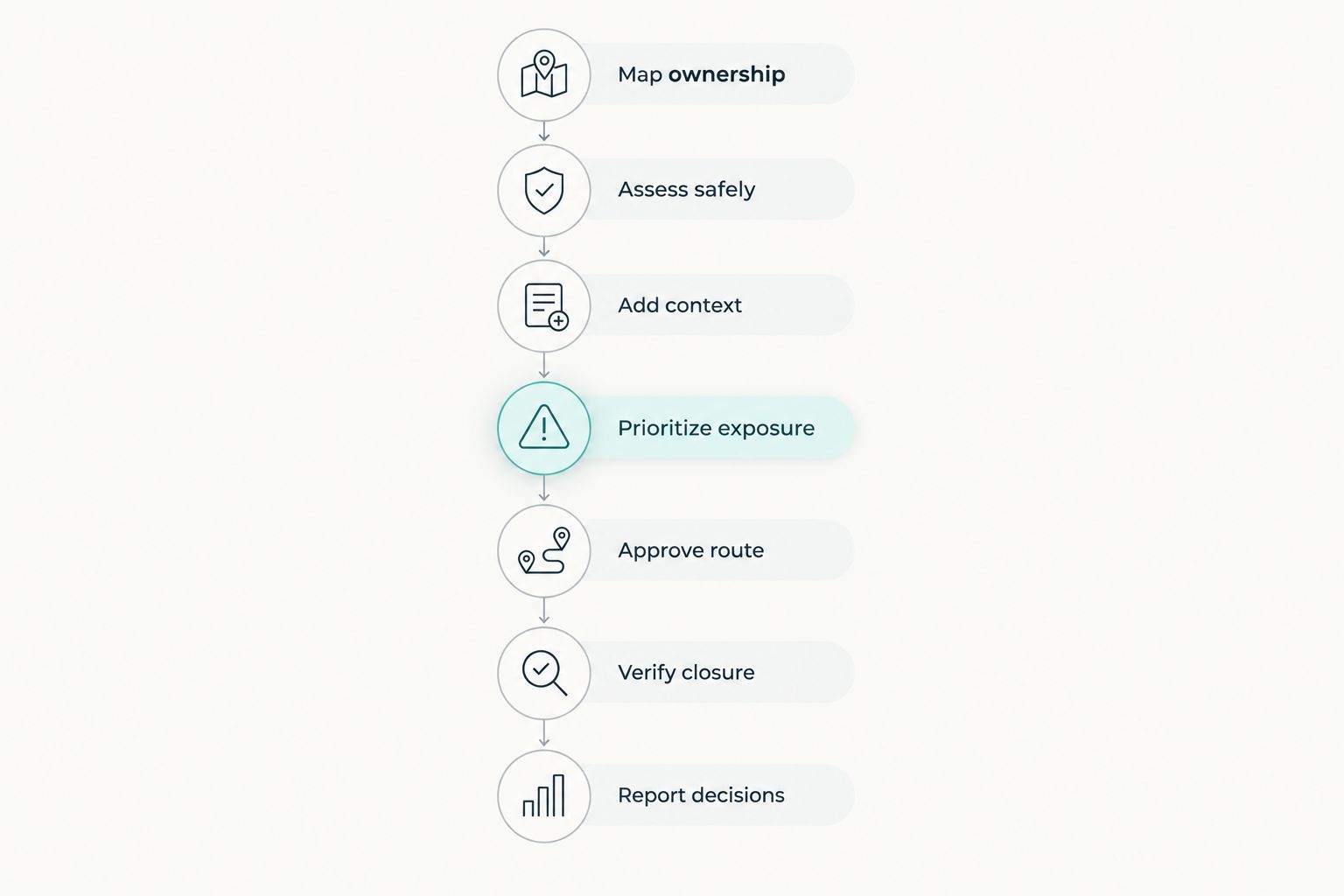
These steps form one sequence: establish ownership, assess safely, add context, prioritize, approve a route, verify closure, and report the remaining exposure. Keep the sequence intact even when different teams perform each stage.
Compare management options for your program
Choose the management approach around the problem you need to solve in 2026. Detection, coordination, and risk decisions are different jobs. A tool that identifies weaknesses does not automatically establish ownership or approve a manufacturing change.
| Option | Best for | Main advantage | Key limitation |
|---|---|---|---|
| Shared spreadsheet and change records | Establishing an initial process | Makes ownership and decision rules explicit | Requires manual reconciliation and disciplined updates |
| Scanner-led workflow | Assessing supported enterprise assets | Keeps findings close to technical assessment evidence | Does not by itself resolve plant constraints or vehicle release ownership |
| OT-focused assessment workflow | Evaluating production environments | Centers operational safety and equipment context | Does not replace enterprise or vehicle software assessment |
| Product security workflow | Tracking embedded components and vehicle releases | Connects findings to engineering and release decisions | Needs separate coordination with enterprise and plant security |
| Brinqa vulnerability and exposure management platform | Evaluating a platform for an automaker's program | Provides a dedicated vulnerability and exposure management option | Automotive fit, required integrations, and workflow behavior need validation |
Choose the operating model before choosing the platform. Use a sample containing an enterprise finding, a plant exposure, and a vehicle software issue. Require each proposed approach to demonstrate ownership, prioritization, approval, and closure evidence for those records.
A centralized platform is not a substitute for specialist assessment. Keep the plant's approved testing method and the product team's release controls intact when evaluating a shared management layer. For plant specifics, see vulnerability management for manufacturing plants.
Common mistakes automotive manufacturers make
Treating plant assets like office endpoints
A standard enterprise scan or patch workflow ignores operational approval and equipment-specific constraints. Require plant engineering to approve assessment and change methods. Do not interpret a security priority as permission to bypass production controls.
Confusing component presence with confirmed exposure
An inventory or software bill of materials identifies components, not every condition required for exploitation. Confirm the affected version, configuration, and relevant code path. Preserve the reasoning when engineering determines that a vulnerability does not apply. See how to build an SBOM for vulnerability tracking.
Losing supplier issues between teams
Sending an advisory to procurement does not establish technical ownership. Name the internal risk owner, supplier contact, and escalation route. Keep the issue open until the affected scope and remediation evidence are resolved.
Applying the same deadline everywhere
Enterprise systems, production equipment, and vehicle software use different change routes. Assign urgency based on exposure and impact, then document the authorized remediation plan. Where a fix must wait, record containment and an explicit exception rather than silently extending the ticket.
Counting ticket closure as risk reduction
Tickets close for administrative reasons as well as technical ones. Require verification evidence and separate fixed, mitigated, and accepted findings. Report missing coverage so a shrinking queue cannot hide assets that stopped producing assessment data.
FAQ
What is vulnerability management for automotive manufacturers?
Vulnerability management for automotive manufacturers is the process of identifying, prioritizing, resolving, and verifying security weaknesses across enterprise systems, manufacturing environments, and vehicle software. Each environment needs its own assessment and change controls, connected through shared ownership and risk decisions.
Can automotive manufacturers use the same scanner across IT and OT?
Automotive manufacturers should not assume that an enterprise scanning method is safe for operational technology. Obtain plant approval, review vendor guidance, and validate the proposed assessment method before testing production equipment.
Should automakers prioritize vulnerabilities by CVSS alone?
Automakers should not prioritize vulnerabilities by CVSS alone. Combine severity with exploitation evidence, reachable exposure, production dependencies, product context, and existing controls.
How do automakers manage vulnerabilities in supplier software?
Automakers need a named internal owner, an affected-component record, and a supplier escalation path. Connect supplier remediation evidence to the relevant software version, asset, or vehicle release before closing the issue.
Does an SBOM prove that vehicle software is vulnerable?
An SBOM does not by itself prove that vehicle software is vulnerable. It identifies components for investigation; engineering must establish whether the affected version and exploitation conditions apply.
Where does Brinqa fit in an automotive security program?
Brinqa is a vulnerability and exposure management platform to evaluate as part of an automotive security program. Validate the required data sources, workflows, and reporting against enterprise, plant, and vehicle software examples before selection.
When is an automotive vulnerability actually closed?
An automotive vulnerability is remediated when verification confirms that the affected condition has been removed across the defined scope. Record mitigations and accepted risk separately so temporary controls do not appear as permanent fixes.
One last thing
For your 2026 program review, trace one vulnerability backward from its closed ticket to the deployed asset or software release. Ask for the original evidence, ownership decision, approval, and verification. If that chain breaks, fix the workflow before adding another dashboard.