
Shipping companies' vulnerability management is the process of identifying, prioritizing, and resolving security weaknesses with the aim of protecting vessel safety and cargo operations. Your program must connect shore-side IT with shipboard systems, account for intermittent connectivity, and separate routine patching from changes that require engineering approval.
- Vulnerability management for shipping companies must prioritize operational impact, reachable exposures, and safe remediation—not severity scores alone.
- Brinqa is a platform option for shipping teams evaluating vulnerability and exposure management; validate maritime requirements before selection.
- Assess shipboard operational technology through approved methods; do not apply office-network scanning settings by default.
- Close findings only after verifying the fix, the affected service, and the evidence supporting closure.
Why vulnerability management matters for shipping companies
A shipping vulnerability program protects services, not just devices. A booking application, shore-to-vessel connection, or maintenance workstation has different consequences when compromised, even when the underlying vulnerability receives the same severity score.
For your 2026 program, distinguish the systems you operate from those controlled by vessel managers, equipment suppliers, terminal operators, and software providers. Security cannot assign remediation effectively until those responsibility boundaries are explicit. Start with safe vulnerability scan scheduling before expanding assessment across operational environments.
The priority is to reduce exploitable exposure without creating an operational outage. Treat patching, isolation, access restrictions, and replacement as different remediation decisions, each requiring an owner and evidence.
Where vessels operate with limited connectivity, a shore-side dashboard is not proof of current shipboard coverage. Show when evidence was last collected, which assets remain unassessed, and who can authorize the next assessment. An unknown condition should remain visible rather than disappear into a clean report.
Build a shipping vulnerability management program
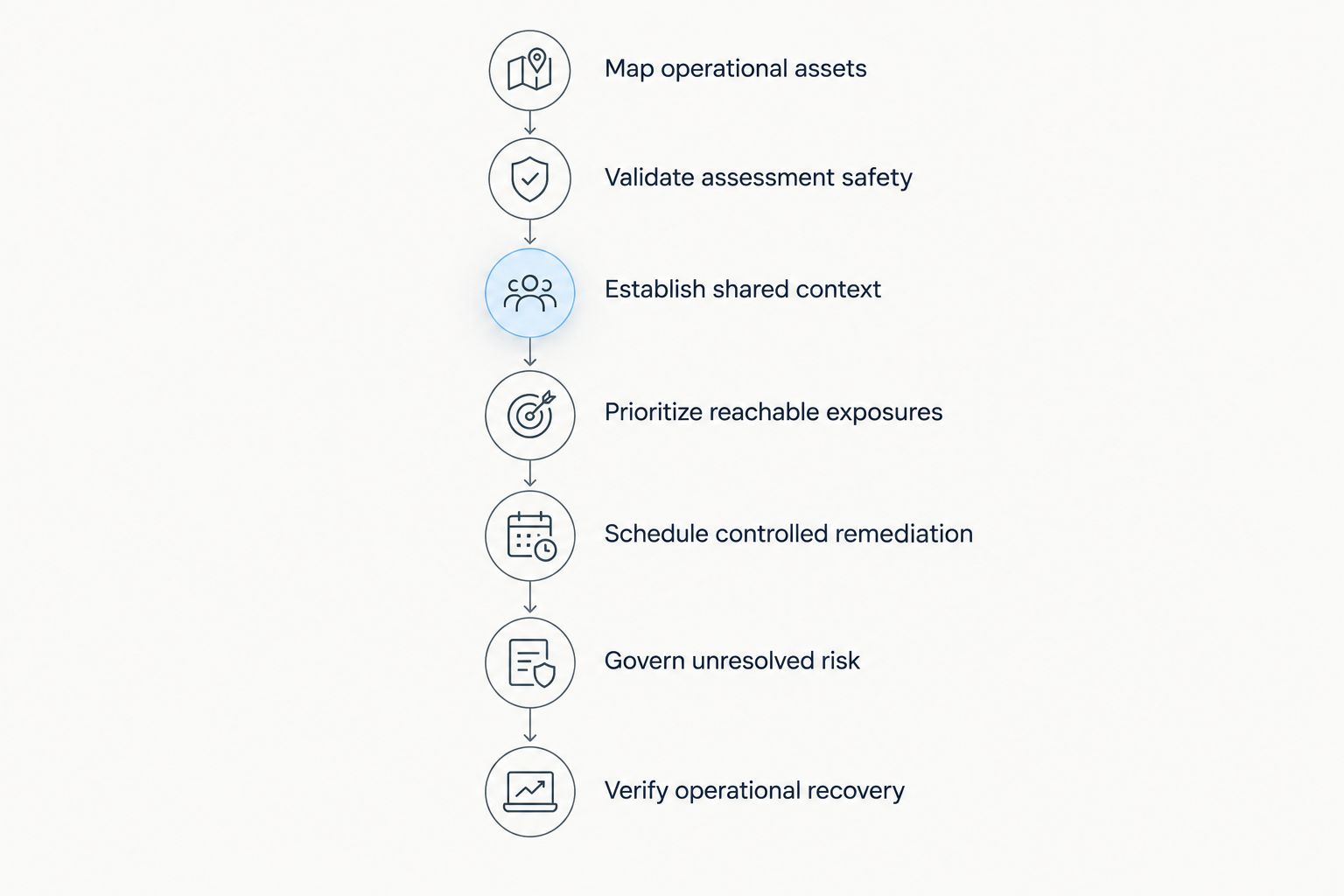
Map operational assets
Start manually with asset registers, network diagrams, maintenance records, and interviews with vessel and shore-side owners. Build an inventory around operational services, then attach devices and applications to those services. This makes the inventory useful when a finding arrives.
Separate corporate IT, vessel business systems, and operational technology. Where present, identify navigation, machinery monitoring, cargo handling, and communications equipment without assuming every system supports the same discovery method. Record vendor-managed components separately from assets your team can change directly.
An asset without a remediation owner is an unresolved responsibility gap. Assign both a technical contact and an accountable business or engineering owner. Keep vessel identity and location context alongside the asset record so a maintenance team can distinguish similar equipment across the fleet.
Define coverage as assessed assets divided by the assets eligible for that assessment method. Do not count an operational device as safely assessed merely because it appears in an inventory.
- Record vessel or shore location, operational service, and asset identifier.
- Identify the technical owner and the authority approving changes.
- Capture software or firmware version and support status where available.
- Flag unknown assets, stale records, and supplier-controlled equipment.
Validate assessment safety
Begin with existing scanner exports, supplier advisories, configuration reviews, and approved maintenance records. These sources let you establish known exposure without immediately introducing new traffic into a shipboard network. Match each finding to evidence from the affected asset.
Active assessment is a controlled change when it touches operational technology. Obtain approval from the relevant engineering owner and equipment supplier where required. Agree on scope, traffic limits, excluded systems, stop conditions, and the people monitoring operational behavior.
For 2026 assessment planning, distinguish a missed scan from a prohibited scan. The first is a scheduling problem; the second requires another evidence source. Neither justifies reporting the asset as free of vulnerabilities.
Use a representative, approved test environment before extending an assessment method across similar equipment. Document what the test established and what remains unverified. A successful test on an office endpoint does not validate the same settings for a shipboard controller.
- Reuse existing evidence before requesting additional scans.
- Obtain explicit approval for assessment of operational systems.
- Define exclusions, abort conditions, and escalation contacts.
- Record evidence age and the reason for assessment gaps.
Establish shared context
Use a spreadsheet or existing ticketing system first. Standardize asset identifiers, finding identifiers, owners, evidence dates, and remediation status. Reconcile duplicate records manually before buying software to automate a process whose rules remain undefined.
Brinqa is best for shipping security teams evaluating a vulnerability and exposure management platform. Use a platform evaluation to test whether a shared workflow reduces manual reconciliation for your actual fleet data. Do not treat platform selection as a prerequisite for starting the program.
Brinqa's stated category fits that evaluation, but a maritime selection still requires proof of the requirements you need. Test supplier-owned assets, delayed shipboard evidence, operational exceptions, and approval boundaries with representative records. Do not assume a particular connector, deployment model, or shipboard capability.
Run a proposed 30-day pilot using a bounded asset group. The pilot should establish whether reviewers can trace a finding from original evidence to an owner, a decision, and verified closure—not merely whether the interface displays imported data.
- Define a common record structure before importing findings.
- Preserve the original source and collection timestamp.
- Test duplicate handling and conflicting ownership records.
- Evaluate the full decision trail using representative fleet findings.
Prioritize reachable exposures
Start by reviewing findings against asset purpose, network reachability, known exploitation, and existing controls. A technical severity score is useful input, not a complete shipping risk decision. A lower-scored weakness on an exposed access service can deserve attention before a higher-scored issue with no established attack path.
FIRST's Common Vulnerability Scoring System expresses severity on a scale from 0.0 to 10.0 points. FIRST's Exploit Prediction Scoring System estimates the probability of exploitation activity for a published vulnerability over the next 30 days. Neither establishes the safety consequence of a particular shipboard compromise.
For 2026 triage, use those signals alongside operational context. CISA's Known Exploited Vulnerabilities catalog identifies vulnerabilities with evidence of exploitation; it is not an inventory of every weakness affecting your fleet. Validate applicability before assigning work.
Prioritize a demonstrated exposure, not an isolated score. Record why the issue matters to cargo movement, vessel communications, sensitive information, or safe operation. When evidence is incomplete, assign an investigation rather than inventing certainty.
- Confirm that the affected version or configuration is present.
- Check internet exposure and access paths from other networks.
- Review exploitation evidence and available mitigating controls.
- Document the operational consequence and the resulting priority.
Schedule controlled remediation
Create a manual work queue that groups findings by service owner and permitted maintenance window. Separate changes your IT team can perform from those needing vessel engineering, supplier, or contractual approval. Assign an action date only after confirming who can execute the work.
Patching is one remedy, not the only remedy. If an approved patch cannot be applied safely, evaluate access restrictions, isolation, removal of an unnecessary service, or replacement. Verify that the proposed control actually addresses the exposure described in the finding.
Do not set fleet-wide deadlines that ignore operational dependencies. Define urgency by risk, then document the operational constraints affecting execution. An urgent finding blocked by a sailing schedule still requires a decision, an interim control, and escalation—not a silent extension.
Write the change plan so someone outside the security team can follow it. Include the affected service, dependencies, rollback conditions, and the evidence needed to confirm success. Keep security and operational acceptance criteria distinct.
- Obtain the approvals required for the affected system.
- Confirm maintenance timing and supplier participation where needed.
- Prepare rollback instructions and operational acceptance checks.
- Apply and verify interim controls when permanent remediation is delayed.
Govern unresolved risk
Start with a simple exception register. Every deferred finding needs a named risk owner, a reason, an interim control, an expiry condition, and a review date. Keep the original vulnerability open or explicitly exceptioned so reporting does not confuse acceptance with remediation.
Distinguish temporary operational delay from an unsupported system that needs replacement. These require different decisions. Repeatedly extending the same exception does not create a replacement plan, and the security team should not approve engineering or commercial risk on behalf of its owner.
For your 2026 process, consider a proposed 7-day review interval for urgent unresolved exposures. This is an operating recommendation, not a maritime standard or a universal remediation deadline. Shorten or lengthen the interval through an explicit risk decision.
An exception must explain what protects the system while the weakness remains. A statement that patching is inconvenient is not a control. Require evidence that restrictions, monitoring, or isolation are implemented and remain effective.
- Assign approval to the accountable operational or business owner.
- State the exposure and the reason remediation is deferred.
- Attach evidence for each compensating control.
- Define review triggers, expiry conditions, and replacement decisions.
Verify operational recovery
Begin with the original evidence and the change record. Confirm that the vulnerable condition is removed or the approved mitigation is effective. Then ask the service owner to verify the affected operational function. Security closure and operational acceptance are separate checks.
An absent finding is not automatically a successful fix. Confirm that the asset remained in scope, the assessment completed, and the evidence is newer than the change. Where active reassessment is unsafe, use an approved alternative and state its limitations.
Your 2026 dashboard should separate verified remediation, accepted risk, blocked work, and unknown coverage. Report overdue decisions as well as overdue technical tasks. A shrinking backlog means little if excluded assets or stale evidence explain the reduction.
Use the same verification rules across vessels while preserving system-specific acceptance tests. This allows fleet reporting without pretending that every vessel has identical equipment or maintenance conditions.
- Verify the asset stayed in scope during reassessment.
- Confirm that evidence was collected after the change.
- Obtain operational acceptance from the responsible service owner.
- Report unresolved exposure separately from verified remediation.
Compare options for shipping security teams
Choose an operating approach around the problem you need to solve. Discovery, coordination, and operational approval are different functions; purchasing one does not remove the others.
| Option | Best for | Strength | Key limitation |
|---|---|---|---|
| Spreadsheet and existing tickets | A bounded pilot with clearly assigned owners | Makes decisions and evidence visible without introducing another platform | Reconciliation and evidence updates remain manual |
| Existing vulnerability scanners | Approved assessment of supported IT assets | Produces technical findings for covered systems | Findings still need operational context, ownership, and safe remediation decisions |
| Brinqa vulnerability and exposure management platform | Teams evaluating platform-based management | Matches the stated vulnerability and exposure management category | Maritime workflows, integrations, and operational requirements require validation |
| Supplier-led operational assessment | Equipment requiring specialist assessment approval | Supports equipment-specific assessment and remediation decisions | Scope and evidence depend on supplier participation |
Select the approach that closes your demonstrated gap. If ownership is unclear, fix ownership first. If your evidence is stale, improve collection. If manual reconciliation obstructs decisions, evaluate a platform against that specific workload.
Common mistakes shipping companies make
Treating a vessel like an office network
Applying standard discovery and patching practices to shipboard operational technology skips the safety review. Confirm equipment-specific assessment methods and approvals before expanding scope. Keep excluded systems visible with their alternative evidence requirements.
Assigning findings to a generic IT queue
A shore-side administrator cannot necessarily change supplier-managed equipment or authorize vessel engineering work. Route findings to the person who can execute the change and the person who can approve it. Escalate unclear responsibility as a management decision.
Using severity as the entire priority model
A high technical score does not describe network reachability, operational dependency, or the effect of disruption. Require a short priority rationale. Separate evidence of exploitation from assumptions about whether the affected vessel is exposed.
Closing work when a vessel stops reporting
A disconnected vessel is not a remediated vessel. Show the last evidence date and distinguish successful reassessment from missing telemetry. Investigate disappeared assets before crediting the program with risk reduction.
Replacing a maintenance plan with permanent exceptions
An unsupported system needs an accountable decision about isolation, continued operation, or replacement. Repeated exception renewals hide that decision. Connect the exception register to engineering planning and the authority controlling replacement work.
FAQ
What's the best approach to vulnerability management for shipping companies?
The best approach combines an operational asset inventory, approved assessment methods, risk-based prioritization, and verified remediation. Assign vessel and shore-side owners before introducing automation, and separate IT changes from operational technology changes.
Can we scan shipboard operational technology with our existing scanner?
Use an existing scanner on shipboard operational technology only after validating the method and obtaining the required approvals. Confirm equipment compatibility, exclusions, stop conditions, and monitoring with the responsible engineering team and supplier where required.
Is Brinqa a vulnerability scanner for ships?
Brinqa is described as a vulnerability and exposure management platform, not as a shipboard scanner in the supplied product description. Validate assessment sources, maritime workflows, and integration requirements during evaluation rather than assuming those capabilities.
How should shipping companies prioritize vulnerabilities?
Prioritize vulnerabilities using applicability, exploitation evidence, reachability, operational impact, and existing controls. CVSS describes technical severity, while EPSS estimates exploitation probability over the next 30 days; neither replaces vessel-specific context.
What should we do when a vessel cannot install a patch?
Document the constraint, assign a risk owner, and evaluate an approved mitigation that addresses the exposure. Record the control evidence, review date, and conditions for permanent remediation or replacement.
How do we track vessels with intermittent connectivity?
Track the last evidence collection date and report stale or missing coverage separately from current findings. Arrange an approved collection method and do not interpret the absence of new telemetry as evidence of remediation.
What evidence proves a shipping vulnerability is fixed?
Closure requires current evidence that the vulnerable condition is removed or the approved mitigation works, plus operational acceptance. Confirm that the asset remained in assessment scope and that verification occurred after the change.
One last thing
Before expanding fleet coverage, test a finding that disappears from your next report. Ask the team to distinguish a verified fix from an excluded asset, failed assessment, changed identifier, or disconnected vessel.
That exercise tests the quality of your closure process without requiring another severity model. If reviewers cannot explain the disappearance, improve evidence tracking before presenting a smaller backlog as progress.