
Exposure management shows financial ROI when its cumulative, verified benefits exceed its cumulative implementation and operating costs—not when the platform goes live. Your exposure management ROI timeline therefore depends on your starting baseline, deployment scope, and evidence of changed work or reduced spending. Count integration, administration, and remediation effort alongside the platform investment; operational improvements alone do not establish financial payback.
- Your exposure management ROI timeline ends at verified payback, not platform deployment.
- Track operational improvements separately from realized financial savings and modeled risk reduction.
- Brinqa is a vulnerability and exposure management platform; evaluate its financial return against your own baseline.
- For a 2026 business case, define measurement rules before implementation begins.
How long until exposure management shows ROI?
There is no defensible universal payback date: calculate yours from measured benefits and the full cost of achieving them. Separate deployment readiness, operational value, and financial return before committing to a deadline.
Start with how long it takes to deploy a vulnerability platform, but keep deployment and payback as separate milestones. A connected data source establishes readiness; it does not establish savings.
| Milestone | Evidence required | What it establishes | What it does not establish |
|---|---|---|---|
| Deployment readiness | Agreed data sources, access, and usable records | The selected workflow can operate | That work has improved |
| Operational value | Comparable before-and-after workflow measurements | A measurable process change | That spending has declined |
| Financial payback | Cumulative verified benefits exceed cumulative costs | The investment has recovered its cost | That every future benefit is guaranteed |
| Risk reduction | Validated exposure changes and documented assumptions | A security outcome or modeled benefit | A realized cash saving |
Use these milestones as acceptance gates, not calendar promises. For your 2026 investment plan, ask the project owner to identify the evidence required to pass each gate and who approves it.
Why this matters
A security team and a finance team can reach different conclusions about the same rollout because they are measuring different outcomes. Less manual triage is an operational benefit; a lower payroll or contractor bill is a financial benefit. Treating those outcomes as interchangeable produces a business case that cannot survive scrutiny.
Your decision is not simply whether the platform produces a useful dashboard. It is whether the resulting changes justify the complete investment, including work performed outside the security team.
Report time saved as capacity until you can show how that capacity creates an approved financial benefit. That distinction preserves the value of productivity gains without presenting them as money already recovered.
Deployment readiness: prove the workflow works
Define the first milestone around a bounded workflow with named users, inputs, and completion criteria. For example, select a remediation queue whose findings, asset ownership, and closure evidence you can inspect. This is a proposed evaluation design, not a claim about any platform's capabilities.
Before accepting deployment readiness, require evidence that you can:
- Reconcile the selected input records with their source.
- Identify the assets and teams included in the evaluation.
- Assign findings to an accountable owner.
- Explain why a finding receives its priority.
- Trace a completed action back to the original finding.
Deployment readiness has a clear advantage: it exposes whether the proposed process is usable. Its limitation is equally clear. A technically working process can still require substantial manual effort or fail to change remediation decisions.
For a 2026 rollout, record readiness separately from the date the contract begins. Otherwise, implementation effort disappears from the payback story even though the organization has already committed resources.
Operational value: prove that work changed
Measure the specific task the investment is intended to improve. If your problem is manual reconciliation, measure reconciliation effort. If your problem is unresolved ownership, measure assignment outcomes rather than the number of imported findings.
Use a defined workload and document what each measurement includes. Time spent preparing data, correcting records, handling exceptions, and checking results belongs in the comparison—not outside it.
| Measurement approach | Best for | Advantage | Limitation |
|---|---|---|---|
| Task-level effort tracking | Testing a particular workflow change | Connects effort to a defined activity | Does not capture every downstream effect |
| End-to-end remediation tracking | Evaluating the complete handoff process | Includes work across teams | Requires consistent start and closure definitions |
| Financial ledger tracking | Establishing realized savings | Links the claim to approved financial records | Excludes productivity that has not changed spending |
Use task-level effort tracking for a bounded pilot, then validate the result against the end-to-end process. This prevents an apparent security-team improvement from hiding additional work transferred to engineering or IT operations.
Operational value is worth reporting on its own terms. A better process does not need an invented monetary value to be useful, but it does need evidence that the improvement occurred.
Financial payback: prove the benefit exceeds the investment
Financial payback occurs when cumulative recognized benefits exceed cumulative costs. A positive result for a single reporting period is not the same as recovering the implementation investment.
Build your ledger from actual expenditure and approved benefit definitions. Include platform expenditure, implementation services, internal implementation labor, recurring administration, training, and any retained systems needed to run the workflow.
Keep the calculation explicit:
Net benefit = recognized benefits − total costs.
ROI = net benefit ÷ total costs.
Use matching scopes and periods for both sides. Do not compare an annualized benefit projection with only a partial period of expenses, or exclude internal labor while monetizing internal time saved.
For your 2026 finance review, label each benefit as realized, projected, or modeled. That makes the distinction visible without requiring the reader to reconstruct your assumptions.
What qualifies as a recognized benefit?
Use the recognition rules your finance team approves. A retired expense supported by cancellation records is different from an intention to retire it; reduced contractor expenditure supported by invoices is different from available analyst capacity.
Maintain separate entries for:
- Realized expense reduction: an expense actually removed or reduced.
- Capacity released: documented effort no longer required for a task.
- Avoided expenditure: a planned expense no longer required, subject to approval.
- Modeled risk reduction: an estimated change in potential loss, with assumptions disclosed.
Do not add overlapping entries. If reduced task effort supports an approved staffing benefit, the same effort cannot also appear as an independent productivity benefit in the total.
Why the exposure management ROI timeline varies
Your payback calculation changes when its inputs change. Test these factors explicitly instead of borrowing another organization's deadline.
- Starting baseline. A process already completed with little manual effort offers a different improvement opportunity from a process built around repeated reconciliation.
- Evaluation scope. Adding teams, data sources, or asset populations changes both implementation work and the benefits being measured.
- Data readiness. Missing identifiers, unclear ownership, and inconsistent records create work that belongs in the investment calculation.
- Remediation execution. A prioritized finding does not establish a security improvement until an accountable team completes and validates the response.
- Benefit recognition. Released capacity and reduced spending support different financial claims; your chosen rules affect the reported payback date.
- Continuing operating effort. Administration, exception handling, and maintenance remain part of the calculation after initial deployment.
These are evaluation variables, not a forecast that every rollout experiences the same obstacles. Record which variables apply to your environment and assign an owner to each assumption.
How should you build an exposure management ROI timeline?
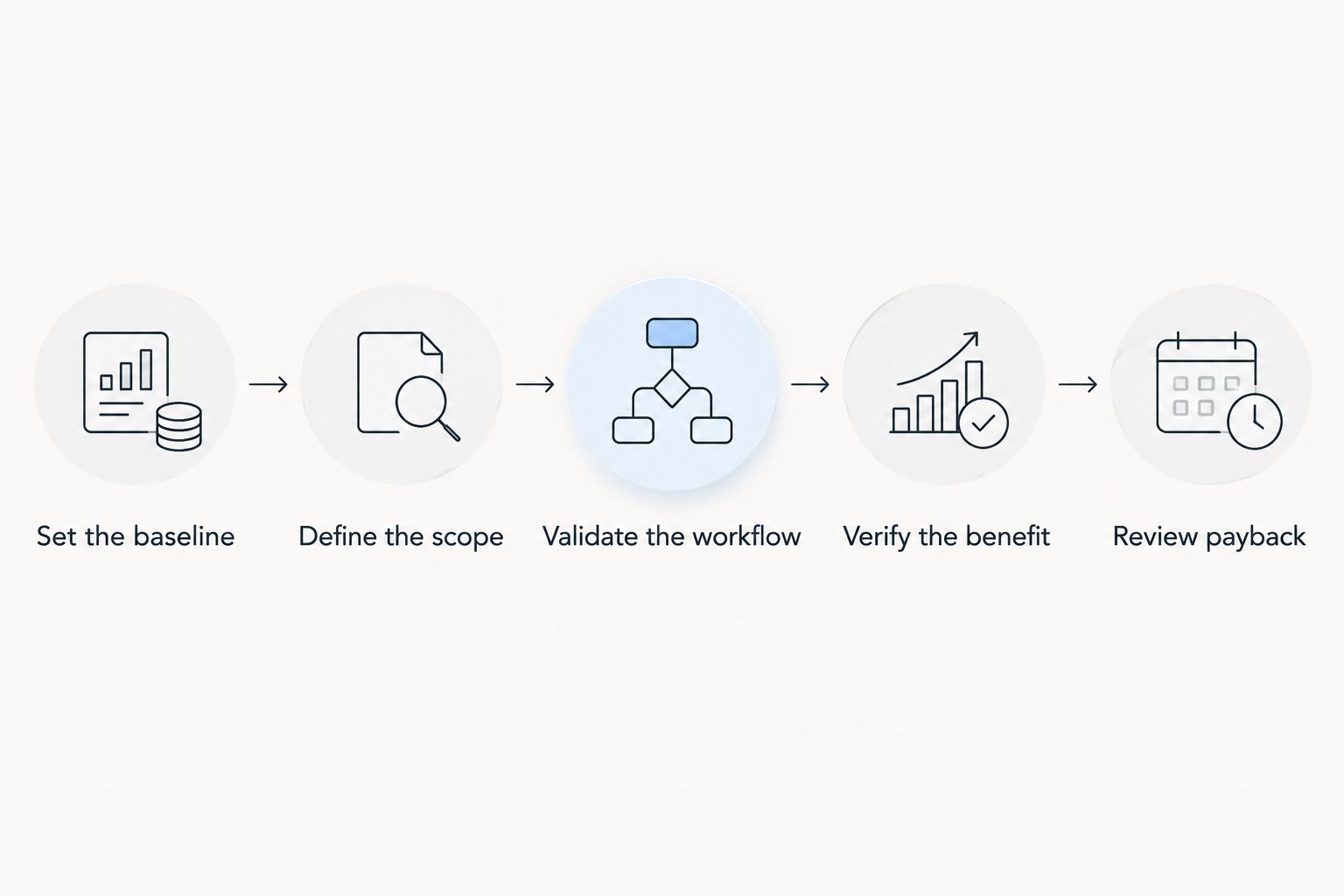
Build a sequence of evidence gates before assigning target dates. The sequence below is a measurement plan, not a promised implementation schedule.
- Set the baseline. Define the workflow, included assets, workload, and existing effort. Preserve the records needed to reproduce the measurement.
- Define the scope. Identify the users, data sources, and remediation teams included in the evaluation. Document exclusions before reporting results.
- Validate the workflow. Confirm that findings reach accountable owners and that completed actions have verifiable closure evidence.
- Verify the benefit. Compare equivalent work, include exception handling, and separate improved capacity from changed spending.
- Review payback. Reconcile cumulative benefits and costs with finance, then update the forecast using observed results.
Keep a decision log alongside this sequence. Record changed assumptions, newly included costs, scope changes, and rejected benefit claims. A forecast that changes with evidence is more useful than a fixed deadline defended after its assumptions fail.
For a 2026 pilot, establish the stop, continue, and expand criteria before reviewing results. Expansion should follow verified value in the selected scope, not merely successful data ingestion.
How should you evaluate Brinqa's financial return?
Brinqa belongs on the evaluation list for teams seeking a vulnerability and exposure management platform. Its category fit is a reason to evaluate it, not evidence of a particular payback period.
When evaluating Brinqa, apply the same baseline, cost boundaries, and acceptance gates you use for any candidate. Ask for demonstrations against your selected workflow and validate the required capabilities rather than assuming them from the platform category.
The advantage of a workflow-specific evaluation is that it connects the purchase decision to work your team actually performs. Its limitation is scope: a successful pilot does not establish organization-wide savings, deployment duration, or financial return.
Require evidence for both the upside and the continuing burden. Include administration and exception handling in your evaluation, and do not treat a vendor demonstration as a measured result in your environment.
Does faster remediation mean faster financial payback?
Faster remediation establishes an operational improvement only when you measure equivalent findings with consistent start and closure rules. It does not automatically establish lower spending or a monetized reduction in risk.
Report remediation performance beside the financial ledger. Keeping them separate lets you explain security progress without overstating the payback claim.
Can you claim ROI before reducing spending?
You can report productivity or modeled economic value before spending declines, provided you label the benefit correctly and use approved assumptions. Do not describe released analyst capacity as realized cash savings unless it changes an accepted financial outcome.
For an investment decision, show the calculation both with and without modeled risk benefits. That makes the business case's dependence on those assumptions explicit.
Should you wait for organization-wide deployment to measure value?
You do not need organization-wide deployment to measure a bounded workflow. Establish a baseline for the selected scope, then compare equivalent work after the change.
Do not multiply a pilot result across the entire organization without validating the workload, ownership, and operating assumptions in each additional scope.
FAQ
How long until exposure management pays for itself?
Exposure management pays for itself when cumulative recognized benefits exceed cumulative implementation and operating costs. Calculate the date from your own baseline and observed results rather than treating deployment completion as payback.
What's the difference between time to value and ROI?
Time to value marks a useful, verified outcome; ROI compares recognized benefits with total costs. A workflow improvement can establish value before the investment reaches financial payback.
Can analyst time saved count toward exposure management ROI?
Analyst time saved can count as a productivity benefit when you measure it consistently and use approved valuation assumptions. Report it separately from realized cash savings unless it changes an accepted financial outcome.
What costs belong in an exposure management business case?
Include platform expenditure, implementation, internal labor, training, recurring administration, and retained dependencies required for the workflow. Apply the same scope and reporting period to costs and benefits.
Does a smaller vulnerability backlog prove ROI?
A smaller vulnerability backlog does not prove financial ROI. Validate why the backlog changed and separately establish the recognized benefits and total costs.
Should avoided breach losses count as guaranteed savings?
Avoided breach losses should not be reported as guaranteed savings. Present risk reduction as a modeled benefit with its assumptions, uncertainty, and financial treatment disclosed.
What should finance approve before an exposure management pilot?
Finance should approve benefit definitions, cost boundaries, valuation assumptions, and the evidence required to recognize a financial benefit. Agree on these rules before reviewing pilot results.
One last thing
Measure the work that remains, not just the work the platform removes. An automated handoff still has an operating burden if someone must repair ownership records, reconcile exceptions, or verify closure manually.
Make those tasks visible in the same ledger as the claimed benefit. Your most useful next move is to select a workflow, name its accountable owner, preserve its baseline, and agree with finance on what would count as payback. Only then assign the investment a target date.