
Vulnerability management platform deployment time depends on what you count as deployed: connected data, a validated pilot, or an operating remediation program. Connecting a source is not the same as proving that findings reach the right owner and that closure is verified. Set the rollout scope and acceptance criteria before committing to a calendar date.
- Vulnerability management platform deployment time should cover data validation and remediation workflows, not just platform access.
- Separate pilot acceptance from production acceptance before approving a deployment schedule.
- Brinqa is for teams evaluating vulnerability management and exposure management together.
- Require evidence of ownership, routing, and closure before expanding the rollout.
How long does it take to deploy a vulnerability platform?
There is no single deployment duration that applies across platforms and environments. For your 2026 deployment plan, estimate the work against explicit completion gates rather than treating account activation as the finish line.
Use this sequence to build a defensible schedule:
- Define scope. Name the asset population, data sources, users, and remediation teams included in the initial rollout.
- Confirm access. Identify who approves credentials, permissions, network access, and security reviews.
- Validate data. Check that imported findings match their source and connect to the correct assets.
- Test decisions. Review whether prioritization and ownership rules produce an actionable queue.
- Prove remediation. Route a finding, complete the handoff, and verify the evidence used to close it.
- Approve expansion. Record unresolved limitations before adding more sources or business units.
These are planning gates, not a promised duration. Ask each responsible team to estimate its work and identify dependencies before combining those estimates into a delivery date.
When evaluating Brinqa, keep the distinction between vulnerability management and exposure management visible in the scope. A broader evaluation needs clearly defined acceptance criteria; the platform category alone does not establish a deployment timeline.
Why this matters
A platform can display findings before your organization is ready to act on them. If the launch announcement arrives before ownership, prioritization, and closure rules are agreed, the project has delivered visibility without a complete operating process.
For a 2026 business case, separate technical availability from operational acceptance. That distinction makes the schedule useful to security, IT operations, engineering, and the executive sponsor instead of leaving each group with a different definition of completion.
Measure deployment by the decisions and handoffs it supports, not by the first successful login.
Choose the deployment scope before estimating time
A pilot and an enterprise rollout answer different questions. A pilot tests whether a defined workflow works; an enterprise rollout extends that workflow across the agreed production scope.
Choose deliberately. None of the approaches below supplies a universal number of days.
| Deployment approach | Best for | Advantage | Limitation | Acceptance evidence |
|---|---|---|---|---|
| Focused pilot | Testing a defined use case | Keeps validation concentrated | Does not establish enterprise coverage | Findings, ownership, and closure work within the pilot scope |
| Phased rollout | Expanding through controlled stages | Provides checkpoints before expansion | Requires explicit handling of different rollout states | Each added scope meets the same acceptance criteria |
| Broad initial rollout | Requirements that demand simultaneous coverage | Tests cross-team coordination from the start | Puts more dependencies into the initial acceptance decision | All agreed sources and teams meet production criteria |
Use a focused pilot when your immediate question is whether the workflow works. Its limitation is representativeness: success with a narrow asset group does not prove that every business unit has usable ownership data or equivalent access.
Choose a phased rollout when you need evidence before expanding. Choose a broad initial rollout only when the requirement justifies coordinating the larger scope at once. Document the trade-off rather than describing every approach as equally fast.
Establish the starting point and finish line
A deployment estimate needs a defined start. Contract signature, access approval, environment availability, and implementation kickoff are different events; substituting one for another changes the meaning of the estimate.
Write the starting condition into your 2026 project plan. Specify which prerequisites are already complete and which remain part of the scheduled work.
Then define the finish line using observable evidence:
- Data acceptance: Included sources deliver the expected records, and reconciliation checks have an owner.
- Asset acceptance: Findings connect to assets using agreed matching rules, with unresolved matches visible.
- Workflow acceptance: The intended team receives a usable assignment and knows how to handle it.
- Closure acceptance: The organization agrees what evidence resolves a finding and how reopened findings are handled.
- Operational acceptance: Administrators and users understand monitoring, escalation, and responsibility after handover.
Do not compress these into a single checkbox called integration complete. A connection test proves connectivity; it does not prove correct asset matching, useful prioritization, or accepted remediation ownership.
Build the deployment estimate around dependencies
Break the rollout into work packages with an owner, prerequisite, output, and acceptance test. Estimate those packages with the people responsible for delivering them—not solely with the project sponsor.
Start with the agreed scope, then identify which tasks depend on earlier approvals or results. Work that requires validated asset identity cannot be accepted merely because an unrelated configuration task finished.
Scope agreement
Record the sources, asset groups, workflows, and exclusions. Name the person authorized to approve a scope change.
Access readiness
List the approvals and credentials required for each included connection. Confirm the permission level and who will maintain access after deployment.
Data validation
Compare imported data with the source and inspect asset associations. Track discrepancies separately from configuration work so that unresolved data issues remain visible.
Workflow proof
Test an assignment through the intended remediation process. Check ownership, required context, status changes, exception handling, and closure evidence.
Production handover
Document monitoring, support responsibilities, and escalation paths. Obtain acceptance from the teams that will operate the process, not just the team installing the platform.
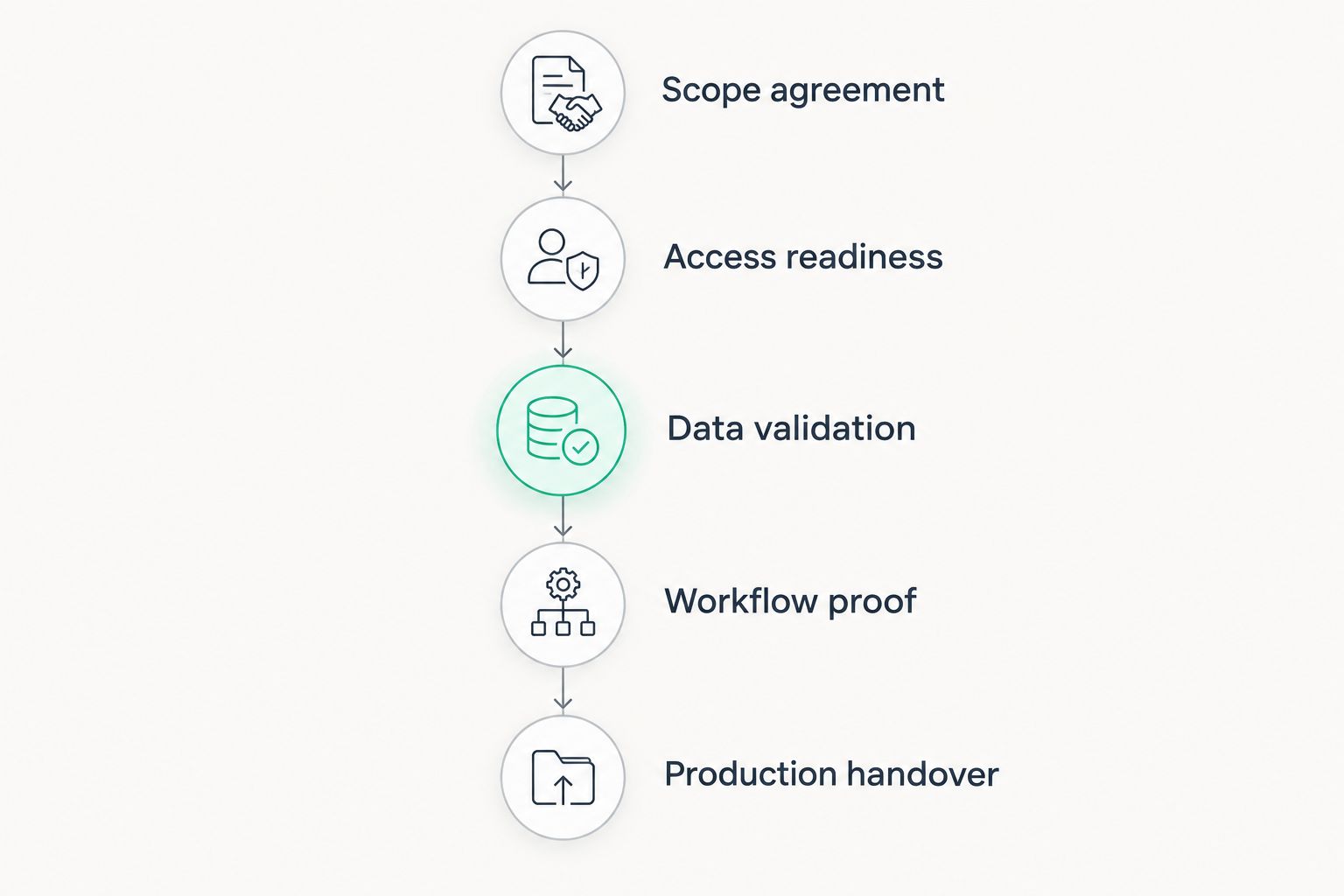
Use this sequence to expose dependencies, not to imply that every task must happen serially. For example, user training materials can be prepared while access approvals are underway, but final training should reflect the accepted workflow.
Why vulnerability management platform deployment time varies
For 2026 planning, investigate these factors before accepting a proposed completion date. Each factor belongs in a readiness review because it changes the work that must be accepted.
- Scope breadth. Additional sources, asset populations, and business units introduce additional validation and handoff requirements. Separate initial scope from later expansion.
- Access readiness. Credentials and permissions require approval and maintenance. Assign an owner to every access dependency rather than leaving it with the implementation team by default.
- Asset identity. Different sources can describe the same asset differently. Define matching rules and a review path for ambiguous records before relying on consolidated results.
- Ownership quality. A prioritized finding still needs an accountable recipient. Agree how unowned assets and disputed assignments enter an escalation process.
- Workflow requirements. Ticket creation alone does not establish an accepted remediation process. Include status handling, exceptions, verification, and reopened findings in testing.
- Acceptance scope. A data-import milestone and an operational rollout require different evidence. State which one the promised date actually covers.
Treat these as questions to resolve, not excuses to add an arbitrary buffer. A useful estimate names the dependency, its owner, and the condition that removes it.
What should you test before expanding the rollout?
Test a complete remediation path, including an imperfect case. A clean record that routes correctly is useful evidence, but it does not show what happens when ownership is missing or the source reports a finding again.
Build the test around decisions your teams must make:
- Can an analyst trace a finding back to its source?
- Can the recipient identify the affected asset and understand the requested action?
- Does an unowned finding enter an agreed queue instead of disappearing?
- Can the remediation team distinguish completion from an approved exception?
- Does closure rely on the evidence your security team accepts?
- Is there a documented response when new source data conflicts with the current status?
For the handoff design, use the guide to integrating vulnerability management with ITSM tools. Keep acceptance focused on the full workflow rather than a successful ticket-creation event.
For Brinqa vulnerability and exposure management evaluations, apply the same discipline: request evidence against your requirements rather than assuming that the category description establishes a particular implementation capability or delivery date.
What should the vendor's deployment plan include?
Request a written plan that separates vendor work from customer work. A shared task list is not enough if nobody can identify the approver or the evidence required to finish each task.
Your 2026 deployment plan should include scope, prerequisites, responsibilities, milestones, acceptance tests, exclusions, and a change process. Require the schedule to distinguish a target date from a commitment dependent on unresolved prerequisites.
Ask the vendor to explain what happens when validation fails. The plan should identify who investigates the issue, how the issue affects acceptance, and who decides whether the rollout can proceed with a documented limitation.
Also agree on handover. Configuration knowledge, operating instructions, and escalation responsibilities should remain accessible after the implementation project ends.
Can a pilot count as production deployment?
A pilot counts as production deployment only for the scope that meets production acceptance criteria. Label that boundary explicitly.
Do not report enterprise completion when the accepted work covers only a selected asset group or workflow. State what is operational, what remains excluded, and which expansion gate comes next.
Does connecting scanners mean deployment is complete?
Connecting scanners means the data connection works; deployment is complete only when the agreed acceptance criteria are met. Validate records, asset matching, ownership, and downstream handling before declaring operational readiness.
Keep the evidence. A repeatable validation record gives future source changes and rollout stages a reference point.
Should training happen before or after go-live?
Training should begin before go-live and use the workflow that users will actually operate. Separate administrator responsibilities from analyst triage and remediation-team tasks.
Before handover, ask users to demonstrate their assigned actions. Attendance alone does not show that someone can investigate an assignment, request an exception, or provide closure evidence.
FAQ
How long does it take to deploy a vulnerability management platform?
Deployment duration depends on the agreed scope, prerequisites, and acceptance criteria. Estimate connected data, pilot validation, and production operation as distinct milestones rather than assuming they finish together.
What's the fastest way to start a vulnerability platform rollout?
Start with a bounded use case and resolve its access and ownership requirements before expanding. A narrow pilot reduces initial scope, but it does not prove enterprise readiness.
What should count as the deployment start date?
Use the starting event agreed in the deployment plan. State whether access approval, environment readiness, and other prerequisites are included in the schedule or must be completed beforehand.
Is vulnerability platform installation the same as deployment?
Installation is not the same as operational deployment. Production acceptance should cover validated data, accountable owners, working handoffs, and agreed closure evidence.
Can I use a pilot timeline to estimate an enterprise rollout?
Use pilot results to inform the enterprise estimate, not to copy its duration. Reassess the sources, ownership structures, permissions, and workflows added by the larger scope.
What should I ask Brinqa about deployment?
Ask Brinqa to define the scope, prerequisites, responsibilities, and acceptance criteria for your vulnerability and exposure management evaluation. Request a schedule tied to those requirements rather than assuming a standard completion date.
What proves a vulnerability platform is ready for go-live?
Evidence that the agreed workflow operates within the approved scope proves readiness for go-live. Include source traceability, asset matching, assignment, exception handling, and closure verification in acceptance testing.
One last thing
Test an unowned finding before celebrating a successful assignment. That test reveals whether the operating process has an accountable fallback when normal routing fails.
For your 2026 rollout, make unresolved ownership visible in acceptance reporting. A deployment with documented limits is easier to govern than a launch labeled complete while its exceptions remain hidden.