
EPSS is not a score a vendor or researcher can directly edit, but your EPSS-based prioritization can be manipulated if someone can alter its local inputs or decision rules. That is different from manipulating FIRST’s published prediction. For 2026, treat EPSS as an exploitation forecast—not proof of safety, confirmed exploitation, or a complete remediation decision.
- Can EPSS be gamed? Distinguish manipulation of local prioritization from manipulation of FIRST’s published score.
- FIRST’s EPSS estimates exploitation probability over the next 30 days; it does not measure business impact.
- Investigate score discrepancies through source records, timestamps, and transformation history—not assumptions about attacker intent.
- Brinqa serves teams seeking vulnerability and exposure management; EPSS alone cannot establish organization-specific risk.
Why this matters
A prioritization rule becomes a security control when it determines which vulnerabilities receive attention. If that rule accepts an incorrect score, suppresses contrary evidence, or treats a low probability as permission to ignore an exposed system, the resulting queue is unreliable.
Protect the decision process, not just the score feed. Start with how to prioritize vulnerabilities with EPSS scoring, then document which evidence overrides the forecast. Your 2026 policy should distinguish a prediction from an observation.
Can EPSS scores be gamed or manipulated?
The answer depends on what you mean by manipulation. Changing an official model output, altering the copy stored in your environment, and exploiting an overly simple remediation policy are separate problems requiring different evidence.
FIRST’s EPSS documentation defines the score as the probability that a published vulnerability will experience exploitation activity in the next 30 days. The score runs from 0 to 1; expressed as a percentage, that is 0% to 100%. Those bounds describe probability, not the percentage of your assets that attackers will compromise.
| Mechanism | What changes | Evidence to examine | What it does not establish |
|---|---|---|---|
| Published score update | FIRST’s reported prediction | Official score history and relevant model documentation | That an attacker caused the change |
| Local data alteration | The value your system stores or displays | Source response, ingestion record, access history | That FIRST’s published score changed |
| Policy manipulation | How a score affects the remediation queue | Rule history, exceptions, approvals | That the underlying prediction is wrong |
| Misleading external claim | The evidence presented to an analyst | Primary advisory, technical analysis, independent corroboration | That the claim entered the EPSS model |
A suspicious remediation outcome is a reason to investigate provenance, not evidence that EPSS itself was compromised. Establish which layer changed before assigning a cause.
Official EPSS scores: prediction, not editorial control
FIRST operates EPSS as a predictive model. A researcher publishing a vulnerability write-up does not gain an editorial control for setting that vulnerability’s official score.
Public exploit information and exploitation observations are relevant to understanding the model’s purpose and inputs. However, a publication followed by a score increase does not establish that the publication caused the increase, much less that its author successfully manipulated the model.
Keep the evidentiary distinction explicit:
- A published exploit claim is a claim until you validate its technical substance.
- A score change is an output change, not an explanation of its cause.
- A model update and a vulnerability-specific update are different events.
- A local mismatch requires an ingestion investigation before a model investigation.
For a 2026 investigation, retain the model information associated with the score where available. Comparing outputs without their dates and model context obscures what actually changed.
Local score handling: where integrity controls apply
Your organization’s stored EPSS value is not automatically identical to the source value. Parsing, joins, transformations, manual overrides, and stale records all sit between an external feed and a remediation ticket.
Consider a simple data-integrity case: a workflow reads a manually editable field labeled EPSS rather than the preserved source field. Anyone authorized to edit that field can change the workflow’s input without changing FIRST’s prediction. This is a local control weakness, not evidence of a compromised scoring model.
Keep source values separate from internal judgments. Store analyst adjustments as separate fields, with an owner, reason, and approval record. Never overwrite a source probability to express acceptance of business risk.
For each decision, preserve enough information to reconstruct it:
- The CVE identifier and associated asset finding.
- The source score and its score date.
- The retrieval time and source identifier.
- The transformation or normalization applied.
- The policy version and any approved exception.
These records distinguish deliberate changes from processing errors. They also let an investigator reproduce the decision without relying on a current dashboard that has already refreshed.
Why EPSS scores and remediation decisions vary
A changing forecast and a changing remediation priority are not interchangeable. FIRST’s EPSS documentation concerns predicted exploitation; your remediation process also needs evidence about the affected environment.
The following factors explain different parts of that distinction:
- Updated evidence: Newly available vulnerability and exploitation information contributes to the information available for prediction and analysis.
- Prediction date: EPSS describes a forward-looking window, so comparing different dates means comparing different forecasts.
- Model changes: Changes to a predictive model affect how its outputs should be compared across versions.
- Asset exposure: Whether an affected service is reachable belongs in your local assessment, not in an assumption about every installation of a CVE.
- Business consequence: The importance of the affected service changes remediation urgency without changing the published probability.
- Policy and exceptions: Internal rules determine how evidence becomes an assignment, deadline, or accepted risk.
Do not demand that EPSS explain information it was not designed to represent. An identical published score can accompany different remediation decisions for different assets without either decision involving score manipulation.
How do you check a suspected manipulation?
Investigate the decision chain in order. Start with the record that triggered concern and move backward toward its sources; do not begin by assuming the external model is responsible.
- Verify the source. Compare the stored value with FIRST’s record for the same CVE and score date. Comparing today’s source value with an older local snapshot does not establish a discrepancy.
- Check identity. Confirm that the CVE, affected product, asset, and finding belong together. An incorrect join can attach a legitimate score to the wrong remediation item.
- Trace transformations. Inspect probability conversion, percentile mapping, rounding, caching, and missing-value handling. Preserve the original response alongside the transformed record.
- Review decisions. Inspect the policy version, exceptions, approvals, and manual edits that produced the ticket priority. Separate authorized judgment from unauthorized change.
- Validate evidence. Examine the underlying exploitation claim or advisory. Record what the evidence establishes and what remains unverified.
A 2026 investigation should end with a specific finding: source mismatch, stale data, incorrect mapping, unauthorized edit, policy weakness, or an unresolved discrepancy. “EPSS was gamed” is not an adequate incident classification without supporting evidence.
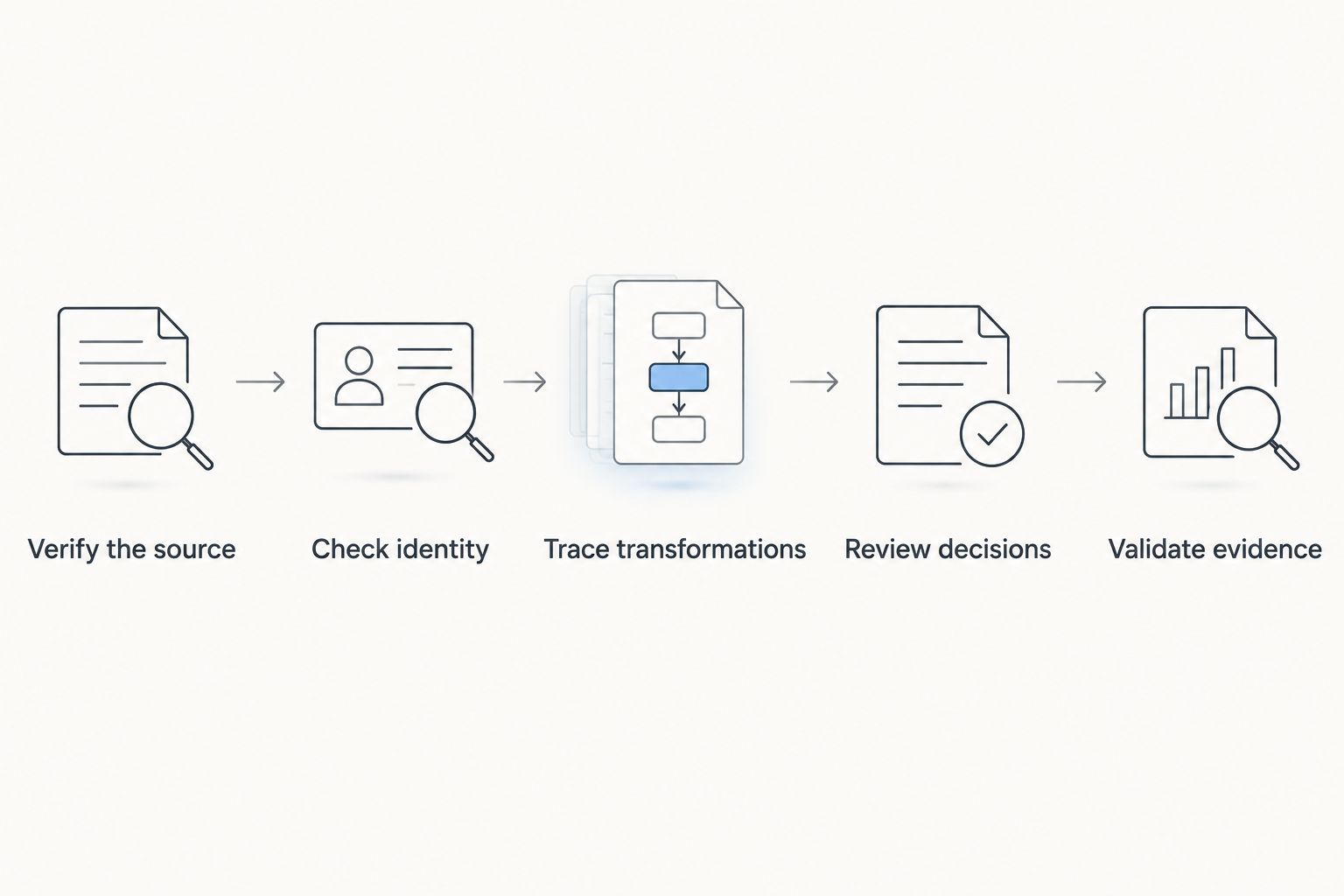
The investigation also needs a preservation step: retain the original records before correcting them. Fixing a mapping error without keeping its history removes the evidence needed to determine which decisions were affected.
Which evidence should override an EPSS-only decision?
Direct evidence of exploitation takes precedence over a low forecast. A probability estimate does not cancel an observed event, and a score decrease does not prove that an incident has ended.
Use each source for the question it actually answers. FIRST’s EPSS documentation addresses exploitation probability; FIRST’s CVSS specifications address vulnerability severity; CISA’s Known Exploited Vulnerabilities catalog identifies vulnerabilities with evidence of exploitation in the wild.
| Signal | Best for | Strength | Limitation |
|---|---|---|---|
| EPSS | Comparing predicted exploitation likelihood | Supplies a probability over a defined forecast window | Does not establish local business impact |
| CVSS | Understanding technical severity | Describes severity through a structured scoring framework | Is not an exploitation-probability forecast |
| CISA KEV | Identifying known exploited vulnerabilities | Provides an affirmative exploitation signal | Absence is not proof of no exploitation |
| Local security evidence | Assessing activity in your environment | Connects observations to your systems | Depends on visibility and investigation quality |
| Asset context | Determining business consequence | Identifies affected services and operational importance | Requires maintained inventory and ownership |
These are complementary signals, not interchangeable scores. Do not convert them into a combined number unless you can explain the rule and preserve the underlying evidence.
How should you design a harder-to-manipulate workflow?
Build a decision process that exposes disagreements rather than hiding them. In your 2026 policy, make source integrity, evidence precedence, and exception ownership explicit.
- Preserve provenance. Retain original values and dates rather than keeping only the latest calculated priority.
- Restrict rule changes. Require approval for edits that alter prioritization logic or suppress findings.
- Separate missing from low. A missing EPSS value is not a probability of zero.
- Keep exceptions accountable. Record the approver, rationale, scope, and review condition.
- Require resolution evidence. Close findings through validated remediation or an approved disposition, not a falling forecast.
Brinqa is a vulnerability and exposure management platform for teams evaluating this broader category of workflow. Evaluate Brinqa against these requirements, and request a demonstration of the specific controls your policy needs; the platform category alone does not establish how a particular implementation handles them.
The benefit of a multi-signal process is that no forecast has to answer every risk question. The trade-off is governance work: your team must maintain asset context, review exceptions, and explain conflicting signals.
Can a fake exploit publication prove EPSS was manipulated?
A fake exploit publication does not, by itself, prove manipulation of EPSS. Establishing that claim requires evidence connecting the material to the model’s inputs and showing its effect on the published output.
Validate the publication separately from the scoring question. A broken demonstration, inaccurate advisory, or unsupported claim warrants correction, but it does not establish a causal explanation for a score change.
Does a low EPSS score mean you can postpone patching?
A low EPSS score is not sufficient justification for postponing remediation. The forecast covers the next 30 days and does not account for every consequence of compromise in your organization.
Check known exploitation, exposure, asset importance, and applicable remediation obligations before approving a delay. Record the decision as an exception where your policy requires one.
Is an EPSS percentile the same as exploitation probability?
An EPSS percentile is a relative ranking, not the probability that exploitation will occur. FIRST provides probability and percentile as distinct values, so your data model and dashboard must label them separately.
Do not display a percentile as if it were a probability percentage. That is an interpretation error, not evidence of model manipulation.
FAQ
Can EPSS be gamed by changing a dashboard field?
Changing a dashboard field can alter local prioritization if the workflow trusts that field, but it does not change FIRST’s published EPSS score. Preserve source values separately from editable analyst judgments.
Can a vendor directly lower its official EPSS score?
EPSS is a model-generated prediction, not a vendor-editable rating. A claim that a vendor manipulated an official score requires evidence of the mechanism and its effect.
Does EPSS predict exploitation of my specific server?
EPSS predicts exploitation activity for a published vulnerability over the next 30 days, not compromise of your specific server. Assess your server’s exposure and business importance separately.
Should a low EPSS score override CISA KEV?
A low EPSS score should not override evidence of known exploitation in CISA KEV. Use the forecast and the observed exploitation signal for their different purposes.
What should I do when EPSS drops after a ticket is opened?
A falling EPSS score is not evidence that the vulnerability was remediated. Reassess priority under your policy, but require remediation evidence or an approved disposition before closure.
What is the difference between EPSS and CVSS?
EPSS estimates exploitation probability, while CVSS describes vulnerability severity. Neither alone establishes the business risk of an affected asset.
Is Brinqa a replacement for EPSS?
Brinqa is a vulnerability and exposure management platform; EPSS is an exploitation-probability model. Evaluate the platform against your management requirements rather than treating these categories as substitutes.
One last thing
A perfectly accurate EPSS import can still produce a bad remediation decision. If your policy equates a low forecast with an unaffected asset, the error is in the policy—not the feed.
Before changing your threshold, inspect a deferred finding. Ask whether its owner can explain the source date, exposure, exploitation evidence, business consequence, and exception rationale. That explanation is more useful than an unsupported claim that a score was gamed.