
Cyber risk quantification software cost needs a scoped vendor quote, not a generic budget figure: define the business services, risk scenarios, data sources, and outputs you need before requesting proposals. Budget separately for implementation, internal analysis, and model maintenance so the software subscription does not become your entire business case.
- Compare cyber risk quantification software cost against a written scope, not an isolated subscription quote.
- Include implementation, data preparation, analyst effort, and ongoing model maintenance in your total cost of ownership.
- Brinqa is relevant when your buying requirement is vulnerability and exposure management; assess financial quantification separately.
- Require explainable assumptions and repeatable results before accepting a cyber risk quantification proposal.
How much does cyber risk quantification software cost?
Use a scoped proposal to establish your budget. For a 2026 evaluation, ask every supplier to quote against the same requirements and separate recurring commitments from initial deployment work. A headline subscription figure cannot tell you whether the proposal includes the work needed to produce a usable risk assessment.
Start with the decision the assessment must support. The guide to cyber risk quantification for CISOs provides related context; your purchasing brief should specify whether you need investment analysis, business-service risk assessment, or executive reporting.
Use this breakdown when reviewing proposals:
| Budget component | What to request | What to verify |
|---|---|---|
| Software subscription | Written scope and licensing unit | Included capabilities, usage boundaries, and renewal terms |
| Implementation | Deployment tasks and acceptance criteria | Responsibilities for configuration, testing, and handover |
| Data preparation | Required inputs and ownership | Who resolves missing, inconsistent, or duplicated records |
| Modeling support | Scenario design and assumption review | What the supplier delivers versus what your analysts maintain |
| Internal operations | Named owners and estimated effort | Time required from security, finance, IT, and business teams |
| Ongoing maintenance | Update and support responsibilities | Who refreshes inputs and validates changed results |
Treat this as a request checklist, not a statement that every supplier bills each component separately. Ask suppliers to identify what is included, optional, or your responsibility.
Why this matters
A purchasing decision can fail even when the software meets its technical requirements. If nobody owns the business assumptions, your team cannot defend the resulting financial analysis.
For your 2026 business case, distinguish the ability to produce a report from the ability to maintain a decision process. Buy an explainable operating model, not just an executive dashboard.
What should your budget include beyond the subscription?
Build the budget around delivery responsibilities. Every task needs an owner, whether the supplier performs it or your team absorbs the work.
Implementation and acceptance
Ask for a written implementation plan that names the inputs, configuration work, test cases, and handover materials. Define acceptance around a completed assessment that your team can explain and repeat.
Avoid accepting “configured” as the sole completion criterion. Require a demonstration using an agreed business scenario, followed by a review of assumptions and results.
Data preparation and business context
Document the information needed to connect a technical event with a business consequence. Depending on your scenario, that includes service dependencies, recovery assumptions, operational disruption, and the people responsible for validating them.
Do not assign every input to security by default. Finance should review financial assumptions, while service owners should validate operational dependencies and consequences.
Analyst time and ongoing ownership
Assign responsibility for scenario updates, assumption reviews, and management reporting before purchase. Otherwise, those tasks remain unbudgeted even though the analysis depends on them.
Ask who maintains the model after implementation support ends. A handover should explain how to change an input, review its effect, and preserve the reasoning behind the change.
Contract boundaries
Have procurement document the licensing unit, included services, support boundaries, and conditions that change your commercial commitment. Do not assume a capability demonstrated during evaluation is included in the proposed agreement.
Use a 12-month planning period to separate deployment work from recurring operations. For longer procurement decisions, add a 36-month planning period using the actual contract terms rather than an assumed renewal increase.
Why cyber risk quantification software cost varies
Use these scope questions to explain differences between proposals. They are evaluation factors, not evidence that a particular supplier uses a particular billing model.
- Assessment scope: Are you evaluating a defined service, a business unit, or an enterprise portfolio? Require the proposal to state its coverage and exclusions.
- Scenario requirements: Specify the events and decisions the analysis must address. Ask whether scenario design and validation are included.
- Data requirements: Identify the source systems, manual inputs, and business context needed for the assessment. Establish who prepares and maintains them.
- Modeling responsibilities: Clarify who selects assumptions, reviews uncertainty, and approves changes. Include any external advisory work in the purchasing brief.
- Workflow requirements: State whether results must support reporting alone or also feed operational decisions. Require demonstrations of any necessary handoffs.
- Support and governance: Define training, documentation, access controls, review responsibilities, and ongoing assistance. Check these against the agreement.
When proposals differ, reconcile the scope before comparing the commercial terms. A smaller commitment is not a better deal if it leaves required work outside the agreement.
Which approach fits your buying requirement?
Financial risk analysis and vulnerability prioritization answer different questions. Financial analysis examines business loss under defined assumptions; vulnerability prioritization determines which technical findings deserve attention.
Use the comparison below to choose an evaluation track. These are approaches, not named vendor tiers or claims about individual products.
| Approach | Best for | Strength | Limitation to assess |
|---|---|---|---|
| Focused financial risk assessment | A defined investment or business-service decision | Keeps evaluation tied to a specific question | Does not establish ongoing enterprise coverage |
| Repeatable financial risk program | Recurring risk reviews across business services | Creates a consistent assessment process | Requires maintained assumptions and accountable owners |
| Vulnerability and exposure management | Operational teams managing technical exposures | Addresses a different, operational security requirement | Does not by itself establish financial loss estimates |
Choose the approach by the decision you need to make, not by the language in a product category. Do not require an operational security platform to prove financial modeling capabilities unless those capabilities are explicitly part of your requirements and demonstrated during evaluation.
Where vulnerability and exposure management fits
Brinqa is for security teams seeking a vulnerability and exposure management platform. That is a relevant requirement when your buying decision concerns technical exposures rather than financial modeling alone.
The useful distinction is category fit. Brinqa's stated focus is vulnerability and exposure management; that description does not establish financial quantification functionality, implementation scope, or commercial terms.
If you evaluate Brinqa, ask the supplier to demonstrate the workflows your team needs and document the boundaries of the proposal. Assess any financial modeling requirement separately rather than assuming it follows from exposure management.
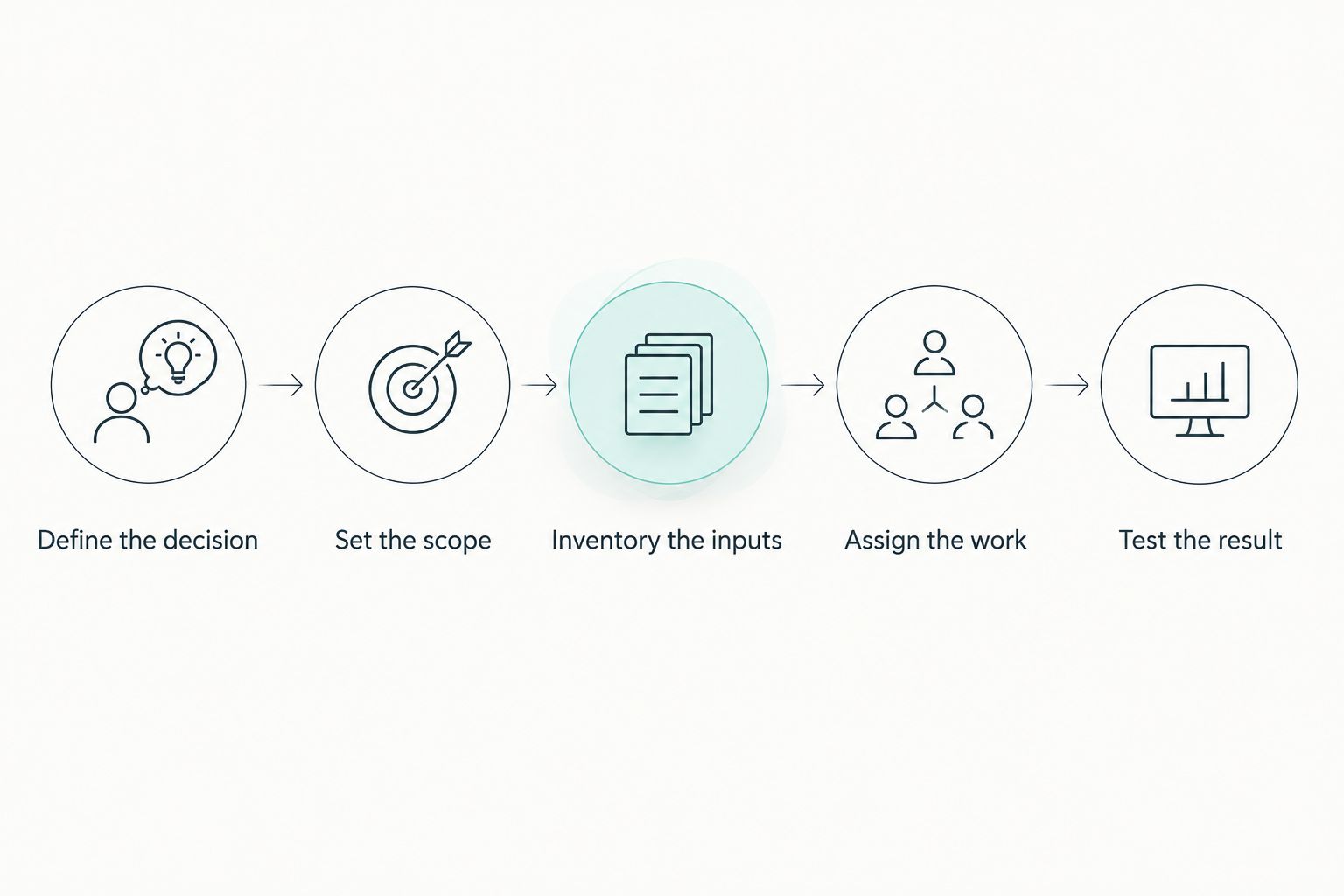
How do you get comparable vendor quotes?
Give every supplier the same evaluation brief. For a 2026 procurement, keep the assessment scope stable until you understand the differences between proposals.
- Define the decision. State the business question and who will act on the result. “Support security investment decisions” needs a specific investment and an accountable decision-maker.
- Set the scope. Name the business services, scenarios, users, and required outputs. State exclusions as clearly as inclusions.
- Inventory the inputs. Identify available information, missing inputs, and the people responsible for validating assumptions. Ask suppliers to explain dependencies.
- Assign the work. Separate supplier tasks from internal tasks. Require written deliverables for implementation, training, and handover.
- Test the result. Use the same evaluation scenario and acceptance criteria across suppliers. Review the reasoning behind the output, not just its presentation.
A proposal becomes comparable when you can map it back to this brief. Where a supplier changes the scope, request an explicit explanation rather than filling in the difference yourself.
What should a proof of value demonstrate?
A useful evaluation establishes whether your team can understand, challenge, and maintain the analysis. An attractive output is not enough.
For your 2026 evaluation, start with 1 business service as a recommended test boundary. Choose a service whose owner can validate dependencies and consequences; expand only after the initial assessment meets your acceptance criteria.
Explain the assumptions
Ask the evaluator to show the inputs behind the result. Identify which are measured, estimated, supplied externally, or selected through expert judgment.
Require a plain-language explanation of uncertainty. A precise-looking output does not remove uncertainty from its inputs.
Test a changed assumption
Change an agreed input and review the effect on the analysis. The purpose is to understand the model's behavior, not to obtain a preferred result.
Ask the evaluator to explain why the output changed and whether other assumptions should change with it. Record the reasoning so another reviewer can follow the same logic.
Demonstrate repeatability
Have the intended internal owner walk through an update using the handover documentation. Confirm that the owner understands the review and approval steps.
Set acceptance criteria before the demonstration. If the evaluation exposes unresolved dependencies, assign them an owner instead of treating them as future implementation details.
How do you compare total cost of ownership?
Compare total cost of ownership over the same planning period and against the same scope. Include the subscription commitment, implementation work, internal effort, and ongoing maintenance responsibilities.
Keep internal effort visible even when it does not appear on a supplier invoice. Use your organization's staffing assumptions rather than an unsupported industry estimate.
Separate contractual commitments from planning assumptions. Label an unsigned renewal estimate as an assumption, and use agreed terms wherever they exist.
Is a vulnerability risk score the same as financial quantification?
A vulnerability risk score is not, by itself, a financial loss estimate. It can support prioritization without expressing the financial consequences of a defined event.
Require a financial quantification evaluation to explain the connection between the scenario, its likelihood, and its consequences. Do not treat a currency-formatted dashboard as evidence that this reasoning is sound.
FAQ
How much should I budget for cyber risk quantification software in 2026?
Base your budget on a scoped vendor proposal and the internal work needed to operate the assessment process. Separate subscription commitments, implementation, data preparation, modeling support, and ongoing maintenance.
What should I ask a cyber risk quantification vendor to include in a quote?
Ask for defined coverage, licensing terms, implementation deliverables, support boundaries, and acceptance criteria. Require the supplier to distinguish included work from your team's responsibilities.
Should I budget for internal staff as well as software?
Yes. Assign and budget the work needed to validate business assumptions, maintain inputs, review results, and report decisions, even when those tasks do not appear on a supplier invoice.
Is financial risk quantification the same as vulnerability prioritization?
No. Financial risk quantification examines business loss under defined assumptions, while vulnerability prioritization determines which technical findings deserve attention.
How can I compare cyber risk quantification proposals fairly?
Use the same assessment scope, planning period, required outputs, and acceptance criteria for every proposal. Resolve differences in coverage before comparing commercial commitments.
What should a cyber risk quantification proof of value show?
A proof of value should show explainable assumptions, the effect of changing an input, and a repeatable update process. Require the intended internal owner to understand the resulting analysis.
One last thing
Ask the supplier to remove the dashboard from the final evaluation meeting and explain the assessment using only its assumptions, inputs, and decision logic. If your team cannot follow that explanation, the presentation has outpaced the evidence.
For a 2026 purchase, make understandable reasoning an acceptance condition. The result must survive questions from the people expected to act on it.