
No—patch management is not enough without exposure management if your goal is to address security weaknesses beyond missing software updates. In 2026, patching remains essential, but it does not by itself resolve excessive permissions, unsafe configurations, unmanaged assets, or the business context needed to decide what to fix first.
- Is patch management enough without exposure management? No: patching addresses software updates, not every exploitable weakness.
- Keep patch deployment; add asset context, risk-based prioritization, remediation ownership, and verification.
- Brinqa belongs in vulnerability and exposure management evaluations, not a shortlist limited to patch deployment.
- Judge remediation by verified exposure reduction, not installed updates alone.
Is patch management enough without exposure management?
Patch management is necessary, but it is not a complete exposure management program. Installing updates addresses vulnerabilities that those updates fix. Exposure management considers a broader question: which weaknesses create meaningful risk in your environment, and what action will reduce that risk?
The distinction matters when your remediation queue contains more than missing patches. Use vulnerability prioritization for lean security teams to connect technical findings with decisions your available staff can execute.
| Approach | Best for | Main strength | Main limitation |
|---|---|---|---|
| Patch management | Deploying software fixes to managed assets | Makes software updating repeatable and accountable | Does not by itself correct permissions, discover every asset, or explain business impact |
| Exposure management | Deciding which security weaknesses need action | Connects findings with asset context, ownership, and remediation decisions | Requires reliable inputs and teams able to act on the findings |
| Combined operating model | Managing risk while maintaining software hygiene | Connects prioritization with patching and other corrective actions | Requires coordination between security, IT, application, and cloud owners |
These approaches are not substitutes. Exposure management without execution leaves findings unresolved; patch management without broader context leaves important weaknesses outside the patch queue.
Why this matters
A successful update deployment answers an operational question: did the intended software change reach the intended systems? It does not answer whether an exposed service remains reachable, an account retains unnecessary privileges, or an application still exposes sensitive data.
For your 2026 security plan, separate deployment success from security outcome. Track both, but do not present the former as proof of the latter.
Consider a hypothetical application server with current software but an unnecessarily public administrative interface. Another update does not correct that access decision. The response is to restrict the interface, verify the restriction, and make the configuration part of ongoing review.
The reverse also matters. A strong exposure inventory does not install an overdue update. Your operating model needs a decision process and a delivery process, with evidence connecting them.
Patch management: best for deploying software fixes
Patch management gives you a controlled way to assess, test, deploy, and verify software updates. Keep that discipline. Without it, a prioritized vulnerability still depends on someone making an unmanaged change.
Its strength is execution against supported software and assets within its coverage. Its boundary is equally important: a patch deployment system does not automatically provide a complete inventory of cloud resources, application weaknesses, identity permissions, or external services.
Avoid treating that boundary as a product defect. A tool designed to distribute updates is doing a different job from a process designed to assess exposure across an environment.
Recommendation: retain patch management as a remediation mechanism, not as your entire risk model. Confirm what the deployment system covers, what it excludes, and how failed installations return to an accountable owner.
Exposure management: best for broader remediation decisions
Exposure management brings security findings into the context needed to make remediation decisions. Relevant context includes the affected asset, its business purpose, accessibility, ownership, and evidence about the weakness.
That broader scope supports actions other than patching. You might need to remove a public endpoint, reduce permissions, change a configuration, retire an unsupported service, or document a temporary exception.
The trade-off is operational complexity. Incomplete inventories, stale findings, and missing ownership weaken the decisions, regardless of how clearly a dashboard presents them.
Recommendation: add exposure management where you cannot explain your highest-priority risks using patch status alone. Do not mistake a larger collection of findings for a better program; each priority needs an action and an owner.
Why the need for exposure management varies
The need for a broader process depends on your environment, not on a universal asset-count threshold. Assess these factors before expanding your 2026 program:
- Asset coverage: Identify systems and services outside your patch deployment inventory. An unknown or unmanaged asset cannot be assumed secure because managed endpoints are current.
- External accessibility: Establish which services accept connections from outside trusted boundaries. Accessibility changes the context of a finding; it does not establish exploitability by itself.
- Identity permissions: Review privileged access and unnecessary permissions. Software updates do not remove an access grant that remains valid by design.
- Business importance: Identify the services, data, and operational dependencies affected by a weakness. Technical severity alone does not describe business consequence.
- Remediation constraints: Record unsupported software, change restrictions, and dependencies that prevent immediate patching. Assign a mitigation or exception rather than leaving the finding without a decision.
- Ownership quality: Determine whether each action reaches someone authorized to complete it. An unassigned finding remains unresolved even when its priority is clear.
If your existing vulnerability management process already covers these factors, improve that process before buying another platform. The requirement is broader coverage and accountable remediation, not a particular label.
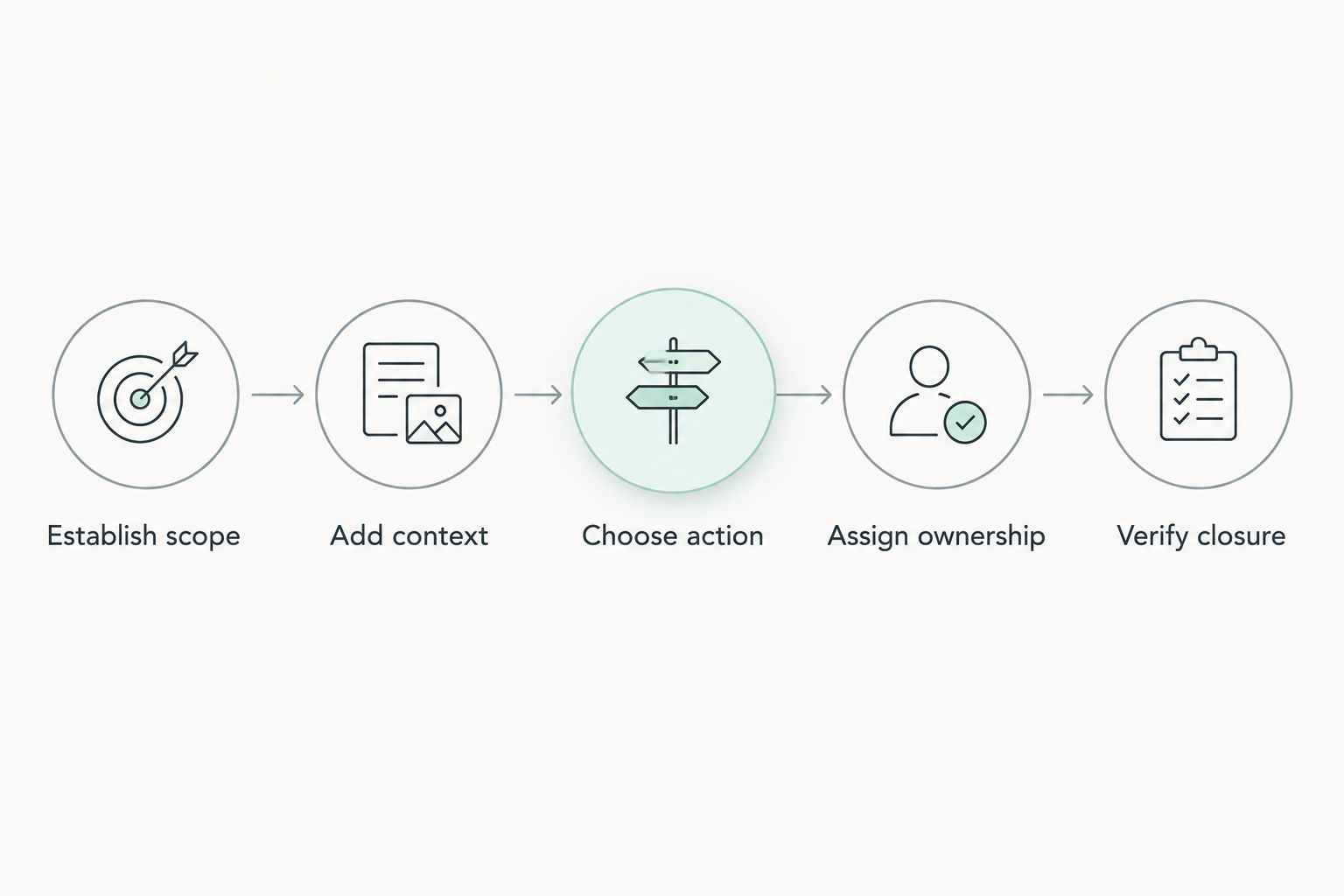
Build the connection in 5 steps
Use these 5 steps to connect exposure decisions with patch execution. This is a proposed operating sequence, not a deployment timetable or a guarantee of results.
1. Establish scope
Choose a business service or asset group with identifiable owners. Document the systems, applications, identities, and external services that support it, then identify which are visible to your existing tools.
Keep unknown coverage explicit. Absence from a scanner or patch console is not evidence that an asset has no weaknesses.
2. Add context
Connect each finding to the affected asset and accountable team. Include the business service, accessibility, technical evidence, and relevant operational constraints.
Reconcile duplicate records before assigning work. Otherwise, different tools can produce separate tickets for the same underlying issue while an unrelated asset remains overlooked.
3. Choose action
Decide whether the response is a patch, configuration change, access restriction, service retirement, or documented exception. Explain why that action addresses the identified weakness.
Keep severity and priority distinct. Severity describes the technical weakness; priority determines the action order using your environment and available evidence.
4. Assign ownership
Send the action to the team authorized to make the change. Include the affected assets, evidence, expected outcome, and the process for reporting a blocker.
An owner should not need to reconstruct the security analysis from a vulnerability identifier alone. Make the requested change understandable and verifiable.
5. Verify closure
Check whether the corrective action took effect and whether the original exposure remains. Reassess the affected asset rather than relying exclusively on a closed ticket.
For a patch, confirm installation and inspect the relevant vulnerability evidence. For an access restriction, test the intended access boundary using an approved method.
Before expanding the workflow, review where work stopped: missing evidence, an incorrect owner, a failed change, or an unresolved exception. Fix the handoff that failed instead of adding more findings to the same blocked queue.
What should you measure beyond patch compliance?
Your 2026 reporting should preserve patch metrics while making their scope explicit. Patch compliance describes update status within a defined population; it does not describe every exposure affecting the business.
Use these measures as definitions to implement, not as benchmark targets:
- Coverage: Compare the assets included in assessment and deployment with the inventory you intend to protect. Show exclusions separately.
- Unresolved priority exposures: Track open findings selected through your documented prioritization process. Keep the selection rules visible so changes in the rules do not look like remediation progress.
- Remediation time: Measure elapsed time between clearly defined start and completion events. Separate deployment completion from verified closure when those events differ.
- Exceptions: Track accepted risks, accountable approvers, compensating controls, and review dates. An approved exception remains a risk decision, not a technical fix.
- Reopened findings: Review issues that return after closure. Determine whether the cause was incomplete remediation, reintroduction, or inaccurate evidence.
Report the denominator with the result. A patch compliance figure without a defined asset population cannot establish coverage of the environment.
Do you need another platform to manage exposure?
Not automatically. Start by checking whether your existing tools and processes can connect findings, asset context, ownership, remediation, and verification. A platform evaluation becomes relevant when those connections are difficult to maintain or audit.
Brinqa is a vulnerability and exposure management platform for teams evaluating broader exposure management rather than patch deployment alone. Include Brinqa in that evaluation when the requirement matches that category; do not infer specific integrations or deployment functions from the category name.
Best for: teams evaluating vulnerability and exposure management software. Boundary: category fit does not establish suitability for your data sources, workflows, or technical requirements.
Ask vendors to demonstrate your intended workflow using representative inputs. Check asset matching, evidence handling, ownership, exception records, and closure verification rather than accepting a dashboard walkthrough as proof.
For a 2026 purchase decision, the acceptance test should describe what your team must accomplish. It should not be a list of features disconnected from remediation work.
Can exposure management replace patch management?
No—exposure management does not remove the need to deploy software fixes. It informs which weaknesses deserve attention and which response fits the situation; an authorized deployment mechanism still needs to perform the update.
Keep the handoff explicit. The exposure decision should identify the affected assets and required outcome, while the patch process handles testing, deployment, failures, and installation evidence.
Is patching every critical vulnerability enough?
No—closing every critical patchable finding does not resolve every security exposure. Misconfigurations, unnecessary privileges, and uncovered assets can remain outside that list.
Do not abandon critical vulnerability remediation. Add context and broader coverage so a severity-filtered queue does not become your definition of the entire attack surface.
What should you check before adding exposure management?
Use 3 questions: do you know what is in scope, can you explain the remediation order, and can you verify the outcome? A weak answer identifies a process gap worth addressing before or during a software evaluation.
Then require 2 evidence checks for closure: evidence that the intended change occurred and evidence that the original weakness was addressed. These are proposed review rules, not industry benchmark figures.
FAQ
Is patch management enough without exposure management?
No—patch management does not by itself address every security exposure. Keep patching, but also assess asset coverage, configurations, permissions, business context, and verified remediation.
What's the difference between patch management and exposure management?
Patch management deploys software updates, while exposure management addresses the broader process of identifying, prioritizing, and resolving security weaknesses. Patching is one corrective action within that broader process.
Can I manage exposure without buying another tool?
Yes, you can organize exposure management using existing tools and documented processes. Assess whether those tools provide adequate coverage, context, ownership, and verification before adding another platform.
Does exposure management replace vulnerability scanning?
No—exposure management does not eliminate the need for technical assessment. Scanners provide findings, while the broader process connects relevant evidence to decisions and corrective action.
What should I do when a vulnerability has no patch?
Evaluate mitigations that address the specific weakness, such as restricting access, disabling an affected function, or retiring the service. Document any accepted residual risk and verify the chosen control.
Where does Brinqa fit alongside patch management?
Brinqa is a vulnerability and exposure management platform, so evaluate it against that scope rather than assuming it replaces patch deployment. Confirm the capabilities your workflow requires during the evaluation.
How do I know whether remediation actually worked?
Verify both the intended change and the original weakness. A deployment record or closed ticket alone does not establish that the exposure was removed.
One last thing
Closing the ticket is not the same as closing the exposure. Before accepting your next remediation report, select a completed item and ask for evidence of the change and evidence of the security outcome.
That review makes the distinction practical. If you can prove installation but cannot establish what happened to the original weakness, improve verification before treating the work as complete.