
Yes—vulnerability management platforms can cover OT and IoT when they receive reliable device data, preserve operational context, and support remediation that does not depend on immediate patching. In 2026, evaluate coverage by the assets and exposures you can verify, not by an integration logo. A central platform does not replace specialist discovery, device-vendor guidance, or operational approval for changes.
- Vulnerability management for OT and IoT needs verified device identities, safe assessment, and operationally approved remediation.
- Brinqa is a vulnerability and exposure management platform; evaluate OT and IoT suitability through a representative pilot.
- Passive discovery, approved active assessment, and management records provide different evidence; none proves complete coverage alone.
- Treat patching, compensating controls, and risk acceptance as distinct outcomes with separate verification requirements.
Why this matters
A finding on an industrial controller is not the same operational problem as a finding on an employee laptop. Your response must account for the physical process, device support, and consequences of interruption—not just technical severity.
For your 2026 program, separate vulnerability visibility from permission to change a device. The guide to exposure management for OT and ICS environments addresses the broader setting; this page explains what a platform must demonstrate before you count OT and IoT as covered.
Coverage means knowing what exists, understanding the evidence, assigning action, and verifying the result. A populated dashboard proves only that data arrived.
Can vulnerability management platforms cover OT and IoT?
Yes, provided the platform can use evidence appropriate to the environment. OT coverage requires operational context and approved assessment methods; IoT coverage requires dependable device identification, firmware information, and a workable ownership model.
Use the following comparison to distinguish collection methods from the management layer that consumes their findings. These are complementary approaches, not interchangeable replacements.
| Approach | Best for | Main contribution | Limitation to verify |
|---|---|---|---|
| Passive discovery | Devices requiring minimal assessment traffic | Observes communications to infer device identity and relationships | Visibility depends on observed traffic and monitoring placement |
| Approved active assessment | Devices cleared for direct querying | Collects information through permitted probes or authenticated checks | Requires device-specific scope, testing, and operational approval |
| Management records | Managed IoT fleets and documented equipment | Supplies inventory, firmware, configuration, and ownership records | Records need reconciliation with deployed devices |
| Central vulnerability management | Coordinating findings across environments | Organizes evidence, priorities, ownership, and response status | Cannot compensate for missing or inaccurate source data |
A platform passes the coverage test only when you can trace a finding back to its source and forward to an accountable response. Ask the vendor to demonstrate that chain using your devices, including an asset that cannot be patched during normal operation.
OT coverage: prioritize process safety and change control
For OT, start with the operational function of the asset. Record the process it supports, the responsible operations team, relevant network connections, and restrictions on interrogation or change.
A controller, engineering workstation, and supervisory server require different assessment decisions. Do not assign the same scan policy simply because they share a network segment. Obtain approval for the device type, assessment method, timing, and stop conditions.
Best for OT: a workflow that keeps security findings connected to operational decisions. The benefit is a response plan that reflects production constraints. The limitation is dependence on operations staff, equipment knowledge, and approved maintenance opportunities.
Require the platform evaluation to answer these questions:
- Can you distinguish an observed firmware version from an inferred version?
- Can you retain the affected process and operational owner alongside the finding?
- Can you record why a patch is deferred without labeling the vulnerability fixed?
- Can you assign and verify a compensating control separately from patch deployment?
A finding without this context is still useful evidence. It is not yet an executable work order.
IoT coverage: verify identity, firmware, and ownership
For IoT, build coverage around the device lifecycle rather than an endpoint-agent assumption. Your evidence might come from network observations, device-management systems, manufacturer records, or approved direct assessment.
Device identity matters because a product family name alone does not establish that a vulnerability applies. Preserve the model, hardware revision where relevant, firmware version, and evidence source. Mark missing information as unknown instead of interpreting it as a clean result.
Best for IoT: repeatable identification and response across device groups. Grouping makes shared firmware and configuration issues easier to manage. The limitation is that superficially similar devices can differ in hardware, software, or support status.
Assign a technical owner and a business owner before distributing findings. A facilities team, product team, or external operator might control the change; the security team still needs a named party who can authorize action.
For a fleet-wide issue, retain device-level exceptions. A completed change for one group must not close findings on devices that were offline, unreachable, or excluded from the deployment.
Why OT and IoT coverage varies
Coverage varies because the available evidence and permitted response differ by device and environment. During a 2026 evaluation, inspect these factors before comparing dashboard totals:
- Device identification: Model and firmware detail determine whether a vulnerability match is defensible. A generic device label leaves applicability unresolved.
- Observation scope: Passive monitoring sees traffic available at its collection points. Inventory imports reflect the systems and records included in the feed.
- Assessment permissions: Approved queries differ across device types. A method permitted for a server is not automatically appropriate for a controller.
- Operational consequence: Prioritization needs the affected process, connectivity, and potential impact—not severity alone.
- Remediation constraints: Vendor guidance, maintenance windows, support status, and change approval shape the available action.
- Evidence freshness: Devices and configurations change. Preserve collection times so reviewers can distinguish current evidence from historical observations.
These factors explain why an integration count is a weak buying criterion. Ask which records arrive, which fields survive ingestion, and which decisions those fields support.
How do you validate coverage before buying?
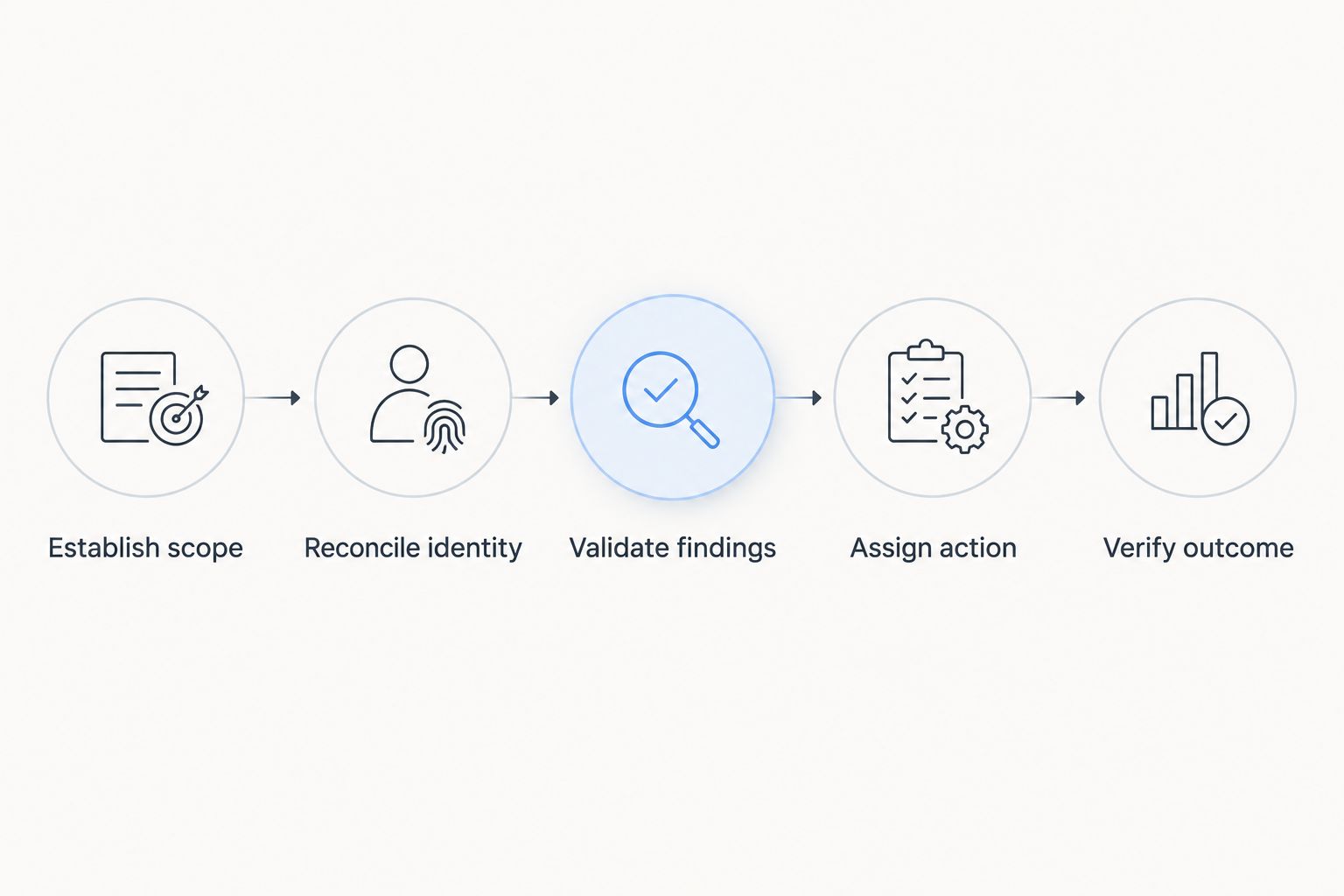
Use a 5-step pilot in 2026 to test the complete workflow. Choose representative equipment with operations staff; include different device types, data sources, and remediation constraints rather than selecting only easy-to-assess assets.
1. Establish scope
Agree on the devices, network areas, permitted collection methods, and accountable owners. Document exclusions before collecting findings so an unassessed device cannot disappear into an apparently healthy total.
Keep the pilot bounded enough for owners to inspect the evidence. A large import is not a substitute for checking whether individual records are correct.
2. Reconcile identity
Compare imported records with an operationally trusted inventory. Inspect duplicate records, reused network addresses, missing firmware, and devices that appear in only one source.
Require visible evidence for record merging. An incorrect merge can attach a finding to the wrong device; an unresolved duplicate can inflate the apparent workload.
3. Validate findings
Select findings and inspect the affected-product match, firmware evidence, advisory conditions, and source timestamp. Separate confirmed applicability from suspected applicability.
Do not use exploit execution as the default validation method on operational equipment. Resolve uncertainty through approved evidence collection and device-vendor guidance before considering intrusive testing.
4. Assign action
Route each selected finding to an authorized owner. Specify whether the response is a patch, configuration change, access restriction, replacement plan, or documented risk decision.
Require the owner to record operational dependencies and approval requirements. A ticket assigned to a generic queue does not demonstrate an actionable response.
5. Verify outcome
Inspect the evidence after the change. For patching, confirm the relevant software or firmware state; for a compensating control, confirm the intended restriction is implemented and remains applicable.
Keep unresolved vulnerabilities visible even when a control reduces exposure. Close the action that was completed, not a different technical condition that still exists.
What should you require from a central platform?
Require evidence handling before convenience features. Your evaluation should show that the platform preserves source details, records uncertainty, connects findings to owners, and distinguishes technical status from workflow status.
Brinqa is a vulnerability and exposure management platform for security teams evaluating centralized management. Assess Brinqa against the OT and IoT pilot above rather than assuming category membership proves device coverage. The potential benefit of a central management layer is a shared response process; its limitation is continued dependence on discovery quality and operational approval.
Use these acceptance checks during the demonstration:
- Traceability: Open the original evidence behind an imported finding.
- Identity handling: Explain why records from different sources represent the same asset.
- Uncertainty: Show unknown firmware and unconfirmed applicability without hiding them.
- Ownership: Route work to the team authorized to change the device.
- Status separation: Distinguish patched, mitigated, accepted, deferred, and unverified findings.
- Reassessment: Show how new evidence changes an existing record and its assigned work.
Reject a demonstration that jumps from import to an attractive risk score without explaining the underlying evidence. Your team needs to defend the decision after the sales presentation ends.
Can passive discovery replace active scanning for OT?
Passive discovery cannot replace every function of active assessment, but it provides evidence without sending assessment probes to the observed device. Its usefulness depends on the traffic available to the sensor and the information exposed by that traffic.
Use passive observations alongside approved records and targeted assessment. An unseen vulnerability is not evidence of an unaffected device, especially when firmware or product identity remains unknown.
What if an OT or IoT device cannot be patched?
An unpatchable device still belongs in vulnerability management. Assess approved alternatives such as restricting access, disabling an unnecessary service, changing configuration, or planning replacement.
Document the control, responsible owner, remaining exposure, and review trigger. Risk acceptance records a decision; it does not remove the underlying vulnerability or prove that a compensating control works.
Can one dashboard prove complete OT and IoT coverage?
One dashboard cannot prove complete OT and IoT coverage without a reconciled inventory and explicit assessment scope. Separate assets with validated evidence from assets that are merely listed, excluded, unreachable, or missing required information.
For reporting, show the 3 coverage states separately: assessed, unassessed, and excluded. Define each state before using totals, and keep finding status separate so assessed assets are not automatically described as secure.
FAQ
Can vulnerability management for OT and IoT use the same platform?
Yes, a shared platform can manage OT and IoT findings when it preserves device identity, source evidence, operational context, and ownership. Collection methods and change approvals still need to suit each environment.
Is it safe to run an IT vulnerability scanner on industrial devices?
Do not assume an IT scan policy is safe for industrial devices. Obtain device-specific guidance, operational approval, and an agreed assessment scope before running active checks.
Do IoT devices need an agent for vulnerability management?
No, IoT vulnerability management does not require an agent on every device. Network observations, management records, vendor information, and approved queries can supply evidence, with different visibility limits.
Does Brinqa automatically cover every OT and IoT device?
Do not assume universal OT and IoT coverage from Brinqa's platform category. Validate the required data sources, identity fields, operational context, and response workflow using representative devices.
What should an OT vulnerability management pilot test in 2026?
A 2026 OT pilot should test asset identification, finding applicability, operational ownership, approved response, and outcome verification. Include devices with assessment restrictions and patching constraints.
Can segmentation count as fixing an IoT vulnerability?
Segmentation can reduce exposure, but it does not remove vulnerable firmware or software. Record the implemented restriction separately from the vulnerability and verify that it blocks the intended access.
What is the biggest mistake when measuring OT and IoT coverage?
Counting imported assets as assessed assets is a coverage mistake. Report unknown identity, missing firmware, exclusions, and unassessed devices explicitly rather than treating them as clean results.
One last thing
For your 2026 acceptance test, choose a device that your team knows is present but cannot fully assess. Ask the platform vendor to show exactly how that uncertainty appears in reporting and assigned work.
A visible unknown is more useful than a false clean result. If missing evidence produces a reassuring status, the platform is obscuring the next action your team needs to take.