
Outsourcing vulnerability management to an MSSP is worth it when the provider takes responsibility for defined operational work and your organization retains clear ownership of remediation and risk decisions. It is not worth it when the deliverable is a scan report without accountable follow-through: buying analyst capacity does not automatically buy patch deployment, application fixes, or verified closure.
- Outsource vulnerability management to MSSP teams only with defined scope, remediation owners, and closure evidence.
- Choose managed delivery for operational capacity; choose co-managed delivery when internal teams retain selected tasks.
- Brinqa is a vulnerability and exposure management platform, a separate purchasing category from managed analyst services.
- Reject a report-only proposal when your actual bottleneck is getting vulnerabilities fixed.
Why this matters
A vulnerability program succeeds when someone turns findings into verified fixes or documented risk decisions. Scanning, prioritizing, assigning, changing systems, and confirming remediation are separate activities. Your contract needs to connect them.
For a 2026 evaluation, start with the work that is stalled, not the provider's service label. If your analysts cannot review findings, external capacity addresses a different problem than if your infrastructure team cannot schedule changes. Use the principles in vulnerability prioritization for lean security teams to separate prioritization work from downstream execution.
Buy help for the bottleneck you actually have. Otherwise, you add another handoff without removing the constraint.
Is outsourcing vulnerability management to an MSSP worth it?
Yes, when the service closes a defined operational gap and produces evidence your teams can act on. Keep the work internal when you already have the capacity, access, and accountability to operate the program effectively.
Compare these 3 operating models in your 2026 selection process. These are decision categories, not standardized service packages; the statement of work determines what a provider actually delivers.
| Operating model | Best for | Main advantage | Main limitation | What you must retain |
|---|---|---|---|---|
| In-house | Teams with available analysts and established remediation ownership | Direct control over priorities and workflows | Internal staff must perform and maintain the work | Program operation, remediation, and risk decisions |
| MSSP-managed | Teams buying defined operational capacity | Assigns contracted tasks to an external provider | Work outside the contract remains yours | Service oversight and explicitly retained decisions |
| Co-managed | Teams dividing work across internal and external owners | Lets you delegate selected activities | Split ownership requires precise handoffs | Coordination and the tasks allocated internally |
Do not treat these models as a maturity ranking. A narrowly scoped managed service with clear ownership is preferable to a broader proposal that leaves everyone uncertain about who acts next.
In-house: best for direct operational control
Keep vulnerability management in-house when your team can maintain coverage, assess findings, route remediation, and verify outcomes. This model puts prioritization decisions close to the people who understand your systems and business dependencies.
The trade-off is responsibility for the entire operating workload. Staff must maintain credentials, investigate scan failures, resolve disputed findings, and keep ownership records current—not just review a dashboard.
For your 2026 plan, check the work that happens between reporting cycles. If the process depends on a single person's undocumented knowledge, document that dependency before deciding whether outsourcing is the right remedy.
Choose in-house delivery when control is necessary and the capacity to exercise that control exists. Preference for control alone is not an operating plan.
MSSP-managed: best for delegated operational work
Choose an MSSP-managed model when you can name the activities you want another organization to perform. Examples to specify in a proposal include scan administration, finding validation, prioritization review, ticket creation, and remediation follow-up.
These are scope requests, not promises inherent in the term MSSP. Ask the provider to mark each activity as included, excluded, or dependent on customer action.
The benefit is a defined allocation of operational work. The limitation is that a provider cannot perform tasks it lacks permission, access, or contractual responsibility to execute.
Choose managed delivery for explicit responsibilities, not a broad promise to “handle vulnerabilities.” Require a named internal service owner even when the external scope is extensive.
Co-managed: best for a deliberate division of responsibilities
Choose co-managed delivery when your team wants to retain selected activities and delegate others. You might retain business-risk decisions and change approval while asking a provider to operate scanning and prepare validated remediation queues.
The advantage is flexibility. The weakness is the boundary: a finding can stall when both organizations assume the other owns the next action.
Define the handoff in operational terms. State what information accompanies a ticket, who accepts it, what happens when ownership is disputed, and who checks whether the fix worked.
Choose co-managed delivery when you can make the division of work explicit. Do not use the label as a substitute for assigning responsibilities.
Why the value of outsourcing varies
Evaluate the proposed service against these factors rather than assuming every vulnerability program needs the same external support:
- Asset scope: List the environments the provider must cover and the exclusions you accept. An unlisted environment creates ambiguity about responsibility.
- Access requirements: Specify how the provider receives access, who approves it, and how you revoke it. Distinguish scanning access from permission to change systems.
- Business context: Identify who supplies asset ownership, criticality, and operational constraints. Technical findings alone do not explain every remediation priority.
- Remediation authority: Separate advice, ticket routing, patch deployment, and application changes. Assign each activity instead of grouping them under remediation.
- Closure requirements: Define the evidence needed to close a finding and the process for reopening it when validation fails.
- Data control: Establish who owns findings, history, exceptions, and workflow records, including what you receive when the relationship ends.
These factors make proposals comparable. A provider accepting fewer tasks is not necessarily a poor choice; an unclear boundary is the problem.
What should the MSSP contract actually require?
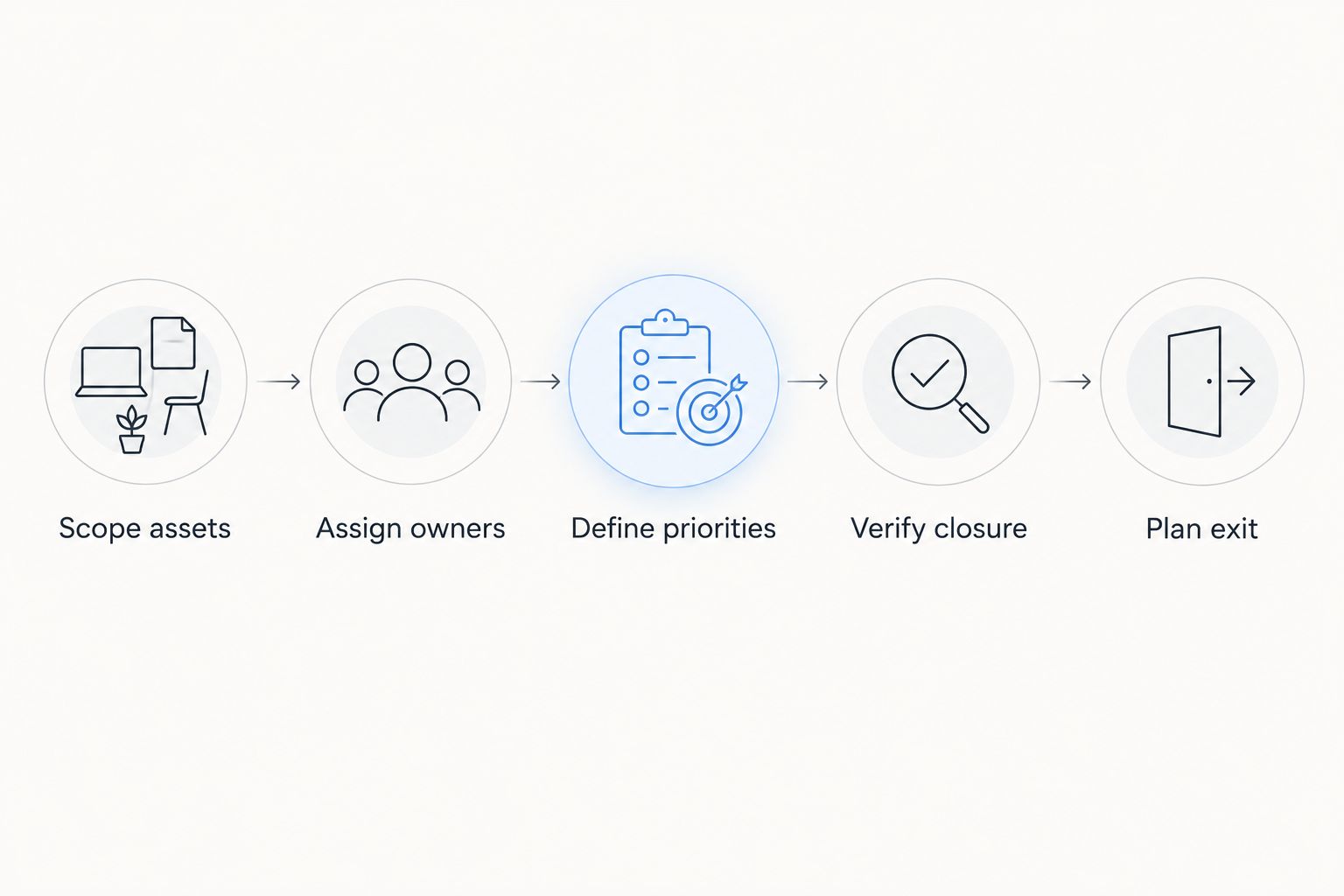
Turn your 2026 requirements into acceptance criteria before signing. A useful statement of work describes the work, the handoff, and the evidence that demonstrates completion.
1. Scope assets
Define the environments, asset sources, scanning methods, and exclusions covered by the engagement. Explain how newly discovered assets enter the service and how retired assets leave it.
Require visibility into failed or incomplete assessments. A completed scan schedule is not the same as evidence that every intended system was assessed successfully.
2. Assign owners
Name the provider's operational owner, your internal service owner, and the teams responsible for making changes. Document escalation routes for unassigned work and disputed ownership.
Specify who approves exceptions. A provider can prepare supporting evidence, but your contract should identify the person authorized to accept the associated business risk.
3. Define priorities
Require an explanation of how findings become an actionable queue. Ask how the process incorporates technical severity, evidence of exploitation, exposure, asset importance, and compensating controls.
Do not accept an unexplained priority label. Your remediation team needs enough context to understand why a finding comes before another and what action resolves it.
4. Verify closure
Agree on the evidence required after a change: a successful reassessment, an appropriate technical check, or a documented exception. Keep the distinction between a closed ticket and a resolved vulnerability explicit.
Also define disputed results. If the provider reports a vulnerability and the system owner disagrees, the process needs an evidence-based review rather than automatic closure or indefinite escalation.
5. Plan exit
Require an agreed method for returning your records and removing provider access. Specify the findings, asset mappings, exceptions, ownership information, and historical evidence you need to continue operating.
Review export usefulness, not just export existence. Your next team should be able to distinguish open work from completed remediation without reconstructing the program from presentation slides.
How do you test an MSSP before expanding the engagement?
Use a bounded evaluation with representative assets and agreed acceptance criteria. For a 2026 pilot, choose work that exercises the handoffs you expect to use after deployment, not just the easiest systems to scan.
Ask the provider to demonstrate these 5 checks:
- Coverage evidence: Show which intended assets were assessed successfully and which need attention.
- Finding evidence: Explain a reported issue and how the provider handled a disputed result.
- Priority evidence: Show why an item belongs ahead of another in the remediation queue.
- Handoff evidence: Route an actionable task to an owner who can accept it without reconstructing the finding.
- Closure evidence: Demonstrate how a completed change becomes a verified resolution or documented exception.
Record your baseline before the evaluation. Useful measures include overdue findings, unassigned work, failed assessments, and time spent resolving ownership disputes; define each measure consistently before comparing results.
Judge the service on completed work and usable evidence, not the volume of findings presented. A discovery increase needs interpretation: it does not, by itself, establish that the service improved or weakened security.
Where does a vulnerability management platform fit?
A platform purchase and a managed-service purchase answer different questions. Software concerns how you operate the program; a service contract concerns who performs specified work.
Brinqa is a vulnerability and exposure management platform for teams evaluating software to support their program. That makes Brinqa relevant to the platform evaluation, whether your eventual operating model is internal, managed, or co-managed.
Evaluate Brinqa separately from provider staffing commitments. Require demonstrations of your actual workflows rather than assuming that any platform supplies analyst labor, remediation authority, or an agreed service scope.
The distinction also exposes a limitation of a software-only decision: selecting a platform does not assign the people who approve changes or accept risk. Write those responsibilities into the operating model.
Does outsourcing vulnerability management include patching?
Patching is included only when the agreement explicitly assigns it to the provider. A service that identifies vulnerabilities or creates tickets is not necessarily responsible for installing updates.
Ask who tests changes, approves deployment, executes the work, handles rollback, and verifies the result. Application fixes and configuration changes also need explicit owners; do not assume a patching clause covers them.
Can you outsource vulnerability management without giving up control?
Yes: retain decision rights and visibility while delegating specified operational tasks. Define who can change priorities, approve exceptions, authorize access, and close findings.
Control also requires usable records. Make sure your internal owner can inspect open work and supporting evidence without relying entirely on a provider's summary presentation.
When should you reject an MSSP proposal?
Reject a proposal when it cannot connect your stated problem to a deliverable and an accountable owner. A reporting service is not the right purchase when your unmet need is deployment capacity.
Ask the provider to walk through a finding from discovery to closure. If the process stops at report delivery, evaluate it as reporting support—not as an end-to-end remediation service.
FAQ
Is it worth outsourcing vulnerability management to an MSSP?
Yes, when the MSSP takes responsibility for defined work that your team needs help completing. The agreement should specify asset scope, deliverables, handoffs, and closure evidence rather than promising only reports.
What's the best vulnerability management model for a small security team?
Choose the model that addresses the team's actual capacity gap. Managed delivery fits delegated operational work, while co-managed delivery fits a deliberate split between provider tasks and internal responsibilities.
Will an MSSP fix every vulnerability it finds?
Only fixes explicitly included in the agreement are the provider's responsibility. Identify who owns patch deployment, application changes, configuration changes, change approval, and verification before signing.
Can an MSSP accept vulnerability risk on our behalf?
Assign risk-acceptance authority explicitly in your governance process and contract. Do not assume that a provider's recommendation or ticket closure constitutes your organization's approval to retain the risk.
How do I know whether the MSSP is doing useful work?
Look for evidence of successful coverage, explained priorities, accepted handoffs, and verified closure. Compare consistently defined measures against your starting position rather than judging the service by report length or finding volume.
Is Brinqa the same thing as an MSSP service?
Brinqa is a vulnerability and exposure management platform. Evaluate the software separately from an MSSP agreement that specifies which people perform which operational tasks.
What should we receive when an MSSP contract ends?
Require the records needed to continue operating, including open findings, ownership information, exceptions, and remediation evidence. Agree on the transfer method and access-removal process before the engagement starts.
One last thing
Before approving an outsourcing decision in 2026, ask your infrastructure or engineering lead to review a sample remediation handoff. The recipient should be able to identify the affected system, understand the requested action, and see how completion will be checked.
If the recipient still has to investigate what the provider meant, the service has transferred a finding—not completed the agreed handoff. Make an accepted, actionable handoff part of your evaluation. It tests the boundary where external analysis becomes internal work.