
Yes, CTEM can reduce critical open vulnerabilities when prioritization leads to completed remediation and verification—not just a reordered backlog. The caveat is that discovering more assets, removing duplicate findings, or changing severity rules also changes the count, so you must separate verified fixes from reporting changes.
- Can CTEM reduce critical vulnerabilities? Yes—when teams complete fixes and verify closure against a consistent baseline.
- A smaller priority queue does not prove that fewer critical vulnerabilities remain open.
- Track verified remediation, new findings, reopened findings, and scope changes separately.
- Brinqa is a vulnerability and exposure management platform; evaluate it against your remediation workflow.
Can CTEM reduce the number of critical open vulnerabilities?
CTEM reduces the critical backlog through action, not scoring alone. Continuous threat exposure management connects discovery and prioritization with validation and mobilization: determining what matters, checking exposure, and getting responsible teams to act.
For your 2026 baseline, define exactly what counts as an open critical vulnerability. Preserve that definition throughout the reporting period. Otherwise, a change in labels can look like a security improvement.
Start with a repeatable process for reducing mean time to remediate vulnerabilities, then distinguish the outcomes below.
| Action | Best for | What improves | Limitation |
|---|---|---|---|
| Verified remediation | Removing the underlying vulnerability | The affected asset no longer has the verified flaw | Requires implementation and validation |
| Verified mitigation | Reducing exposure while remediation remains pending | A relevant attack path or exploitation condition is restricted | The underlying vulnerability remains open |
| Risk acceptance | Recording an authorized decision to retain risk | Accountability and exception visibility | Does not remove the vulnerability |
| Deduplication | Correcting repeated records of the same finding | Backlog accuracy | Does not repair the affected system |
| Reprioritization | Directing attention toward consequential exposures | Work ordering | Does not close a vulnerability |
These outcomes belong in different reporting categories. Treating every administrative closure as remediation makes the backlog smaller without establishing that the environment is safer.
Why this matters
A critical-vulnerability count answers a narrow question: how many findings meet your critical classification and remain open? It does not independently explain exploitability, business impact, or remediation progress.
FIRST's CVSS v3.1 specification assigns the Critical qualitative rating to scores from 9.0 points through 10.0 points. That rating describes technical severity; it does not establish whether a particular deployment exposes the vulnerable component to an attacker.
For a 2026 security report, show the technical-severity backlog beside the risk-prioritized work queue. Keep both visible. A finding that moves down the work queue still belongs in the critical backlog until your closure criteria are met.
This distinction also protects engineering capacity. Teams need a clear explanation of why a finding deserves immediate action, not another list in which every entry appears equally urgent.
How CTEM turns prioritization into verified closure
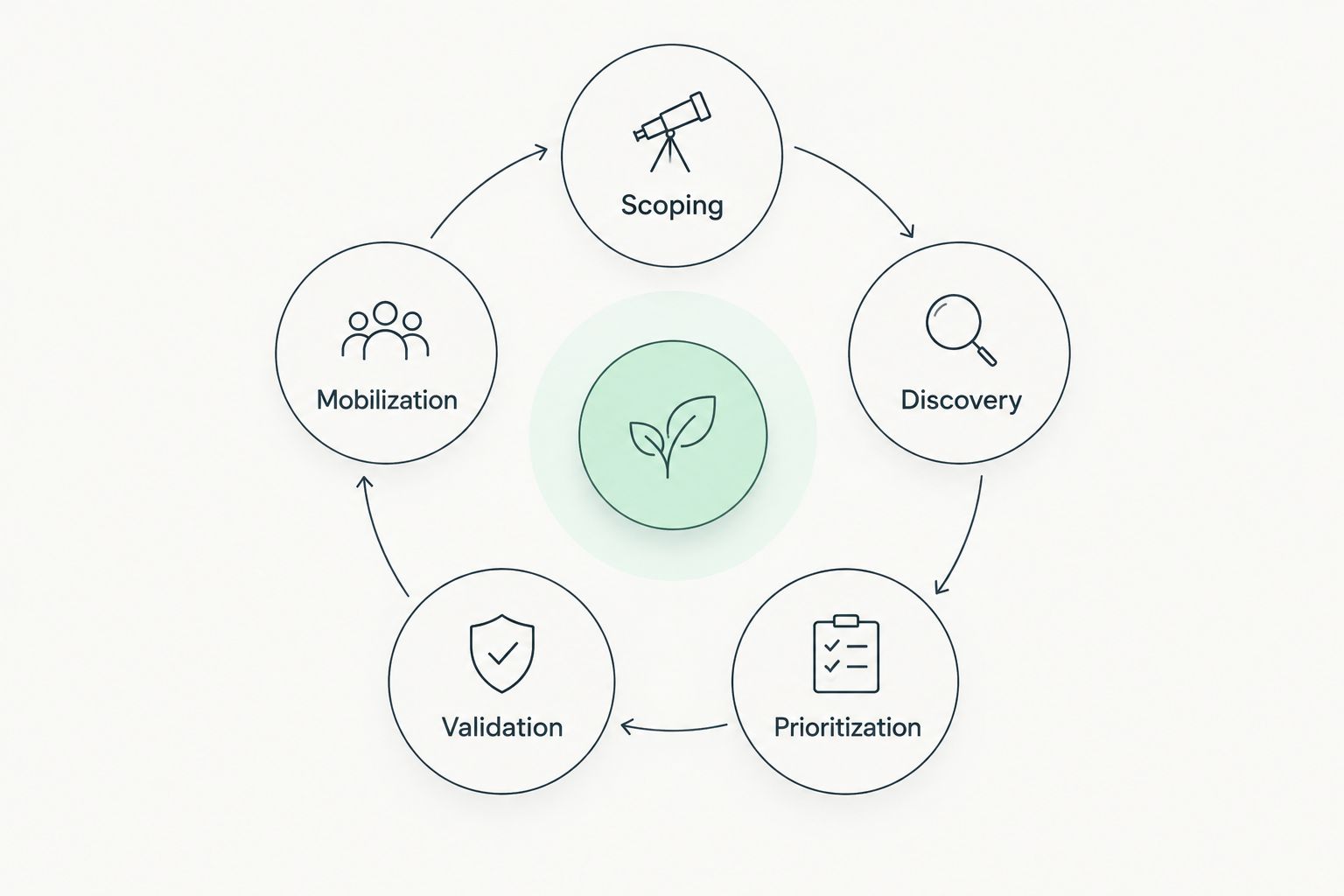
Use the CTEM cycle to connect evidence with ownership. Each stage should produce a decision or an actionable record rather than another dashboard.
1. Scoping
Choose the business services, assets, and environments included in the program. Record exclusions and the reason for each exclusion before comparing backlog totals.
Assign business ownership alongside technical ownership. An infrastructure team can implement a change, while the service owner explains the operational consequences of delaying it or scheduling downtime.
Keep the measurement boundary stable. When coverage expands, report the newly included population separately before combining it with the existing baseline.
2. Discovery
Collect findings from the discovery and assessment sources appropriate to the scope. Reconcile asset identities so that repeated observations do not become separate remediation tasks for the same underlying instance.
Define the finding unit explicitly. A CVE affecting distinct assets is not the same measurement as a count of unique CVE identifiers across the organization.
Retain source evidence and observation timestamps. When findings disappear, you need to distinguish a verified fix from an expired record, an unreachable scanner target, or a retired asset.
3. Prioritization
Rank work using technical severity alongside exploitation evidence, accessibility, business importance, and relevant controls. Keep the original severity visible even when business context changes the action priority.
FIRST's Exploit Prediction Scoring System, or EPSS, estimates the probability that a published CVE will be exploited in the wild during the next 30 days. It is a prioritization input, not proof that your asset is exploitable or protected.
Use context to explain urgency, not erase findings. Document why a critical vulnerability receives a particular treatment and what evidence would trigger reassessment.
4. Validation
Validate the exposure assumptions that drive the decision. Check affected versions, relevant configurations, reachability, and the controls relied upon to restrict exploitation.
Choose validation methods that fit the environment and obtain authorization before intrusive testing. A production service does not need an unsafe exploitation attempt to justify remediation when reliable configuration and version evidence already establish the flaw.
Record what the validation actually proves. Evidence that a network path is blocked supports a mitigation claim; it does not prove the vulnerable component has been repaired.
5. Mobilization
Give the responsible team a concrete action, affected assets, supporting evidence, and the required completion criteria. Group work around the change that resolves it rather than handing engineering disconnected scanner records.
After implementation, verify the result with suitable evidence. Reopen findings when validation fails, and preserve the history rather than creating an unrelated record that conceals recurrence.
How to measure whether the critical backlog is shrinking
For your 2026 measurement plan, separate a fixed starting cohort from the changing total backlog. The starting cohort shows whether existing debt is being removed; the total shows whether new findings are outpacing that work.
Track the starting cohort
Freeze the list of critical findings present at baseline, including their asset identities and classification. Track each finding through verified remediation, mitigation, acceptance, or continued exposure.
Report confirmed false positives separately. They correct the baseline but do not represent repaired systems. Likewise, record verified asset retirement as retirement rather than patching.
This cohort view answers a practical question: are teams resolving the critical vulnerabilities they already knew about?
Reconcile the total backlog
Explain the ending backlog using the starting backlog, newly discovered findings, reopened findings, verified remediations, and other documented adjustments. Separate scope changes from operational activity.
If the arithmetic does not reconcile, investigate the data before presenting the trend. Missing records and inconsistent asset matching are reporting problems, not evidence of reduced exposure.
Your 2026 dashboard should make these movements visible without requiring the reader to infer them from a single trend line.
Measure age and completion quality
Track the age of unresolved findings and the time from discovery to verified remediation. Define the start and end timestamps consistently, including how you handle reopened findings.
Also track unsuccessful verification and findings that recur after closure. Fast ticket completion is not useful if the vulnerable condition remains present.
A closed ticket is a workflow event; a verified fix is a security outcome. Keep those events separate in both operational reporting and leadership summaries.
Why CTEM results vary
CTEM has no universal reduction percentage. Your result depends on whether the program changes the conditions that keep critical findings open.
- Coverage: Expanding discovery adds previously unseen findings. Report the coverage change alongside the backlog increase.
- Asset identity: Inconsistent identifiers create duplicates or break finding history. Reconcile records before measuring closure.
- Ownership: Findings without accountable owners lack a clear route to implementation. Resolve ownership before escalating deadlines.
- Remediation constraints: Compatibility requirements, maintenance windows, and unsupported systems affect the available treatment. Document the constraint and interim controls.
- Validation quality: Ticket status and absent scan results are weaker evidence than a successful, relevant verification. Specify what qualifies as closure.
- Threat and environment changes: New exploitation evidence, configuration changes, and newly reachable services change urgency. Reassess priority without rewriting historical results.
Use these factors to explain movement, not excuse inactivity. Each blocked finding needs a responsible owner, a treatment decision, and a condition or date for review.
What should you require from a supporting platform?
Brinqa fits teams seeking a vulnerability and exposure management platform. Evaluate Brinqa against the same evidence standard you apply to your CTEM program: whether your actual workflow preserves finding history and supports defensible remediation decisions.
Ask for a demonstration using representative asset records, repeated observations, ownership gaps, and reopened findings. Check whether the proposed setup distinguishes underlying severity from action priority and verified remediation from accepted risk.
The benefit of a supporting platform is its role in organizing vulnerability and exposure work; the limitation is that software selection alone does not establish remediation performance. Your teams still need accountable ownership, approved changes, and verification criteria.
Review Brinqa as a platform candidate, not as a substitute for those operating decisions. Require demonstrated capabilities before incorporating them into your implementation plan.
Can the critical count increase after CTEM starts?
The critical count can increase when discovery expands, because previously untracked assets and vulnerabilities enter the measured population. That increase is not proof of worsening remediation performance.
Separate newly covered assets from the original baseline. Then compare remediation progress within the unchanged population while reporting the additional exposure discovered elsewhere.
Do not respond by suppressing findings to preserve a downward chart. Better visibility and a growing backlog can coexist; your report must explain both.
Does mitigating a vulnerability count as closing it?
Mitigation does not remove the underlying vulnerability. It changes an exploitation condition or reduces exposure, so record the control, validation evidence, and remaining remediation requirement separately.
If your workflow closes a treatment task after mitigation, preserve the unresolved vulnerability record. Otherwise, the task system and security report will tell different stories about the same asset.
How quickly should CTEM reduce critical vulnerabilities?
There is no universal completion timeline for CTEM. Discovery coverage, existing debt, change constraints, and verification requirements determine when a defensible reduction becomes visible.
For 2026 planning, start with a bounded business service and measure completed, verified work against its starting backlog. Expand only after ownership, evidence, and reporting rules work consistently.
FAQ
Can CTEM reduce critical vulnerabilities without replacing our scanners?
Yes. CTEM is an operating approach, not a requirement to replace scanners. Existing assessment sources can support the program when they provide suitable coverage and evidence.
Is CTEM the same as vulnerability prioritization?
No. Prioritization is part of CTEM, alongside scoping, discovery, validation, and mobilization. A ranked list does not establish that remediation occurred.
Should we close a critical finding when its risk score drops?
No. A lower risk score changes priority, not the underlying vulnerable condition. Preserve the finding until it meets your documented closure criteria.
Does an accepted risk count as a fixed vulnerability?
No. Risk acceptance records an authorized decision to retain exposure. Keep accepted findings visible with an owner, rationale, and review requirement.
What should we ask Brinqa during a platform evaluation?
Ask Brinqa to demonstrate your vulnerability and exposure management workflow using representative records. Require evidence for asset reconciliation, finding history, ownership, and closure handling before treating those capabilities as established.
Can we prove CTEM worked using only the total critical count?
No. The total critical count mixes remediation with discovery, scope changes, duplicates, and classification changes. Pair it with a fixed baseline and verified closure evidence.
Does every critical vulnerability need an exploitation test?
No. Reliable version, configuration, and applicability evidence can establish a remediation requirement. Use authorized validation methods suited to the environment rather than requiring intrusive testing for every finding.
One last thing
An unchanged critical count can conceal real remediation progress. New findings can replace resolved findings in the total, just as scope reductions can make an inactive program appear successful.
Before your next leadership review, select a critical finding reported as closed and trace it from discovery through the implemented change to verification. If the evidence stops at a ticket status, repair that handoff before celebrating the trend.