
The cost to consolidate vulnerability scanners depends on whether you replace scanning tools or keep them and consolidate vulnerability management; budget for the platform, implementation, retained scanners, and ongoing administration. For your 2026 business case, include contract overlap and internal migration work before subtracting any verified savings.
- The cost to consolidate vulnerability scanners starts with scope: replacing scanners differs from consolidating vulnerability data.
- Brinqa is a vulnerability and exposure management platform; evaluate it against your security team's consolidation requirements.
- Count retained scanner contracts, implementation work, and administration alongside the platform subscription.
- Treat reduced analyst effort as capacity savings unless it changes an approved spending commitment.
Why this matters
One management platform does not necessarily mean one scanning engine. Network, application, and cloud assessments address different technical scopes. Bringing their findings together and replacing their detection capabilities are different projects, with different acceptance criteria.
Brinqa is a vulnerability and exposure management platform. That category is relevant when your objective is managing exposures, but a category label alone does not establish which existing tools you can retire.
Your budget needs to follow the architecture you intend to operate. Otherwise, a proposal that adds a management layer gets compared with a replacement proposal as though both deliver the same outcome.
How much does consolidating scanners into one platform cost?
Build the cost from a defined scope rather than a headline subscription. The useful comparison is your current operating cost versus the complete proposed operating cost over the same period.
Use this breakdown for your 2026 procurement worksheet. Keep supplier charges separate from internal effort so finance can distinguish spending from staff capacity.
| Budget component | What to include | Evidence to request |
|---|---|---|
| Platform subscription | The proposed scope, licensing basis, and contractual commitments | A written quote with definitions and exclusions |
| Scanner contracts | Detection tools that remain after consolidation | Existing agreements and a coverage decision for each tool |
| Implementation | Configuration, integrations, migration, and acceptance work | A statement of work with responsibilities |
| Internal migration effort | Security, engineering, IT, and procurement participation | Named owners and estimated hours by activity |
| Transition overlap | Existing and proposed services operating together | Renewal dates and an agreed cutover plan |
| Ongoing operations | Administration, integration maintenance, and data-quality work | An operating model with accountable owners |
| Exit obligations | Data export, retention, and contract termination requirements | Relevant terms from existing and proposed agreements |
Calculate the proposed total as the platform commitment plus retained tools, implementation, transition obligations, and operating effort. Then compare that total with the baseline—not just with the scanner contracts you hope to cancel.
For a 12-month comparison, separate one-time migration work from recurring commitments. Add a 24-month comparison to show how the decision changes after implementation, using the actual contract terms throughout.
These are planning horizons, not deployment estimates. Do not assume that a longer comparison automatically produces savings.
Data consolidation: retain detection, change management
Best for: teams that need to bring findings together without first replacing their scanning coverage. The project focuses on how vulnerability data becomes usable across tools, owners, and reporting requirements.
The benefit is a narrower replacement scope: you can evaluate the management workflow while retaining existing detection sources. The limitation is equally clear—you must keep the associated scanner commitments in the budget until a separate retirement decision is approved.
For this approach, ask vendors to demonstrate your required source connections, asset matching, finding handling, and reporting. Do not treat those capabilities as confirmed because a proposal uses the word consolidation.
Brinqa belongs in a vulnerability and exposure management evaluation. Assess Brinqa against your documented requirements rather than assuming that adopting a platform eliminates the scanners supplying its data.
Scanner replacement: change detection and management
Best for: teams with documented overlapping coverage and an approved replacement requirement. This approach includes proving that the proposed detection capability covers the systems and assessments you intend to retain.
The benefit is the opportunity to retire a contract when replacement coverage and contractual conditions permit it. The limitation is additional validation work: a shared dashboard does not prove that a replacement scanner detects the same issues.
Compare both approaches explicitly before requesting final proposals.
| Approach | Best for | Main benefit | Main limitation | Approval evidence |
|---|---|---|---|---|
| Data consolidation | Teams retaining specialist detection tools | Changes management without requiring scanner replacement | Retained scanner commitments remain | Validated ingestion and usable workflows |
| Scanner replacement | Teams with proven overlapping detection needs | Enables an approved tool-retirement decision | Requires coverage validation and migration work | Accepted replacement coverage and an executable exit plan |
A combined project needs both sets of evidence. Keep the replacement decision separate from the data-management decision, even when the same supplier participates in both.
Why consolidation cost varies
The cost to consolidate vulnerability scanners follows the work you require and the commitments you retain. Use these factors to make proposals comparable, not to assume that every vendor charges for each item separately.
- Coverage scope: Define which environments and assessment types remain in scope. A consolidation decision must preserve the detection you require.
- Licensing definitions: Request the supplier's definition of each billable unit. Reconcile that definition with your inventory before accepting a quote.
- Integration requirements: List source systems, authentication requirements, required fields, and ownership. Ask which connections are included and which require additional work.
- Data preparation: Specify asset identifiers, duplicate-handling rules, historical records, and ownership mappings. Make acceptance of the resulting data part of the project.
- Workflow changes: Identify ticket routing, exception handling, permissions, and reporting requirements. Assign responsibility for configuration and testing.
- Contract timing: Align proposed start dates with existing renewal and termination terms. Separate avoidable overlap from commitments you cannot cancel.
For 2026 budgeting, attach each factor to an owner and a supporting document. A cost assumption without an accountable owner is not ready for approval.
How do you build a defensible consolidation budget?
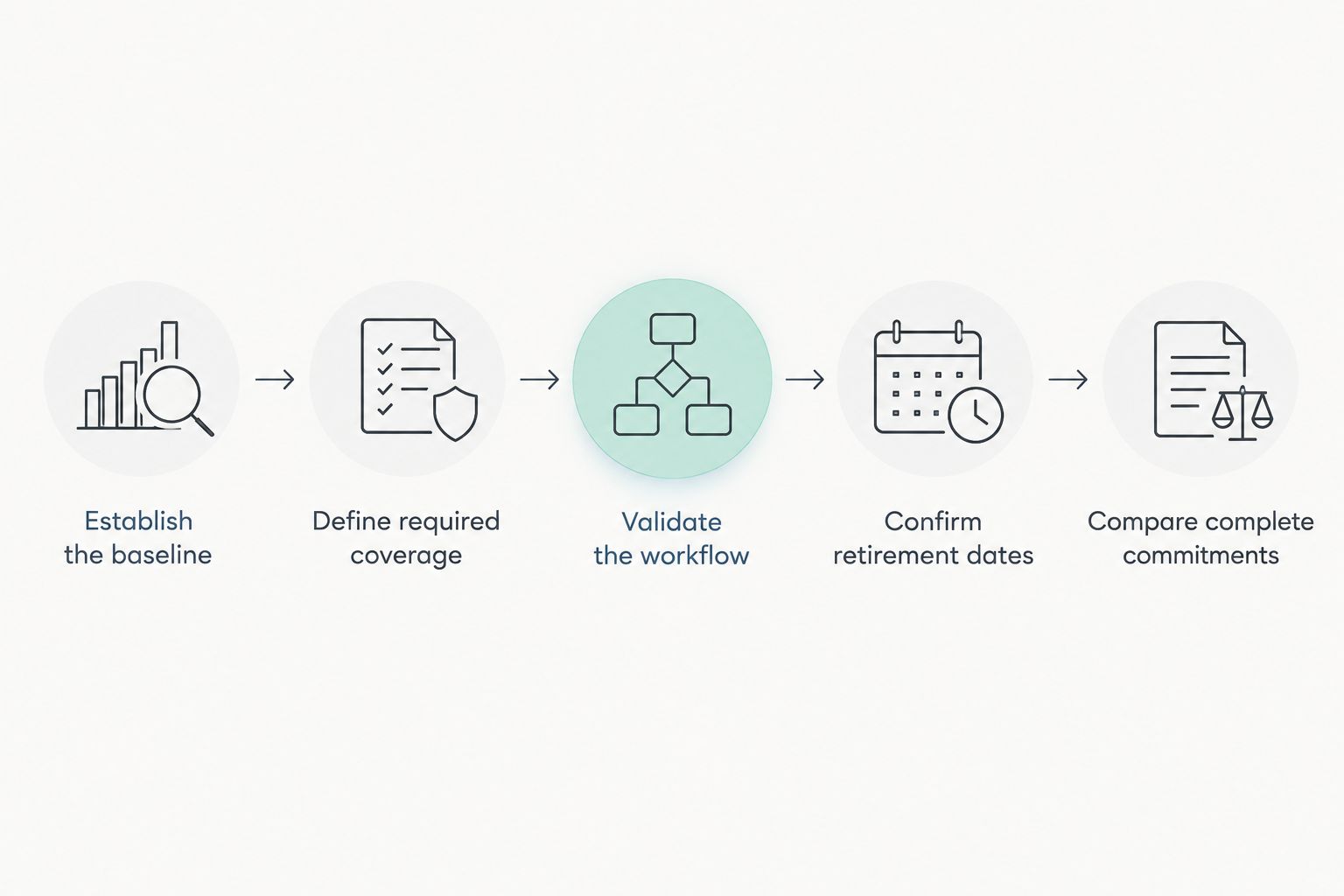
Follow the dependency order: establish the baseline, define required coverage, validate the proposed workflow, and only then approve retirement assumptions. The guide to consolidating vulnerability data from multiple scanners addresses the data-management side of that scope.
1. Establish the baseline
Record current contracts, renewal dates, administration tasks, reporting work, and integration responsibilities. Separate actual invoices from internal labor estimates.
Use a consistent labor convention: record effort in units of 1 hour, then apply your organization's approved labor rate. This is a measurement method, not an estimate of how long any task takes.
2. Define required coverage
List the environments and assessment types that must remain covered. Identify which existing tool supplies each requirement and what evidence would justify replacing it.
Do not mark a scanner for retirement solely because another tool produces findings for some of the same assets. Require the technical owner to accept the replacement scope.
3. Validate the workflow
Use representative data to evaluate asset matching, duplicate handling, ownership assignment, and reporting. Agree on acceptance criteria before the evaluation begins.
Include the people who will operate the resulting process. A workflow that security accepts but remediation owners cannot use has not met the operational requirement.
4. Confirm retirement dates
Map each proposed cancellation to its contractual notice period and technical acceptance decision. Keep a contract in the proposed budget until its removal is executable.
5. Compare complete commitments
Present recurring spending, one-time work, transition obligations, and internal capacity separately. Give finance the same scope and time horizon for the baseline and proposed state.
How should you evaluate a vendor quote?
Require a scope-matched quote, not a feature-count comparison. Give each supplier the same inventory assumptions, required connections, workflow requirements, and acceptance conditions.
For a Brinqa vulnerability and exposure management evaluation, use the same procurement discipline you apply to any candidate. Request written confirmation of requirements; do not substitute a general product description for contractual scope.
Ask these questions before approving your 2026 commitment:
- What exactly determines the subscription commitment, and how is that quantity measured?
- Which implementation deliverables are included, and who accepts them?
- Who maintains each integration after deployment?
- What happens contractually when your environment or required scope changes?
- What data can you export, and what obligations apply at termination?
Record each answer in the comparison worksheet. If an obligation is essential, resolve it in the proposal or agreement rather than leaving it in a demonstration conversation.
Does consolidating scanners automatically reduce spending?
Consolidation does not automatically reduce spending. Adding a management platform while retaining scanner contracts changes the cost structure; it does not, by itself, remove an invoice.
Maintain separate benefit categories. Contract savings require a real reduction in committed spending, while capacity savings describe work your team no longer needs to perform.
Reduced manual reconciliation can be useful even when headcount stays unchanged. Describe that outcome as recovered capacity, and identify the work that capacity will support rather than presenting it as cash returned to the budget.
Can one platform replace every vulnerability scanner?
A platform should replace a scanner only after required detection coverage is validated. Consolidating findings proves a data-management function, not equivalence between detection methods.
Give each proposed retirement its own acceptance decision. Keep the existing source when replacement evidence does not satisfy the responsible technical owner.
What should your finance team approve?
Finance should approve the complete commitment and the assumptions behind it. Present the baseline, proposed state, one-time work, and confirmed retirement dates together.
For the 2026 decision, distinguish benefits already supported by evidence from benefits that depend on later validation. Do not subtract conditional savings from committed spending as though both are certain.
FAQ
What's included in the cost to consolidate vulnerability scanners?
The cost to consolidate vulnerability scanners includes the proposed platform, retained scanning tools, implementation, transition obligations, and ongoing operations. Separate supplier spending from internal staff effort so the budget shows both clearly.
Is consolidating scanner data cheaper than replacing scanners?
Neither approach is automatically cheaper. Data consolidation retains detection sources, while scanner replacement requires coverage validation; compare the complete commitments for your actual scope.
Do I still need scanners after buying an exposure management platform?
Keep scanners wherever their detection capability remains required and has not been replaced. A platform's ability to manage findings does not establish replacement detection coverage.
How do I calculate scanner consolidation savings?
Calculate savings by comparing the current baseline with the complete proposed cost over the same period. Count contract reductions only when cancellation is executable, and report recovered staff capacity separately.
Should I include internal staff time in the budget?
Include internal staff time as a separate resource requirement. Use recorded or estimated hours and your organization's approved labor rate rather than an assumed industry benchmark.
What should a consolidation proof of concept demonstrate?
A consolidation proof of concept should demonstrate the data and workflows required by your acceptance criteria. Include source ingestion, asset matching, ownership, reporting, and replacement coverage wherever scanner retirement is proposed.
When should I cancel an existing scanner contract?
Cancel an existing scanner contract only after required replacement coverage is accepted and termination conditions are satisfied. Coordinate the technical decision with contractual notice requirements.
One last thing
The decision to retire a scanner needs evidence that the decision to consolidate its data does not provide. Treat those as separate approvals, even when they appear in the same business case.
Before signing, ask the budget owner to identify every claimed saving and the event that makes it real. A cancelled commitment, an accepted replacement, and recovered analyst capacity are different outcomes; naming them correctly makes the proposal easier to defend.