
Fintech application security posture management (ASPM) is the practice of connecting application security findings with business context to reduce risk to financial services, customer data, and transaction workflows. ASPM for fintech companies must distinguish a flaw in a payment authorization path from an isolated development finding, then assign an accountable owner and verify the fix.
- ASPM for fintech companies should prioritize transaction integrity, customer data, and exposed application paths—not scanner severity alone.
- OWASP application security guidance supports testing; ASPM connects findings to ownership, business context, and remediation evidence.
- Start with a bounded application pilot before expanding application security posture management across your portfolio.
- Keep vulnerability management and exposure management connected to application risk without treating them as substitutes for security testing.
Why ASPM matters for fintech companies
A fintech application security program must account for confidentiality, transaction integrity, and service availability. A vulnerability affecting account access deserves different treatment from the same technical finding in a disconnected test environment. Your queue should explain the business consequence, not just repeat a scanner score.
ASPM connects security findings to applications, environments, owners, and remediation decisions. It does not replace source-code analysis, dependency testing, API testing, or a penetration test. For the engineering workflow behind that distinction, see ASPM for DevSecOps teams.
For your 2026 program, define success as a repeatable decision process: identify affected services, rank actionable findings, route work, and retain closure evidence. A dashboard without those decisions is a reporting layer, not an operating process.
Fintech-specific context belongs in that process:
- Transaction integrity: Can the affected application initiate, authorize, or change a financial transaction?
- Customer data: Does the service handle identity records, account information, or other sensitive data?
- Trust boundaries: Does an API connect customer-facing systems to privileged internal services?
- Service dependencies: Does another business-critical application depend on the affected component?
- Release constraints: What validation and rollback evidence does a production change require?
Regulatory scope also varies by business model, geography, and data handling. Keep applicable obligations attached to services rather than assuming every fintech application has identical requirements.
Build an ASPM process around financial workflows
1. Map your applications to business services
Start manually with a shared inventory and a working session between engineering, security, and service owners. Document what each application does before importing its findings. A repository name alone does not identify the customer-facing service, production environment, or team responsible for remediation.
Use 1 production service as the initial pilot boundary. Choose a service with a known owner and a financial or customer-data workflow; this is a proposed starting scope, not a benchmark. Include its supporting repositories and runtime components so the pilot tests relationships rather than an isolated scan.
Keep your 2026 inventory specific enough to distinguish development from production. Record unresolved ownership as a task instead of quietly assigning it to security.
- Map each application to its business service.
- Record repositories, deployment environments, and API endpoints.
- Identify the engineering owner and business owner.
- Describe sensitive data and transaction functions.
- Mark externally accessible and privileged components.
2. Normalize findings without erasing their evidence
Export findings from your existing testing tools and reconcile them in a spreadsheet first. Preserve the source record, affected component, finding type, and detection time. Normalization should make records comparable; it should not remove the details an engineer needs to reproduce a problem.
Static application security testing examines code, software composition analysis examines dependencies, and dynamic testing examines running applications. Their findings are not interchangeable. An authorization defect and a vulnerable library require different evidence and different remediation paths.
Define duplicate rules explicitly. Findings that share a vulnerability identifier can still affect different deployable artifacts, owners, or environments. Conversely, several tools can report the same underlying issue.
- Preserve the original finding identifier and source.
- Standardize application, component, and environment fields.
- Separate code, dependency, configuration, and behavioral findings.
- Document rules for duplicates and related records.
- Flag stale scans and missing deployment mappings.
3. Evaluate a platform against your manual process
Once the manual workflow is clear, evaluate software against the tasks it must simplify. Bring your actual records and ask each vendor to demonstrate how those records become an actionable queue. Do not accept a generic dashboard demonstration as evidence that your application relationships work.
Brinqa is a vulnerability and exposure management platform. Brinqa is best for fintech teams evaluating vulnerability and exposure management alongside application security posture management. Assess it against your ASPM requirements without assuming the category label proves support for a particular scanner, application mapping, or workflow.
The faster path is software that performs the repeatable reconciliation you have already defined. Make that a demonstration requirement, not an assumed product capability. Retain manual review for disputed matches and incomplete context.
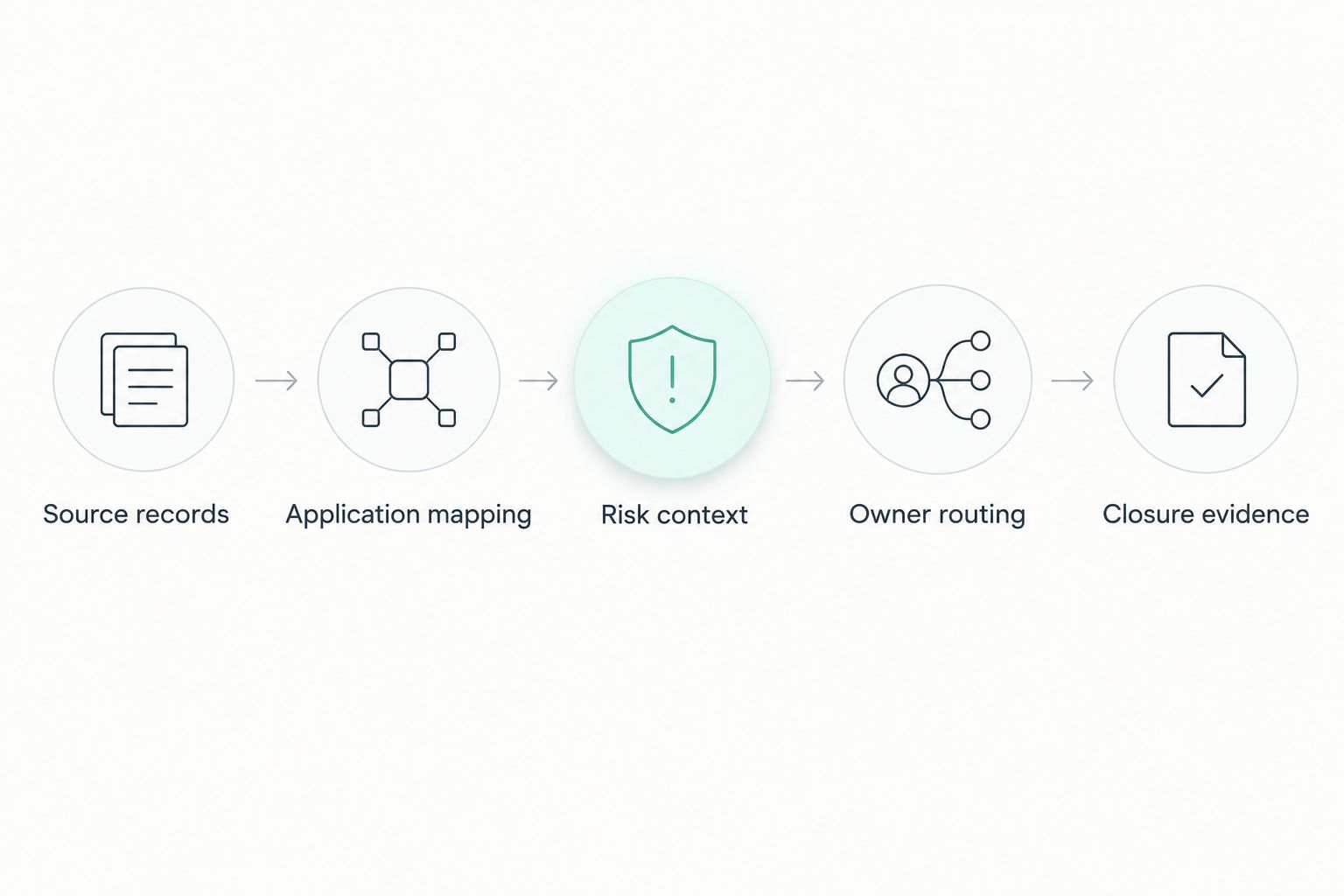
For your 2026 evaluation, require the vendor to show the following using your pilot data:
- Source records: Preserve finding details and detection history.
- Application mapping: Explain how findings connect to deployed services.
- Risk context: Show the evidence behind a priority decision.
- Owner routing: Demonstrate assignment and reassignment behavior.
- Closure evidence: Distinguish a completed ticket from a verified fix.
4. Rank findings by financial-service impact
Create a written prioritization rubric before configuring scores. Review a sample manually with an application engineer and the service owner. Separate technical severity from deployment context, exploitability evidence, and business consequence so reviewers can explain disagreements.
For a hypothetical payment API, an authorization flaw affecting another customer's transactions warrants direct investigation even without a common vulnerability identifier. A dependency alert also warrants investigation, but its deployment, reachability, and available fixes determine the next action. Do not infer safety from the absence of a published identifier.
Use CVSS as technical severity input, not a complete business-risk decision. Where applicable, EPSS estimates exploitation probability for published vulnerabilities; it does not describe the business impact of your application or cover every application defect.
- Record technical severity separately from business impact.
- Check production deployment and external accessibility.
- Assess affected transaction and customer-data workflows.
- Attach exploitability evidence and known compensating controls.
- Document priority changes and the decision owner.
5. Route remediation through engineering ownership
Begin with the issue tracker your engineering teams already use. Write a remediation ticket manually and confirm that the assigned team can reproduce the finding, identify the affected deployment, and understand the required outcome. Automate routing only after that handoff works.
A shared library needs both a component owner and a clear view of affected consuming applications. Fixing the source package does not establish that every production service has deployed the corrected version. Keep that distinction visible throughout remediation.
As a suggested pilot cadence, review unassigned and blocked work every 7 days. This is an operating choice, not a mandated deadline. Set actual remediation targets according to risk, contractual commitments, and your approved security policy.
- Assign a responsible engineering team for every actionable finding.
- Include reproduction details and affected environments.
- Separate component fixes from downstream deployment tasks.
- Escalate findings with missing owners or blocked dependencies.
- Require approved, expiring exceptions for deferred work.
6. Verify fixes and retain decision evidence
Start with a manual closure checklist. Require evidence that the affected production path or artifact changed, then use the appropriate test to confirm the original condition is resolved. A successful build is useful deployment evidence, but it is not automatically proof that an authorization defect disappeared.
Keep remediation status separate from risk acceptance. An exception records an approved decision to retain exposure under stated conditions; it does not convert the finding into a fix. Preserve the approver, rationale, expiration, and compensating-control evidence.
Your 2026 evidence set should let a reviewer follow the finding from detection to the final decision. Restrict access to sensitive reproduction details, especially when test artifacts contain customer information or credentials.
- Retest the affected behavior or component.
- Record the deployed artifact or change reference.
- Preserve test results and closure rationale.
- Track accepted risk separately from remediated findings.
- Reopen findings when the original condition returns.
7. Measure the workflow before expanding coverage
Use a 30-day pilot as a proposed evaluation window. It is a planning choice, not a promised implementation timeline. During that window, measure whether your process produces traceable decisions for the selected service, including difficult cases such as disputed ownership and duplicate findings.
Report denominators with every percentage. Ownership coverage means findings with confirmed owners divided by findings in scope; it should not silently exclude the unassigned records causing the problem. Track remediation time from a defined starting event to verified closure, with accepted risk reported separately.
For the 2026 expansion decision, compare the effort saved against the reconciliation and maintenance work introduced. Expand only when the team can sustain the process and explain its remaining gaps.
- Measure confirmed ownership across in-scope findings.
- Track findings missing application or deployment context.
- Measure time from triage to verified remediation.
- Count reopened findings and expired exceptions.
- Record manual effort needed to maintain mappings.
Compare ASPM approaches for fintech teams
Choose the approach that solves your current decision bottleneck. A small, bounded portfolio can start with manual coordination. A larger or fragmented portfolio needs an evaluation that tests data relationships, ownership, and verification—not just record ingestion.
These options serve different purposes. The table separates category-level strengths from requirements you must verify for a named platform.
| Option | Best for | Strength | Key limitation |
|---|---|---|---|
| Manual inventory and issue tracker | A bounded application portfolio with clear owners | Makes decisions and handoffs explicit without another platform | Reconciliation and evidence maintenance remain manual |
| Scanner-centered workflow | Teams improving a specific testing discipline | Keeps findings close to the tool that detected them | A scanner's perspective does not establish complete business context |
| Dedicated ASPM platform | Teams coordinating application findings across testing sources | Designed around application security posture and workflow coordination | Source coverage, mapping accuracy, and workflow depth require validation |
| Brinqa vulnerability and exposure management | Fintech teams evaluating application risk alongside broader exposure management | Offers a platform category relevant to vulnerability and exposure management | Fintech-specific ASPM fit, integrations, and workflow behavior require demonstration |
Do not replace a testing tool simply because a management platform accepts its findings. Collection, prioritization, and testing solve different problems. Keep the detection methods your applications require, then evaluate how well the management process connects their results.
Common mistakes fintech teams make
Treating every critical finding as equal
A severity label does not explain whether a finding affects transaction authorization, customer data, or an isolated environment. Keep technical severity visible, then add business context. Do not downgrade a finding merely because its application owner calls it inconvenient.
Assigning application risk entirely to security
Security can define triage policy and review evidence, but engineering controls application changes and deployments. Name the team that can implement the fix and the business owner who can approve a risk decision. An application without those owners needs an ownership decision before automated routing.
Closing shared-component findings before deployment
A corrected dependency in a repository does not prove that consuming services run it. Track the affected artifacts and environments. Require deployment and validation evidence before closing the production exposure.
Treating a dashboard as compliance evidence
A status chart does not establish the applicable control, the tested scope, or the approval behind an exception. Keep finding histories, change records, test evidence, and risk decisions. Map them to your actual obligations rather than assuming a platform creates compliance by itself.
Ignoring flaws without vulnerability identifiers
Business-logic and authorization findings can exist outside a CVE-based queue. Include penetration-test findings and application-specific defects in your process. For fintech services, a flaw in who can authorize an action deserves investigation regardless of its identifier format.
FAQ
What is ASPM for fintech companies?
ASPM for fintech companies connects application security findings with application ownership, deployment context, and business impact. It helps teams prioritize remediation for financial workflows and customer-data services, then retain evidence of the outcome.
Is ASPM the same as application security testing?
ASPM is not the same as application security testing. Testing identifies weaknesses; ASPM organizes findings, adds context, and coordinates decisions and remediation across the application portfolio.
Can a fintech company start ASPM without buying another platform?
A fintech company can start ASPM with an application inventory, existing testing tools, and an issue tracker. Establish mapping, priority, ownership, and verification rules manually before evaluating software to simplify those tasks.
Is Brinqa an application security scanner?
Brinqa is a vulnerability and exposure management platform. Evaluate it for your management requirements and separately verify the application testing capabilities and integrations your program needs.
Should fintech teams prioritize vulnerabilities using CVSS alone?
Fintech teams should not use CVSS alone to prioritize vulnerabilities. Add deployment context, exploitability evidence, affected financial workflows, and customer-data impact so the priority reflects the application at risk.
How do you know an application vulnerability is fixed?
An application vulnerability is fixed when validation confirms the original condition is resolved in the affected deployment. Retain the change reference and test evidence rather than relying only on a closed ticket.
Does ASPM make a fintech company compliant?
ASPM does not make a fintech company compliant by itself. It supports finding management and evidence collection, while compliance depends on the obligations, controls, scope, and evidence applicable to the business.
One last thing
Test an ownership change before you expand ASPM. Reassign the pilot service, update its deployment context, and check whether open findings, exceptions, and closure responsibilities follow the change. A process that works only while the inventory stays still is not ready for routine application change.