
Real estate vulnerability management is the process of finding, prioritizing, and resolving security weaknesses with the aim of protecting transactions, tenant information, and property operations. Vulnerability management for real estate companies must distinguish corporate systems from property technology and separate assets you control from services a landlord, operator, or vendor manages.
- Vulnerability management for real estate companies starts with asset ownership, business context, and verified remediation.
- Brinqa fits teams seeking a vulnerability and exposure management platform.
- Prioritize exposed transaction systems and tenant data before sorting findings by technical severity alone.
- Treat building systems separately: approve assessment methods with operators before scanning or patching.
Why vulnerability management matters for real estate firms
A finding without an accountable owner is not a remediation plan. For your 2026 program, identify who controls each affected system before assigning a deadline. A property address, application name, or scanner result alone does not establish authority to make changes.
A brokerage, property manager, and property owner need different scopes. Include transaction applications when you operate them, tenant services when you manage them, and building equipment when your responsibility extends to those systems. Do not treat every real estate business as a building operator.
Use the guide to vulnerability management for multi-location businesses to structure location-level accountability. Your central security team needs visibility; each location still needs a named person who can arrange access, approve maintenance, and confirm service restoration.
Vulnerability management also has a boundary. It addresses technical weaknesses; it does not replace payment verification, fraud controls, identity security, or incident response. Protecting a transaction requires those controls alongside remediation, not a scanner report presented as complete protection.
Build your real estate vulnerability management workflow
1. Define your scope around business services
Start manually with a spreadsheet and interviews with IT, finance, property operations, and application owners. List the services whose disruption or compromise would interrupt your work. Then map the technology supporting each service.
For a 2026 scope review, distinguish owned infrastructure, leased equipment, vendor-managed systems, and externally hosted applications. An outsourced tenant portal belongs in your risk register even when you cannot inspect its underlying servers. Your action is then to obtain evidence and assign vendor follow-up, not perform unauthorized testing.
Give every asset a business purpose. A server supporting document exchange needs different handling from a workstation used for public listing updates, even when both have the same technical finding.
- List transaction, tenant, accounting, and property-operation services you actually use.
- Record the legal entity and property associated with each asset.
- Name a technical owner and a business approver.
- Mark whether you can scan, patch, configure, or only request changes.
- Record data sensitivity and service dependencies.
2. Establish assessment coverage without disrupting operations
Compare your asset register with existing endpoint, network, cloud, and application assessment reports. Do this manually first. An asset missing from a scanner export needs investigation; absence of findings does not prove that the asset is secure.
Separate conventional IT from building automation and other operational equipment. Before active assessment, ask the responsible operator or manufacturer which methods are supported. Obtain written scope, maintenance approval, and stop conditions rather than reusing the office-network scan profile.
For hosted services, request vulnerability-handling documentation and relevant assessment evidence. Confirm which parts of the service the evidence covers. A report about a vendor's corporate network does not establish coverage of your tenant-facing application.
- Reconcile assessed assets against the approved inventory.
- Record assessment dates and failed authentication attempts.
- Approve scan scope and intensity with system owners.
- Define stop conditions for service degradation.
- Track vendor-managed systems through evidence requests.
3. Consolidate findings before evaluating platforms
Export your existing findings into a common worksheet. Preserve the source, asset identifier, vulnerability identifier, observation date, and remediation guidance. Merge duplicates only when you can demonstrate that they describe the same weakness on the same asset.
Different tools describe assets differently. A hostname change, reused address, or replacement device can distort your backlog if you treat a single identifier as permanent. Retain enough evidence to distinguish a recurring weakness from a newly discovered asset.
Brinqa is a vulnerability and exposure management platform. Evaluate Brinqa as a platform path after defining your manual workflow, not as a prerequisite for starting. Your 2026 evaluation should use representative data and require a demonstration of the capabilities your process needs; do not assume compatibility from a category label.
- Preserve original finding identifiers and source records.
- Define rules for matching assets across reports.
- Separate duplicate observations from separate affected systems.
- Test platform candidates with approved sample data.
- Document unresolved ownership and data-quality gaps.
4. Prioritize findings by exposure and business consequence
Review the technical finding alongside the affected service, accessibility, exploitation evidence, and existing safeguards. Manual triage works when reviewers can see these fields together. A severity score alone cannot tell you whether a weakness threatens a transaction workflow or sits on an isolated test system.
Use authoritative exploitation information, such as CISA's Known Exploited Vulnerabilities Catalog, when applicable. Confirm that the affected product and version match your environment. Catalog membership is an escalation input, not proof that your organization has been compromised.
For your 2026 queue, keep the reasoning visible. Write why a finding receives its priority and what evidence would change that decision. This lets property operators challenge incorrect assumptions without silently removing security work.
- Identify internet exposure and reachable attack paths.
- Check whether relevant exploitation evidence exists.
- Map findings to tenant, financial, and operational services.
- Record protective controls and their verification evidence.
- Assign a priority with a written rationale.
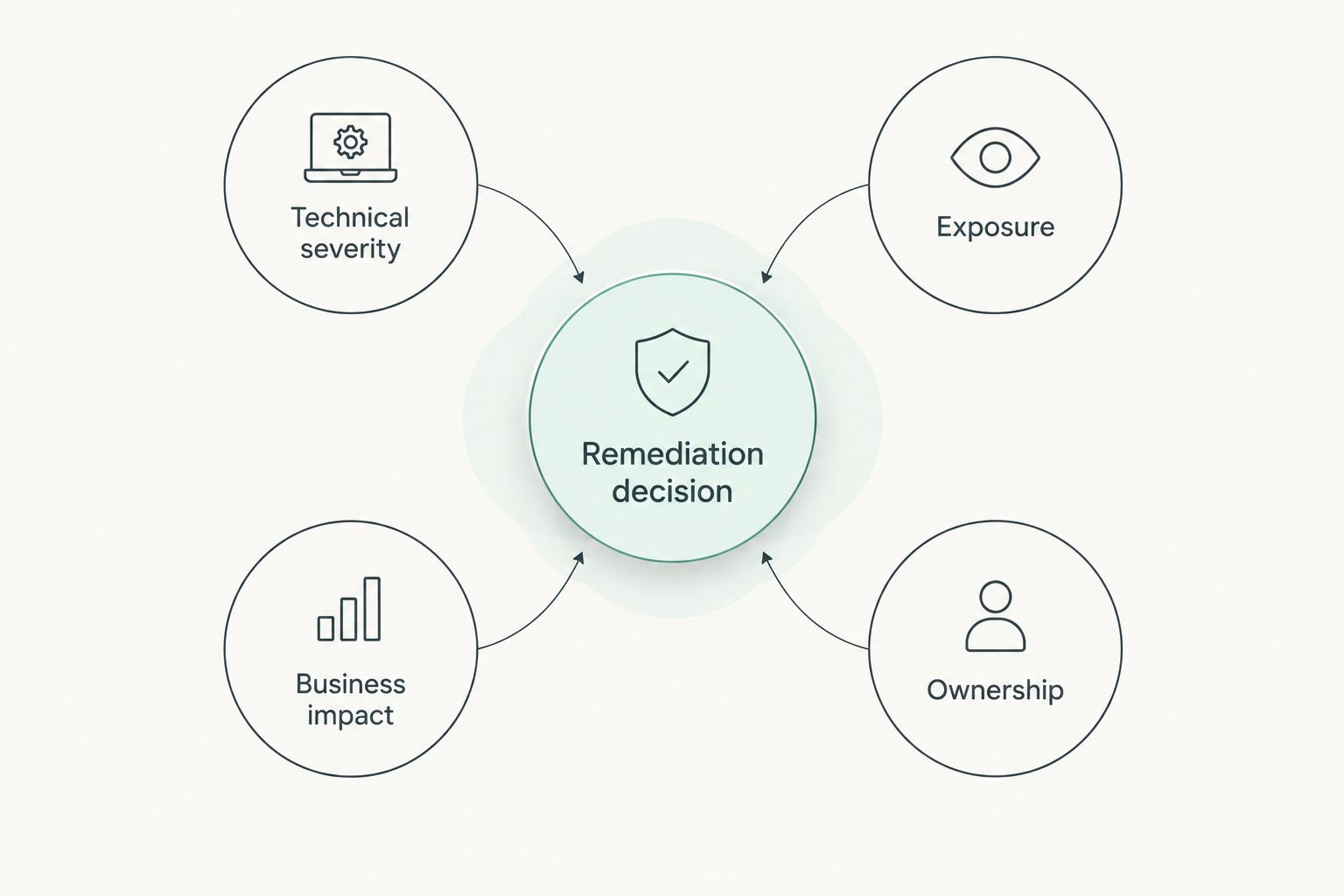
The prioritization record should connect technical severity, exposure, business impact, and ownership to a remediation decision. These inputs belong together; none is a substitute for the others.
5. Assign remediation deadlines and maintenance responsibility
Create tickets manually before automating assignment. Each ticket needs an affected asset, an owner with authority to act, the proposed fix, a target date, and a verification method. A task sent to a generic property mailbox is not an accountable assignment.
As an illustrative internal policy, review urgent findings within 24 hours, review unresolved ownership within 7 days, and review open exceptions every 30 days. These are suggested review intervals, not regulatory deadlines or promises that every vulnerability can be fixed within those periods. Set remediation targets separately according to exposure, consequence, and operational constraints.
Coordinate changes with the service owner. Property systems require an agreed maintenance plan, while externally managed services require a vendor commitment and escalation path.
- Assign a named technical owner and business approver.
- Separate triage deadlines from remediation deadlines.
- Record maintenance windows and rollback arrangements.
- Request dated vendor commitments for outsourced fixes.
- Escalate overdue work to the accountable business owner.
6. Verify fixes and control exceptions
Use the relevant assessment method to confirm that a weakness is no longer present. A closed ticket, installed update, or vendor email is evidence of activity, not necessarily evidence of resolution. Retain the verification result with the original finding.
When a fix cannot proceed, document an exception rather than repeatedly extending the ticket. Specify the affected service, the reason, the remaining exposure, the approving owner, and the review date. Describe compensating controls in testable terms; a control nobody has checked should not justify reduced urgency.
For your 2026 exception register, make expiry actionable. An expired approval should trigger review and escalation, not disappear into the backlog. Replacement plans for unsupported equipment need an owner and an approved next step.
- Reassess the affected asset after remediation.
- Record the verification date and assessment result.
- Distinguish false positives from accepted risks.
- Require approval and expiry for every exception.
- Reopen findings when verification fails or exposure changes.
7. Report business risk and improve the workflow
Start with a worksheet showing coverage, ownership gaps, overdue work, and verified closures. Separate corporate IT, tenant applications, and property systems so decision-makers can see which team controls the next action. Do not combine them into a single total that hides responsibility.
Report findings by business service and property when those distinctions affect decisions. Track elapsed time using defined start and end events, and separate completed work from unresolved findings. Otherwise, closing easy tickets can make performance look better while consequential exposure remains open.
Evaluate Brinqa vulnerability management against this reporting workflow using your own scenarios. Ask for evidence of the required outputs and operating effort. Platform evaluation should test whether your process becomes easier to maintain without obscuring ownership or verification.
- Show assessed assets alongside the in-scope inventory.
- Separate unassigned, overdue, and exception-approved findings.
- Report verified remediation rather than ticket closure alone.
- Define how elapsed remediation time is calculated.
- Review recurring weaknesses with IT and property operations.
Compare options for your real estate security program
Choose the approach that addresses your current bottleneck. Manual coordination, assessment tooling, and a management platform serve different purposes. Buying a platform does not resolve unclear contracts, missing asset owners, or unapproved access to building systems.
| Option | Best for | Main advantage | Key limitation |
|---|---|---|---|
| Spreadsheet and existing ticketing | Teams establishing scope and ownership | Lets you define and inspect the workflow directly | Requires manual reconciliation and follow-up |
| Vulnerability assessment tools | Teams needing technical findings within approved scope | Identify weaknesses in the systems they assess | Findings still require business context, assignment, and verification |
| Brinqa | Teams seeking a vulnerability and exposure management platform | Provides a platform option for that management category | Category fit does not establish suitability; validate required capabilities with your data |
| Managed assessment service | Teams needing external assessment support | Adds specialist assessment work within an agreed scope | Your organization still needs remediation authority and vendor oversight |
A spreadsheet is a sound starting point when your priority is learning what you own. Assessment tools address detection. A management platform warrants evaluation when your defined workflow needs platform support. External assessment support is useful when expertise is the gap, but it does not transfer business accountability.
Use one acceptance test across candidates: present an approved finding affecting a business service and ask how it becomes an assigned, verified remediation record. Check the evidence at each handoff. Reject demonstrations that end at a dashboard without showing who acts next.
Common mistakes real estate firms make
Treating a property address as an asset owner
A location identifies where a system operates, not who can change it. Record the technical operator, contracting party, and business approver separately. Escalate ownership disputes before an urgent finding forces the issue.
Scanning building equipment like office IT
An assessment profile approved for laptops is not blanket authorization for controllers or building automation. Obtain operator approval, supported methods, and stop conditions. Keep unapproved systems visible as coverage gaps rather than silently excluding them.
Assuming outsourced applications are outside scope
Hosting responsibility and business risk are different. Keep the service in your register, request relevant evidence, and track vendor actions. Do not claim direct remediation control when the provider owns the underlying system.
Equating vulnerability management with transaction-fraud prevention
Patching addresses technical weaknesses; it does not verify a payment instruction. Keep payment verification and identity controls in their own workflows. Coordinate them with vulnerability management without claiming that one replaces the others.
Closing findings when maintenance finishes
Completed maintenance does not establish that the weakness disappeared. Require verification, and document failures or residual exposure. For property systems, confirm normal service operation as well as the security result.
FAQ
What's the first step in vulnerability management for real estate companies?
Define the systems and services you are responsible for, then assign accountable owners. Separate corporate IT, transaction applications, tenant services, and building systems according to your actual operating responsibilities.
Do real estate firms need to include smart building systems?
Include smart building systems when your organization operates them or holds responsibility for their security. Agree assessment methods with the responsible operator before active scanning, and track outsourced equipment through vendor evidence and commitments.
Is a vulnerability scanner enough for a real estate company?
A vulnerability scanner is not a complete vulnerability management process. You still need business context, authorized remediation owners, maintenance coordination, exception handling, and verification that fixes worked.
Is Brinqa suitable for real estate vulnerability management?
Brinqa is a vulnerability and exposure management platform to evaluate against your real estate workflow. Test required capabilities with representative data, including property ownership, vendor responsibility, and remediation evidence, before selecting a platform.
How should a real estate firm prioritize vulnerabilities?
Prioritize findings using technical severity, exposure, relevant exploitation evidence, business impact, and existing controls. Document the rationale so application owners and property operators can challenge inaccurate assumptions without losing accountability.
How often should real estate firms scan for vulnerabilities?
Set assessment frequency according to system exposure, change activity, and approved operating constraints. Reassess after relevant changes and remediation, and agree supported methods and maintenance conditions for building systems.
Does patching prevent real estate payment fraud?
Patching does not replace payment verification or identity controls. Vulnerability management addresses technical weaknesses, while payment-fraud prevention also requires a separate process for validating instructions and handling suspicious requests.
What evidence proves a vulnerability was fixed?
A relevant reassessment showing the weakness is no longer present provides verification evidence. Keep that result with the original finding, and distinguish verified remediation from a closed ticket or a completed maintenance task.
One last thing
Before adding another tool, test one finding from discovery to verified closure. Choose a weakness affecting a service you operate and follow every handoff. If nobody can identify the authorized owner, approve the change, or verify the result, fix that workflow first. A clearer handoff is more useful than another unassigned report.