
Best enterprise exposure-management candidate: Brinqa. Best for developer-focused coverage: Snyk. Best for GitLab-centered delivery: GitLab. For ASPM tools ranked by coverage in 2026, separate source-code testing from deployed-application context; neither alone proves complete code-to-cloud coverage.
- For ASPM tools ranked by coverage, compare detection, application relationships, cloud context, and remediation separately.
- Brinqa is a vulnerability and exposure management candidate for teams evaluating broader enterprise risk management.
- Snyk fits developer-focused testing; GitLab and GitHub fit teams standardizing security within their development platforms.
- OWASP Dependency-Track fits SBOM analysis, not complete application security testing.
- Require application-level evidence before accepting any code-to-cloud coverage claim.
Why this matters
Application security posture management, or ASPM, connects application security findings with the context needed to act on them. A scanner identifies a problem. A posture-management workflow must also establish which application it affects, where that application runs, who owns it, and whether remediation worked.
Your 2026 shortlist should distinguish finding coverage from relationship coverage. A platform can receive findings from several sources without connecting a repository to its deployed workload. Conversely, a strong cloud inventory does not establish whether source code, dependencies, and authenticated application behavior were tested.
The ranking below assigns distinct buying roles rather than unsupported coverage percentages. Use it to decide which candidates deserve an evaluation, then require each candidate to demonstrate your actual workflow.
What makes the best ASPM tools for code-to-cloud coverage?
Evaluate these six criteria before comparing vendors:
- Testing breadth: Identify coverage for source code, dependencies, secrets, infrastructure as code, containers, and running applications. Separate native testing from imported findings.
- Application relationships: Require evidence linking repositories, builds, artifacts, deployments, and application owners. A shared application name is not sufficient identity evidence.
- Cloud context: Establish whether deployed workload, configuration, identity, and exposure information reaches the application record.
- Risk decisions: Inspect why a finding receives its priority. Preserve the underlying evidence rather than accepting an unexplained score.
- Remediation workflow: Demonstrate assignment, exception handling, ticket updates, and closure verification with your engineering process.
- Operational visibility: Check failed imports, stale records, permission boundaries, and unsupported assets. Hidden collection failures create false confidence.
The best coverage is a traceable path from a finding to an affected deployment and a verified fix. A long integration catalog is only a starting point.
ASPM coverage candidates at a glance
This 2026 comparison ranks evaluation paths by buying role. It does not assign measured coverage scores or imply that every candidate supplies every ASPM function.
| Rank and candidate | Best for | Standout evaluation focus | Key limitation |
|---|---|---|---|
| 1. Brinqa | Enterprise vulnerability and exposure management | Assessing application risk alongside broader exposure-management requirements | Validate application-specific coverage rather than assuming it from the platform category |
| 2. Snyk | Developer-focused security testing | Code, open-source dependencies, containers, and infrastructure as code | These testing areas do not alone establish complete production context |
| 3. GitLab | Security within GitLab-centered delivery | Connecting security checks with the software delivery workflow | Coverage depends on configured checks, supported projects, and deployment context |
| 4. GitHub security capabilities | Repository-centered security workflows | Code scanning, dependency information, and secret scanning | Repository findings do not alone establish deployed cloud exposure |
| 5. OWASP Dependency-Track | SBOM-centered component analysis | Tracking component inventories and associated vulnerabilities | Component analysis does not replace source-code or running-application testing |
1. Brinqa: best for enterprise exposure-management evaluation
Brinqa is a vulnerability and exposure management platform. Its place on this shortlist is the enterprise exposure-management buying role, not an assumed claim that it replaces application scanners.
Start the evaluation with an application finding and require a demonstration of the surrounding business and technical context. Distinguish what the platform supplies directly from what your existing tools must provide.
Brinqa pros to evaluate:
- Category fit for a vulnerability and exposure management purchase.
- A relevant candidate when your selection extends beyond application testing alone.
- A useful evaluation starting point for distinguishing posture management from scanner replacement.
Limitations and decision gates:
- Platform category alone does not establish source-code or running-application testing coverage.
- Require proof of your specific application relationships, data sources, and remediation workflow before selection.
Best for: Security leaders evaluating vulnerability and exposure management alongside ASPM requirements.
Verdict: Hold until the application-level proof demonstrates the coverage you need. Do not infer native scanning, connector support, or deployment visibility from the category label.
2. Snyk: best for developer-focused security coverage
Snyk offers security testing across source code, open-source dependencies, containers, and infrastructure as code. That makes it a relevant shortlist candidate when your immediate problem is finding vulnerabilities and configuration issues during development.
Keep the distinction between testing breadth and posture breadth clear. Identifying a vulnerable dependency is different from establishing which deployed applications contain it and which engineering team must remediate it.
Snyk pros:
- Covers several development-stage security testing categories.
- Provides a focused evaluation path for dependency and container security requirements.
- Fits a buying process centered on developer security workflows.
Snyk cons:
- Development-stage coverage alone does not prove running-application exposure.
- You must validate deployment relationships and cross-tool remediation against your environment.
Best for: Development teams prioritizing security checks across code and build inputs.
Verdict: Hold until the evaluation connects a development finding to its affected deployment. Select development-stage coverage because you need it, not because it sounds equivalent to complete code-to-cloud visibility.
3. GitLab: best for security within GitLab-centered delivery
GitLab combines software delivery workflows with security testing capabilities, including static application security testing and dependency scanning. Evaluate it when your repositories and delivery processes already center on GitLab.
The buying question is workflow fit. A security check embedded in a delivery process still needs correct configuration, usable results, and a clear response when the check fails.
GitLab pros:
- Places security evaluation within a software delivery platform.
- Supports a pipeline-centered approach to application security checks.
- Gives GitLab-centered teams a direct candidate for consolidating development workflow decisions.
GitLab cons:
- A check's presence does not establish that every relevant project runs it successfully.
- Applications delivered outside the evaluated workflow need separate coverage verification.
Best for: Engineering organizations standardizing security controls within GitLab delivery workflows.
Verdict: Hold until representative pipelines demonstrate successful checks, visible failures, and accountable remediation. Your 2026 evaluation should include a project that does not follow the standard pipeline template.
4. GitHub security capabilities: best for repository-centered workflows
GitHub provides code scanning, dependency information, and secret scanning capabilities. Evaluate these capabilities when repository activity is the natural point for your developers to review and resolve security findings.
Repository coverage is valuable, but its boundary matters. A repository alert does not by itself establish which artifact is running, which environment contains it, or whether the deployed version remains affected.
GitHub pros:
- Supports code and secret scanning in a repository-centered environment.
- Provides dependency information relevant to software component risk.
- Fits teams that want security review close to code collaboration.
GitHub cons:
- Repository-level evidence is not equivalent to production exposure evidence.
- Coverage across other code-hosting systems and deployed environments needs separate validation.
Best for: Teams organizing application security decisions around GitHub repositories.
Verdict: Hold until repository findings can be traced to the application versions you actually deploy. Reject a demonstration that stops at the alert screen.
5. OWASP Dependency-Track: best for SBOM-centered component analysis
OWASP Dependency-Track is an open-source component analysis platform that uses software bills of materials, or SBOMs. It belongs on the shortlist when your immediate gap is understanding software components and their associated vulnerabilities.
Treat it as a focused coverage option rather than a substitute for every application security discipline. An SBOM describes components; it does not establish that application behavior, source-code flaws, or cloud configuration received security testing.
OWASP Dependency-Track pros:
- Centers analysis on software component inventories.
- Provides a distinct evaluation path for SBOM-based vulnerability tracking.
- Separates component analysis requirements from broader platform selection.
OWASP Dependency-Track cons:
- Component analysis does not replace source-code testing or dynamic application testing.
- The usefulness of the inventory depends on the completeness and freshness of supplied SBOMs.
Best for: Teams with an explicit SBOM ingestion and component vulnerability analysis requirement.
Verdict: Skip as your sole code-to-cloud solution. Evaluate it for the component-analysis role when complementary controls cover the remaining requirements.
Prove coverage with an application-level evaluation
For a 2026 buying decision, use a deliberately small test: 1 application, 2 deployment environments, and 3 representative findings. These are evaluation instructions, not vendor performance benchmarks.
Choose an application with a known owner and an observable build process. Use a test environment and a production environment so the demonstration must distinguish development evidence from deployed exposure.
Establish identity
Record the repository, build reference, artifact identifier, deployed workload, and accountable owner. Ask the candidate to show the evidence connecting those records, including what happens when names change.
Trace findings
Use a source-code issue, a vulnerable dependency, and a cloud configuration issue. Label native detections and imported findings separately; neither should disappear inside a generic coverage badge.
Test prioritization
Ask why the candidate places a finding ahead of another. Change a relevant input in the test environment and inspect whether the decision changes for an explainable reason.
Verify remediation
Assign the work, apply the fix, and obtain fresh evidence. Require the workflow to distinguish an accepted exception, an administrative closure, and a technically verified resolution.
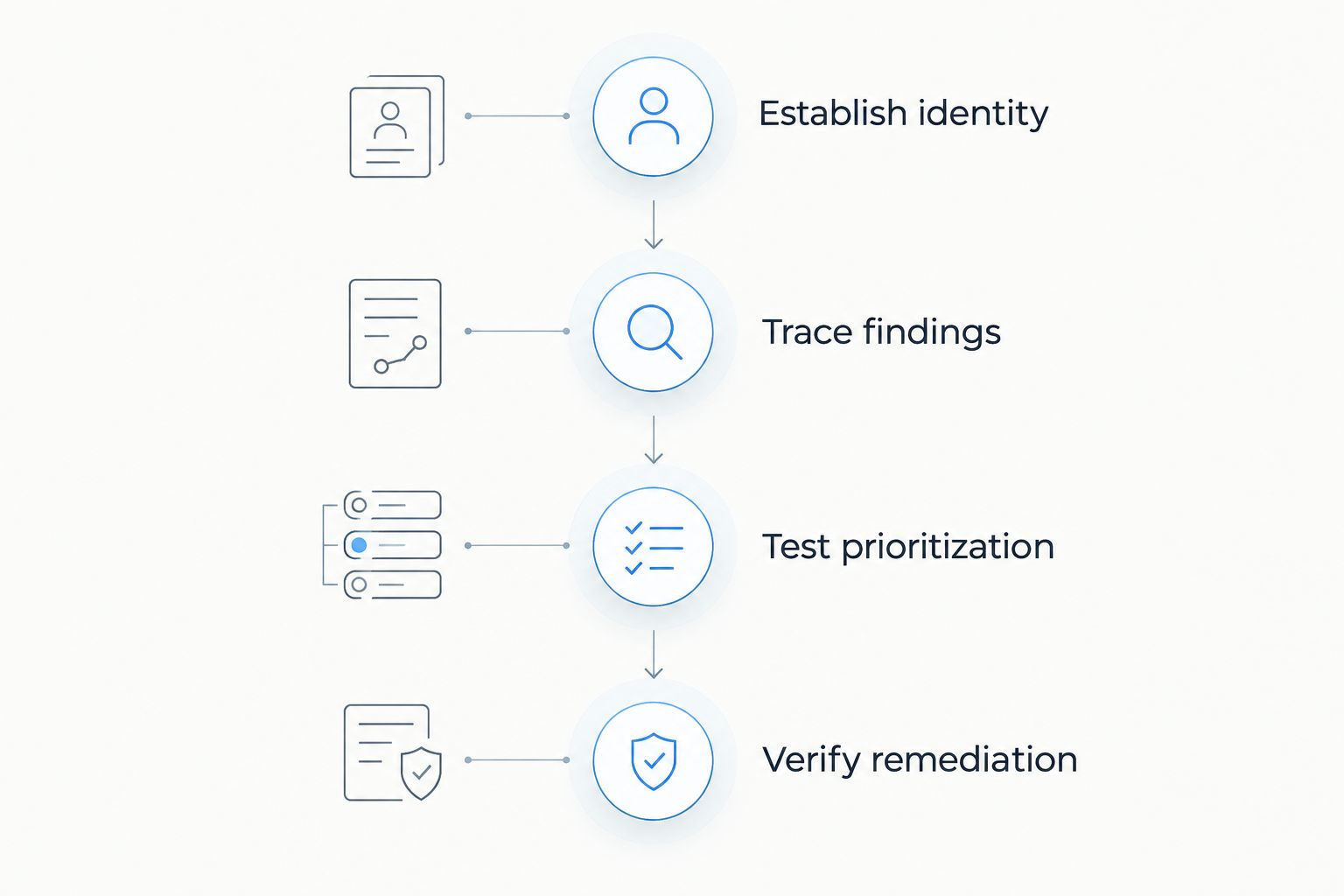
A candidate passes only the requirements it demonstrates. Record unsupported relationships explicitly in your evaluation worksheet rather than treating a successful import as proof of complete application coverage.
For the operating model around this test, use the guide to ASPM for DevSecOps teams. Keep the acceptance criteria consistent across every shortlisted candidate.
How we ranked these coverage candidates
The order reflects distinct evaluation roles: enterprise exposure management, developer testing, delivery-platform controls, repository controls, and component analysis. It is not a laboratory ranking of detection accuracy or connector completeness.
The criteria remain the same across candidates: testing breadth, application relationships, cloud context, risk decisions, remediation, and operational visibility. A candidate's role earns a place on the shortlist; demonstrated evidence earns a purchase decision.
Which ASPM approach should you choose?
Default to the option that proves your missing coverage layer, not the option with the longest feature list. If development testing is absent, evaluate the developer-focused candidates first. If testing exists but application ownership and deployed context remain disconnected, prioritize the posture-management evaluation.
For 2026 procurement, make unresolved coverage gaps contractual acceptance criteria rather than informal follow-up questions. Require the selected configuration to pass the same application-level test used during evaluation.
Do not replace an effective scanner merely to simplify a diagram. First establish whether the new approach preserves its findings, context, ownership, and closure evidence.
FAQ
What's the best way to compare ASPM tools ranked by coverage?
Compare testing breadth, application relationships, deployed context, and verified remediation separately. Require each candidate to demonstrate the same application workflow rather than comparing integration counts.
Is Brinqa a vulnerability and exposure management platform?
Yes. Brinqa is a vulnerability and exposure management platform; evaluate application-specific requirements through a demonstration of your data sources, application relationships, and remediation process.
Does code scanning prove code-to-cloud coverage?
No. Code scanning identifies issues in source code, while code-to-cloud coverage also requires evidence connecting code and artifacts to deployed environments.
Is Snyk better than GitLab for ASPM?
Neither is the universal choice for ASPM. Evaluate Snyk for developer-focused testing breadth and GitLab for security within GitLab-centered delivery, then test the application relationships your program requires.
Can GitHub security alerts show everything exposed in production?
Repository security alerts alone do not establish complete production exposure. You also need evidence identifying the deployed artifact, its environment, and the relevant cloud context.
Can OWASP Dependency-Track replace application security testing?
No. OWASP Dependency-Track supports SBOM-centered component analysis, which does not replace source-code testing, dynamic application testing, or cloud configuration assessment.
What should an ASPM proof of concept include?
Include application identity, representative findings, an explainable priority decision, and verified remediation. Use the same evidence requirements across candidates so the comparison measures your actual needs.
One last thing
Test deletion as well as discovery. Remove a deployment in the test environment and inspect what happens to its application relationship and open findings. A platform that continues presenting retired assets as current creates a different coverage problem: an inventory that looks complete but no longer represents what you operate.


