Implement the five CTEM stages—scoping, discovery, prioritization, validation, and mobilization—as a repeating cycle tied to a defined business service. Set an owner and an evidence requirement for every stage, then use verified remediation results to update the next cycle rather than treating ticket closure as proof that exposure is gone.
- The five CTEM stages connect business scope, exposure discovery, risk prioritization, validation, and mobilization.
- Start with a bounded business service; expand after you can verify remediation across the full cycle.
- Brinqa is a platform to evaluate for vulnerability and exposure management, not a substitute for accountable owners.
- Measure verified exposure reduction, not just findings collected or tickets closed.
How do you implement the five stages of CTEM?
Implement continuous threat exposure management by defining what each stage receives, what decision it makes, and what evidence it hands to the next owner. For the operating model behind this sequence, see continuous threat exposure management for security operations teams.
| CTEM stage | Decision you make | Required output | Exit condition |
|---|---|---|---|
| Scoping | Which business services and attack surfaces matter? | Scope statement and ownership map | Business and technical owners agree on boundaries |
| Discovery | What assets and exposures exist within scope? | Reconciled asset and exposure inventory | Coverage gaps and uncertain records are documented |
| Prioritization | Which exposures deserve action first? | Ranked, explainable work queue | Each priority has supporting business and technical context |
| Validation | Does the suspected exposure hold up under examination? | Evidence of exploitability and control effectiveness | Evidence supports action, further investigation, or reassessment |
| Mobilization | Who will change what, and how will closure be verified? | Assigned remediation or mitigation plan | Verification confirms the intended exposure reduction |
These are operating stages, not separate purchasing categories. You need accountable handoffs between them even when the same team performs several stages.
Why this matters
A vulnerability list tells you what a detection source reported. A CTEM program must also answer whether the affected service matters, whether an attacker has a viable route, and whether your organization can carry out the response.
For your 2026 implementation, make those decisions explicit before expanding coverage. A complete, bounded cycle is a better starting point than an enterprise-wide inventory with no route to remediation. Keep exclusions visible so a small initial scope never becomes a claim of complete protection.
Stage 1: Scoping—choose the business outcome
Start with a service whose business purpose and technical ownership you can explain. Define the outcome you want to protect, such as keeping a customer-facing application available or preventing unauthorized access to sensitive records. Those are example scope choices, not required categories.
Write a short scope statement containing:
- Business outcome: What must remain available, confidential, or trustworthy.
- Technical boundaries: Applications, infrastructure, identities, and dependencies included in the exercise.
- Accountable owners: Who approves scope, supplies context, and authorizes changes.
- Explicit exclusions: Assets or dependencies outside the current assessment.
- Completion evidence: What will demonstrate that the cycle produced an actionable result.
Separate accountability from participation. A security analyst can coordinate the work without having authority to approve a production change or accept residual business risk.
For a 2026 scope charter, name the people responsible for reviewing changes to these boundaries. Revisit scope when you discover a dependency that changes the original risk decision.
Exit criterion: The business owner and technical owner can describe the same boundary and identify who will act on findings. Do not proceed with an unresolved ownership gap disguised as an inventory task.
Stage 2: Discovery—build a usable exposure inventory
Collect information about the assets, identities, configurations, and weaknesses inside your agreed scope. Use existing security and operational data sources where appropriate, but record what each source actually observes. An installed agent, a reachable service, and an application dependency are different forms of evidence.
Reconcile records before counting exposures. Changing addresses, inconsistent names, and duplicate observations require investigation; they are not proof that you have discovered separate assets.
Build each exposure record around these fields:
- A stable asset reference and its source identifiers.
- The affected service and responsible team.
- The observed weakness and supporting evidence.
- Relevant reachability, privilege, and dependency context.
- Observation time and known coverage limitations.
Keep absence of evidence separate from evidence of absence. An asset missing from a scan does not establish that the asset is secure or retired. Check whether collection failed, access was unavailable, or the asset moved outside the source's visibility.
Your 2026 baseline should preserve these uncertainties rather than hiding them behind a total asset count. Assign investigation work for unresolved records and distinguish confirmed coverage from assumed coverage.
Exit criterion: You can trace a finding to an identifiable asset, its business scope, its owner, and the evidence that produced it. Remaining blind spots have named follow-up owners.
Stage 3: Prioritization—rank action, not severity alone
Prioritize exposures using technical severity alongside business impact, reachability, exploitation evidence, and relevant controls. A severity score describes part of the problem; it does not establish the importance of the affected service or prove an attacker can reach the weakness.
Write decision rules your remediation teams can inspect. For each urgent item, explain what makes action urgent and which evidence would change that judgment.
Use a compact decision record:
- Affected outcome: The business service or information at risk.
- Attack conditions: Access, privileges, or dependencies needed to exploit the exposure.
- Threat evidence: Relevant evidence of exploitation or attacker activity.
- Control context: Safeguards that affect the suspected route.
- Action rationale: Why this work takes precedence over other work.
Do not treat missing context as a low-risk signal. Mark uncertainty and assign the investigation needed to resolve it. Likewise, avoid assigning every uncertain finding the highest urgency without distinguishing investigation from remediation.
For your 2026 prioritization policy, document who can override the queue and what justification an override requires. Preserve that justification so later reviews can distinguish a deliberate decision from an unexplained change.
Exit criterion: The receiving team understands both the requested action and the reason it matters. A ranked list without an explanation is not a completed handoff.
Stage 4: Validation—test the assumptions behind priority
Validation examines whether the suspected exposure and attack conditions hold up. Match the method to the question: configuration inspection, reachability checks, control testing, or an authorized security assessment can provide different kinds of evidence.
Validation is not permission to exploit production systems without authorization. Agree on scope, safety limits, approvals, and stopping conditions before intrusive testing. Record limitations when a direct test is unsafe or unavailable.
Ask focused questions:
- Does the weakness exist on the identified asset?
- Can the relevant attacker reach the exposed component?
- Do required privileges or other prerequisites exist?
- Does the stated preventive control block the relevant action?
- Does detection identify the activity without being mistaken for prevention?
Preserve the method, observation time, result, and limitations. A blocked test supports a conclusion about the tested conditions; it does not establish that every route is blocked.
Return contradictory evidence to prioritization. If validation disproves an assumption, change the priority and explain why. If it reveals another dependency, update discovery and reconsider scope where necessary.
Exit criterion: The response decision rests on documented evidence, with unresolved questions clearly separated from confirmed findings. Keep urgent response work moving when the evidence already justifies action; do not turn validation into an administrative delay.
Stage 5: Mobilization—turn the decision into verified change
Mobilization makes the response executable across security, engineering, IT operations, and business ownership. Assign the change to a team with authority to perform it, not merely to the team that detected the issue.
Use the following sequence for each response:
- Assign ownership. Identify the change owner, approving authority, and security contact.
- Approve change. Choose remediation, mitigation, or documented risk acceptance, with the relevant rationale.
- Execute safely. Record dependencies, operational constraints, and rollback requirements before making the change.
- Verify closure. Recheck the original condition and confirm the affected asset was actually assessed.
- Refresh scope. Feed newly discovered dependencies, failed assumptions, and recurring causes into the next cycle.
A mitigation should identify the route it addresses and the evidence that demonstrates its effect. Risk acceptance should identify the accountable decision-maker, the residual exposure, and a review trigger; it is not the same as remediation.
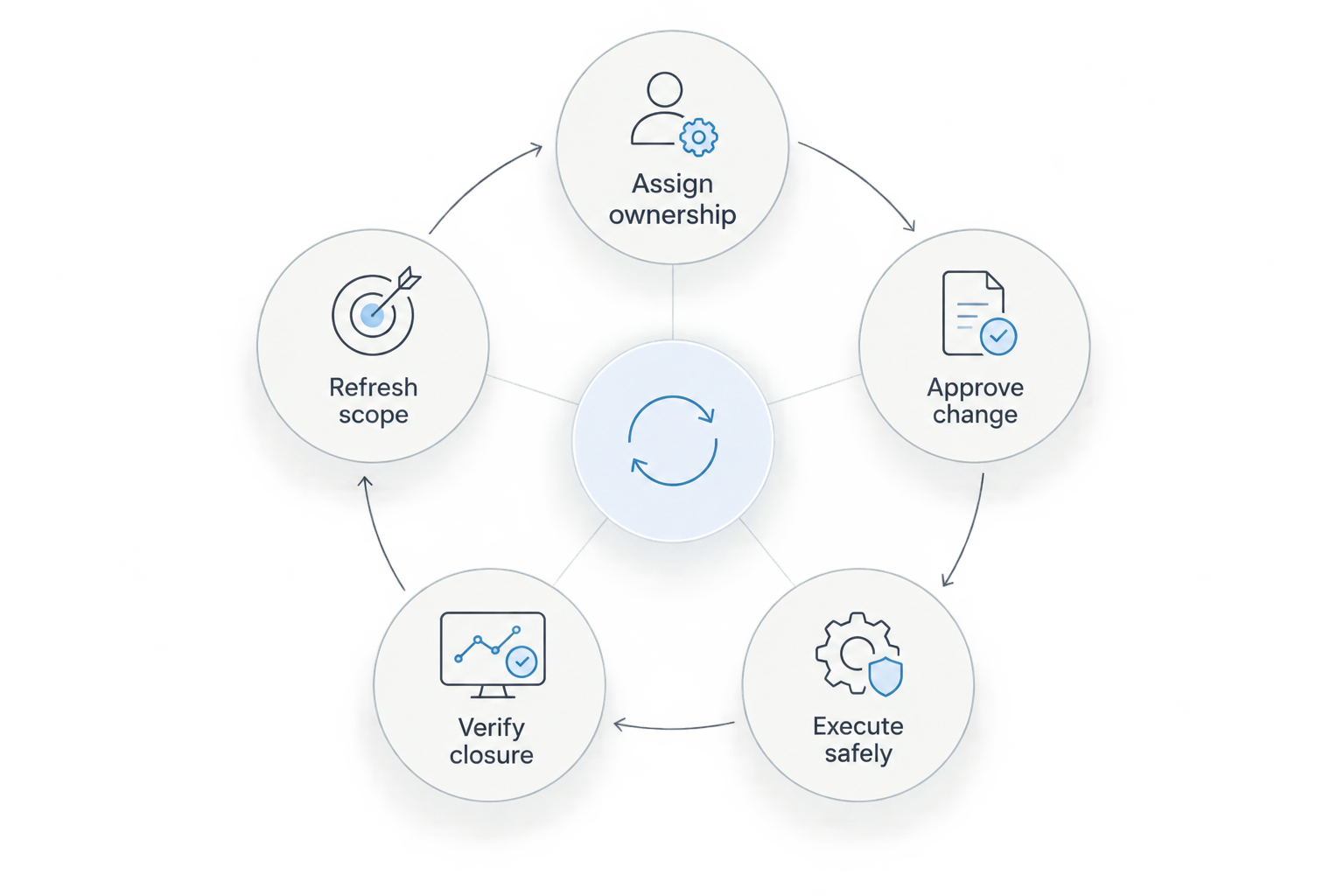
A resolved ticket records workflow status. It does not prove that a vulnerable component was replaced, an exposed service became unreachable, or a control behaved as intended. Require technical verification before reporting the exposure as resolved.
Exit criterion: You have evidence of the change's effect, or an explicit residual-risk decision with accountable ownership. Failed verification reopens the work rather than disappearing into a completed-ticket count.
Why CTEM implementation varies
Keep the five stages consistent while adapting the work to your environment. Your implementation choices should follow the conditions you can document:
- Scope boundaries: A service with shared dependencies requires coordination beyond its immediate application team.
- Evidence coverage: Gaps in asset identification or collection require discovery work before confident decisions.
- Ownership structure: Split authority over infrastructure, applications, and business risk changes the approval path.
- Validation safety: Production constraints determine which tests need additional controls or alternative evidence.
- Change dependencies: Release processes, external providers, and operational restrictions shape execution.
- Residual-risk authority: Acceptance requires a defined decision-maker and a documented basis for review.
Do not copy another organization's timetable as your success criterion. Define progress through completed evidence handoffs, then measure the time those handoffs actually take in your environment.
Where does a vulnerability and exposure management platform fit?
Brinqa is a fit for security teams evaluating a vulnerability and exposure management platform. Evaluate the platform against your operating requirements rather than treating a purchase as completion of the CTEM program.
Ask Brinqa to demonstrate your required workflow using representative data and explicit acceptance criteria. Check how your team would preserve source evidence, resolve ownership, explain a priority, and verify the outcome; treat these as evaluation questions, not assumed capabilities.
The benefit of a platform-led approach is a defined place to manage the work. The limitation is organizational: software does not grant change authority, approve intrusive testing, or accept business risk. Your Brinqa evaluation should therefore include the teams responsible for those decisions.
How do you measure whether CTEM is working?
Measure whether the cycle changes exposure, not just whether it produces activity. Useful measures include validated exposures remaining open, elapsed time between accepted priority and verified resolution, reopened findings, and unresolved ownership assignments.
Define the population and measurement window for every measure. A falling backlog is not automatically improvement if assets disappeared from collection or the scope changed without explanation.
For your 2026 reporting baseline, retain scope changes alongside results. Show what was verified, what remains uncertain, and which decisions require business action.
FAQ
What are the five CTEM stages in order?
The five CTEM stages are scoping, discovery, prioritization, validation, and mobilization. Implement them as a repeating cycle, with verified outcomes informing the next scope and assessment.
Which CTEM stage should my security team start with?
Start with scoping so your security team knows which business outcome, assets, dependencies, and owners the program covers. Existing discovery data can support that decision, but data collection does not replace agreement on scope.
Is CTEM the same as vulnerability scanning?
CTEM is broader than vulnerability scanning because it connects exposure identification to business priorities, validation, and coordinated action. Scanning supplies evidence for the program rather than completing the program by itself.
What is the difference between prioritization and validation in CTEM?
Prioritization decides which exposures deserve attention first; validation examines whether the underlying technical assumptions hold up. Validation results can raise, lower, or otherwise change the response priority.
Do I need to exploit every finding to validate CTEM exposures?
You do not need to exploit every finding to validate CTEM exposures. Choose evidence appropriate to the question and use authorization, safety limits, and documented limitations for any intrusive testing.
When is a CTEM remediation task actually complete?
A CTEM remediation task is complete when verification confirms the intended change and exposure reduction. Ticket closure alone is insufficient, and accepted residual risk must remain distinguishable from a remediated exposure.
Can I implement CTEM before buying a new platform?
You can implement CTEM by defining scope, evidence requirements, decision rules, and accountable handoffs before buying a new platform. Use the resulting workflow to identify which platform capabilities your team actually requires.
One last thing
Choose closure evidence before assigning remediation. If the receiving team cannot tell what proof will satisfy security, the task is not ready for a clean handoff. Recording that requirement upfront gives both teams the same definition of done—and gives the next CTEM cycle evidence it can use.