
Build a vulnerability prioritization matrix by mapping exploit likelihood against business impact, then assigning each intersection a remediation priority. Add explicit escalation rules, evidence requirements, and accountable owners so the matrix produces decisions—not just colored cells.
- Build your vulnerability prioritization matrix around exploit likelihood and business impact, not severity alone.
- Use CVSS for technical severity, EPSS for exploitation probability, and asset context for business consequences.
- Give every priority a remediation owner, an approved response target, and a verification requirement.
- Brinqa is a vulnerability and exposure management platform; evaluate it against your documented prioritization requirements.
How do you build a vulnerability prioritization matrix?
Start with 2 axes, 3 levels per axis, and 9 decision cells. These are suggested design choices, not an industry-mandated scoring system. Keep the underlying evidence visible so analysts can explain why a finding lands in a particular cell.
- Define business impact. Classify the consequences of compromising the affected asset or service.
- Assess exploit likelihood. Use exploitation evidence, technical prerequisites, and reachable attack paths.
- Map the intersection. Assign an initial priority using the table below.
- Apply escalation rules. Separate urgent response conditions from routine scheduling.
- Assign and verify. Route the finding, document the decision, and confirm the remediation worked.
If you need a numeric model behind the matrix, use the guide to building a custom vulnerability severity scoring model. Keep the displayed priority separate from the source severity score.
A starter vulnerability prioritization matrix
Use this table as a proposed policy template for your 2026 program. The labels express relative urgency; your organization must approve the response deadlines attached to them.
| Exploit likelihood | High business impact | Moderate business impact | Limited business impact |
|---|---|---|---|
| High | Emergency assessment | Expedited remediation | Prioritized remediation |
| Moderate | Expedited remediation | Prioritized remediation | Scheduled remediation |
| Low | Prioritized remediation | Scheduled remediation | Scheduled remediation |
Do not treat a low-likelihood classification as proof of safety. Preserve the evidence supporting that classification, and reassess it when exposure or threat information changes.
Why this matters
Technical severity and remediation urgency answer different questions. A severe vulnerability on an isolated system and an exploitable weakness on a business-critical service need context before you can defend their order in the queue.
A matrix makes those judgments explicit. Its benefit is consistency; its limitation is compression, because a small set of cells cannot show every dependency or uncertainty. Preserve the original finding, the decision rationale, and the evidence alongside the priority.
For a 2026 policy, make the matrix a decision aid rather than a substitute for incident response. Evidence of compromise requires investigation even when the affected finding previously occupied a lower-priority cell.
Define business impact before assigning urgency
Classify what the affected service does and what a successful exploit would permit. Do not infer business importance solely from a hostname, operating system, or scanner severity label.
Use these impact definitions as a starting point:
- High impact: Compromise threatens a critical business service, sensitive information, privileged access, or safety-relevant operations.
- Moderate impact: Compromise disrupts a business function, but validated boundaries limit the consequences.
- Limited impact: The affected function has limited business consequences, supported by current service and dependency evidence.
Assign a business owner to approve the classification. Security teams can assess technical consequences, but service owners must validate operational dependencies and acceptable disruption.
Record uncertainty separately from impact. An asset with no owner is unclassified, not automatically low impact. Route missing classifications for review rather than allowing incomplete records to enter the least urgent queue.
Assess exploit likelihood without confusing the signals
Technical severity, predicted exploitation, observed exploitation, and local reachability are different inputs. Preserve those distinctions when you write the rules.
For your 2026 implementation, FIRST's Common Vulnerability Scoring System provides technical severity on a 0–10 scale. FIRST's Exploit Prediction Scoring System estimates the probability that a published vulnerability will be exploited in the wild within the next 30 days; it does not predict whether your organization will suffer a breach.
| Input | Best for | Strength | Limitation |
|---|---|---|---|
| CVSS | Describing technical severity | Standardized vulnerability characteristics | A base score does not describe your complete business context |
| EPSS | Adding predicted exploitation probability | A forward-looking exploitation signal | It is not proof of exploitation or local reachability |
| CISA Known Exploited Vulnerabilities catalog | Identifying documented exploitation | Evidence that exploitation has occurred | Absence from the catalog does not establish safety |
| Local exposure evidence | Assessing whether an attack path exists | Reflects the affected environment | Conclusions depend on coverage and evidence freshness |
| Business service context | Assessing consequences | Connects technical findings to operational impact | Ownership and dependency records need maintenance |
Avoid counting the same fact repeatedly. If internet exposure already determines your likelihood category, adding a separate exposure multiplier can overemphasize that input without a documented reason.
Write observable likelihood definitions
Define high, moderate, and low likelihood using evidence an analyst can inspect. Specify how your policy treats documented exploitation, applicable exploit prerequisites, externally reachable services, and validated access restrictions.
Do not assign a universal EPSS cutoff without testing its effect on your queue. Document the threshold you adopt, why it suits your response capacity, and which escalation rules take precedence over it.
Turn the matrix into a repeatable workflow
A priority label is incomplete until someone owns the next action. Use the following workflow to connect classification with remediation and verification.
Collect evidence
Retain the finding identifier, affected asset, detection source, observation time, technical severity, and available exploitation evidence. Include the relevant service and owner records, with timestamps for context that can become stale.
Classify context
Determine business impact and exploit likelihood independently. Record missing fields explicitly, and distinguish a confirmed restriction from an assumption about isolation.
Assign priority
Apply the matrix, then evaluate escalation rules. Store the rule version and a short explanation so another analyst can reproduce the decision.
Route work
Assign the finding to the team that can change the affected system. Include the required outcome, approved response target, validation method, and escalation contact—not just the scanner description.
Verify closure
Confirm that the vulnerable condition no longer exists or that an approved mitigation addresses the relevant attack path. A completed ticket alone is not verification evidence.
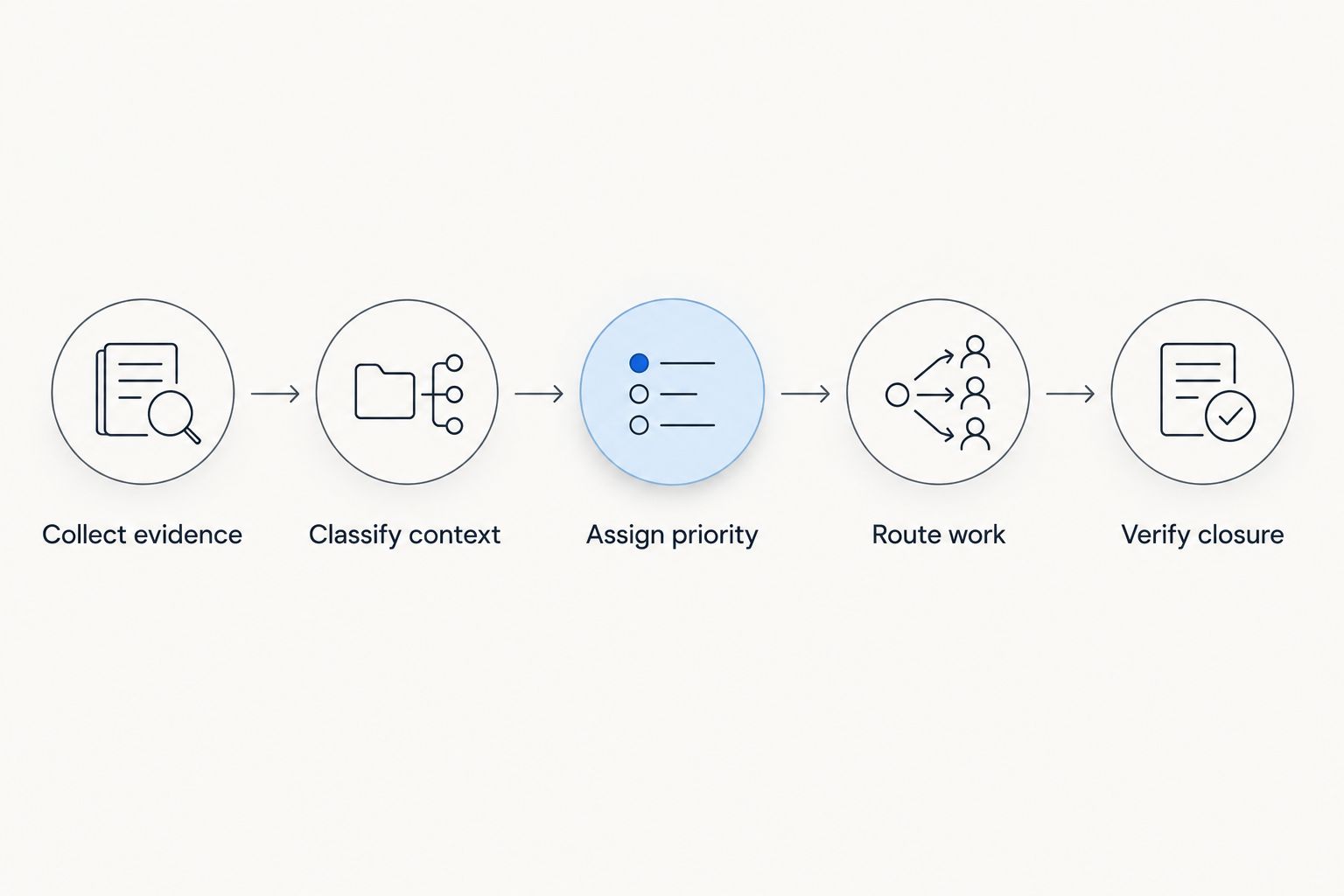
The workflow also needs a reopening rule. If a mitigation fails, an asset becomes reachable, or the vulnerable condition reappears, reassess the finding instead of preserving its previous closure status.
Define each response class
Give every response class a distinct operational meaning. The following definitions are a suggested policy design, not prescribed remediation deadlines.
Emergency assessment
Best for: Findings that meet your urgent-response criteria, including applicable exploitation evidence combined with serious business consequences. Trigger immediate assessment, determine whether incident response is necessary, and identify containment options while remediation is prepared.
Expedited remediation
Best for: Findings that need work ahead of the routine maintenance queue. Assign an owner and an accelerated, approved target; escalate blockers instead of silently extending the deadline.
Prioritized remediation
Best for: Findings that require deliberate scheduling based on documented risk. Keep the rationale visible, and promote the finding when threat or exposure evidence changes.
Scheduled remediation
Best for: Findings suitable for planned maintenance under your approved policy. Scheduling is not risk acceptance, and the classification does not remove the requirement to track and verify the fix.
Each class has a trade-off. Faster response interrupts planned work; slower response leaves the condition unresolved longer. Your policy should make that decision visible rather than hiding it behind a color.
Why vulnerability priorities vary
The same vulnerability can require different actions across assets because its exploitation conditions and consequences differ. Reassess priority when any of these factors changes:
- Exploitation evidence: Documented exploitation changes the threat assessment; suspected compromise also requires investigation.
- Attack-path reachability: Public access, authenticated access, and validated isolation create different exploitation conditions.
- Business consequences: Service criticality, sensitive data, privileges, and dependencies affect impact.
- Verified controls: A tested restriction can alter exposure; an untested control should not justify a downgrade.
- Evidence quality: Stale inventory, uncertain ownership, and conflicting detections require investigation rather than automatic reassurance.
Keep remediation difficulty outside the risk classification. A difficult patch still needs a truthful priority; handle the deployment constraint through mitigation, escalation, or an approved exception.
Test the matrix before adopting it
Replay representative findings through the proposed rules before approving your 2026 matrix. Include a reachable critical service, a restricted internal service, an asset with unknown ownership, and a finding with documented exploitation.
Ask security and operations reviewers to classify the same cases independently. Disagreement exposes ambiguous definitions: clarify whether the dispute concerns evidence, likelihood, impact, or response authority.
Use acceptance checks rather than invented accuracy claims:
- Every decision can be traced to source evidence.
- Unknown context does not automatically reduce urgency.
- Urgent-response rules take precedence over routine scheduling.
- Every remediation class has an owner and an approved response target.
- Exceptions have approval, an expiry condition, and reassessment requirements.
Approve the rules only after reviewers can explain their outcomes. Matching colors is not enough if reviewers reach those colors for incompatible reasons.
Where does a platform fit?
Brinqa is for teams evaluating a vulnerability and exposure management platform. Use your matrix as the evaluation checklist: ask vendors to demonstrate your classifications, evidence handling, routing requirements, exceptions, and verification process against representative findings.
The benefit of evaluating Brinqa is category fit: vulnerability and exposure management is its stated focus. Category fit alone does not establish support for your particular rules, integrations, or operating requirements; validate those requirements before selecting a platform.
Should CVSS determine remediation priority?
CVSS uses a 0–10 scale for technical severity, not a complete remediation decision. Combine severity with exploitation evidence, local exposure, and business impact instead of converting every score directly into a deadline.
Does EPSS show whether my organization will be breached?
EPSS estimates exploitation in the wild over the next 30 days, not your organization's breach probability. Use it as a likelihood input alongside local context, not as a replacement for asset or service analysis.
When should I reassess a finding?
Reassess a finding when exploitation evidence, reachability, business impact, or control effectiveness changes. Also define a scheduled review cadence in your 2026 policy so unchanged records do not remain trusted indefinitely.
FAQ
What's the simplest vulnerability prioritization matrix to start with?
Start with exploit likelihood and business impact, each divided into high, moderate, and low levels. This suggested design creates 9 decision cells; define the evidence and response action for each intersection.
Is CVSS enough to prioritize vulnerabilities?
CVSS alone is not a complete remediation priority. Its 0–10 severity scale needs exploitation evidence, local exposure, and business consequences to support an environment-specific decision.
Should every known exploited vulnerability receive the same priority?
Assess known exploited vulnerabilities promptly, then apply your urgent-response rules using applicability, exposure, and business impact. Document the reasoning instead of assuming every affected asset presents identical consequences.
What should I do when asset criticality is unknown?
Treat unknown asset criticality as a classification gap, not evidence of low impact. Assign an owner to establish the service context and use your documented interim handling rule.
Can a compensating control lower vulnerability priority?
A compensating control can justify reassessment when evidence shows it changes the relevant attack path or consequences. Record the validation, scope, owner, and conditions that require another review.
How do I choose remediation deadlines for each matrix cell?
Approve remediation deadlines through your security and operations governance process. Account for response capacity, business requirements, and applicable obligations; keep deployment difficulty separate from the underlying risk classification.
Can I use this matrix to evaluate Brinqa?
Use your matrix as a requirements checklist when evaluating Brinqa as a vulnerability and exposure management platform. Request demonstrations of your actual decision rules and operational requirements rather than assuming category membership proves feature fit.
One last thing
Test the downgrade rules as carefully as the escalation rules. An urgent finding is visible; an unjustified downgrade can disappear into scheduled work. Require evidence for every reduction in priority, and preserve who approved it and what would reverse the decision.


