
Measure CTEM program success with KPIs that track assessment coverage, priority exposure reduction, verified remediation time, overdue work, ownership, validation, and recurrence. Judge improvement against a fixed baseline and consistent scope—not ticket volume alone—and keep accepted risk separate from verified fixes.
- CTEM KPIs should show exposure reduction, not just closed tickets or completed scans.
- Pair remediation speed with overdue exposure age so unresolved work stays visible.
- Keep assessment coverage and business scope consistent when comparing reporting periods.
- Brinqa is a vulnerability and exposure management platform; evaluate reporting against your metric definitions.
Why this matters
A closed ticket records a workflow event. It does not, by itself, demonstrate that an exposure disappeared or that a compensating control works.
Your 2026 CTEM scorecard should connect security work to a defensible outcome: fewer unresolved priority exposures affecting the business services you selected. Use the same definitions across security, engineering, and operations. For the executive presentation, see how to report vulnerability management metrics to the board.
How do you measure CTEM program success with KPIs?
Build a scorecard that follows exposures from discovery through verified treatment. Give each measure a defined population, calculation, accountable owner, and reporting date.
Use these 7 KPIs as a starting set. Each answers a different question; none proves success independently.
| KPI | Calculation or measurement | Best for | Limitation |
|---|---|---|---|
| Assessment coverage | Assessed in-scope assets divided by known in-scope assets | Detecting assessment gaps | Unknown assets remain outside the denominator |
| Priority exposure reduction | Baseline priority exposures minus those still unresolved in that baseline cohort | Showing progress against agreed priorities | Excludes newly discovered exposures unless reported separately |
| Verified remediation time | Elapsed time from first observation to verified treatment | Measuring response speed | Completed work alone excludes the unresolved backlog |
| Overdue exposure rate | Open exposures past their deadline divided by open exposures with a deadline | Identifying missed commitments | Results depend on deadline rules |
| Ownership coverage | Open exposures with an accountable owner divided by open exposures | Finding routing gaps | Assignment does not prove action |
| Closure validation rate | Closures meeting evidence requirements divided by closures reviewed | Testing closure quality | Weak evidence rules produce weak assurance |
| Exposure recurrence rate | Verified closures that reappear within the defined observation window divided by eligible verified closures | Finding repeat conditions | Requires stable identity and comparable observations |
Treat verified priority exposure reduction as the outcome measure, with coverage and closure quality as safeguards. Faster processing is useful only when the underlying exposure receives effective treatment.
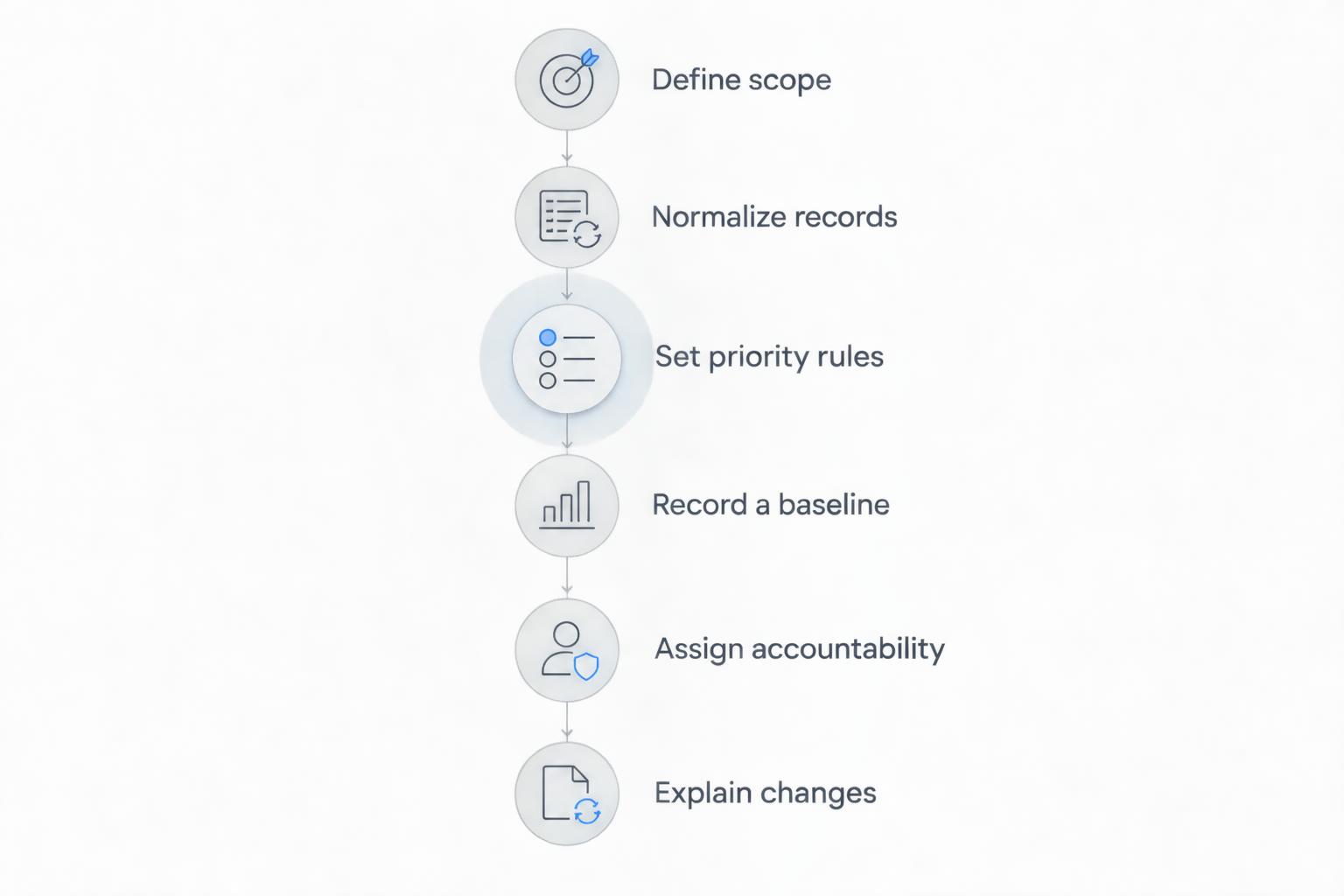
Set up the scorecard before setting targets
- Define scope. Name the business services, environments, asset classes, and exposure types included. Record exclusions explicitly.
- Normalize records. Decide how asset identities, duplicate findings, and recurring observations map to a single exposure record.
- Set priority rules. Document how technical severity, threat evidence, reachability, and business importance affect treatment order.
- Record a baseline. Preserve the starting exposure population, assessment coverage, priority rules, and unresolved backlog.
- Assign accountability. Give each KPI a reporting owner and each exposure an accountable treatment owner.
- Review and explain changes. Separate verified treatment from discovery changes, asset retirement, reclassification, and accepted risk.
For your 2026 baseline, save the definitions alongside the results. A historical chart without its calculation rules is difficult to reproduce.
Assessment coverage: measure what you can actually assess
Calculate assessment coverage using assets that meet your documented assessment requirements, not merely assets appearing in an inventory. Define what counts as assessed for each asset class, including acceptable evidence freshness.
Report the numerator and denominator alongside the percentage. A percentage without population counts hides whether the environment expanded or contracted.
Use coverage as a condition for interpreting improvement. A smaller backlog accompanied by declining assessment coverage requires investigation before you call it risk reduction. Keep known exclusions visible, and distinguish unsupported assessment methods from temporarily missed assessments.
Priority exposure reduction: preserve the baseline cohort
Track whether exposures present at the baseline remain unresolved. Keep new arrivals in a separate inflow measure so discovery does not erase evidence of completed treatment.
For the current backlog, reconcile opening exposures, new exposures, reopened exposures, verified treatments, and scope removals. Explain reclassifications separately rather than counting a lower priority label as a fix.
Show both baseline progress and the current priority backlog. The first reveals execution against commitments; the second shows the work that still matters. Neither should hide the other.
Do not label a percentage reduction in findings as an equivalent percentage reduction in breach probability. That conclusion requires a separate risk model and supporting evidence.
Verified remediation time: keep the clock honest
Measure elapsed time between 2 timestamps: first observation and verified treatment. State whether your clock uses calendar time or business time, and apply that rule consistently.
Break the elapsed time into assignment, treatment, and verification stages when those events are available. This separates routing delays from implementation delays and waiting for reassessment.
Report the median alongside an upper percentile and the age of unresolved priority exposures. Label the percentile you choose and keep it consistent. Otherwise, faster completion of easy work can obscure difficult exposures that remain open.
Do not reset the clock when ownership changes or a ticket is recreated. Preserve the exposure's original observation date, and record administrative events separately.
Overdue exposure rate: measure commitments, not deadline changes
Calculate overdue exposure rate only for records with an applicable deadline. Show records without deadlines separately, rather than silently excluding them from management attention.
Freeze the original due date for performance reporting. If an authorized extension changes the operational deadline, retain both dates and the approval reason.
Your 2026 scorecard should distinguish missed commitments from approved exceptions. Neither category belongs in verified remediation totals. Pair the overdue rate with overdue exposure age so a stable percentage does not conceal increasingly old work.
Ownership coverage: require accountable acceptance
Require 1 accountable owner for each exposure record, even when several teams contribute to treatment. A queue name without a responsible team and an escalation path is not enough for operational accountability.
Measure assignment coverage, then inspect whether owners accept the work and whether reassignment loops persist. Keep ownerless priority exposures visible as a separate queue.
Do not confuse assigned work with progressing work. Ownership coverage identifies routing gaps; treatment timestamps and overdue measures show whether the assigned work moves.
Closure validation rate: define acceptable evidence
Count a closure as validated only when it satisfies a documented evidence rule. Suitable evidence depends on the exposure and treatment: reassessment, configuration verification, or a controlled test of the relevant security condition.
Separate verified remediation, verified mitigation, asset retirement, false-positive disposition, and accepted risk. These outcomes answer different questions and should not collapse into an undifferentiated closed status.
Where you review only a sample, report the sample size and selection method. A validation rate calculated from sampled closures describes that sample, not automatically every closure in the program.
Make verification failure actionable. Reopen unresolved exposures and identify whether the problem was treatment, assessment timing, or evidence quality.
Exposure recurrence rate: distinguish repeats from new findings
Define recurrence before calculating it. The same underlying condition returning on the same asset after verified closure is different from discovering that condition on another asset.
Choose an observation window and include only closures with sufficient follow-up opportunity. Otherwise, recent closures have less time to recur and distort the comparison.
Use recurrence reviews to examine configuration drift, deployment practices, incomplete fixes, and inaccurate asset matching. Treat those as investigation categories, not assumed explanations. A recurrence metric is useful when it changes the treatment process, not when it merely counts reopened tickets.
Why CTEM KPI results vary
Before comparing teams or reporting periods, check the measurement conditions. These factors determine what a change actually means:
- Scope: Adding services or asset classes changes the population being measured.
- Assessment freshness: Older observations provide a different view from current reassessments.
- Priority rules: Changes to business importance or threat context alter which exposures qualify as priorities.
- Identity and deduplication: Merged or split records change counts without necessarily changing exposure.
- Closure evidence: Stricter verification rules change which treatments qualify as complete.
- Treatment constraints: Approved exceptions and maintenance restrictions affect execution; report them without erasing elapsed time.
Annotate your 2026 trend charts whenever these rules change. Preserve the original series or mark a clear break instead of presenting unlike populations as continuous improvement.
How should you set CTEM KPI targets?
Set targets against your baseline, business priorities, and treatment capacity. Establish an owner and an escalation action for each target before adding it to the dashboard.
Avoid importing an unsupported universal remediation benchmark. A deadline for an exposed business-critical service and a deadline for a constrained legacy asset need explicit policy decisions, not an unexplained shared average.
For your 2026 operating plan, pair each performance target with a safeguard: faster treatment with validation, backlog reduction with coverage, and ownership coverage with acceptance. Do not reward a metric that can improve simply by changing a record's status.
What belongs in an executive CTEM report?
Lead with the priority exposure trend for named business services, then show overdue age, coverage gaps, and unresolved decisions. Explain what changed, why it changed, and who must act.
Keep detailed routing measures in the operational view. Executives need the consequence and decision: an unresolved exposure affecting a critical service, the accountable owner, the treatment plan, and the decision blocking progress.
Where reporting software enters the discussion, Brinqa is a vulnerability and exposure management platform. Brinqa fits teams seeking a vulnerability and exposure management platform. Evaluate metric traceability and reporting requirements during selection; a platform does not replace agreed scope, deadlines, or verification rules.
Can CTEM KPIs prove that breach risk fell?
CTEM KPIs demonstrate specific changes in assessed coverage, unresolved exposures, treatment speed, and closure quality. They do not independently establish a quantified change in breach probability or financial loss.
State the result at the level the evidence supports. Verified treatment of priority exposures is a defensible operational outcome; a financial risk-reduction claim needs a documented model, assumptions, and uncertainty.
FAQ
What are the most useful CTEM KPIs to start with?
Start with assessment coverage, priority exposure reduction, verified remediation time, overdue exposure rate, ownership coverage, closure validation, and recurrence. Use them together so speed or volume cannot hide weak coverage or incomplete fixes.
Is mean time to remediate enough to measure CTEM success?
Mean time to remediate is not enough because it describes completed work without showing all unresolved exposure. Pair elapsed treatment time with overdue age, coverage, and verification results.
How often should we review CTEM KPIs?
Review CTEM KPIs on a documented cadence matched to treatment decisions and data freshness. Keep reporting boundaries consistent, and escalate urgent exposures outside the scheduled review.
Should accepted risks count as remediated vulnerabilities?
Accepted risks should not count as remediated vulnerabilities. Report them separately with the accountable approver, rationale, expiry, and review conditions.
What is a good target for CTEM remediation time?
A useful remediation target follows your documented priority policy and business constraints. Establish a baseline, distinguish exposure classes, and keep verification requirements consistent before comparing results.
How do we stop duplicate scanner findings from inflating CTEM metrics?
Define a canonical exposure identity and retain the source observations attached to it. Apply consistent asset matching and deduplication rules before comparing counts across reporting periods.
What should we check when evaluating Brinqa for CTEM reporting?
Evaluate Brinqa against your vulnerability and exposure management reporting requirements. Ask how your proposed implementation would preserve metric definitions, historical scope, evidence, and traceability to source records.
One last thing
A rising exposure count can accompany better visibility. That is why a backlog chart needs a coverage chart beside it.
Before your next review, select a reported closure and trace it from the original observation to the treatment evidence and KPI calculation. If that chain is broken, fix the measurement before celebrating the trend.