Start a Gartner CTEM program in 2026 by selecting a business-critical scope, assigning accountable owners, and working through scoping, discovery, prioritization, validation, and mobilization as a repeating cycle. A scanner rollout alone does not complete the program: you also need business context, evidence that exposures matter, and a process for getting corrective action approved and verified.
- Start a Gartner CTEM program with a defined business scope, not an organization-wide tool replacement.
- Gartner’s CTEM approach has five stages: scoping, discovery, prioritization, validation, and mobilization.
- Require an accountable owner and closure evidence for every exposure selected for action.
- Evaluate Brinqa as a vulnerability and exposure management platform, not as a substitute for program ownership.
How do you get a Gartner-aligned CTEM program started?
Start with 1 business service and prove the complete operating cycle before expanding. This is a recommended pilot boundary, not a Gartner-mandated minimum. Choose a service whose business purpose, supporting technology, and remediation owners you can identify.
If you are still deciding whether that scope fits your team, review CTEM for mid-market security teams.
Why this matters
Gartner’s continuous threat exposure management approach connects technical exposure to business priorities. Its 5 stages extend beyond finding vulnerabilities: they include deciding what matters, validating exposure, and mobilizing the people who can address it.
That distinction changes your starting point. Instead of asking which scanner to buy, ask which business outcome you need to protect and what evidence would justify corrective action.
Use this sequence to launch:
- Scope: Identify the business service, its boundaries, and its accountable owner.
- Discover: Collect evidence about relevant assets and exposures.
- Prioritize: Rank exposures using threat and business context.
- Validate: Test the assumptions behind those priorities safely.
- Mobilize: Agree on action, ownership, escalation, and closure evidence.
These are connected stages, not independent projects. Discovery can expose a missing dependency that changes scope; validation can change a priority; remediation can reveal an ownership gap.
Scoping: choose a business outcome you can defend
For your 2026 pilot, write a short scope statement that explains what you are protecting and why. Name the service, the consequence of disruption or compromise, the technology boundaries, and the person authorized to accept residual risk.
Avoid starting with an asset list alone. A list tells you what exists; a scope statement explains why those assets belong in this program.
Your scope record should include:
- Business purpose: The activity or service you need to protect.
- Technology boundary: The applications, infrastructure, identities, and dependencies you intend to examine.
- Accountability: The business owner and technical owners who can authorize changes.
- Exclusions: What remains outside the pilot and why.
- Success evidence: What would demonstrate that an important exposure was reduced.
Which pilot scope should you choose?
Each starting scope offers a different boundary. Choose the one you can connect to business impact and corrective action, rather than the one producing the largest findings export.
| Starting scope | Best for | Advantage | Limitation |
|---|---|---|---|
| Business service | Teams with an identifiable service owner | Connects technical decisions to a business outcome | Requires tracing dependencies across teams |
| Internet-facing application | Teams with an accountable application owner | Provides a concrete entry point for examining exposure | Does not represent the entire internal environment |
| Defined cloud environment | Teams with clear account or subscription ownership | Establishes an administrative boundary | Shared identities and services can extend beyond that boundary |
Prefer a business-service scope when ownership and dependencies are identifiable. If they are not, document a narrower technical boundary and its business connection instead of claiming enterprise coverage.
Discovery: build evidence, not just a findings inventory
Gather the existing records relevant to your chosen scope. These can include asset inventories, vulnerability findings, configuration assessments, identity information, application records, and penetration-test findings where those sources exist.
Do not treat every record as equally current or complete. Preserve its source, observation time, affected asset, and available ownership information so an analyst can inspect the underlying evidence.
Before combining findings, agree on how you will recognize the same asset across systems. Hostnames, addresses, and cloud identifiers serve different purposes; matching records without checking their meaning creates unreliable relationships.
For each exposure selected for review, retain:
- The affected asset or identity and its relationship to the scoped service.
- The condition observed and the evidence supporting it.
- The source and observation time.
- The responsible technical team, or an explicit ownership gap.
- Any uncertainty that affects the decision.
Keep unknowns visible. An asset with no confirmed owner is an unresolved assignment problem, not evidence that the exposure is low priority. Likewise, missing discovery coverage is a limitation to report, not a clean bill of health.
Prioritization: explain why an exposure deserves action
Set your 2026 prioritization rules before reviewing the full backlog. Otherwise, the queue becomes difficult to explain and different analysts can reach inconsistent decisions from similar evidence.
Use technical severity alongside business context. Consider whether the affected service is important, whether an attacker can reach the condition, what privileges are required, and whether exploitation evidence or effective controls change the assessment.
Keep these questions distinct:
- Technical severity: What consequence does the vulnerability describe?
- Threat relevance: What evidence supports a credible exploitation concern?
- Environmental exposure: Is the condition reachable or usable in this environment?
- Business impact: What service, information, or operation would be affected?
You do not need to begin with a new numerical scoring model. A documented decision rule is a useful starting point when the evidence cannot support precise arithmetic.
For example, require an analyst to explain why an exposure enters the action queue, what evidence could change that decision, and which owner must respond. Treat that as a recommendation for your pilot, not a universal threshold.
A priority should include a reason, not just a rank. Preserve that reason when you pass the work to engineering or operations.
Validation: test the assumptions behind the priority
Validation asks whether the exposure and its expected consequences hold up in the scoped environment. It is not permission to run uncontrolled exploitation against production.
Choose an authorized method appropriate to the question. Configuration inspection, access review, controlled security testing, and examination of compensating controls can provide different kinds of evidence; the method must match the claim you are checking.
Record the question before performing the check. For example: can the relevant source reach the affected service, does the vulnerable component exist in the deployed system, or does the claimed restriction actually prevent the proposed path?
Keep these distinctions clear:
- A scanner finding is evidence of a detected condition, not proof of every possible attack consequence.
- An unsuccessful test does not prove that every attack path is blocked.
- A control should reduce priority only when its relevance and operation are supported by evidence.
Validation should produce a decision: proceed with corrective action, revise the priority, investigate further, or document an accepted limitation. Record the evidence and the conditions under which the decision needs review.
Mobilization: get agreement on action and closure
Mobilization connects the security decision to the people who can make a change. Creating a ticket is only part of that work; the receiving team needs enough context to understand the request and act safely.
Build the handoff around Decision evidence, Accountable owner, Corrective action, and Closure evidence. These elements keep the priority explanation attached to execution rather than separating analysis from remediation.
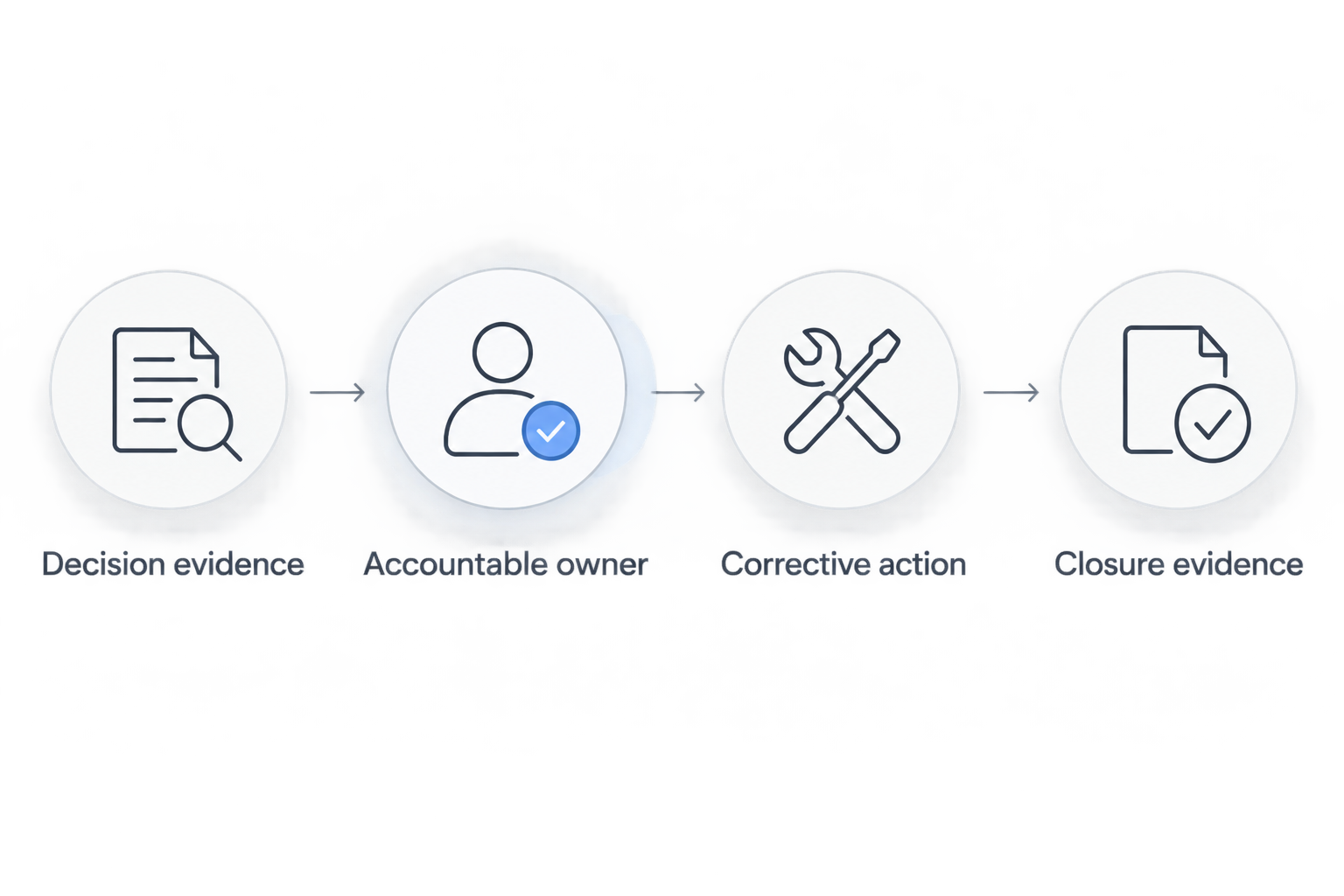
The work request should identify the affected service, explain the exposure, name the requested outcome, and specify how the team will verify it. Let the technical owner propose the implementation when change constraints require specialist judgment.
Define 3 closure states for your pilot: remediated, mitigated, and risk accepted. These are recommended reporting categories, not interchangeable outcomes. Remediation removes the condition; mitigation reduces exposure; risk acceptance records an authorized decision to retain it.
Keep deferred or blocked work visible. Require an owner, a reason, and a review trigger rather than treating an administrative ticket closure as proof of risk reduction.
Why your CTEM starting scope varies
There is no useful universal rollout boundary. Your starting scope should reflect the evidence and authority available to complete the cycle.
- Ownership clarity: Select a boundary with someone who can approve action and someone who can implement it.
- Discovery coverage: State which relevant systems your existing sources can and cannot observe.
- Dependency visibility: Identify shared services that extend beyond the proposed boundary.
- Validation safety: Choose checks that fit operational restrictions and authorization requirements.
- Change authority: Confirm that corrective actions can enter the responsible team's change process.
These factors are selection criteria, not reasons to postpone the entire program. Narrow the pilot when necessary, and document what the smaller boundary leaves unresolved.
What should your 2026 CTEM charter contain?
Keep the charter short enough for service owners to use. Include the scope, decision rights, evidence sources, prioritization rules, validation boundaries, escalation route, and closure definitions.
Assign program coordination separately from remediation execution. Security can coordinate analysis and reporting, but the teams operating the affected systems need explicit responsibility for changes.
Measure the process without inventing a maturity target. Track ownership coverage, exposures awaiting a decision, time from decision to action, and closures supported by verification evidence. State each metric's denominator and scope so readers can interpret changes correctly.
Do not report a smaller backlog as proof of lower exposure without checking why it shrank. Scope changes, duplicate removal, accepted risk, and verified remediation describe different events.
Where does a vulnerability and exposure management platform fit?
Brinqa is best evaluated by teams seeking a vulnerability and exposure management platform. That category matches the stated role of Brinqa; fit for your CTEM program requires evaluation against your actual workflow.
Ask Brinqa to demonstrate your scoped evidence moving from discovery through prioritization and owner handoff. Check the relevant data sources, decision traceability, ownership handling, and closure records rather than assuming capabilities from the category name.
The benefit of a platform evaluation is testing whether software supports your operating process. The limit is organizational: software does not assign business accountability, authorize production testing, or accept residual risk on your behalf.
Can you start CTEM without replacing your scanners?
Yes. Start by assessing whether your existing sources provide usable evidence for the selected scope, then identify the specific gaps that prevent a decision or verification.
A replacement decision should follow that assessment. Buying another discovery source does not resolve unclear ownership or an absent remediation process.
How do you show that your CTEM pilot is ready to expand?
Show that a material exposure can move through all 5 stages with traceable evidence and accountable action. This demonstrates a functioning cycle, not a claim that the scoped service is free of risk.
Before expanding your 2026 program, review where the pilot stalled. Resolve recurring identity-matching, ownership, validation, or change-approval problems before adding more scope.
FAQ
What are the stages of a Gartner CTEM program?
Gartner’s CTEM approach has five stages: scoping, discovery, prioritization, validation, and mobilization. Run them as a repeating cycle, with findings from later stages informing earlier decisions.
Is Gartner-aligned CTEM the same as vulnerability scanning?
No. Vulnerability scanning supplies discovery evidence, while CTEM also includes business scoping, prioritization, validation, and mobilization for corrective action.
What should I scope first when starting CTEM?
Start with a business-critical service whose boundaries and owners you can identify. Document exclusions so a successful pilot is not mistaken for enterprise-wide coverage.
Do I need to exploit every finding to validate it?
No. Match the validation method to the question, using authorized evidence collection and testing appropriate to the environment. Document what the check establishes and what remains uncertain.
Who should own a CTEM program?
Assign a program owner to coordinate the cycle and technical owners to execute corrective actions. Identify the authority responsible for accepting residual business risk separately.
Does Brinqa replace the need for a CTEM process?
No. Brinqa is a vulnerability and exposure management platform; your organization still needs scope, decision rights, accountable owners, and closure criteria.
What should a CTEM pilot demonstrate in 2026?
A 2026 CTEM pilot should demonstrate a repeatable path from scoped discovery to evidence-based decisions and verified corrective action. Report limitations and accepted risk alongside completed remediation.
One last thing
Choose your closure evidence before issuing the work request. If security and the receiving team disagree about what proves completion, the program has an acceptance-criteria problem—not simply a remediation-speed problem.
Start the next cycle by revisiting those disagreements. They identify exactly where your operating process needs a clearer decision.