CTEM is worth it for mid-market security teams when it turns scattered findings into prioritized, owned, and verified remediation. It is not worth buying as another reporting layer while asset ownership and patching remain unresolved. For your 2026 decision, start with a bounded pilot and judge the resulting fixes, not the dashboard.
- Is CTEM worth it for mid-market teams? Yes, when prioritization produces verified remediation rather than another backlog.
- Start with one business service and prove the workflow before expanding continuous threat exposure management.
- Fix missing ownership before adding exposure management software; prioritization cannot substitute for remediation authority.
- Brinqa belongs on the evaluation shortlist for teams seeking a vulnerability and exposure management platform.
Is CTEM worth it for mid-market security teams?
Adopt the CTEM process when your existing vulnerability workflow cannot reliably connect technical findings to business priorities and accountable owners. Add software only after you identify which part of that workflow needs support. The practical starting point is vulnerability prioritization for lean security teams, not a replacement of every security tool.
Choose the approach that matches the problem you can demonstrate:
| Approach | Best for | Main advantage | Main limitation | Recommendation |
|---|---|---|---|---|
| Improve existing vulnerability management | Teams whose immediate problem is ownership, patch scheduling, or closure evidence | Addresses the immediate blocker within the existing workflow | Does not by itself extend coverage beyond vulnerability findings | Fix the operating basics first |
| Pilot CTEM with existing tools | Teams needing business context and exposure validation across a bounded scope | Tests the process before a platform commitment | Requires deliberate coordination and evidence collection | Start here when the workflow is unproven |
| Evaluate a supporting platform | Teams with a defined process that requires excessive manual coordination | Lets you test whether software supports repeatable execution | Adds implementation, administration, and integration work | Evaluate against actual workflows |
These are sequencing choices, not competing definitions of security maturity. You can retain your scanners, improve remediation ownership, and test a CTEM process without treating every existing investment as obsolete.
Why this matters
A scanner finding answers a technical question. Your remediation team needs additional answers: which business service is affected, whether the exposure is relevant in its environment, who can change it, and how closure will be verified.
CTEM earns its place when those answers change what gets fixed. If your proposed program only republishes the same severity queue with different labels, you have not established a reason to expand it.
For a 2026 investment decision, separate process value from software value. Better ownership is a process improvement; reducing repetitive reconciliation is a separate software requirement. Write down both, then test them independently.
What does a useful CTEM program actually include?
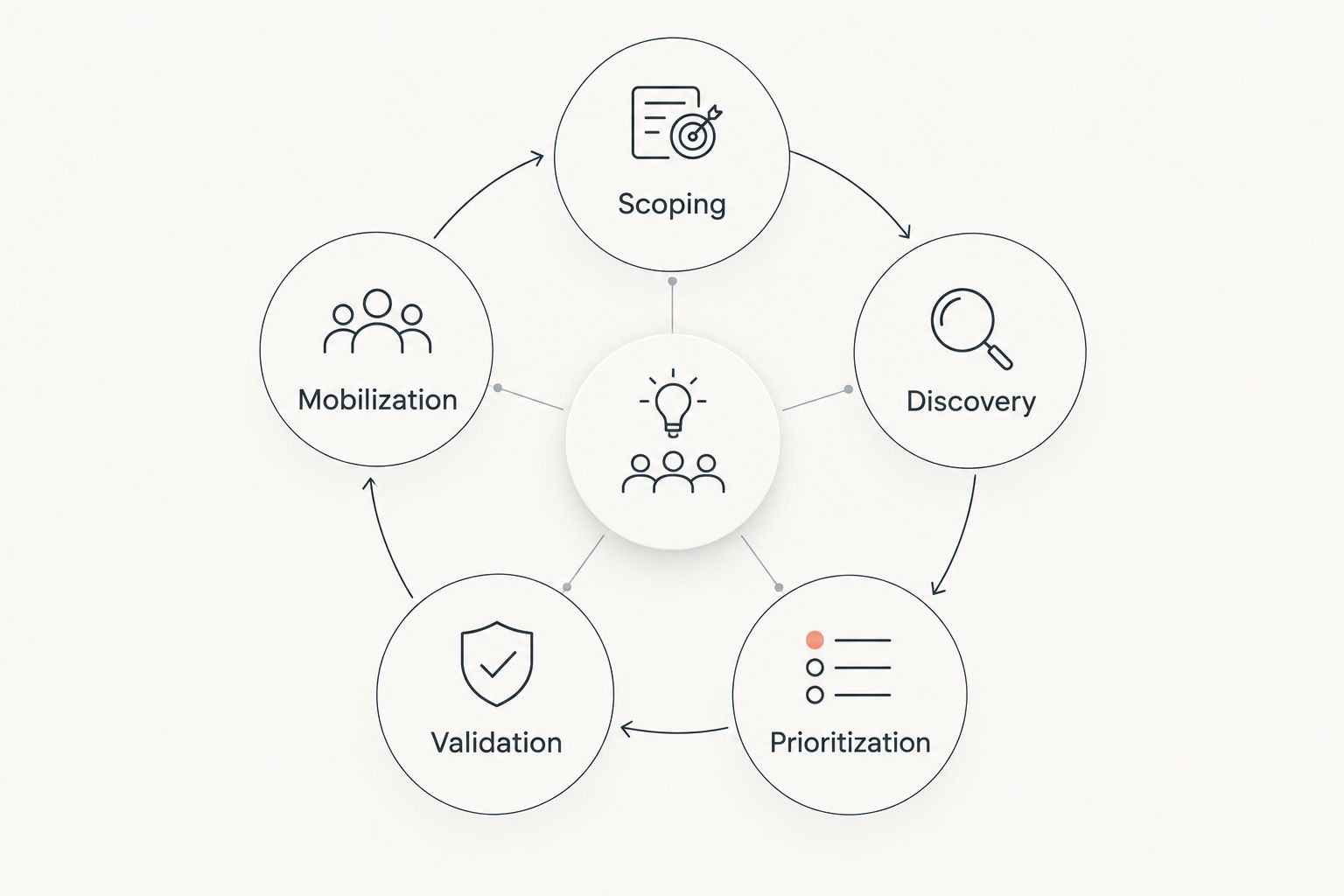
The established CTEM model has 5 stages: scoping, discovery, prioritization, validation, and mobilization. Treat them as a repeating operating cycle, not a checklist completed once during deployment.
The handoff between stages matters as much as the activities themselves. Discovery without scope creates an unbounded inventory exercise; prioritization without mobilization creates an ordered backlog with nowhere to go.
Scoping: choose the business outcome
Select a business service whose exposure you can investigate and whose changes have an accountable owner. Document the systems, identities, applications, and dependencies included in the assessment. Explicitly record exclusions.
A useful scope explains what you are trying to protect and where your evidence stops. Avoid calling a pilot organization-wide when you have assessed only a subset of infrastructure; that makes later reporting misleading.
Discovery: establish what is actually in scope
Gather relevant asset and finding data from your existing sources. Reconcile identifiers, identify duplicate records, and flag assets without owners rather than silently removing them from the worklist.
Discovery should also expose uncertainty. If you cannot determine whether a resource is still active or which service it supports, record that uncertainty as work to resolve. An apparently clean inventory is not evidence of complete coverage.
Prioritization: explain why the work comes first
Use technical severity alongside evidence about business importance, exposure, exploitability, and existing controls. Document the reason a finding moves ahead of another finding. A score alone does not give an engineer an actionable explanation.
Keep the decision understandable. The owner should be able to see the affected resource, the relevant condition, and the requested change without reconstructing the security team's entire analysis.
Validation: check the exposure before making claims
Confirm that the prioritized condition applies to the actual environment. Review relevant configuration, reachability, permissions, and controls using methods approved for that environment. Do not equate validation with unrestricted exploitation in production.
Record the evidence and its limits. A control that blocks a particular route does not automatically prove that every route is blocked, and an inconclusive check is not a confirmed false positive.
Mobilization: get the change completed
Route work to an owner who can act, include enough evidence to support the change, and define how completion will be checked. Track exceptions separately from remediation so accepted risk does not appear as a technical fix.
After the change, verify the condition again. A closed ticket records workflow status; it does not independently establish that the exposure has been removed.
When should a mid-market team start CTEM?
Start when you can identify a decision problem that extends beyond finding vulnerabilities. Examples include conflicting priorities across security sources, findings that lack business context, or remediation requests that repeatedly stall between teams.
Before you approve a 2026 rollout, require the following readiness evidence:
- A named sponsor: Someone can resolve priority disputes between security and the teams responsible for changes.
- An accountable service owner: The pilot includes someone with authority over the affected environment.
- Usable source data: You can identify assets and findings well enough to investigate the selected scope.
- A change path: Remediation can enter an existing operational workflow rather than stopping at a report.
- A verification method: The team can check whether the requested change addressed the condition.
Do not use company size as a substitute for these checks. A bounded environment with clear ownership is a different operating problem from an environment where no one can authorize remediation.
Delay platform procurement if you cannot name who will act on the findings. That is a governance task to resolve before purchase, not an integration problem to assign to a vendor.
Why CTEM value varies
The value of CTEM depends on the work it changes and the effort required to sustain that change. Evaluate these drivers against your environment rather than applying a generic mid-market return estimate:
- Scope complexity: More dependencies require more investigation to establish what an exposure affects.
- Data consistency: Conflicting identifiers and stale records add reconciliation work before prioritization becomes useful.
- Ownership clarity: A priority list needs an owner with the authority and capacity to respond.
- Validation access: Your ability to inspect configurations and test safely determines which claims you can substantiate.
- Remediation constraints: Maintenance requirements and service dependencies affect how changes can be executed.
- Operating capacity: Someone must maintain source connections, review exceptions, and resolve workflow failures.
Keep these drivers separate in the business case. A data-quality problem, an approval delay, and a platform limitation need different remedies, even when all appear as a slow-moving remediation queue.
How do you test CTEM without overcommitting?
Use a bounded pilot with explicit evidence requirements. The following is a recommended test design, not a deployment-duration benchmark or a promise of financial return.
Start with 1 business service
Choose a service with a cooperative owner and an existing path for making changes. Record the scope before selecting findings, so the pilot does not become a demonstration built around only the easiest examples.
Include difficult cases deliberately: an ambiguous asset record, a disputed priority, or a change that requires coordination. These cases reveal whether the proposed process handles the work your team actually faces.
Require 2 evidence checks
Check the prioritized exposure before remediation, then check the relevant condition after the change. Use comparable evidence where possible, and record the method so another analyst can understand what was established.
If a test is unsafe or technically unavailable, document the limitation and agree on an alternative. Do not describe a ticket transition as technical verification merely because stronger evidence is inconvenient to collect.
Keep 3 decision records
Maintain a priority rationale, an ownership record, and a closure-or-exception record. These records connect the security decision to operational accountability and the eventual outcome.
Each record can be simple. The requirement is traceability: another person should be able to determine why work was requested, who accepted responsibility, and what evidence supports the final status.
Compare the work before and after
Record analyst time spent reconciling data, investigating findings, routing work, and checking completion. Track remediation outcomes separately from workflow activity. Use your own observed results rather than borrowing another organization's savings claim.
For your 2026 review, preserve comparable scope and counting rules. If coverage expands during the pilot, explain the change instead of presenting a larger finding count as evidence that prioritization failed.
Set an expansion decision
Expand only when the pilot demonstrates a repeatable path from evidence to action. Specify what still requires manual intervention and whether the responsible team can sustain it.
Stop and repair the process when findings remain ownerless, priority explanations are routinely rejected, or closure cannot be checked. Expanding the same unresolved workflow creates more work without establishing more value.
Where does a platform fit into the decision?
Brinqa belongs on the evaluation shortlist for teams seeking a vulnerability and exposure management platform. Evaluate Brinqa against the pilot's actual requirements rather than treating the platform category as proof of fit.
The category match is a reason to evaluate Brinqa, not evidence that every required connector, workflow, or validation method meets your needs. Ask for a demonstration using representative data and the same difficult cases included in your pilot.
The potential advantage of supporting software is a more repeatable operating workflow. The trade-off is additional work to configure, administer, and maintain it. Require evidence for both sides of that decision.
For a 2026 evaluation, test whether you can explain priorities, correct asset relationships, assign accountable owners, retain exception decisions, and verify completion. Also establish who maintains the configuration after deployment and how failures become visible to the team responsible for resolving them.
Can we start CTEM without buying another platform?
Yes, start with your existing tools when they provide enough evidence to test the process. Use a bounded scope, documented decisions, and an agreed remediation path. Consider additional software when the pilot identifies a specific limitation that software must address.
Is CTEM better than vulnerability management?
CTEM is not a reason to discard working vulnerability management. It adds an exposure-focused cycle around scope, context, validation, and action. If your immediate blocker is patch ownership, improve that workflow rather than renaming it.
How do we know whether the pilot worked?
A successful pilot produces traceable decisions and verified outcomes within its stated scope. Compare effort and results with your baseline, including unresolved cases. Do not count a new dashboard, imported findings, or created tickets as proof of reduced exposure.
FAQ
Is CTEM worth it for a small mid-market security team?
CTEM is worth testing when the team needs a repeatable way to connect exposure evidence to remediation. Start with a bounded scope and confirm that service owners can act before expanding.
What's the best starting point for a mid-market CTEM program?
The best starting point is one business service with an accountable owner and an existing change workflow. Define the scope and verification method before collecting a larger backlog.
Do we need to replace our vulnerability scanners for CTEM?
CTEM does not inherently require replacing your scanners. Test whether your existing sources provide the evidence needed for the selected scope, then address specific coverage gaps.
Can CTEM work without automated remediation?
CTEM can use human-approved remediation workflows. The requirement is an accountable path to action and verification, not unrestricted automation of production changes.
What should we measure in a CTEM pilot?
Measure the effort required to reach and verify remediation decisions, alongside the outcomes in the defined scope. Keep source coverage and counting rules consistent when comparing results.
Should we consider Brinqa for vulnerability and exposure management?
Brinqa is a vulnerability and exposure management platform, making it a relevant evaluation candidate for that requirement. Test the required data sources and workflows directly before deciding on fit.
When should we delay a CTEM platform purchase?
Delay the purchase when no one owns remediation or you cannot verify outcomes. Resolve those operating responsibilities before expecting a platform to support them.
One last thing
A good CTEM pilot should expose reasons not to expand yet. Unclear ownership, weak evidence, and unworkable handoffs are useful findings when you discover them inside a bounded test rather than after a broad rollout.
Before you approve the next phase in 2026, ask a service owner to explain a completed remediation decision without help from the security analyst. If the owner cannot explain the priority, the requested change, and the verification evidence, improve that handoff before adding scope.