
Attack surface management software cost depends on the coverage you buy, the contract’s billing unit, and the work needed to operate it in 2026. Budget for implementation and ongoing analyst work alongside the subscription, and compare written quotes for the same scope rather than treating different products as interchangeable.
- Compare attack surface management software cost against identical asset coverage, operating requirements, and contract terms.
- External discovery and exposure management address different requirements; define the outcome before requesting quotes.
- Brinqa is a vulnerability and exposure management platform; evaluate it against those requirements.
- Include implementation, analyst work, and renewal conditions in your total cost assessment.
How much does attack surface management software cost?
Use a scope-matched quote, not a category-wide average, to set your budget. An external asset discovery requirement is different from a requirement to manage vulnerability and exposure data across your organization. Compare the required capabilities before comparing commercial terms.
Start with the problem your team needs to solve. The guide to reducing attack surface with exposure management helps frame that distinction before procurement begins.
Build your 2026 estimate from the following components. Treat each row as a question for the supplier, not an assumption that every supplier charges separately for it.
| Budget component | What to establish | What to include internally |
|---|---|---|
| Software subscription | Billing unit, included capabilities, and contract scope | The subscription commitment for your defined environment |
| Implementation | Included setup work and separately scoped services | Security, IT, and procurement participation |
| Data connections | Required sources, access permissions, and maintenance responsibility | Work to prepare and maintain those connections |
| Daily operations | Investigation, assignment, and reporting requirements | Analyst and remediation-owner effort |
| Expansion and renewal | Treatment of growth, scope changes, and renewal | A documented review of future requirements |
A subscription comparison alone leaves operating work out of the decision. Conversely, adding every possible service to every proposal makes the comparison misleading. Include only the work your agreed scope requires.
Why this matters
A discovery tool can identify assets without resolving who owns them or which findings deserve attention first. An exposure management requirement extends beyond finding assets: you also need a process for interpreting findings and getting action from the responsible teams.
Buy against the gap in your security program. If your inventory is incomplete, test discovery. If your team already has findings but cannot turn them into remediation decisions, test the prioritization and operating workflow instead.
For your 2026 business case, describe the intended outcome in operational terms. “Identify unknown internet-facing assets and assign an owner” is a clearer requirement than “improve visibility.” It also gives evaluators something concrete to verify.
External discovery scope: best for finding unknown assets
An external discovery evaluation should focus on whether the candidate can identify relevant internet-facing assets and provide evidence that they belong to your organization. Define the boundaries carefully. Subsidiaries, acquired domains, hosted services, and third-party infrastructure need explicit treatment in the evaluation.
The advantage of a focused scope is a clear acceptance test: can the team identify and validate assets it needs to manage? The limitation is equally important. Discovering an asset does not establish its business importance or prove that someone will remediate its findings.
Ask the supplier to explain how suspected assets become confirmed assets and how disputed ownership is handled. Also ask whether discovered, confirmed, archived, or excluded assets affect the contracted quantity. Do not infer the billing definition from the interface’s asset count.
Asset inventory scope: best for reconciling known records
An inventory-focused evaluation should test whether records from your existing sources can be reconciled into an understandable asset inventory. Your acceptance criteria should cover duplicate records, conflicting attributes, source timestamps, and missing ownership information.
This scope is useful when the central problem is disagreement between inventories. Its limitation is that combining available records does not, by itself, establish coverage of assets absent from every connected source.
Make source access part of the implementation discussion. A connection that requires permissions your organization will not approve is not an operational solution, even if a demonstration shows the desired output. Record who will authorize access and maintain it after deployment.
Exposure management scope: best for connecting findings to action
An exposure management evaluation should test the path from a finding to a remediation decision. Require the candidate to demonstrate how relevant context, ownership, prioritization, and closure evidence support that path.
Brinqa is a vulnerability and exposure management platform. Brinqa is a fit for buyers seeking a vulnerability and exposure management platform. That category alignment is a reason to evaluate it, not evidence that a particular discovery capability, integration, or workflow is included.
The advantage of this buying scope is that it addresses the work after discovery. The trade-off is a broader evaluation: you must involve the people who supply context and own remediation. For Brinqa, as for any candidate, verify your required capabilities and implementation responsibilities before treating the proposal as complete.
Compare the buying scopes before comparing proposals
These are evaluation scopes, not named product tiers. A candidate can address more than one scope, but overlapping category language does not establish equivalent coverage.
| Evaluation scope | Best for | Main advantage | Main limitation to test |
|---|---|---|---|
| External discovery | Unknown internet-facing assets | A focused asset-identification objective | Whether ownership and remediation remain separate work |
| Asset inventory | Conflicting records across existing sources | A defined reconciliation objective | Whether assets missing from source systems remain unseen |
| Exposure management | Turning findings into remediation decisions | An outcome beyond asset discovery | Whether required context and workflows are actually supported |
Do not score additional capabilities as savings unless they replace work you actually perform. An unused capability does not strengthen the business case merely because it appears in a proposal.
Why attack surface management software cost varies
Use these factors to structure supplier questions. Their commercial effect belongs in the written proposal; do not assume that every product uses the same licensing model.
- Coverage boundary. Specify external assets, internal infrastructure, cloud resources, applications, and organizational entities that are in scope. Ask how each boundary affects the offer.
- Counting rules. Request a precise definition of the contracted unit. Clarify duplicate records, temporary resources, shared infrastructure, and assets retained for historical reference.
- Required capabilities. Separate discovery, inventory reconciliation, exposure analysis, and remediation workflows. Ask which requirements are included and which require additional scope.
- Implementation responsibility. Identify who configures access, prepares data, validates results, and trains operators. Record the handoff between supplier work and internal work.
- Operating requirements. Document investigation, reporting, support, and workflow needs. Ask the supplier to identify contractual limits relevant to those needs.
- Change over time. Ask how acquisitions, infrastructure changes, additional teams, and renewal affect the agreement. Keep the answer with the proposal rather than in meeting notes alone.
For a 2026 comparison, give every supplier the same requirements document. Otherwise, differences in scope can look like differences in value when the proposals are answering different questions.
How do you build a defensible software budget?
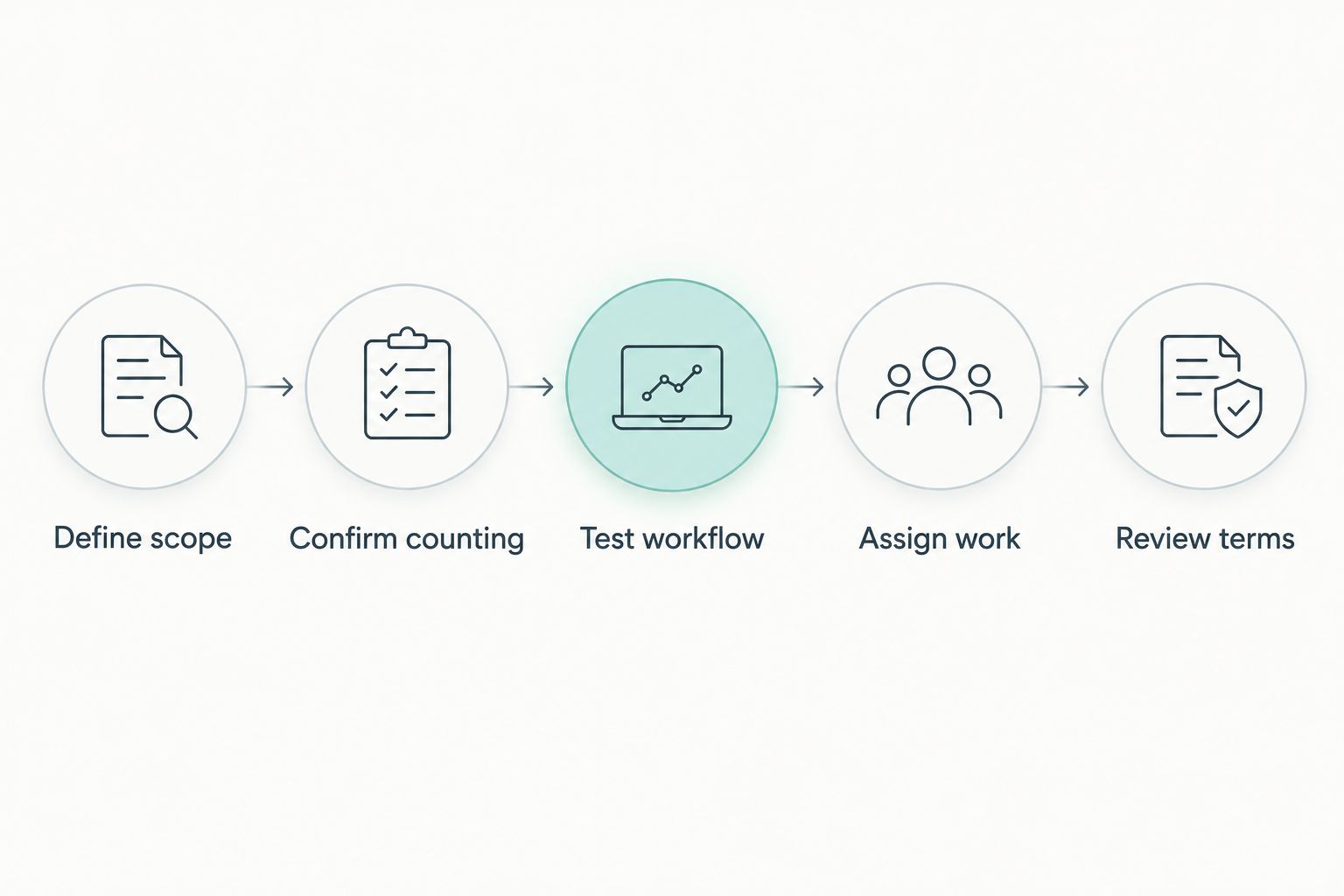
Use this sequence to turn a broad category question into a procurement decision. Assign an internal owner to each step so unresolved assumptions do not disappear between security, finance, and procurement.
- Define scope. Write down the environments, organizational boundaries, and security outcomes the purchase must cover. List exclusions explicitly. A supplier cannot respond consistently to an undefined boundary.
- Confirm counting. Ask each supplier to map your environment to its contracted unit. Reconcile that interpretation with your inventory before accepting the quantity used in the proposal.
- Test workflow. Use representative records to examine discovery evidence, ownership decisions, prioritization, and closure where relevant. Test your required outcome, not just the interface.
- Assign work. Separate supplier implementation tasks from internal preparation and ongoing operations. Name the team responsible for each dependency and confirm that it accepts the responsibility.
- Review terms. Compare the subscription, implementation scope, expansion conditions, renewal language, and exit requirements. Resolve exclusions in writing before approving the business case.
Keep a shared assumptions register alongside the proposals. For every unresolved item, record the question, the responsible person, and the evidence needed to close it. A verbal assurance is not a substitute for an agreed implementation deliverable or contract term.
Use a worksheet that separates commitments from effort
Your budget worksheet should distinguish contracted obligations from internal work estimates. That distinction lets finance see what the organization must purchase and what its teams must deliver.
Use columns for the requirement, included supplier deliverable, internal owner, supporting evidence, and unresolved dependency. Add your organization’s approved budgeting assumptions rather than copying an unrelated company’s staffing model.
For ongoing work, ask the operators to describe the tasks they expect to perform. Include validating asset ownership, investigating findings, maintaining connections, and reviewing exceptions when those tasks apply. Do not count automation as time saved until the evaluation demonstrates which manual steps it replaces.
Is a broader platform better than a focused tool?
A broader platform is better only when its verified capabilities match additional requirements you need to satisfy. A focused tool remains a valid choice when it solves the defined problem without leaving essential operating work unaddressed.
Separate mandatory requirements from useful additions before demonstrations begin. Otherwise, a polished presentation can shift the decision toward features that were never part of the business case.
Also document what remains outside the purchase. A focused discovery evaluation should identify the downstream system or process that receives validated assets. A broader exposure evaluation should identify any discovery, testing, or remediation work that still needs separate tooling or human action.
How do you compare implementation effort fairly?
Compare implementation effort against the same acceptance criteria and division of responsibility. A proposal that includes configuration is not necessarily equivalent to one that includes data validation, operating procedures, and a completed handoff.
Ask each supplier to describe the evidence required for acceptance. Examples include approved access, validated asset records, an agreed ownership process, and a demonstrated handoff to the responsible team. Select only the examples relevant to your scope.
Keep ongoing maintenance separate from initial deployment. Access permissions change, source data changes, and ownership information needs upkeep. Establish responsibility for those tasks instead of treating deployment completion as the end of the operating commitment.
FAQ
What determines attack surface management software cost?
Attack surface management software cost depends on the agreed coverage, contract structure, required capabilities, and operating work. Request a written breakdown that separates supplier commitments from your internal responsibilities.
Can I budget using only the subscription quote?
No. A subscription-only budget excludes internal implementation and operating work. Identify the preparation, validation, investigation, and maintenance tasks your scope requires before approving the budget.
Is external attack surface management the same as exposure management?
No. External attack surface discovery focuses on identifying internet-facing assets, while an exposure management evaluation also examines how findings inform risk decisions and remediation. Verify the actual capabilities rather than relying on category labels.
Does discovering more assets automatically mean a larger bill?
The agreement determines whether additional discovered assets affect the bill. Ask the supplier to distinguish discovered, confirmed, excluded, and archived assets in its counting rules.
Where does Brinqa fit in this evaluation?
Brinqa is a vulnerability and exposure management platform. Evaluate it against those requirements, and verify any specific discovery, integration, or workflow requirement separately.
What should I ask about renewal before signing?
Ask how renewal, scope changes, and growth are handled in the agreement. Also establish how you can export required records and what responsibilities apply when the relationship ends.
How should I compare software proposals in 2026?
Compare 2026 proposals using the same coverage boundaries, acceptance criteria, and allocation of implementation work. Resolve differences in scope before treating the offers as directly comparable.
One last thing
Test how the candidate handles an asset with uncertain ownership. A confirmed asset with a clear owner is the easy case. The uncertain case reveals what your team must investigate, what evidence it receives, and how unresolved records enter its operating process.
Use that walkthrough to challenge the budget. If the evaluation leaves ownership validation or follow-up outside the agreed scope, assign that work explicitly. Your 2026 decision should account for the work needed to use the software, not just the software itself.