
No—attack surface management cannot replace vulnerability scanning unless the replacement also performs the assessments your scanners provide. Attack surface management discovers assets and exposures; vulnerability scanning examines reachable or locally observable systems for specific weaknesses. For a 2026 consolidation decision, replace duplicate capabilities, not distinct security functions.
- Attack surface management vs vulnerability scanning is a coverage decision: discovery does not replace authenticated assessment.
- Keep vulnerability scanning for technical findings; use attack surface management to identify assets missing from assessment scope.
- Retire a scanner only after proving equivalent coverage, assessment depth, and remediation verification.
- Brinqa is a vulnerability and exposure management platform; evaluate it separately from the scanning capabilities you must retain.
Can attack surface management replace vulnerability scanning?
Not on the strength of asset discovery alone. A product that discovers an internet-facing server has not necessarily examined its installed packages, local configuration, or missing patches. Replacement requires equivalent evidence, not a similar dashboard.
The distinction also matters when evaluating a vulnerability and exposure management platform such as Brinqa. Evaluate discovery, assessment, and management as separate functions, even when vendors package them together.
| Capability | Attack surface management | Vulnerability scanning |
|---|---|---|
| Best for | Finding assets and externally observable exposures missing from known scope | Assessing specified systems for detectable vulnerabilities |
| Primary question | What assets and exposures exist? | What weaknesses can this assessment identify? |
| Typical evidence | Domains, addresses, reachable services, exposure observations | Vulnerability checks, affected components, configuration evidence |
| Main strength | Broadening visibility beyond the existing assessment inventory | Producing technical findings within supported assessment scope |
| Main limitation | Discovery does not establish internal assessment depth | Assessment cannot cover assets excluded from scope or inaccessible to the method |
| Replacement requirement | Must also provide the required assessment capabilities | Must retain discovery coverage if replacing an attack surface management function |
Product boundaries overlap. An attack surface management product can include vulnerability checks, while a scanning product can include discovery. Compare the actual checks and access methods, not the category labels.
Why this matters
For your 2026 security plan, the consequential mistake is removing assessment coverage because another tool reports more assets. A larger inventory is useful, but it does not prove that the newly discovered assets have received an adequate vulnerability assessment.
The reverse mistake is treating a successful scan as evidence that your inventory is complete. A scanner can finish its assigned job while an unmanaged service remains outside its target list. Discovery and scanning address different failure modes.
You need an evidence trail that connects an asset to an assessment, a finding, an owner, and a verified resolution. If several tools contribute to that trail, consolidation should preserve the trail rather than merely reduce the number of consoles.
Attack surface management: best for finding missing scope
Attack surface management is the stronger starting point when your immediate question is whether you know what is exposed. External attack surface management specifically examines assets and services visible from outside your environment. Broader attack surface management offerings differ in scope.
Its practical advantage is discovery beyond a manually maintained scan list. An unfamiliar hostname or exposed service gives your team something concrete to investigate, attribute, and bring under management.
Its limitation is depth. An external observation does not establish which packages are installed behind the service, whether assessment credentials work, or whether an internal configuration meets your requirements.
Use attack surface management to challenge your inventory. Then determine the appropriate assessment for each confirmed asset. Discovery is the beginning of that decision, not evidence that the assessment has already happened.
Vulnerability scanning: best for technical assessment
Vulnerability scanning is the stronger starting point when you need evidence about weaknesses on systems within an established scope. The assessment method matters: an unauthenticated network scan observes different information from an authenticated assessment or a local agent.
Authenticated access can expose information that is unavailable from outside a system, including installed software and local configuration. That access still needs validation; an assessment configured with credentials is not necessarily an assessment that successfully authenticated.
The limitation is scope and visibility. A scanner cannot assess a system it does not target, cannot reach, or cannot inspect through its supported methods. Application logic and authorization weaknesses also require assessment methods beyond a generic infrastructure scan.
Keep the assessment method that supplies the evidence you need. For a deeper review of scope and technique, use the guide to network vulnerability scanners for enterprise networks.
Why replacement feasibility varies
The attack surface management vs vulnerability scanning decision changes with the environment and the capabilities being replaced. Use these factors to explain differences rather than assuming that every deployment needs the same tool combination.
- Asset reachability: Internet-facing services support external observation. Private systems require an assessment method with appropriate access.
- Assessment depth: Service identification, version inference, authenticated checks, and application testing answer different questions.
- Inventory completeness: A fixed target list needs a way to identify assets that were never added to it.
- Access reliability: Failed credentials, disconnected agents, and network restrictions change what an assessment can establish.
- Evidence requirements: Your remediation and assurance processes determine which technical details and verification records must survive a tool change.
These factors explain why functional overlap is not the same as equivalence. A tool can cover the same host while collecting less useful evidence about that host.
How do you prove a scanner can be retired?
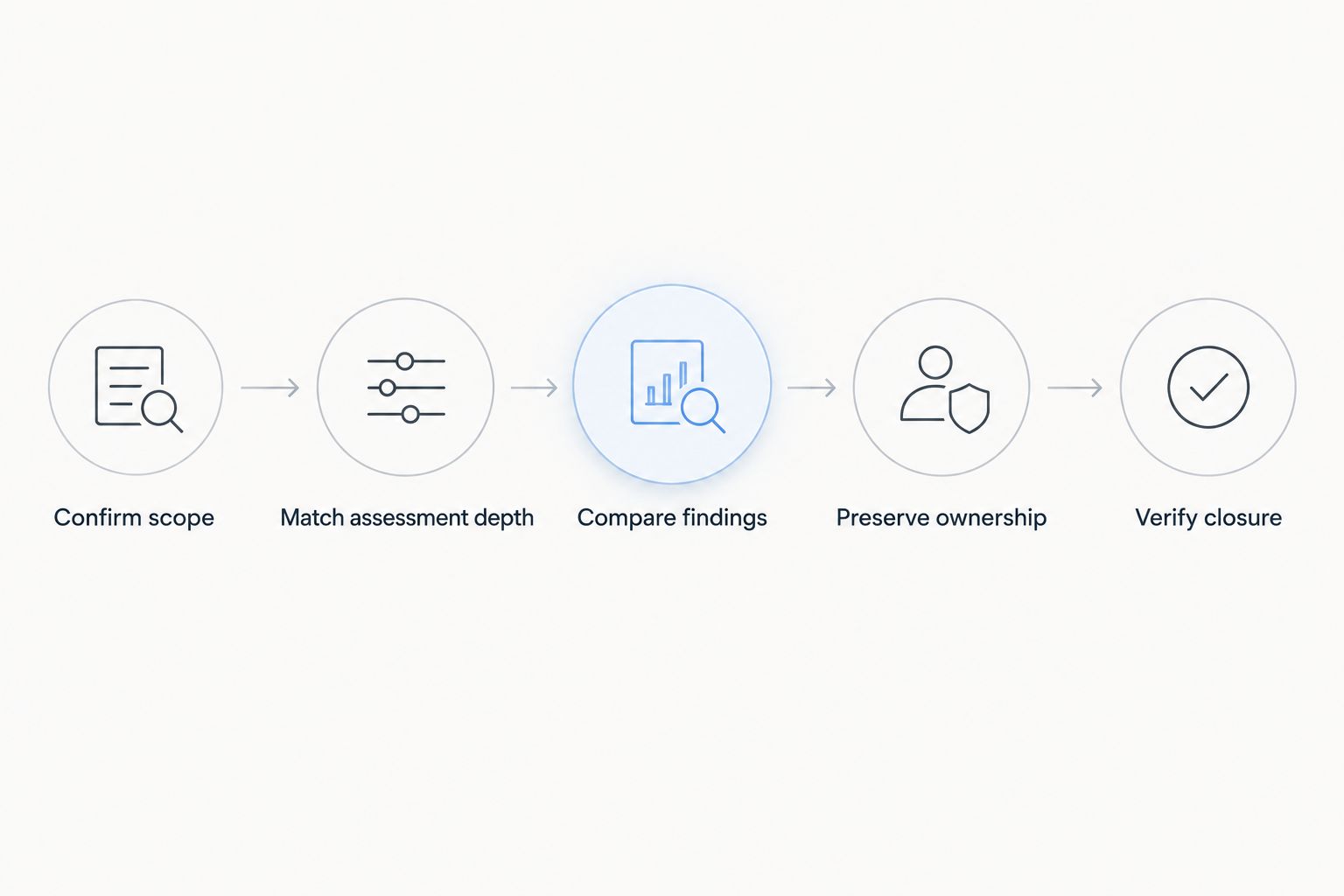
For a 2026 replacement review, use 5 checks before approving retirement. Apply them to representative assets from your environment, including difficult cases—not just systems that are easy to discover and assess.
1. Confirm scope
List the asset classes and environments the existing scanner covers. Include private systems, externally reachable services, and any specialized assessment scope that your team actually uses.
Compare that list with the proposed replacement's supported coverage. Record exclusions explicitly; an unsupported asset class is a coverage gap, not an implementation detail.
2. Match assessment depth
Identify whether each existing assessment uses network observation, authenticated access, a local agent, or an application-specific method. Require the replacement to demonstrate the evidence needed for the same security objective.
Do not accept a discovered software name as proof of an installed-package assessment. Check what the tool observed and how it reached the conclusion.
3. Compare findings
Run the existing and proposed assessment methods against an authorized, representative scope. Investigate findings present in only one result set rather than judging equivalence from total counts.
A smaller result set can reflect fewer duplicate findings, missed checks, different scope, or different detection logic. The count alone does not distinguish those explanations.
4. Preserve ownership
Confirm that each actionable finding reaches an accountable owner with enough evidence to act. Preserve asset identifiers and assessment timestamps so engineering teams can locate the affected system and understand the observation.
A technically accurate result still fails operationally if it cannot be matched to the right asset. Include reassigned addresses and renamed systems in the review.
5. Verify closure
Demonstrate how the replacement confirms that remediation worked. Require a successful follow-up assessment or another approved verification method appropriate to the finding.
A finding disappearing from a feed is not sufficient. The asset might have fallen out of scope, become unreachable, or stopped reporting.
This sequence separates a purchasing decision from a security decision. Complete the evidence review before removing the existing assessment path.
What evidence should survive consolidation?
Retain 4 evidence fields for each assessment record: asset identity, observation time, assessment method, and technical result. These fields establish what was assessed, when it was assessed, how it was assessed, and what the assessment found.
Ownership and remediation status add operational context, but they do not replace the underlying technical record. A ticket marked complete establishes a workflow state; it does not independently establish that the weakness is gone.
For your 2026 acceptance criteria, distinguish these outcomes clearly:
- Assessed: The required method completed successfully against the asset.
- Not assessed: The method did not run, lacked access, or excluded the asset.
- Resolved: Verification supports closing the finding.
- Unknown: The available evidence does not support a current conclusion.
Do not report unknown coverage as clean coverage. Keeping these states separate makes a consolidation review more useful than a comparison of dashboard totals.
What does overlap look like in practice?
Use 3 scenarios to test whether the proposed combination handles discovery, assessment, and remediation without gaps. These are evaluation cases, not claims about any specific product.
An internet-facing service outside the scan list
Attack surface management identifies a service that your vulnerability assessment inventory does not contain. Confirm ownership and authorization before assigning it to an assessment method.
The discovery closes an inventory gap. It does not establish that the service has received the checks required by your vulnerability management process.
A private server with a missing patch
An external discovery process does not establish the installed patch state of a private server. Use an assessment method with the necessary internal access or local visibility.
The key question is not whether the server appears in a central inventory. It is whether a successful assessment produced evidence about the relevant weakness.
A finding disappears after a change
A team changes a firewall rule, and a previously observed service is no longer reachable from the assessment location. That supports a conclusion about reachability from that location, not necessarily about patch installation.
Verify the intended outcome. Exposure reduction and vulnerability remediation can both be valid actions, but they are different claims and need different evidence.
Where does a vulnerability and exposure management platform fit?
Brinqa is best for teams evaluating a vulnerability and exposure management platform, rather than a scanner-only purchase. Keep that category distinction explicit when defining your requirements.
Brinqa's stated scope includes vulnerability and exposure management. That makes it relevant to this evaluation, but platform scope alone does not establish which discovery methods, assessment checks, or verification functions a deployment provides.
The boundary is equally important: do not infer that Brinqa replaces a scanner merely because both participate in vulnerability management. Require evidence for every capability you intend to retire, and evaluate integration and workflow requirements separately from detection depth.
Can one product perform both functions?
One product can perform both discovery and vulnerability assessment if its implemented capabilities support both functions. That is a product capability question, not proof that attack surface management and vulnerability scanning are interchangeable.
Ask for separate demonstrations. First, show discovery of an authorized asset missing from the supplied inventory; then show the assessment evidence available for that asset and the limits of that evidence.
Should you keep both if the findings overlap?
Keep both when they provide distinct coverage or evidence that your program requires. Overlapping findings are a reason to examine duplication, not an automatic reason to remove a tool.
If the same weakness appears in several sources, preserve the source records while deciding how to present the actionable work. A consolidated remediation view should not erase differences in observation time or assessment method.
FAQ
Can attack surface management replace vulnerability scanning in 2026?
Attack surface management cannot replace vulnerability scanning unless it also delivers the required assessment capabilities. Prove equivalent scope, depth, and remediation verification before retiring a scanner.
What's the main difference between attack surface management and vulnerability scanning?
Attack surface management focuses on identifying assets and exposures; vulnerability scanning assesses systems for detectable weaknesses. Their capabilities overlap, but discovery alone does not establish assessment coverage.
Does attack surface management find vulnerabilities?
Attack surface management can identify vulnerabilities when the product includes relevant assessment checks. Examine the checks and supporting evidence rather than assuming that every discovered asset receives a deep assessment.
Do I still need authenticated vulnerability scans?
You still need authenticated assessment when your security requirements depend on information unavailable through external observation. Validate successful access and the specific checks performed, not just the presence of configured credentials.
Is external attack surface management enough for private systems?
External attack surface management alone does not establish vulnerability coverage for private systems. Use an assessment method with the internal access or local visibility needed to examine those systems.
Can I retire a scanner if another tool reports the same assets?
Matching asset lists is not sufficient evidence to retire a scanner. Compare assessment methods, supported checks, technical findings, and closure verification for those assets.
How do I know a vulnerability is actually fixed?
Verify remediation through a successful follow-up assessment or another approved method appropriate to the finding. A missing result or closed ticket alone does not prove that the weakness was removed.
One last thing
The absence of a finding is meaningful only when you know the assessment succeeded. Before your next 2026 renewal decision, choose an asset that is difficult to assess and ask each proposed tool to show its last successful assessment, access status, and supporting result.
That exercise tests something an inventory comparison cannot: whether the tool knows the difference between a system with no detected weakness and a system it could not examine. Make that distinction a requirement before approving consolidation.