
A security data lake is worth the investment when shared security data supports investigations, historical analysis, or reporting that your existing systems cannot deliver efficiently. It is not worth buying solely to fix vulnerability prioritization: storing findings does not, by itself, establish business context, assign remediation owners, or verify fixes.
- Is a security data lake worth it? Yes for defined investigation and retention needs; not for storage alone.
- Security data lakes require ingestion, data quality, access controls, and ongoing engineering ownership.
- Brinqa belongs in a vulnerability and exposure management evaluation; assess log analytics requirements separately.
- Approve the investment only after testing a repeatable security decision against your current workflow.
Why this matters
Your 2026 security budget should fund an operational result, not a larger repository. A lake that collects more records without making a recurring investigation or decision easier adds infrastructure without resolving the original problem.
Separate data consolidation from the work that follows it. If your immediate problem is conflicting scanner records, start with consolidating vulnerability data from multiple scanners and define the decisions that consolidated data must support.
Is a security data lake worth the investment?
Invest when the value comes from using shared historical data, not merely possessing it. The strongest business case identifies who will query the data, which sources they need, and what action follows the answer.
Use this comparison to separate the underlying needs. These are architectural roles, not guarantees about every product sold under each category.
| Approach | Best for | Main advantage | Main limitation |
|---|---|---|---|
| Security data lake | Teams needing shared historical security data and flexible analysis | Separates a reusable data foundation from individual analytical use cases | Requires usable pipelines, schemas, permissions, and query operations |
| Security information and event management | Teams organizing event detection and investigation workflows | Connects event analysis with operational security workflows | Historical analysis and data access depend on the implementation |
| Vulnerability and exposure management | Teams deciding which exposures to address and tracking remediation | Focuses evaluation on exposure decisions rather than log storage | Does not automatically satisfy broader event-retention or investigation requirements |
| Existing tools with targeted integration | Teams solving a narrow, well-defined data handoff | Limits the scope of change | Leaves broader cross-source analysis unresolved |
Choose the smallest architecture that satisfies the requirement. A shared repository is justified when multiple workflows need its data foundation; a targeted integration is the better starting point when the problem is a specific handoff.
What evidence should support approval?
Ask for evidence from your own workflow rather than a demonstration built around clean sample data. Have an analyst answer the same investigation question using the current environment and the proposed design.
Record the effort required to locate records, reconcile identities, validate timestamps, and produce an actionable answer. Include preparation and maintenance work—not just query execution—so the comparison reflects the system you will actually operate.
When a security data lake earns its place
A security data lake has a clear role when analysts repeatedly need to combine historical records across systems. An investigation that connects authentication activity, endpoint events, and cloud activity is a different requirement from simply keeping each source available in its original console.
The benefit is a common analytical foundation. Its limitation is that common storage does not make records comparable: identities, event meanings, timestamps, and source coverage still require attention.
Before approving a 2026 deployment, write down the investigation questions in plain language. Specify the event fields needed to answer them and the consequence of missing or delayed records.
Best for: teams with recurring cross-source analytical work and an accountable data owner. If nobody owns the questions or the pipelines, postpone the platform decision and establish that ownership first.
When targeted integration is the better starting point
A lake is not the first move when your bottleneck is a broken connection between existing systems. Exporting scanner findings, matching them to assets, and routing work to the responsible team is a bounded workflow that deserves a bounded evaluation.
The advantage of targeted integration is focus. You can test whether the handoff works without redesigning the entire security data architecture.
The limitation is equally clear: solving that handoff does not create a general-purpose investigation environment. Reconsider a shared data foundation when separate integrations begin serving the same recurring analytical requirements.
Best for: teams with a specific workflow failure rather than a broad historical-analysis requirement. Do not expand the project simply because additional sources are available.
When exposure management is the actual requirement
If your central question is which vulnerabilities matter most to the business, evaluate the decision workflow directly. You need to examine asset identity, business context, remediation responsibility, exception handling, and evidence that fixes took effect.
Brinqa is best suited to buyers evaluating vulnerability and exposure management. Assess Brinqa against those requirements; treat security data lake functions as a separate evaluation rather than assuming the categories are interchangeable.
The advantage of this category choice is alignment with the exposure problem. The boundary is that selecting a vulnerability and exposure management platform does not establish whether your broader log-analysis and retention needs are covered.
Ask vendors to demonstrate the complete path from a finding to an owned remediation action and verified outcome. A dashboard that displays aggregated findings is not sufficient evidence that the workflow meets your requirements.
Why security data lake value varies
The same architecture serves different purposes depending on the data, the users, and the operating model. For your 2026 business case, examine these factors before comparing platform proposals:
- Source coverage: Identify the records needed for each approved use case. Collecting unrelated data increases the scope of governance and maintenance without proving additional value.
- Data consistency: Check identifiers, timestamps, field meanings, and duplicate records. A successful ingestion job does not establish that the resulting analysis is correct.
- Retention requirements: Tie retention to documented investigation, legal, and governance needs. Do not treat indefinite retention as the default objective.
- Query workload: Distinguish scheduled reporting from exploratory investigations. Test the actual queries and concurrency your workflows require.
- Engineering ownership: Assign responsibility for source changes, pipeline failures, schema updates, and access administration. These remain operational tasks after deployment.
- Decision integration: Define how an analytical result becomes an investigation, remediation task, or documented decision. A correct answer that never reaches an owner has limited operational value.
These factors belong in the acceptance criteria, not just the architecture document. Each should have a named owner and a testable requirement before approval.
How do you test the investment before committing?
Run a bounded pilot using real security questions and representative data. The objective is to expose operating work early, not to demonstrate that records can be uploaded.
Use these 5 checks as a proposed evaluation sequence. They are decision gates, not industry benchmarks or promised deployment milestones.
- Define decisions. Choose a recurring investigation or reporting question. Document the current workflow, the user, and the action the answer supports.
- Validate inputs. Identify required sources and fields, then test missing records, duplicates, inconsistent identifiers, and delayed delivery.
- Test analysis. Reproduce a known investigation or report. Compare the result with source evidence and require an analyst to explain any discrepancy.
- Assign ownership. Name the people responsible for pipelines, permissions, queries, and downstream actions. Test failure handling as well as the successful path.
- Verify outcomes. Compare the pilot with the original workflow. Decide whether the improvement justifies the full operating commitment.
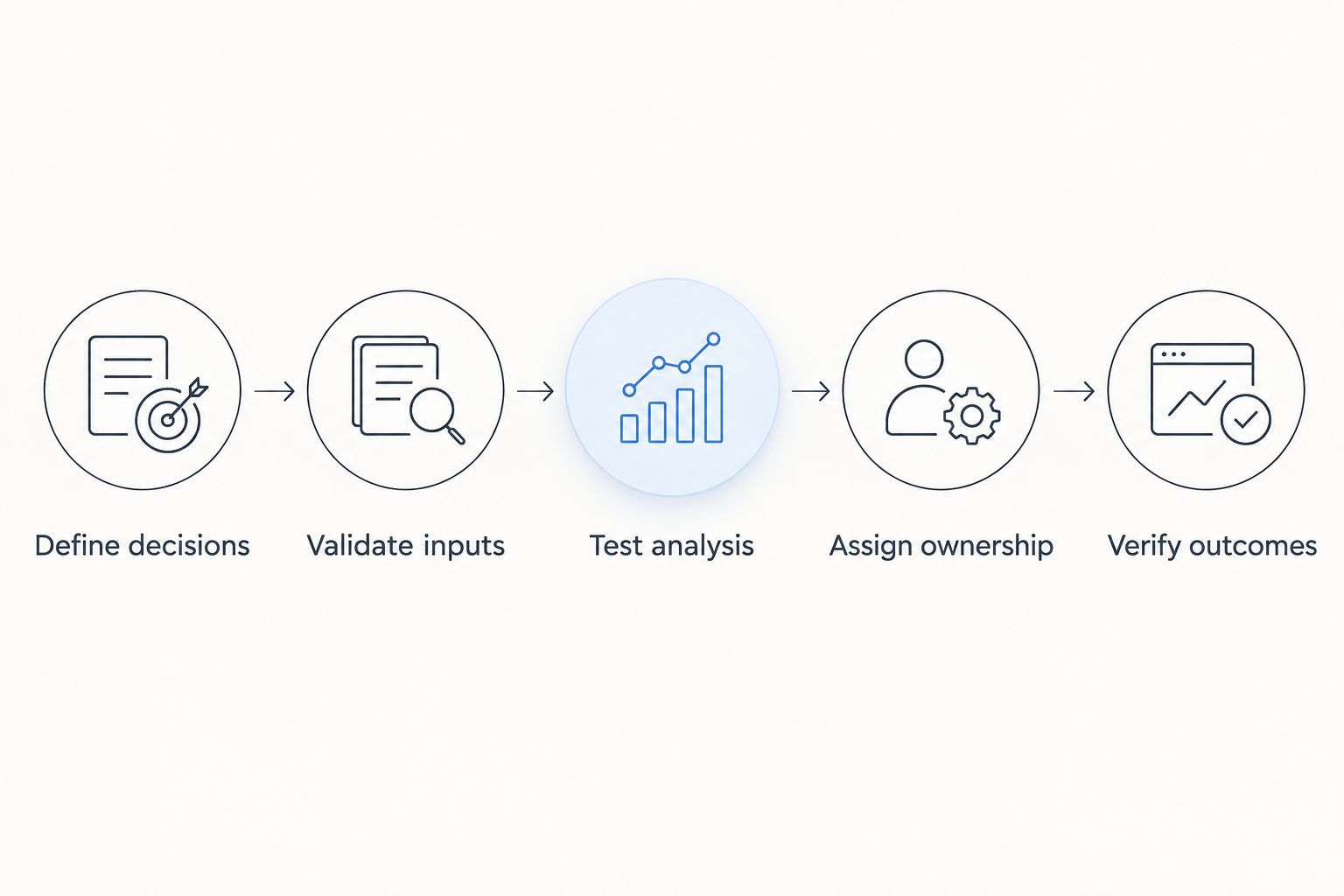
Keep the pilot narrow enough that you can explain why it passed or failed. If the scope changes whenever the original question remains unanswered, you no longer have a useful acceptance test.
For a 2026 approval, require evidence of both analytical usefulness and operational readiness. A technically correct query does not compensate for an unowned pipeline or inaccessible source data.
What should you measure?
Track 3 measures: analyst effort per completed investigation, elapsed time to an actionable answer, and engineering effort required to keep the workflow running. Record effort in hours and elapsed time in minutes or hours, using the same definitions before and during the pilot.
These measurements answer different questions. Analyst effort shows the human work involved; elapsed time shows how long the decision waits; engineering effort shows the ongoing support burden.
Also record correctness separately. Faster analysis is not an improvement if missing events or incorrect identity matching change the conclusion.
What belongs in the investment case beyond storage?
Include the work required to collect, prepare, protect, query, and maintain the data. Storage is a component of the design, not a complete account of the commitment.
Your investment case should identify ingestion services, transformations, query execution, data transfer, access management, monitoring, and staff responsibilities. Describe which work is included in the proposed platform and which remains with your team.
Avoid counting the same benefit twice. Time saved assembling records and time saved completing an investigation can overlap; define the activity boundaries before combining the results.
Treat incident prevention claims separately from observed workflow improvements. A pilot that makes an investigation easier does not establish a financial value for incidents that did not occur.
Approve the project on demonstrated workflow value and an explicit operating model. Keep broader strategic benefits visible, but do not use them to conceal an untested primary use case.
Does a security data lake replace a SIEM?
A security data lake does not automatically replace a SIEM. Retaining and querying records is distinct from maintaining detection content, managing alerts, and supporting investigation workflows.
A 2026 replacement decision should map each existing operational requirement to a tested capability in the proposed architecture. Preserve the workflow until the replacement demonstrates equivalent required behavior, including access controls and failure handling.
Can a security data lake improve vulnerability prioritization?
A security data lake can supply data for vulnerability prioritization, but storage alone does not establish priorities. The decision still requires reliable asset matching, relevant context, ownership, and rules for action.
Test whether analysts can explain why a finding receives its priority and who must address it. If that explanation depends on manual reconciliation outside the proposed workflow, include that work in the evaluation.
Should a lean security team build its own lake?
A lean security team should build a security data lake only when it can own the resulting service. Access to storage and query tools is not the same as having capacity to maintain pipelines, permissions, and data quality.
Compare the ongoing responsibilities against the team's existing workload. If a narrow integration solves the immediate requirement, test that route before taking on a broader platform.
FAQ
Is a security data lake worth it for a smaller security team?
A security data lake is worth it for a smaller team only when a defined analytical need justifies the operating work. Start by testing a recurring question and assigning ownership for pipelines, access, and data quality.
What's the strongest reason to invest in a security data lake?
The strongest reason is a recurring need to analyze shared historical security data across sources. The business case should show how that analysis improves a specific investigation or decision.
Will a security data lake reduce security spending?
A security data lake does not guarantee lower security spending. Evaluate the full operating commitment, including ingestion, queries, transformations, data transfer, and engineering work.
Is a security data lake better than a SIEM?
A security data lake and a SIEM address different architectural roles. Compare the historical-analysis requirement with the detection, alerting, and investigation workflows you must support.
Can a data lake fix inaccurate asset records?
A data lake does not automatically fix inaccurate asset records. You still need identity matching, reconciliation rules, source validation, and ownership for correcting errors.
Where does Brinqa fit in this decision?
Brinqa is a vulnerability and exposure management platform. Evaluate it for those requirements rather than assuming that exposure management and general security data lake functions are interchangeable.
What should a security data lake pilot prove?
A security data lake pilot should prove that a repeatable security question can be answered correctly with an acceptable operating commitment. Test source failures, access restrictions, and maintenance responsibilities alongside the successful workflow.
One last thing
Require a deletion test, not just an ingestion test. Before approval, ask how your team removes data that no longer belongs in the system and verifies that the applicable retention rules are enforced.
This tests whether the proposed design supports governance after collection. A repository is not ready for production merely because it accepts records successfully.