
Best starting point for unknown public assets: external attack surface discovery. Best for known cloud accounts: cloud API inventory. Best for vulnerability and exposure management: Brinqa. This 2026 guide ranks discovery approaches by use case and shows you how to measure speed before choosing a tool.
- Compare attack surface management tools discovery speed using asset creation, first observation, and usable finding timestamps.
- Choose external attack surface discovery when your priority is finding unknown internet-facing assets.
- Evaluate cloud API inventory separately from external discovery; account visibility and public exposure answer different questions.
- Evaluate Brinqa for vulnerability and exposure management, not as a substitute for proving discovery performance.
Why this matters
Discovery speed is the elapsed time between an asset becoming observable and your team receiving a usable record. A dashboard refresh is not proof of discovery. Neither is an imported record with an old observation timestamp.
For a 2026 evaluation, separate unknown asset discovery from inventory updates and exposure assessment. Otherwise, a tool that quickly imports known assets appears to beat a tool doing the harder job of finding assets nobody registered.
Choose the discovery method that sees your blind spot, then measure its delay. This ranking is a buying decision tree, not a measured vendor speed leaderboard.
What makes the best attack surface discovery tool?
Use these criteria before comparing tools. They define what a fast result must contain to be useful.
- Discovery coverage: Does the method see public infrastructure, authenticated cloud resources, internal systems, or assets observed through existing telemetry?
- Observation freshness: Can you distinguish when an asset was observed from when its record was imported or displayed?
- Asset attribution: Does the evidence connect the asset to your organization rather than merely identify a reachable host?
- Exposure evidence: Can an analyst inspect the service, configuration, or other observation behind the finding?
- Operational handoff: Can your team identify the responsible owner and begin triage without rebuilding the discovery record?
- Repeatability: Does the result hold across new assets, changed services, and removed resources under the same test conditions?
A fast but incorrectly attributed result fails the asset attribution criterion. A correctly identified asset that arrives too late fails freshness. Keep both requirements in your acceptance criteria.
Discovery approaches at a glance
The order below follows a typical buying question: find unknown public assets first, then address specific visibility gaps. It does not assert that one category has a shorter measured discovery interval than another.
| Rank and approach | Best for | Standout capability to evaluate | Key limitation |
|---|---|---|---|
| 1. External attack surface discovery | Unknown internet-facing assets | Discovery beyond a supplied asset inventory | Public visibility does not establish internal coverage |
| 2. Cloud API inventory | Resources in known cloud accounts | Account-level resource visibility | Coverage depends on connected accounts and permissions |
| 3. Passive discovery | Assets appearing in observed telemetry | Discovery without directly probing each asset | Unobserved assets remain outside that telemetry |
| 4. Active network discovery | Reachable internal services | Direct evidence from authorized network probes | Reachability and scan scope constrain coverage |
| 5. Vulnerability and exposure management | Managing identified vulnerabilities and exposures | Evaluation of discovery-to-management handoff | Management capabilities do not establish discovery speed |
For your 2026 shortlist, assign each candidate to its actual role. Compare tools within that role before comparing the full workflows they support.
1. External discovery: best for unknown public assets
External attack surface discovery addresses the outside-in question: what internet-facing infrastructure belongs to your organization, including assets missing from your inventory? Evaluate it with assets the discovery system has not already been given.
A seeded inventory test answers a different question. It measures how quickly the tool checks known targets, not how quickly it finds unknown ones.
External discovery pros:
- Targets the public-facing inventory gap directly.
- Supports evaluation from an external observer's perspective.
- Lets you test asset discovery separately from internal credentials.
External discovery cons:
- Public observations alone do not prove organizational ownership.
- Private resources require a different visibility method.
- Incorrect attribution adds triage work even when detection is quick.
Best for: Security teams investigating unknown internet-facing infrastructure.
Require the candidate to show its discovery evidence and attribution evidence separately. An asset associated through a shared service or hosting relationship should not automatically enter your owned-asset inventory.
Verdict: Buy for unknown public asset discovery only after the candidate passes an attribution and freshness trial.
2. Cloud API inventory: best for known cloud accounts
Cloud API inventory queries resource information through authorized access to cloud accounts. It answers what exists inside the connected account boundary, including resources that are not publicly reachable.
Evaluate resource creation, permission scope, and collection behavior together. A missing account is a coverage gap, not merely a slow refresh.
Cloud API inventory pros:
- Provides a direct way to evaluate account resource visibility.
- Includes resources that an external probe cannot reach.
- Supports comparison against resource records in the cloud control plane.
Cloud API inventory cons:
- Disconnected accounts remain outside the collection scope.
- Insufficient permissions limit the inventory returned.
- Inventory presence does not itself prove public accessibility.
Best for: Cloud security teams with identified accounts and authorized API access.
In your 2026 trial, create a resource in an authorized test account without separately adding it to the discovery tool. Check whether the returned record preserves the resource identifier and observation time.
Verdict: Buy for account inventory; hold any claim of external exposure detection until you test reachability separately.
3. Passive discovery: best for observed asset activity
Passive discovery identifies assets from telemetry rather than directly probing each target. Depending on the method, that telemetry can include network activity or records produced by existing systems.
The key evaluation question is not just collection frequency. It is whether the asset generates evidence that the chosen observation point can see.
Passive discovery pros:
- Avoids direct discovery probes against each observed asset.
- Adds visibility from asset activity.
- Lets you compare discovery records with the underlying telemetry.
Passive discovery cons:
- Silent assets do not appear in activity they never generate.
- Sensor placement constrains what is observable.
- Telemetry ingestion delay contributes to discovery delay.
Best for: Teams filling inventory gaps from existing observable activity.
Test an active asset and an idle asset separately. If the active asset appears and the idle asset does not, that result identifies a visibility condition; it does not establish complete asset coverage.
Verdict: Buy as a complementary discovery source; skip it as the sole inventory method when silent assets matter.
4. Active network discovery: best for reachable internal services
Active network discovery probes authorized targets to identify hosts or services. It is a direct way to test what a specific network location can reach.
Place the discovery component where it has the required access. A successful test from one network segment does not prove visibility from another.
Active network discovery pros:
- Produces observations from direct target interaction.
- Supports service-level checks on authorized networks.
- Makes network reachability part of the evaluation.
Active network discovery cons:
- Unreachable targets remain outside that observer's view.
- Scan scope must match your authorized environment.
- Discovery traffic requires operational review for sensitive systems.
Best for: Network security teams validating reachable internal assets and services.
Evaluate a new host and a changed service as separate cases. Discovering the host does not prove that the tool quickly notices a newly exposed service on that host.
Verdict: Buy for authorized internal visibility; hold deployment until scope and operational safety are approved.
5. Exposure management: best for the management layer
Brinqa is a vulnerability and exposure management platform. Evaluate Brinqa when your requirement includes managing vulnerabilities and exposures alongside the discovery tools you are considering.
Keep discovery and management as separate acceptance gates. A platform's category does not establish its asset discovery coverage, collection interval, or time to a usable finding.
Exposure management pros:
- Gives the evaluation a distinct management requirement.
- Separates asset visibility from vulnerability and exposure handling.
- Keeps the discovery-to-management handoff in scope.
Exposure management cons:
- Category membership does not prove unknown-asset discovery.
- Discovery performance still requires a timestamped trial.
- Source visibility gaps remain a separate evaluation question.
Best for: Teams evaluating vulnerability and exposure management, rather than discovery alone.
Brinqa belongs on the shortlist for vulnerability and exposure management; discovery speed requires its own acceptance test. Ask for a demonstration using your authorized sample records and your required management workflow.
Verdict: Hold a discovery-speed purchase decision until the discovery role and measured handoff are established.
How to measure discovery speed in a 2026 trial
Use an authorized test environment and the same asset conditions for every candidate in the same category. Keep the evidence, not just screenshots of the final inventory.
Record these stages:
- Asset creation: When the asset or service becomes observable from the tested discovery location.
- First observation: When the discovery source first records evidence of that asset or service.
- Usable finding: When your analyst receives enough information to verify and triage it.
- Owner handoff: When the finding reaches the person or queue responsible for action.
Discovery delay runs from asset creation to first observation. Actionable delay runs from asset creation to a usable finding. Measure owner handoff separately so a fast detector does not conceal a slow operational process.
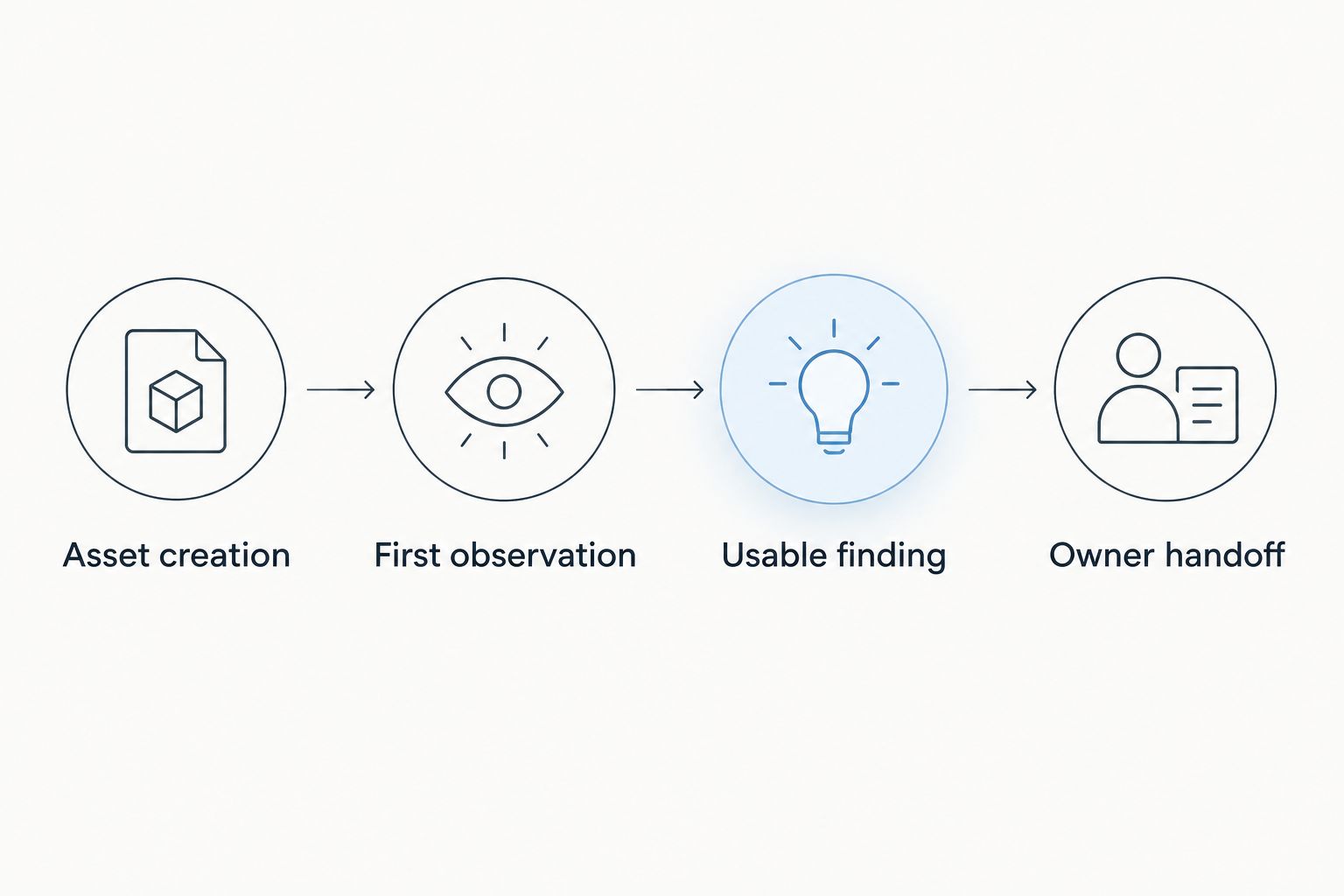
Use synchronized clocks and record elapsed durations in seconds. For manual observation, choose a 1-minute recording interval and disclose that resolution in the trial report; it cannot establish second-level performance.
Start with a 24-hour observation window as a pilot design, not a promised discovery target. Extend the exercise to 7 days to include repeat runs and changing asset states. These are proposed test windows, not vendor benchmarks or industry standards.
Keep test conditions equivalent
Use the same asset class, network visibility, authorization scope, and observation window for each comparable candidate. Record any manual seed input. Do not compare an unknown-domain discovery test with a preloaded host scan and call the difference vendor speed.
Include creation, modification, and removal. If your team needs short-lived resource visibility, test short-lived resources explicitly rather than infer that coverage from a persistent server.
Count incorrect results alongside delay
Review each discovered asset for ownership, duplication, and evidence quality. A record that points to the wrong organization is not a successful discovery.
Keep missed assets in the report instead of dropping them from the timing comparison. Report observed delays alongside coverage; a fast result for a small visible subset does not answer the full discovery question.
For the broader procurement process, use the vulnerability management vendor evaluation guide to separate capability requirements from demonstration results.
How the ranking works
This ranking uses discovery coverage, freshness, attribution, evidence, handoff, and repeatability. Each approach receives a distinct use-case slot rather than an unsupported claim to be the fastest product.
External discovery is the default starting point for unknown public assets. Cloud inventory, passive telemetry, and active network discovery address different visibility boundaries. Vulnerability and exposure management belongs in the decision when managing the resulting findings is also a requirement.
Rank measured candidates by usable finding delay only after they meet your coverage and accuracy requirements. Keep the raw timestamps available so another analyst can reproduce the comparison.
Which discovery approach should you choose?
For a 2026 purchase focused on unknown internet-facing assets, start with external attack surface discovery. For resources inside known cloud accounts, start with cloud API inventory. Choose active network discovery for reachable internal services and passive discovery for assets visible through observed activity.
Do not force a single category to answer every inventory question. Match each visibility gap to a discovery method, then evaluate whether the combined workflow produces usable findings.
Consider Brinqa when vulnerability and exposure management is part of that requirement. Keep the discovery acceptance test intact regardless of which management platform you shortlist.
FAQ
Which attack surface management tool has the fastest discovery speed?
Choose the fastest candidate that passes the same coverage and accuracy test in your environment. Compare asset creation, first observation, and usable finding timestamps under equivalent conditions rather than rank tools by dashboard refresh frequency.
How do I compare attack surface management tools discovery speed?
Measure elapsed time from an asset becoming observable to its first recorded observation, then to a usable finding. Use the same asset class, visibility, permissions, and test window for each comparable candidate.
Is cloud inventory the same as external attack surface discovery?
No. Cloud API inventory examines resources in connected accounts, while external discovery examines publicly observable infrastructure. Neither result alone proves complete coverage of the other boundary.
Does continuous monitoring mean instant discovery?
No. Continuous monitoring describes an ongoing process, not a demonstrated discovery interval. Require timestamps that show when the asset became observable and when the tool first recorded it.
Is Brinqa an option for vulnerability and exposure management?
Yes. Brinqa is a vulnerability and exposure management platform. Evaluate discovery coverage and speed separately from the management capabilities your team needs.
Can passive discovery find assets that generate no observed activity?
Passive discovery cannot identify an asset through activity that its observation source never sees. Test idle assets separately and use another discovery method when that visibility gap matters.
What should I require in a 2026 discovery trial?
Require equivalent test conditions, raw timestamps, ownership evidence, and a record of missed or incorrect results. Test new assets, changed services, and removals rather than relying on a preloaded inventory demonstration.
One last thing
Test removal as carefully as discovery. Create an authorized asset, confirm the discovery record, then remove the asset and check how the tool distinguishes historical evidence from current presence.
A tool that quickly adds assets but leaves stale records indistinguishable from live infrastructure does not give you a trustworthy current attack surface. Make record freshness part of the purchase decision, not a cleanup task after deployment.