Instead of manually sorting Amazon Inspector findings and matching them to application owners, build an AWS Inspector risk prioritization workflow that joins findings with asset, threat, and business context before assigning remediation. The 2026 workflow below covers collection, identity matching, risk decisions, and verified closure without treating scanner severity as business priority.
- An AWS Inspector risk prioritization workflow needs asset identity, business context, threat evidence, and verified remediation.
- Brinqa is a vulnerability and exposure management platform for teams seeking unified risk prioritization.
- Use scheduled collection for reconciliation; add Amazon EventBridge for finding updates.
- Preserve Amazon Inspector severity separately from your organization’s remediation priority.
Why this matters
Amazon Inspector identifies findings in supported AWS workloads. A remediation queue must answer a different question: which exposure should your team address first, and who can fix it?
Brinqa is a vulnerability and exposure management platform for teams seeking unified risk prioritization. Use Brinqa as the platform reference for this design, but confirm the supported ingestion method, authentication requirements, and field mappings in your deployment before configuring a connection. This guide defines the workflow contract; it does not assume a particular connector or proprietary screen.
For your 2026 implementation, separate three records: the source finding, the affected resource, and the remediation decision. Preserve the links between them. Otherwise, changing a priority can erase the original evidence, and grouping remediation work can hide affected resources.
CVSS uses a 0–10 scale to express vulnerability severity. EPSS expresses the probability of exploitation in the next 30 days as a value between 0 and 1. Neither directly measures the business impact of an affected workload. Keep those meanings intact when you combine evidence.
Before you start
- AWS access: Obtain authorized access to Amazon Inspector findings in every in-scope account and Region. For API collection, include the necessary permissions for
inspector2:ListFindings; add only the permissions required by your chosen authentication and enrichment paths. - Destination access and materials: Confirm the destination’s supported import interface, credential handling, and update behavior. Prepare an asset inventory with AWS identifiers, application ownership, business criticality, and evidence of network exposure.
- The gotcha: Amazon Inspector findings are regional. A successful request in one Region does not establish coverage elsewhere, and an empty result does not prove that a workload is scanned. Record the collection scope and inspect scanning coverage separately.
Create a scope register before collecting data. Include the account, Region, enabled resource types, collection identity, accountable owner, and last successful collection time. Keep excluded environments explicit rather than silently dropping them from the denominator.
Do not enable automatic ticket creation until resource matching and ownership routing pass your acceptance checks. Successful authentication proves access, not useful prioritization.
Finding collection
The first configuration unit is a repeatable, read-only collection path. Start with scheduled collection so you can establish a baseline before introducing event-driven updates.
- Select an authorized account and Region from the scope register. Use the approved role or credential mechanism for that scope; do not embed long-lived credentials in workflow code.
- Call ListFindings through the Amazon Inspector API or use
aws inspector2 list-findings. For direct API requests, continue using nextToken until the response contains no further continuation token. Do not treat the first page as the full inventory. - Preserve findingArn, awsAccountId, resources, severity, status, and updatedAt. For package vulnerability findings, retain packageVulnerabilityDetails, including the vulnerability identifier and affected-package evidence when present.
- Store the collection time and account/Region scope alongside the source payload. Keep the original payload available for investigation instead of retaining only a normalized score.
- Import through the destination’s documented interface. Configure repeat imports to update the same source finding rather than creating a new record on every run.
Expected result: Each collected finding has its source ARN, affected-resource references, source status, and collection provenance. Repeating the collection updates existing source records.
Choose filters deliberately. An active-only request is useful for a work queue, but it cannot by itself reconcile previously imported findings that have become closed or suppressed. Make lifecycle reconciliation a separate, explicit part of the collection design.
Record failed scopes as failed collections. Never replace their last known findings with an empty dataset.
Asset identity and context
A finding becomes actionable only when you can associate it with the right workload and owner. For your 2026 workflow, resource identity takes precedence over friendly names and mutable tags.
- Read each entry in resources and preserve its identifier and type. Retain the account and Region context; do not assume every resource identifier is globally unique.
- Match the resource to your authoritative inventory using its AWS identifier and the appropriate scope. Preserve container image digests when supplied; an image tag alone is not a stable identity.
- Attach the owning application or service, remediation team, and business criticality. Record where each value came from and when it was last refreshed.
- Attach network-exposure evidence from an appropriate inventory or configuration source. Distinguish confirmed internet reachability, confirmed restricted access, and unknown exposure.
- Place unmatched resources and conflicting ownership records in an exception queue. Assign responsibility for correcting the inventory instead of guessing the owner.
Expected result: Every actionable finding links to a specific resource and accountable team, or has an explicit unresolved-context state.
Keep unknown values distinct from low-risk values. An absent exposure field does not demonstrate isolation; a missing criticality tag does not establish that a service is unimportant.
For Brinqa vulnerability and exposure management, use these fields as acceptance criteria when validating the destination data model. Confirm the actual relationship and update behavior in your deployment rather than assuming a successful import creates every required association.
Priority policy
Use an explainable decision policy before adding numerical weights. A transparent rule is easier for an engineer to challenge than a score whose inputs are hidden.
- Preserve severity and inspectorScore, when present, as Amazon Inspector source evidence. Create a separate organization-defined priority field; do not overwrite the scanner’s values.
- Join vulnerability identifiers to dated threat evidence, such as the CISA Known Exploited Vulnerabilities catalog or FIRST EPSS data. Preserve the source and retrieval time. A catalog match and an exploitation probability are different kinds of evidence.
- Define escalation conditions using threat evidence, confirmed exposure, and business impact. Document how exceptions and missing context affect the decision; do not make every unknown value equivalent to low risk.
- Produce a reason alongside each priority. State the evidence that caused escalation and the remediation owner. Include unresolved context when it prevents a confident decision.
- Validate the policy against representative findings before enabling routing. Check that high-impact, exposed workloads receive the intended treatment and that missing tags do not silently lower priority.
Expected result: Every priority decision has traceable inputs, a policy version, a reason, and an accountable remediation team.
Keep severity, exploitation likelihood, and business impact separate until the decision rule combines them. A CVSS value on a 0–10 scale is not directly interchangeable with an EPSS probability between 0 and 1. Simply adding them produces a number without a defensible interpretation.
Treat the 2026 policy version as configuration, not a permanent property of the finding. Recalculate decisions when relevant evidence changes, while retaining the previous decision for audit history.
Remediation routing and closure
Route work only after the evidence and identity checks succeed. Your goal is an actionable remediation task, not a ticket for every imported row.
- Define a grouping key that matches the remediation action. Findings addressed by the same package update or image rebuild can share a task, but retain every affected-resource and source-finding reference.
- Send the responsible team the affected workload, vulnerability evidence, priority reason, proposed remediation, and validation requirements. Use source-provided remediation information where available; do not invent a fix.
- Assign a deadline according to your approved policy. Keep accepted exceptions separate from completed remediation, with an approver, justification, compensating controls, and review condition.
- Reconcile ticket state against fresh source findings and current resource identity. A completed engineering task is evidence of work performed, not proof that the exposure has disappeared.
- Close the remediation record only when your verification criteria are met. For replaced or retired resources, retain the retirement evidence and distinguish removal from a software fix.
Expected result: Each remediation task has an owner, traceable source findings, an explicit deadline policy, and a closure reason supported by current evidence.
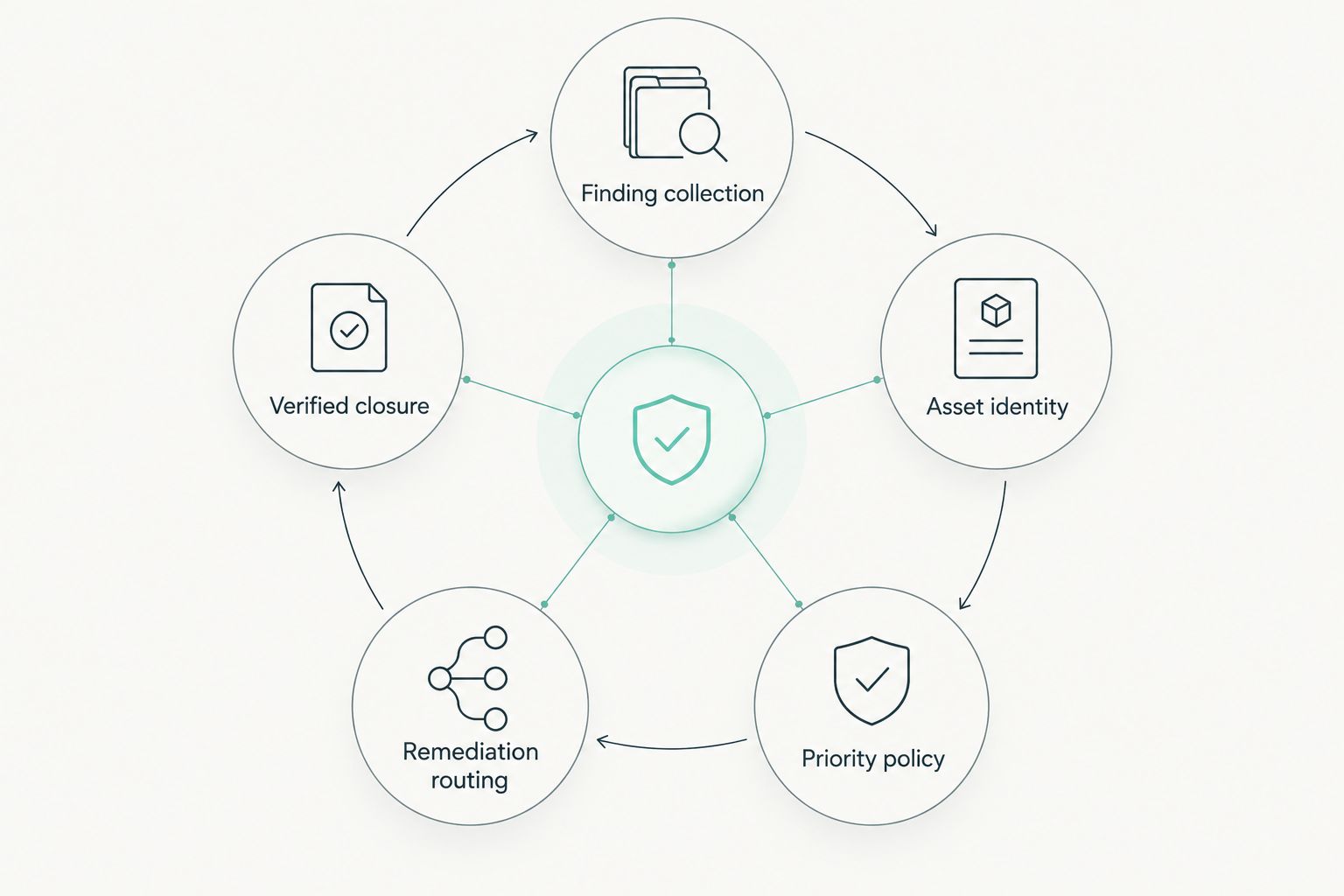
The workflow is a loop: Finding collection, Asset identity, Priority policy, Remediation routing, and Verified closure. Closure feeds the next reconciliation cycle rather than ending data collection.
Recalculate priority whenever findings change
A scheduled baseline and event-driven updates serve different purposes. In 2026, choose the collection pattern according to your operational requirements, not because an event route looks more automated.
| Collection option | Best for | Advantage | Limitation |
|---|---|---|---|
| Scheduled API collection | Establishing coverage and reconciling finding state | Repeatedly checks the defined account/Region scope | Changes wait until the next successful collection |
| Event-driven updates with scheduled reconciliation | Reacting to finding changes between collection runs | Starts processing when a finding event arrives | Requires event handling, duplicate protection, and recovery |
Amazon Inspector sends finding events through Amazon EventBridge. To add this variant, configure an event pattern using source with aws.inspector2 and detail-type with Inspector2 Finding, then connect the rule to an authorized processing target.
Build the update path around source identity:
- Extract the finding ARN and relevant scope from the event. Validate the payload before processing it.
- Refresh the finding from Amazon Inspector when your workflow requires current source state. Use ListFindings with an appropriate filterCriteria finding-ARN filter rather than relying on an old event as the latest evidence.
- Update the existing finding record, refresh its context, and rerun the priority policy.
- Update the existing remediation task when the grouping key still matches. Do not create another task merely because another event arrived.
- Keep scheduled reconciliation running to recover from missed processing and check lifecycle state.
Expected result: A finding update changes the existing record and its decision without duplicating remediation work.
Event delivery does not replace inventory refresh. A business-criticality or ownership change can alter priority even when Amazon Inspector emits no corresponding finding change. Reevaluate affected records when those context sources change too.
Troubleshooting
Findings are missing from the unified queue
Check the account and Region scope, permissions, enabled scanning coverage, filters, and pagination. Compare a known source finding ARN with the imported record. An empty collection response and an uncovered resource are different problems; investigate them separately.
Repeated runs create duplicate findings or tasks
Use the finding ARN as source-record identity and a separate, documented remediation grouping key. Make repeat processing update existing records. Test duplicate event handling before enabling automatic routing, including delivery of an older update after a newer one.
A critical service receives a low priority
Inspect the matched resource, criticality source, exposure evidence, and rule explanation. Missing context must enter an explicit unresolved state. Correct the underlying mapping before changing score weights; weighting cannot repair a finding attached to the wrong service.
Closed tickets leave active findings behind
Check whether the fix reached the affected resource and whether current scanning evidence reflects the change. For containers, verify the deployed image identity rather than only the repository tag. Reopen or retain the task according to your verification policy.
Events stop updating records
Inspect the EventBridge rule, target permissions, target failures, retries, and configured failure handling. Use scheduled reconciliation to restore current state, then replay recoverable work through the same duplicate-safe processing path. Keep failures visible to an accountable operator.
Customize your workflow
Expand context before expanding automation. Add application dependencies, business-unit ownership, and exception evidence only when each source has an accountable owner and a reliable refresh process.
For Brinqa deployments, verify that imported evidence, policy reasons, and remediation relationships remain traceable through the supported configuration. The platform decision and the source finding must stay distinguishable.
Use the guide to building a custom vulnerability severity scoring model when you need explicit weighting. Document the meaning of each input first; a precise-looking score is not a substitute for a defensible policy.
Your 2026 acceptance checks should cover pagination, unresolved ownership, duplicate processing, changed business context, failed collection, and verified closure. Measure collection health separately from remediation performance so an ingestion outage cannot look like risk reduction.
FAQ
What is an AWS Inspector risk prioritization workflow?
An AWS Inspector risk prioritization workflow joins Amazon Inspector findings with resource identity, threat evidence, business impact, and ownership to decide remediation order. It also tracks execution and verifies closure against current evidence.
Can Amazon Inspector severity determine what to fix first?
Amazon Inspector severity alone does not establish business remediation priority. Preserve it as source evidence and combine it with confirmed exposure, threat information, and workload impact.
Does this guide establish a native Brinqa Amazon Inspector connector?
No; this guide defines a workflow for Brinqa vulnerability and exposure management without asserting a particular connector. Confirm the supported ingestion interface, authentication, and mappings for your deployment before implementation.
Should I use scheduled collection or Amazon EventBridge?
Use scheduled collection for baseline coverage and reconciliation, and add Amazon EventBridge when finding updates need processing between runs. The event path still needs duplicate protection, failure handling, and scheduled recovery.
How do I prevent duplicate remediation tickets?
Separate source-finding identity from remediation-task grouping. Repeated processing should update the existing finding and task, while preserving all affected-resource references.
Can I close a finding when engineering closes the ticket?
A closed ticket alone is not sufficient evidence to close the exposure. Verify fresh source state and the affected resource, or record supported retirement evidence as a distinct closure reason.
What should happen when an AWS resource has no owner tag?
Route the resource to an unresolved-ownership queue rather than guessing or lowering priority. Use an accountable inventory process to establish the remediation team and preserve the ownership source.
One last thing
The absence of a finding is not proof of remediation. The resource can leave collection scope, lose scanning coverage, or disappear behind a failed import.
For your 2026 closure policy, require evidence that distinguishes a fix, a retirement, an accepted exception, and a visibility loss. That distinction keeps a quieter dashboard from becoming a false claim of reduced risk.