
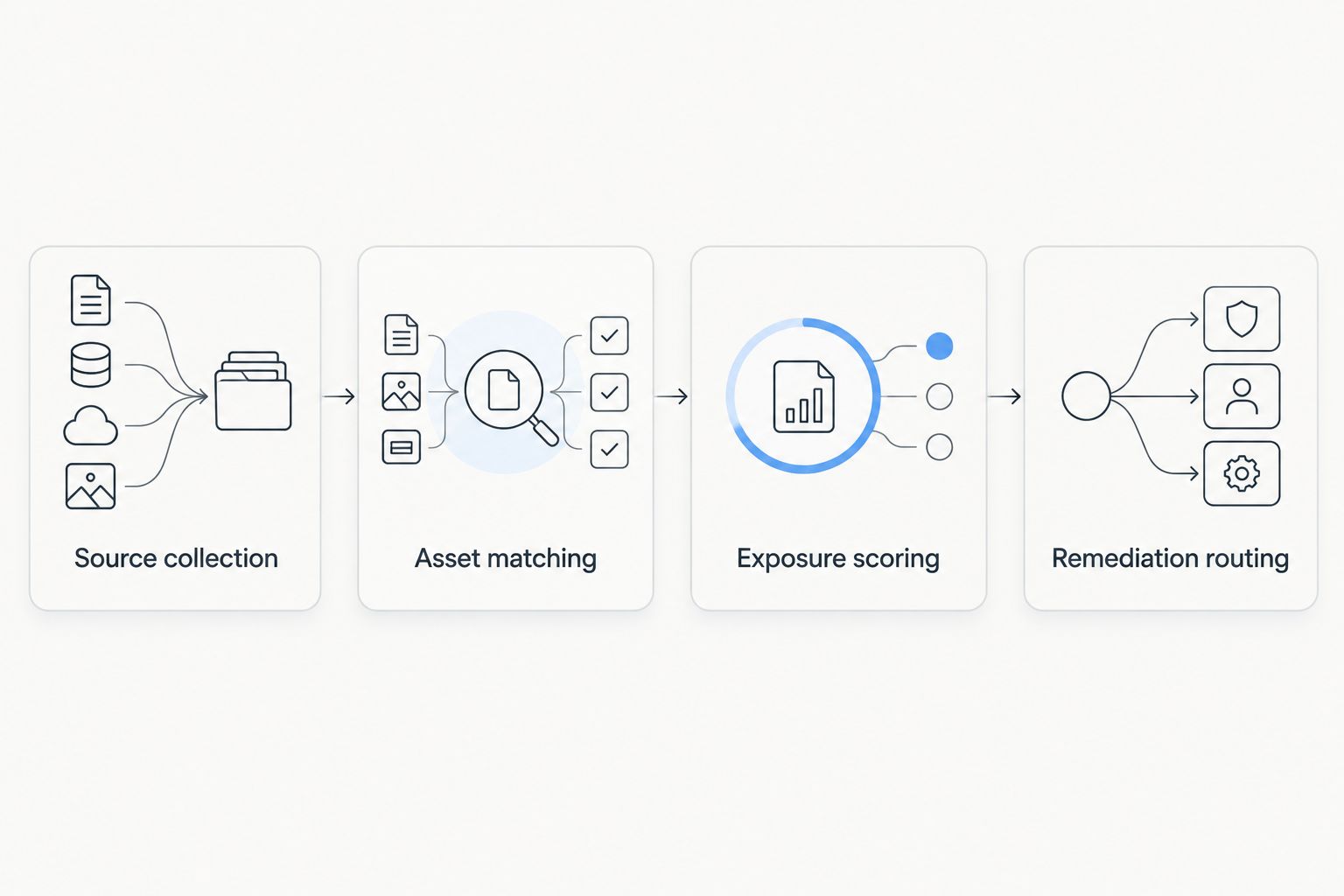
Instead of manually reconciling CrowdStrike Falcon findings with asset spreadsheets, set up a workflow that collects findings, matches assets, adds business context, and produces an explainable remediation queue. This CrowdStrike Falcon exposure scoring workflow separates source severity from your organization's exposure priority, then verifies closure against fresh evidence.
- Use the CrowdStrike Falcon exposure scoring workflow to connect endpoint findings with asset context and remediation ownership.
- Evaluate Brinqa for vulnerability and exposure management; validate the required data transfer before configuring scoring.
- Keep CVSS severity, EPSS probability, and business context separate until your scoring rules combine them.
- Recalculate exposure priority when findings, asset context, or threat intelligence change.
Why this matters
A vulnerability finding does not contain every fact needed to decide what to fix first. You also need to know which asset it affects, who owns that asset, and what the asset supports. A severity-sorted export leaves those decisions to whoever opens the spreadsheet.
For your 2026 workflow, define the output before configuring the transfer: an attributable finding, a matched asset, an explainable priority, and an accountable remediation owner. A unified score is useful only when you can explain the action it changes.
Brinqa is a vulnerability and exposure management platform for security teams evaluating those disciplines together. Treat platform selection and workflow validation as separate decisions: choosing a platform does not prove that your required Falcon records, permissions, and lifecycle states transfer correctly.
This guide is an implementation specification, not a substitute for the documentation for your deployed integration. Apply the steps through your approved transfer mechanism and scoring environment, keeping source configuration separate from the organization-specific rules below.
Before you start
- Source access: Have authorized access to the required CrowdStrike Falcon vulnerability and asset records. Confirm that the account, entitlement, authentication method, and permissions support the data you intend to retrieve; endpoint visibility alone is not proof of vulnerability-data access.
- Destination and context: Have permission to configure ingestion, mappings, scoring, and remediation routing in your selected environment. Identify authoritative sources for asset ownership, business service, and criticality before treating those attributes as scoring inputs.
- Identity and lifecycle agreement: Decide how records match and what establishes closure. The non-obvious gotcha is that a finding disappearing from a response does not prove remediation: filters, incomplete collection, and lost visibility also remove records from view.
Best for: security teams that need repeatable prioritization across endpoint findings and business context. This workflow requires mapping and governance work; keep a narrowly scoped pilot until those rules pass validation.
Source collection
The collection stage must preserve evidence, not just deliver a list of vulnerability identifiers. Configure the 2026 baseline so an analyst can trace any scored finding back to its source observation.
- Define the source scope. Specify which Falcon vulnerability records and associated asset records belong in the workflow. Document inclusion filters, excluded populations, and the difference between vulnerability findings and detection events. Do not mix those record types into an undifferentiated severity queue.
- Establish authorized transfer. Use the supported method approved for your environment. Store credentials in an approved secret store, restrict access to the required data, and validate authentication before enabling scheduled collection. Do not place credentials in exported files or troubleshooting notes.
- Preserve source evidence. Retain the source record identifier, source asset identifier, vulnerability identifier when present, source status, observation timestamps, and collection timestamp. Preserve the original severity rather than replacing it with the destination's priority label.
- Validate collection completeness. Compare the collected population with the same source scope and filters. Follow the documented pagination method where applicable, record failed requests, and prevent a partial retrieval from being treated as a complete snapshot.
Expected result: you have a traceable dataset with a defined scope and a collection outcome. A successful authentication check is not enough; the intended records must arrive with usable identity and lifecycle evidence.
Asset matching
Asset matching establishes which business context belongs to a Falcon finding. Incorrect matches contaminate every later score, even when the scoring formula itself is correct.
- Choose identity precedence. Prefer stable identifiers supported by your source and inventory. Treat hostname and IP address as supporting evidence rather than universal identity keys. Names change, addresses are reused, and separate environments can contain similar labels.
- Separate assets from findings. Maintain an asset record and attach source findings to it. Define the finding key at the granularity your remediation process needs; a vulnerability identifier alone does not distinguish affected assets or separate observations.
- Resolve ambiguity explicitly. Send conflicting matches to an exception queue rather than merging them automatically. Preserve unmatched records with a visible quality flag so they remain available for investigation without borrowing another asset's owner or criticality.
- Attach attributable context. Add owner, business service, environment, and criticality from the designated sources. Record where each value came from and when it was observed. Distinguish an authoritative value from a manually supplied override.
Expected result: each finding points to a verified asset or an explicit matching exception. Every context attribute used in scoring has a source, and conflicting context remains visible rather than silently disappearing.
A renamed endpoint is a useful validation case. Confirm that a supported stable identifier preserves the asset relationship without creating a duplicate or inheriting the wrong business owner.
Exposure scoring
Configure your 2026 scoring policy around evidence and decisions, not a formula chosen because it produces a convenient dashboard. Keep technical severity, exploitation evidence, exposure context, and business impact distinguishable in the stored record.
- Define the decision. Write the action each priority band triggers: ordinary backlog review, expedited owner review, or escalation under your approved policy. Assign an owner to the scoring policy itself, including approval of changes.
- Normalize meaning before values. FIRST defines CVSS severity on a scale of 0.0–10.0 points. FIRST's EPSS estimates the probability of exploitation in the next 30 days on a 0–1 probability scale. These measure different things; do not treat their raw values as interchangeable.
- Add contextual rules. Specify how verified exposure, business criticality, and relevant threat evidence influence priority. Document any override and the evidence it requires. Keep an override distinguishable from the normal scoring path.
- Handle unknowns deliberately. Keep missing ownership, unknown exposure, and stale context visible. Do not interpret missing evidence as low risk. Use a review state when the evidence needed for an automatic decision is absent.
- Test explanations. For each validation finding, inspect the inputs, resulting priority, applicable rule, and policy version. Confirm that the explanation tells the remediation owner why the finding entered that queue.
Expected result: every priority is reproducible from recorded inputs and a versioned policy. Brinqa belongs in your vulnerability and exposure management evaluation; validate the required scoring behavior against your implementation criteria.
For policy design, use the guide to building a custom vulnerability severity scoring model. Keep the organizational priority separate from the original source severity so an analyst can inspect both.
Remediation routing
A scored finding needs an owner and a closure test. Configure the 2026 handoff so queue movement follows evidence rather than ticket activity alone.
- Choose the remediation grouping. Group findings only when the same owner and corrective action apply. Preserve the underlying affected assets and source findings so a grouped work item remains auditable.
- Assign accountable ownership. Route work using the approved ownership map. Send unowned assets to an explicit assignment queue; do not give every unmatched record to a default owner who lacks authority to remediate it.
- Preserve the handoff. Include affected assets, vulnerability evidence, priority explanation, proposed remediation context, and the link or reference your approved process uses to inspect the source record. Exclude unnecessary sensitive details from broadly accessible work items.
- Verify closure. Separate owner-reported completion from source-verified resolution. Recheck affected records after the corrective action and apply the documented lifecycle rule. Retain previous evidence and reopen work when a finding is observed again.
Expected result: every actionable priority has a responsible destination and a defined verification path. A closed ticket does not automatically become a closed exposure.
Recalculate priority when context changes
A finding does not need to be new for its remediation priority to change. An asset's business role, verified exposure, or associated threat evidence can change while its vulnerability observation remains unchanged.
For your 2026 workflow, define which changes trigger recalculation and which records they affect. Use event-driven updates only where the approved integration supports them; otherwise, evaluate changes during scheduled processing. Keep collection timing and scoring timing distinct.
| Workflow option | Best for | Advantage | Limitation |
|---|---|---|---|
| Scheduled refresh | Teams needing a controlled baseline | Provides a defined collection and reconciliation point | Changes wait until the next successful run |
| Change-driven recalculation | Teams with supported change signals | Updates affected priorities when relevant inputs change | Requires reliable change detection and dependency mapping |
Both options require a recovery path. A change-driven workflow still needs reconciliation to catch missed updates; a scheduled workflow needs failed-run handling before its output is treated as current.
Test the variant by changing an approved context attribute in a controlled validation record. Confirm that the relevant priority is recalculated, its explanation changes appropriately, and unrelated findings remain unchanged. Do not promise immediate reprioritization unless the complete update path supports it.
Troubleshooting
Authentication works, but expected findings are absent
Validate vulnerability-data access, source scope, filters, and account entitlements separately from authentication. Compare the same record population on both sides. A working credential proves access to something, not necessarily to the required dataset.
One asset appears as several records
Inspect identity precedence and source identifiers before changing scoring rules. Resolve hostname changes, recycled addresses, and conflicting inventory matches. Preserve source provenance while repairing the relationship; do not erase evidence to make the asset count look cleaner.
Every high-severity finding receives the same priority
Inspect whether contextual fields actually reached the scoring stage and whether the rules reference them. Test findings with deliberately different verified context. If the policy intentionally produces equal priorities, document that choice rather than adding arbitrary distinctions.
Findings close after an incomplete collection
Check whether the lifecycle rule mistakes absence for resolution. Mark the collection incomplete, retain prior finding state, and rerun the affected scope. Require positive resolution evidence or a documented authoritative status before closing the finding.
Tickets close, but findings remain open
Check the remediation action, affected scope, and freshness of subsequent source evidence. Keep administrative completion separate from verified remediation. If an approved exception applies, record the exception decision without relabeling the vulnerability as fixed.
Customize your workflow
Expand the workflow only after the baseline can explain a score and verify a closure. Add another vulnerability source using the same identity, provenance, and lifecycle requirements; do not assume matching severity labels represent matching semantics.
Brinqa is a vulnerability and exposure management platform, not evidence that every proposed integration or rule is already configured. Evaluate the exact source coverage, mapping behavior, and operational controls your team needs before extending automation.
Useful acceptance tests include replaying the same source batch without duplicate work, changing an owner without losing history, and interrupting collection without closing findings. Also test a manually approved exception through expiration and review. Record the expected behavior before running each test.
FAQ
How do I build a CrowdStrike Falcon exposure scoring workflow?
Collect authorized Falcon vulnerability and asset records, verify asset identity, add attributable business context, apply a versioned scoring policy, and route remediation. Validate data transfer and closure behavior before enabling unattended processing.
Does CrowdStrike Falcon severity equal a unified exposure score?
No, source severity and organization-specific exposure priority are different fields. Preserve source severity and document how verified business context and threat evidence influence remediation priority.
Can I use Brinqa for this workflow?
Evaluate Brinqa as a vulnerability and exposure management platform for this workflow. Confirm the required Falcon data transfer, mappings, scoring behavior, and lifecycle handling for your implementation before committing to automation.
Should I combine CVSS and EPSS by adding their values?
Do not add raw CVSS and EPSS values as if they measure the same thing. CVSS describes severity, while EPSS estimates exploitation probability; document normalization and decision rules before combining inputs.
What happens when an asset has no business owner?
Send the asset to an explicit ownership-assignment queue and keep the missing owner visible. Do not treat absent ownership as evidence of low exposure or silently assign an unaccountable default owner.
Should exposure priority change when business context changes?
Yes, recalculate priority when an input used by your scoring policy changes. Use supported change signals or scheduled reevaluation, and retain the updated explanation and policy version.
Can a closed remediation ticket automatically close a vulnerability?
A closed ticket alone does not prove vulnerability resolution. Require source verification or another documented authoritative closure condition, and retain evidence for findings that reappear.
One last thing
Test disappearing evidence before celebrating resolved exposure. Intentionally exclude a validation record from an incomplete collection and confirm that the workflow does not mark it fixed. That test checks whether your closure logic distinguishes missing visibility from remediation.
Make this part of your 2026 acceptance criteria. Brinqa should be assessed against the same evidence-preservation and decision-quality requirements as any platform considered for the workflow.