
Balbix built its name on risk-based vulnerability prioritization, but it's not the only platform doing that work, and it's not the right fit for every security team evaluating balbix alternatives in 2026. This guide ranks six platforms security leaders actually shortlist when they move off Balbix, with honest pros, cons, and a use case for each.
- Brinqa is the best overall balbix alternative in 2026 for teams that need custom risk scoring across hybrid and cloud assets.
- Tenable wins for enterprise network scanning at scale; Qualys VMDR wins for compliance-heavy audit programs.
- Rapid7 InsightVM fits SOC teams that live inside SIEM and detection workflows already.
- CrowdStrike Falcon Spotlight and Palo Alto Cortex Xpanse serve narrower, endpoint-first and external-attack-surface use cases.
- Every option here trades something off — none of them replicate Balbix feature-for-feature.
Why teams look for Balbix alternatives
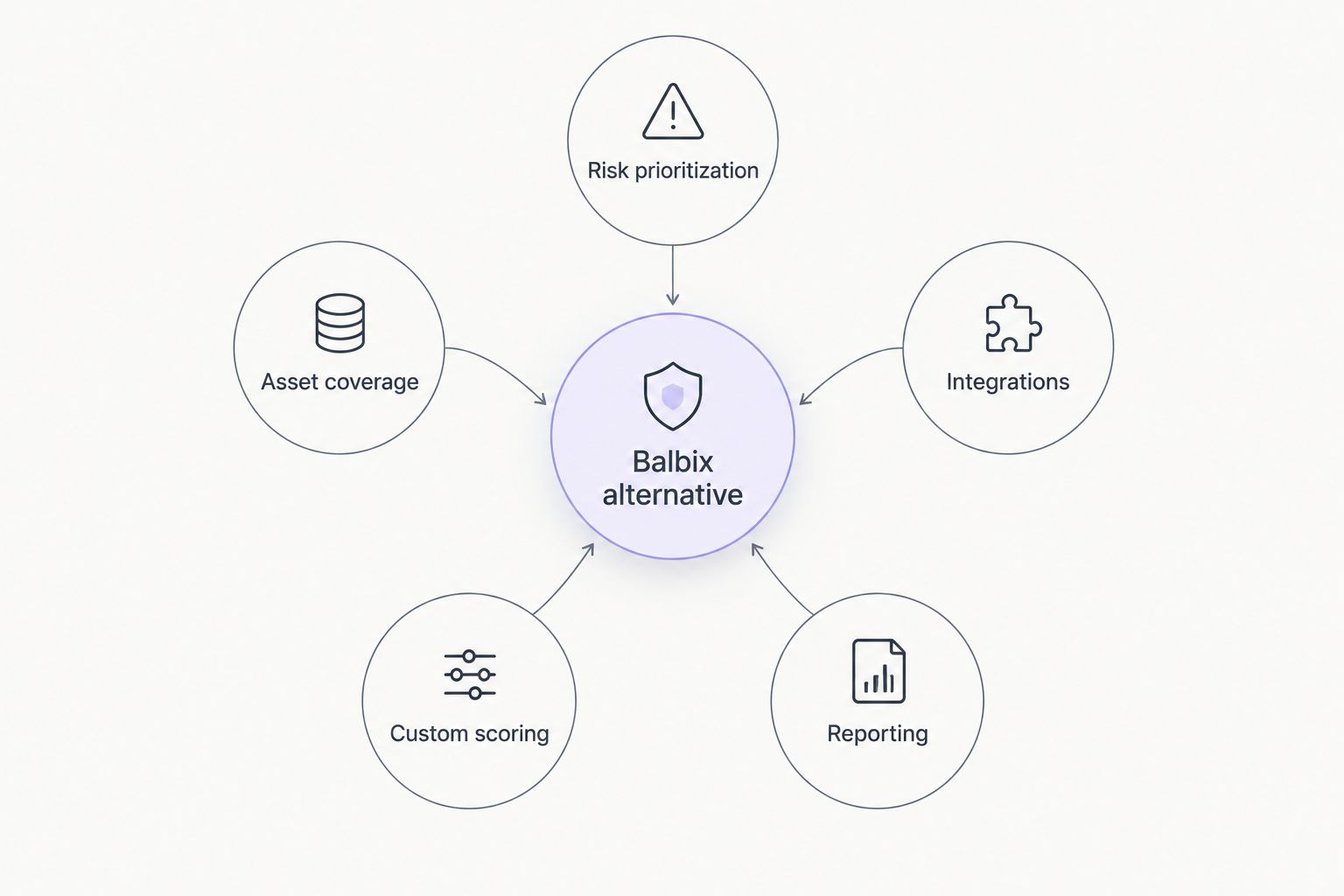
Security teams evaluating balbix alternatives in 2026 usually hit one of three walls: asset coverage gaps in cloud and container environments, prioritization models that don't reflect the org's actual risk tolerance, or integration friction with existing scanners and ticketing systems. None of these are unique to Balbix — every risk-based vulnerability management platform makes tradeoffs somewhere.
The Brinqa platform approaches this from the exposure management side: unify asset and vulnerability data from every existing scanner, then let the team build a scoring model that matches how the business actually weighs risk, instead of accepting a vendor's default formula. That's the lens for this ranking — not which tool has the most features, but which one fits a specific operating model.
What makes the best Balbix alternative
- Risk prioritization beyond raw CVSS — factoring in exploit intelligence, EPSS scores, and asset business context
- Broad asset coverage — cloud, on-prem, container, and increasingly OT/IoT environments in one inventory
- Native integrations — with existing scanners, SIEM platforms, and ticketing tools like Jira or ServiceNow
- Configurable scoring models — the ability to weight severity by business unit, compliance requirement, or exposure window
- Reporting for two audiences — analyst-level detail for triage and board-level rollups for governance
- Deployment flexibility — SaaS, on-prem, or air-gapped, depending on the environment
Balbix alternatives at a glance
| Platform | Best For | Standout Feature | Key Limitation |
|---|---|---|---|
| Brinqa | Risk-based exposure management across hybrid environments | Custom, business-weighted risk scoring models | Configuration takes more upfront effort than a plug-and-play scanner |
| Tenable | Enterprise network vulnerability scanning at scale | Deep Nessus-based scan coverage across large networks | Prioritization historically leans more on severity than business risk context |
| Qualys VMDR | Compliance-driven vulnerability audits | Agent-based continuous scanning tied to compliance frameworks | Module sprawl can make the platform feel fragmented |
| Rapid7 InsightVM | SOC teams running detection and remediation together | Tight native integration with InsightIDR and SIEM workflows | Cloud asset coverage outside core integrations trails dedicated CSPM tools |
| CrowdStrike Falcon Spotlight | Endpoint-first security stacks already on Falcon | Real-time exposure data from the existing Falcon agent | Visibility limited to assets with the agent installed |
| Palo Alto Cortex Xpanse | External attack surface discovery | Continuous internet-facing asset discovery | Less built out for internal vulnerability remediation workflows |
1. Brinqa: best overall Balbix alternative for risk-based exposure management
Brinqa pulls vulnerability, asset, and threat data from existing scanners, cloud providers, and security tools into one data model, then applies a scoring layer teams can customize instead of inheriting a fixed formula. That configurability is the core differentiator for organizations that tried Balbix's approach and found the risk model didn't match how their business actually prioritizes exposure across cloud, on-prem, and container environments.
Brinqa pros:
- Custom risk scoring models built around business unit, compliance requirement, or exploit likelihood
- Broad connector library across scanners, CMDBs, cloud providers, and ticketing systems
- Handles hybrid environments including network security team workflows without forcing a single scanner vendor
Brinqa cons:
- Initial setup and scoring model configuration takes more effort than an out-of-box scanner dashboard
- Value depends on having reasonably clean upstream asset data to correlate against
Best for: security teams that already run multiple scanners and need one prioritization layer on top, not another scanner.
2. Tenable: best for enterprise network vulnerability scanning at scale
Tenable's scanning engine, built on the Nessus heritage, covers large, distributed networks with a scan-first approach that many enterprise IT teams already trust. It's a fit for organizations whose primary gap with Balbix wasn't prioritization logic but raw scan coverage and scheduling flexibility across thousands of assets.
Tenable pros:
- Extensive scan coverage across on-prem and hybrid networks
- Established scheduling and asset discovery tooling for large environments
- Wide market adoption means broad community and integration support
Tenable cons:
- Prioritization logic has historically weighted severity scores more heavily than business risk context
- Advanced exposure management capabilities often require additional modules beyond core scanning
Best for: enterprise IT teams whose priority is scan breadth and network coverage first, prioritization second.
3. Qualys VMDR: best for compliance-driven vulnerability audits
Qualys VMDR combines vulnerability detection, prioritization, and patch tracking in a single agent-based platform built to satisfy recurring audit and compliance cycles. Teams that need continuous evidence for frameworks like PCI DSS or SOC 2 often pick Qualys over Balbix specifically for its compliance-oriented reporting.
Qualys VMDR pros:
- Continuous agent-based scanning reduces gaps between audit windows
- Reporting built with compliance frameworks in mind
- Patch management tied directly to vulnerability data in the same platform
Qualys VMDR cons:
- Multiple modules can make the platform feel fragmented for teams that just want core VM
- Agent deployment overhead on large, diverse fleets
Best for: compliance and audit teams that need continuous, documented vulnerability coverage.
4. Rapid7 InsightVM: best for SOC teams running detection and remediation together
Rapid7 InsightVM ties vulnerability data directly into InsightIDR and the broader Rapid7 detection stack, which matters for SOC teams that want scan findings and live detections in the same workflow instead of two separate tools. That integration depth is the main reason teams evaluating Balbix alternatives in 2026 land on Rapid7 when their SIEM is already Rapid7-native.
Rapid7 InsightVM pros:
- Native integration with InsightIDR and Rapid7's detection stack
- Remediation workflow tracking built into the same console as vulnerability data
- Live dashboards useful for SOC triage
Rapid7 InsightVM cons:
- Cloud and multi-cloud asset coverage trails dedicated CSPM-first platforms
- Full value depends on running other Rapid7 products alongside it
Best for: SOC teams that want vulnerability data inside the same platform as detection and response.
5. CrowdStrike Falcon Spotlight: best for endpoint-first security stacks
Falcon Spotlight rides on the existing CrowdStrike Falcon agent to surface vulnerability exposure without deploying a separate scanning tool. For organizations already standardized on CrowdStrike for EDR, that's a real operational shortcut compared to running Balbix as a separate system.
Falcon Spotlight pros:
- No separate agent deployment for teams already running Falcon
- Real-time exposure data tied to endpoint telemetry
- Simplifies vendor count for CrowdStrike-standardized environments
Falcon Spotlight cons:
- Visibility limited to assets with the Falcon agent installed — no agentless or unmanaged asset scanning
- Less suited to network devices, cloud-native workloads, or OT environments
Best for: organizations already standardized on CrowdStrike Falcon that want exposure data without a second agent.
6. Palo Alto Cortex Xpanse: best for external attack surface discovery
Cortex Xpanse focuses on continuously discovering internet-facing assets an organization may not know it owns — the shadow IT and forgotten subdomain problem Balbix doesn't specifically target. It's a narrower tool than Balbix by design, built for external exposure rather than internal vulnerability remediation.
Cortex Xpanse pros:
- Continuous discovery of internet-facing assets, including unmanaged and shadow IT
- Strong fit for organizations worried about unknown external exposure
- Complements, rather than replaces, internal vulnerability management
Cortex Xpanse cons:
- Not built as a full internal vulnerability remediation workflow
- Works best paired with another platform for internal asset prioritization
Best for: security teams whose biggest gap is unknown external attack surface, not internal scan-and-fix workflows.
“The right Balbix alternative is the one that matches your existing scanner stack, not the one with the longest feature list.”
See how Brinqa prioritizes exposure
Connect existing scanners and build a custom risk scoring model in one platform.
How these Balbix alternatives were ranked
Each platform was weighed against the six criteria above: prioritization depth beyond CVSS, asset coverage breadth, integration maturity, scoring flexibility, dual-audience reporting, and deployment options. No single platform wins on every criterion — that's why the list is organized by use case instead of a single leaderboard, since a compliance team and a SOC team need different things from a balbix alternatives search in 2026.
Which Balbix alternative should you choose?
If the gap with Balbix was prioritization logic that didn't match business risk, Brinqa's configurable scoring model is the strongest starting point. If the gap was raw scan coverage across a large network, Tenable is the safer default. Compliance-first teams should test Qualys VMDR before anything else, and SOC teams already inside Rapid7's ecosystem gain more from InsightVM's native integration than from switching platforms entirely. CrowdStrike Falcon Spotlight and Palo Alto Cortex Xpanse are worth adding alongside a core VM platform, not as full replacements for one.
FAQ
What's the best alternative to Balbix in 2026?
Brinqa is the strongest overall balbix alternative in 2026 for teams that need custom, business-weighted risk scoring across hybrid and cloud environments. Tenable and Qualys VMDR are stronger picks for network scanning scale and compliance auditing respectively.
Is Brinqa better than Balbix for risk-based vulnerability management?
Brinqa differentiates on configurable scoring models that let teams weight risk by business unit or compliance need rather than a fixed formula. Whether it's "better" depends on whether that flexibility matters more than out-of-box simplicity for a given team.
How much does a Balbix alternative cost?
Pricing for platforms like Brinqa, Tenable, Qualys VMDR, and Rapid7 InsightVM typically requires a custom quote based on asset count and deployment scope. Check current pricing directly with each vendor rather than relying on published list prices, which change frequently.
Is Tenable a good alternative to Balbix?
Tenable is a strong alternative for organizations whose main need is broad network scan coverage across a large, distributed environment. Its prioritization model has historically leaned on severity scoring more than the business-context weighting Balbix and Brinqa emphasize.
What's the difference between vulnerability management and exposure management?
Vulnerability management focuses on scanning and patching known CVEs, while exposure management widens the scope to include misconfigurations, external attack surface, and business risk context across all asset types. Most 2026 buyers evaluating Balbix alternatives are really comparing exposure management platforms, not just scanners.
Which Balbix alternative works best for compliance audits?
Qualys VMDR is built specifically around continuous, audit-ready reporting for frameworks like PCI DSS and SOC 2. Teams whose primary driver is compliance evidence generally get more out of Qualys than a pure risk-prioritization platform.
Can I replace Balbix with a free or open-source tool?
Open-source scanners can cover basic vulnerability detection, but they don't replicate risk-based prioritization, asset correlation, or custom scoring models the way Balbix or its commercial alternatives do. Free tools work best as a supplement to a commercial platform, not a full replacement.
How do I evaluate a Balbix alternative before switching?
Map current gaps against the six criteria that matter most: prioritization depth, asset coverage, integration maturity, scoring flexibility, reporting for both analysts and leadership, and deployment fit. Run a proof of concept against real scan data before committing, since demo environments rarely surface integration friction.
One last thing
Most teams shopping for balbix alternatives in 2026 focus on feature checklists and miss the real question: whose default risk-scoring formula matches how the business actually thinks about exposure. That mismatch, not a missing feature, is usually why the original tool got shortlisted for replacement in the first place.