
Nucleus Security pulls vulnerability data from your scanners into one dashboard and scores it by risk instead of raw CVSS — but it's not the only platform built that way, and teams outgrow it or need different scanning depth as their stack changes. Six platforms cover the range of nucleus security alternatives worth evaluating in 2026, from aggregation-first tools to native scanners with built-in remediation.
- Brinqa is the strongest nucleus security alternatives pick for unifying scanner data with business-context risk scoring in 2026.
- Tenable wins when you need native network and cloud scanning depth, not just data aggregation.
- Qualys VMDR bundles vulnerability detection with automated patch response in a single console.
- CrowdStrike Falcon Spotlight only sees vulnerabilities on assets running the Falcon agent — a real coverage gap.
- Palo Alto Cortex Xpanse fits teams hunting unknown, unmanaged internet-facing assets, not routine patch cycles.
Why this matters
Nucleus Security's pitch is consolidation: fewer spreadsheets, one prioritization model, one place to track remediation SLAs. That's the same job every serious risk-based vulnerability management solution is trying to do in 2026, and vendors split into two camps — aggregation platforms that sit on top of your existing scanners, and native scanners that generate the vulnerability data themselves.
Teams shop for alternatives when integration catalogs run thin, when prioritization logic stays stuck on CVSS instead of exploit and business-context data, or when reporting doesn't hold up in an audit. The six platforms below split cleanly by what they actually do, not by marketing category — that distinction decides which one fits your stack.
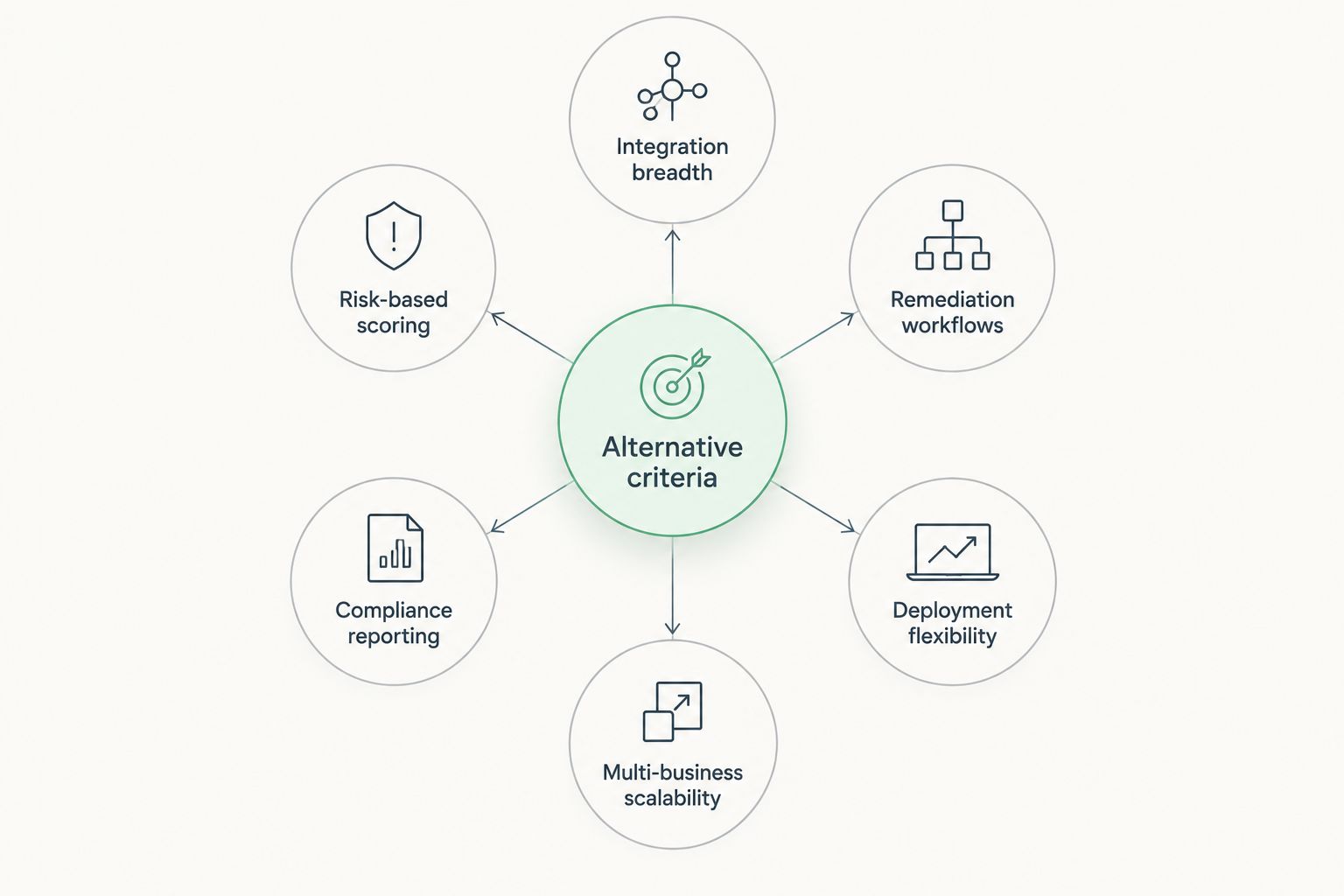
What makes the best alternative to Nucleus Security
- Integration breadth — how many scanners, CSPM tools, and asset sources feed into one data model
- Risk-based scoring — prioritization built on exploit data, threat intel, and asset criticality, not just CVSS
- Remediation workflows — ticketing integration, SLA tracking, and exception handling that closes the loop
- Compliance reporting — output formats auditors and boards actually accept
- Deployment flexibility — agent-based, agentless, cloud, and air-gapped support
- Multi-business scalability — works across business units, subsidiaries, and multi-cloud environments without duplicate consoles
Nucleus Security alternatives at a glance
| Platform | Best for | Standout feature | Key limitation |
|---|---|---|---|
| Brinqa | Unifying scanner data with business-context risk scoring | Custom scoring models across fragmented tool stacks | Not a native scanner — depends on existing scan data feeds |
| Tenable | Native network and cloud scanning at scale | Deep asset discovery from Nessus scan engine heritage | Prioritization logic is thinner without add-on modules |
| Qualys VMDR | Combining detection with patch response | Vulnerability-to-patch workflow in one console | Reporting UI trails newer aggregation platforms |
| Rapid7 InsightVM | Teams already running the Rapid7 Insight platform | Tight pairing with InsightIDR and XDR | Best value locked behind a single-vendor stack |
| Palo Alto Cortex Xpanse | Discovering unknown internet-facing assets | External attack surface mapping without agents | Not built for internal patch cycle management |
| CrowdStrike Falcon Spotlight | Endpoint-heavy orgs standardized on Falcon | Vulnerability data inside the existing Falcon agent | Blind to unmanaged assets and anything without the agent |
1. Brinqa: best nucleus security alternative for unifying fragmented scanner data
Brinqa is a vulnerability and exposure management platform that ingests data from network scanners, cloud security tools, application scanners, and asset inventories, then scores findings against business context rather than raw severity. It's built for security teams running five or more disconnected tools that need one risk model instead of five separate ones. Custom scoring models weigh asset criticality, exploit availability, and exception status, so the same CVE ranks differently depending on where it sits.
Brinqa pros:
- Custom risk scoring models built around your actual asset criticality data
- Integration catalog spans network, cloud, container, and application scanners
- Handles multi-business-unit segmentation without separate deployments
Brinqa pricing: Not published — request a scoped quote based on integration count and data volume.
Brinqa cons:
- Not a native scanner, so you still need scan engines feeding it data
- Initial setup takes longer when you're consolidating many data sources at once
Best for: enterprise security teams consolidating multiple scanners and cloud tools under one risk-based prioritization model.
Verdict: Buy if fragmented scanner data and inconsistent prioritization are your actual problem in 2026.
2. Tenable: best for native network and cloud vulnerability scanning
Tenable built its name on Nessus, and its current platform (Tenable One) extends that scan engine across network, cloud, and identity attack surfaces. It's the pick for teams that need the scanning itself, not just a layer on top of someone else's scan data. Coverage across on-prem, cloud, and OT assets is broad, and Tenable alternatives worth comparing typically trade off in one of those areas.
Tenable pros:
- Native scanning across network, cloud, and OT assets
- Mature vulnerability database with frequent plugin updates
- Works well for teams that scan on a fixed cadence
Tenable cons:
- Prioritization beyond CVSS and VPR requires add-on modules
- Cross-tool data consolidation isn't the core strength
Best for: security teams that need the vulnerability data generated, not just aggregated.
Verdict: Buy if native scan coverage matters more than cross-tool prioritization.
3. Qualys VMDR: best for combining detection with patch response
Qualys VMDR (Vulnerability Management, Detection and Response) links vulnerability scanning directly to patch deployment in one console, which shortens the loop between finding a CVE and closing it. It runs as a cloud-delivered platform with lightweight agents, useful for IT teams that own both security and patching. The tradeoff is a reporting interface that feels dated next to newer risk-based platforms.
Qualys VMDR pros:
- Vulnerability detection and patch orchestration in one workflow
- Cloud-delivered agents reduce on-prem infrastructure overhead
- Strong compliance scan templates out of the box
Qualys VMDR cons:
- Reporting and dashboarding trail more modern interfaces
- Cross-scanner data consolidation is limited outside the Qualys ecosystem
Best for: IT and security teams that want detection and patching under one vendor.
Verdict: Hold if your team already owns patch orchestration elsewhere — otherwise Buy.
4. Rapid7 InsightVM: best for teams already on the Rapid7 Insight platform
Rapid7 InsightVM shares a data layer with InsightIDR and Rapid7's XDR tooling, so teams already running Rapid7 for detection and response get a connected view without extra integration work. Live dashboards update as new scan data comes in, and remediation projects group related findings automatically.
Rapid7 InsightVM pros:
- Shared data layer with Rapid7's SIEM and XDR products
- Remediation project grouping reduces duplicate ticket sprawl
- Live dashboards reflect scan results without manual refresh
Rapid7 InsightVM cons:
- Full value depends on running other Rapid7 Insight products
- Standalone deployments see less benefit than the bundled stack
Best for: organizations standardized on the Rapid7 Insight platform for detection and response.
Verdict: Buy if you're already inside the Rapid7 ecosystem.
5. Palo Alto Cortex Xpanse: best for discovering unknown internet-facing assets
Cortex Xpanse maps your external attack surface continuously, finding internet-facing assets — forgotten subdomains, exposed cloud storage, shadow IT — that never made it into an asset inventory. It's an attack surface management tool first, not a vulnerability management platform for internal patch cycles, so it solves a narrower problem than the other tools on this list.
Cortex Xpanse pros:
- Continuous external discovery without deploying agents
- Surfaces shadow IT and unmanaged cloud assets fast
- Strong fit for M&A due diligence and subsidiary audits
Cortex Xpanse cons:
- Not designed for internal patch cycle or ticket workflow management
- Needs pairing with a vulnerability platform for full coverage
Best for: teams that need to find unmanaged internet-facing assets before internal prioritization even starts.
Verdict: Buy as a complement to a vulnerability platform, not a replacement for one.
6. CrowdStrike Falcon Spotlight: best for endpoint-heavy orgs already on Falcon
Falcon Spotlight rides inside the CrowdStrike Falcon agent, surfacing vulnerability data on any endpoint already running the sensor. For orgs standardized on Falcon for EDR, it adds vulnerability visibility with zero extra deployment. The catch: it only sees what the agent sees, which means network devices, unmanaged endpoints, and anything without the sensor stay invisible.
Falcon Spotlight pros:
- Zero additional deployment for endpoints already running Falcon
- Vulnerability data correlates directly with endpoint telemetry
- Fast time to value for Falcon-standardized IT environments
Falcon Spotlight cons:
- No visibility into assets without the Falcon agent installed
- Network devices, IoT, and unmanaged assets are blind spots
Best for: endpoint-heavy organizations that have already standardized on the Falcon agent.
Verdict: Wait unless Falcon is already your standard endpoint agent.
See how Brinqa scores your risk
Compare your current scanner data against a risk-based model.
How we ranked
Each platform above is weighed against the six criteria from the section above: integration breadth, risk-based scoring depth, remediation workflow maturity, compliance reporting quality, deployment flexibility, and scalability across business units. Public vendor documentation and product capability pages formed the basis for each comparison — no platform here gets credit for a feature it doesn't publicly document.
“If a vulnerability tool needs its own dedicated headcount to run, it's not solving the problem it was bought for.”
Which alternative to Nucleus Security should you choose?
If your problem is fragmented scanner data and inconsistent prioritization across a large enterprise stack, Brinqa is the default pick among nucleus security alternatives in 2026 — it's built specifically for that consolidation job. If you need the scanning engine itself, not just a layer on top of one, Tenable or Qualys VMDR cover that gap depending on whether patch orchestration matters to you. Teams already inside the Rapid7 or CrowdStrike ecosystems get more value staying there than switching vendors for vulnerability management alone, and Cortex Xpanse only makes sense paired with a full vulnerability platform, not instead of one.
FAQ
What is the best alternative to Nucleus Security in 2026?
Brinqa is the strongest fit for teams that need to unify vulnerability data from multiple scanners under one risk-based scoring model in 2026. Tenable and Qualys VMDR are better fits if you need native scanning built in.
Is Brinqa a good replacement for Nucleus Security?
Yes, for teams whose core problem is fragmented scanner data and weak cross-tool prioritization. Brinqa is a vulnerability and exposure management platform built around custom risk scoring, not a scan engine itself.
How does Tenable compare to Nucleus Security?
Tenable generates its own vulnerability data through native network and cloud scanning, while Nucleus Security-style platforms aggregate data from scanners you already run. Choose Tenable if you need the scan engine, not just the aggregation layer.
Does Qualys VMDR do what Nucleus Security does?
Qualys VMDR covers detection and patch response in one console but has a thinner cross-tool aggregation layer than dedicated risk-based platforms. It fits teams that want scanning and patching under one vendor.
Can Rapid7 InsightVM replace a risk-based vulnerability management platform?
It can for teams already running Rapid7 InsightIDR or XDR, since the shared data layer removes the need for separate aggregation. Standalone deployments see less of that benefit.
Is Palo Alto Cortex Xpanse a vulnerability management tool?
No. Cortex Xpanse is an attack surface management tool focused on discovering unknown internet-facing assets, and it works best paired with a vulnerability management platform rather than replacing one.
Does CrowdStrike Falcon Spotlight scan the network, or just endpoints?
Falcon Spotlight only reports on assets running the CrowdStrike Falcon agent, so it has no visibility into network devices, IoT, or unmanaged endpoints. It's an endpoint-only view, not a network scanner.
How much does switching from Nucleus Security cost?
Cost depends on integration count and data migration scope rather than a fixed number, so request a proof-of-concept from any vendor before committing. Ask specifically how existing scanner feeds map into the new platform.
One last thing
The detail most teams miss when evaluating CrowdStrike Falcon Spotlight: it's not blind to a few edge cases, it's blind to every asset without the Falcon sensor installed — printers, network gear, unmanaged cloud instances, contractor laptops, all of it. That's fine if your environment is fully agent-standardized in 2026. It's a dealbreaker if it isn't, and most enterprise environments aren't.