
Best overall: Wiz. Best for unifying cloud findings into one exposure management program: Brinqa. Best budget-native pick for Azure-only shops: Microsoft Defender for Cloud.
- Orca Security alternatives worth evaluating in 2026 include Wiz, Brinqa, Microsoft Defender for Cloud, CrowdStrike Falcon Cloud Security, Tenable Cloud Security, and Aqua Security.
- Wiz wins on agentless cloud coverage across AWS, Azure, and GCP with graph-based risk mapping.
- Brinqa is the pick for teams that need cloud findings correlated with on-prem and application vulnerability data in one risk model.
- Microsoft Defender for Cloud makes sense only if your workloads are concentrated on Azure.
- None of these six tools do everything Orca Security does out of the box - pick based on what you're already running.
Why this matters
Teams shopping for orca security alternatives are usually hitting one of two walls: cost at renewal, or a coverage gap Orca doesn't close - correlating cloud posture findings with the rest of the vulnerability backlog sitting in Jira, ServiceNow, or a SIEM.
Orca Security does agentless cloud workload and posture scanning well. What it doesn't do is tell a CISO how a cloud misconfiguration ranks against a critical CVE sitting on a production database server three business units away. That gap is what pushes security teams toward cloud security posture management tools that either replace Orca outright or sit on top of it to unify the risk picture.
The six platforms below split into two camps: direct feature-for-feature replacements for Orca's scanning engine, and platforms built to consolidate Orca's output (or any scanner's output) into a single prioritized queue. Know which problem you're solving before you pick.
What makes the best Orca Security alternative
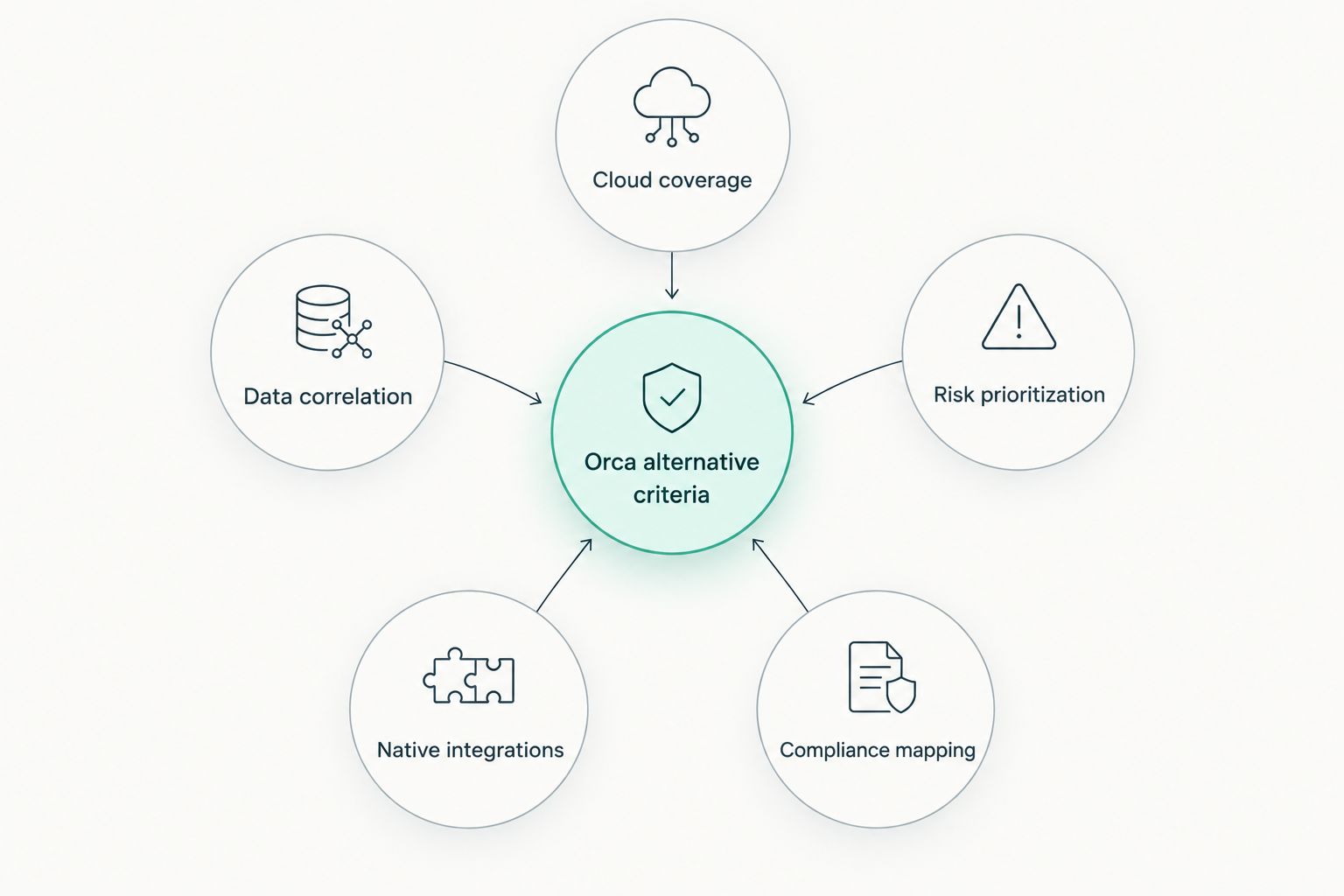
- Cloud coverage without agent sprawl - AWS, Azure, and GCP visibility without deploying agents on every workload
- Cross-source correlation - cloud findings sit next to network, application, and endpoint vulnerability data, not in a separate dashboard
- Risk prioritization beyond raw severity - CVSS scores alone (the scale runs 0 to 10) don't tell you what's exploitable; EPSS scoring (0 to 1) and business context matter more
- Native integrations - ticketing, SIEM, and CI/CD pipelines without custom scripting
- Compliance mapping - SOC 2, ISO 27001, and FedRAMP evidence generation built in, not bolted on
- Vendor roadmap stability - multi-cloud investment that keeps pace with where your infrastructure is actually heading
Orca Security alternatives at a glance
| Tool | Best for | Standout feature | Key limitation |
|---|---|---|---|
| Brinqa | Unifying cloud and on-prem vulnerability data | Correlates findings across scanners, cloud tools, and ticketing systems into one risk model | Not a cloud scanner itself - needs source data feeding in |
| Wiz | Agentless, graph-based cloud risk visualization | Maps toxic combinations across cloud resources without deploying agents | Cloud-only - doesn't extend into legacy on-prem or OT vulnerability management |
| Microsoft Defender for Cloud | Azure-native shops on Microsoft E5 | Direct integration with Azure Policy and Microsoft Sentinel | Weaker multi-cloud story outside Azure |
| CrowdStrike Falcon Cloud Security | Teams standardized on the Falcon agent | Single-agent architecture shared with Falcon endpoint protection | Cloud coverage tied to broader Falcon platform adoption |
| Tenable Cloud Security | Teams wanting cloud and on-prem scanning under one vendor | Cloud posture data lives alongside core Tenable vulnerability management | Cloud module is younger than Tenable's core VM product |
| Aqua Security | Container and Kubernetes runtime protection | Purpose-built image scanning and runtime defense for containerized workloads | Narrower scope than full cloud posture management |
1. Brinqa: best Orca Security alternative for unifying vulnerability data
Brinqa is a vulnerability and exposure management platform built to pull findings from cloud tools, network scanners, application security testing, and ticketing systems into one prioritized risk model. Instead of replacing Orca's cloud scanning outright, Brinqa is often deployed to sit on top of it - correlating cloud posture findings with everything else a security team already tracks.
For organizations running Orca alongside three or four other scanners, that correlation layer is the actual gap Orca leaves open. Brinqa's positioning fits teams that have outgrown spreadsheets for tracking remediation across cloud and on-prem assets and need a single view for multi-cloud exposure management.
Brinqa pros:
- Consolidates findings from multiple scanners and cloud tools into one prioritized queue
- Builds custom risk scoring beyond raw CVSS severity
- Maps vulnerability data to compliance frameworks like SOC 2 and ISO 27001
Brinqa cons:
- Requires existing scan sources feeding in - it doesn't replace Orca's agentless cloud scanning engine on its own
- Setup work is heavier than a point cloud scanner if you're starting from zero tooling
Brinqa pricing: contact sales for current terms.
Best for: security teams that need cloud findings correlated with the rest of their vulnerability backlog, not just another cloud dashboard.
Verdict: Buy if consolidation across tools is the actual problem, not cloud scanning coverage alone.
2. Wiz: best Orca Security alternative for agentless cloud coverage
Wiz scans AWS, Azure, and GCP without deploying agents and builds a security graph connecting misconfigurations, exposed secrets, and vulnerable workloads into attack path visualizations. It's the closest direct replacement for what Orca Security does today.
Wiz pros:
- Agentless deployment across all major cloud providers
- Graph-based visualization of toxic combinations, not isolated findings
- Broad adoption means a mature partner and integration ecosystem
Wiz cons:
- Cloud-only - no meaningful coverage for legacy on-prem infrastructure or OT environments
- Feature overlap with Orca means switching costs are mostly about contract terms, not capability gaps
Best for: teams that want a direct, feature-for-feature Orca Security replacement.
Verdict: Buy if cloud-only coverage is genuinely all you need.
3. Microsoft Defender for Cloud: best for Azure-only environments
Microsoft Defender for Cloud extends posture management and workload protection natively into Azure, with tight integration into Azure Policy and Microsoft Sentinel. For shops already licensing Microsoft E5, it's often the lowest-friction option to evaluate.
Microsoft Defender for Cloud pros:
- Native integration with Azure Policy and Sentinel
- Familiar interface for teams already in the Microsoft security stack
- Bundled licensing can simplify procurement for Microsoft-heavy organizations
Microsoft Defender for Cloud cons:
- Multi-cloud coverage for AWS and GCP lags behind Azure-native depth
- Less mature attack path analysis than cloud-native specialists like Wiz
Best for: organizations running most workloads on Azure with existing Microsoft security licensing.
Verdict: Hold unless your infrastructure is Azure-concentrated - the multi-cloud gaps show up fast otherwise.
4. CrowdStrike Falcon Cloud Security: best for existing Falcon shops
CrowdStrike Falcon Cloud Security runs on the same single-agent architecture as Falcon endpoint protection, extending cloud workload protection to teams already standardized on CrowdStrike.
CrowdStrike Falcon Cloud Security pros:
- Shares an agent and console with existing Falcon endpoint deployments
- Threat intelligence correlation across endpoint and cloud in one platform
- Strong runtime detection for cloud workloads
CrowdStrike Falcon Cloud Security cons:
- Cloud security value is tied to broader Falcon platform adoption - less compelling as a standalone buy
- Posture management depth is newer than Falcon's endpoint detection heritage
Best for: security teams already running Falcon for endpoint protection who want cloud coverage in the same console.
Verdict: Hold if you're not already a Falcon customer - evaluate on cloud merits alone first.
5. Tenable Cloud Security: best for unifying cloud and on-prem scanning
Tenable Cloud Security extends Tenable's core vulnerability management data into cloud posture, giving teams already running Tenable.io or Tenable.sc a path to add cloud coverage under one vendor relationship.
Tenable Cloud Security pros:
- Cloud findings sit alongside Tenable's established on-prem vulnerability management data
- Single vendor relationship for teams already licensing Tenable
- Reduces the number of dashboards analysts have to check daily
Tenable Cloud Security cons:
- Cloud module is younger and less feature-dense than Tenable's core VM product
- Attack path graphing is less developed than Wiz's
Best for: existing Tenable customers who want to add cloud coverage without a new vendor.
Verdict: Wait if you're not already a Tenable shop - the consolidation benefit only applies if you're already there.
6. Aqua Security: best for container and Kubernetes environments
Aqua Security focuses specifically on container image scanning and runtime protection for Kubernetes clusters, a narrower scope than Orca Security's broader cloud posture coverage.
Aqua Security pros:
- Purpose-built scanning for container images and Kubernetes workloads
- Runtime protection designed specifically for containerized environments
- Strong fit for teams with heavy Kubernetes footprints
Aqua Security cons:
- Doesn't cover general cloud posture management the way Orca or Wiz do
- Narrower scope means most teams still need a separate CSPM tool alongside it
Best for: teams whose primary exposure is containerized workloads, not general cloud infrastructure.
Verdict: Skip as a full Orca replacement - Buy as a companion tool if Kubernetes is your biggest exposure.
How we ranked
Each tool got scored against the six criteria above: cloud coverage without agent sprawl, cross-source correlation, prioritization beyond raw CVSS, native integrations, compliance mapping, and roadmap stability. No tool scored a perfect six - that's the honest state of the orca security alternatives market in 2026.
Which Orca Security alternative should you choose?
If you need a direct, cloud-only replacement for Orca's scanning engine, Wiz is the safest default in 2026 - agentless, multi-cloud, and mature. If the actual pain point is fragmented vulnerability data across cloud, network, and application sources, Brinqa solves the correlation problem Orca never tried to solve. If your infrastructure lives almost entirely in Azure, Microsoft Defender for Cloud removes a vendor relationship without adding one.
For everyone still undecided: start by writing down which teams currently pull vulnerability data into which dashboard. If that list has more than two tools on it, correlation - not scanning - is your bottleneck in 2026.
See how Brinqa unifies exposure data
Correlate cloud, network, and application findings in one risk model.
FAQ
What is the best Orca Security alternative in 2026?
Wiz is the closest direct replacement for Orca's agentless cloud scanning in 2026. Brinqa is the better fit if the real problem is correlating cloud findings with on-prem and application vulnerability data.
Is Wiz better than Orca Security?
Wiz and Orca Security both offer agentless multi-cloud posture scanning with graph-based risk mapping, and the choice usually comes down to contract terms and existing tooling rather than a capability gap.
Does Brinqa replace Orca Security's cloud scanning?
No. Brinqa is a vulnerability and exposure management platform that correlates findings from cloud scanners, network tools, and application security testing - it typically sits on top of a cloud scanner rather than replacing one outright.
Which Orca Security alternative works best for Azure-only environments?
Microsoft Defender for Cloud is the strongest fit for Azure-concentrated infrastructure, with native integration into Azure Policy and Microsoft Sentinel.
Can CrowdStrike Falcon Cloud Security replace Orca Security?
It can for teams already running CrowdStrike Falcon for endpoint protection, since cloud coverage shares the same agent and console. Standalone buyers should evaluate it on cloud merits alone first.
Is Tenable Cloud Security a good Orca Security alternative?
It works well for organizations already running Tenable's core vulnerability management product, since cloud findings sit alongside existing on-prem data. New Tenable customers get less consolidation benefit.
What's the difference between Orca Security and container security tools like Aqua?
Orca Security covers broad cloud posture management across cloud accounts, while Aqua Security focuses specifically on container image scanning and Kubernetes runtime protection - a narrower but deeper scope.
How do I prioritize vulnerabilities across multiple cloud and on-prem tools?
Prioritization frameworks that combine CVSS severity (0-10 scale) with EPSS exploitability scoring (0-1 scale) and business context give a more accurate risk picture than any single tool's default severity rating.
One last thing
Most teams evaluating orca security alternatives in 2026 are really running two searches at once - a cloud scanner search and a data consolidation search - without realizing they're separate problems. Buying a cloud-only replacement like Wiz when the real gap is correlation just moves the fragmentation to a different dashboard.