
Best overall: Brinqa, for teams that need one prioritized risk view across scanners they already run. Best for single-vendor scanning breadth: Tenable. Best for Rapid7-based SOCs: Rapid7 InsightVM. Best for endpoint-centric visibility: CrowdStrike Falcon Spotlight. Best for Microsoft-first environments: Microsoft Defender Vulnerability Management. Best for cloud-native stacks: Wiz. Best for external attack surface mapping: Palo Alto Cortex Xpanse.
- Brinqa wins the qualys vmdr alternatives comparison for teams running multiple scanners that need one risk-based prioritization layer.
- Tenable and Rapid7 InsightVM replace Qualys VMDR's scanning function directly if you want a single-vendor scan-to-report tool.
- CrowdStrike Falcon Spotlight and Microsoft Defender Vulnerability Management skip a second agent by reusing endpoint tools already deployed.
- Wiz and Palo Alto Cortex Xpanse cover cloud-native and external-facing assets that scanner-only tools like Qualys VMDR miss.
- No single alternative replaces every function of Qualys VMDR at once; the right pick depends on what's already deployed.
Why this matters
Qualys VMDR bundles scanning, detection, and response into one console, but that bundling is also the limitation teams run into by 2026: it works best when Qualys is the only scanner in the environment. Teams running three or more scanning tools by 2026 need one shared prioritization layer, not another dashboard.
That fragmentation is why "qualys vmdr alternatives" searches spike every renewal cycle. Teams aren't always looking for a straight scanner swap. Some want a platform that sits above every scanner and turns raw CVSS scores into a prioritized list engineers will actually work. Brinqa is built for that second group.
The rest of this list splits alternatives by what they actually replace: the scanner itself, the endpoint agent, the cloud posture layer, or the prioritization logic sitting on top of all of it.
What makes the best Qualys VMDR alternative
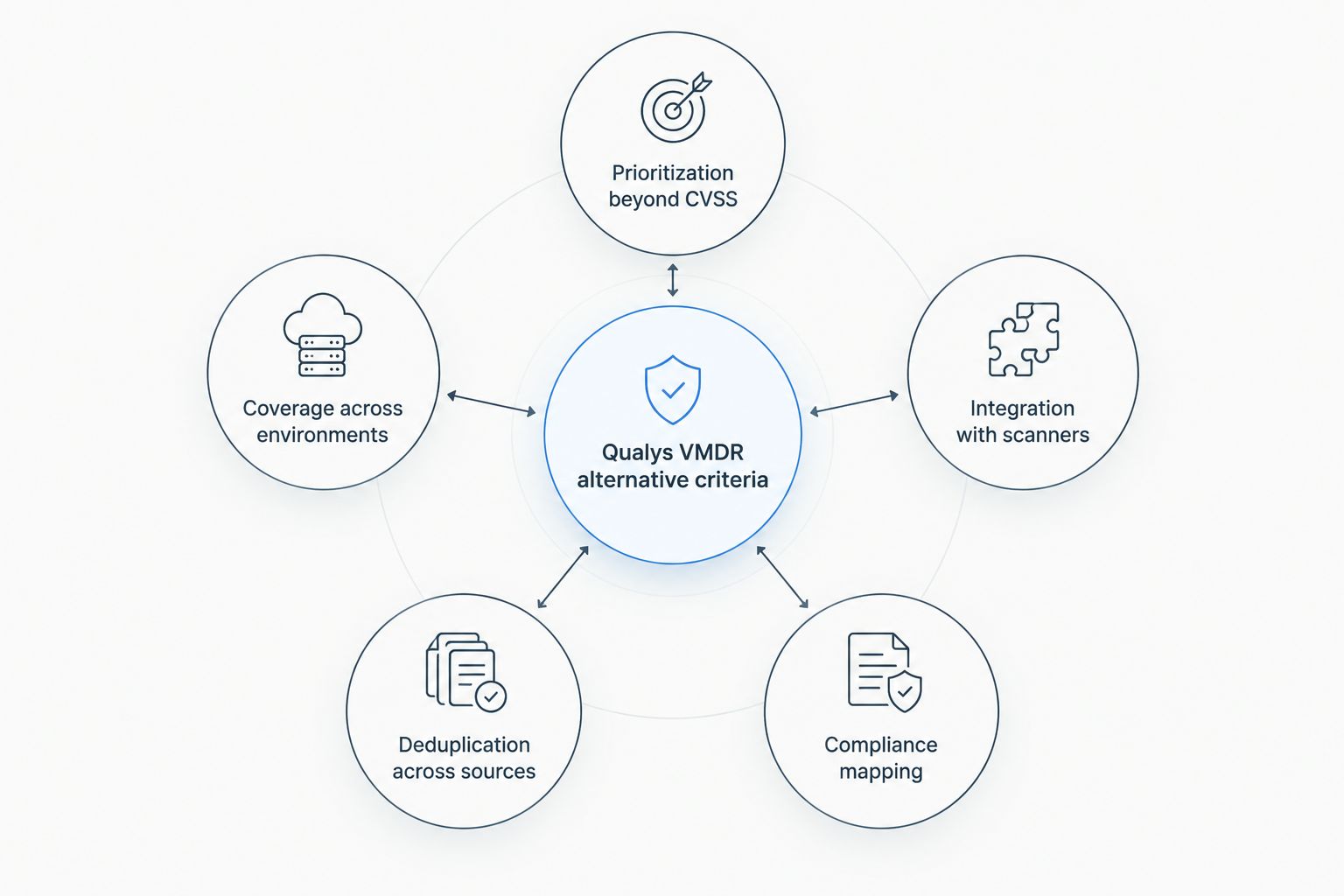
Before ranking anything, the criteria below decide the order:
- Prioritization beyond CVSS — does the tool use exploitability data (CVSS runs 0 to 10, EPSS runs 0 to 1) or just severity?
- Coverage across environments — cloud, on-prem, containers, identity, not just one layer
- Integration with existing scanners — can it ingest data from tools already deployed, or does it force a rip-and-replace
- Deduplication across sources — one asset scanned by three tools should produce one finding, not three
- Compliance mapping — reporting that lines up with SOC 2, ISO 27001, or FedRAMP without manual translation
- Time to a usable report — how fast a new team gets a prioritized list instead of a raw CVE dump
Qualys VMDR alternatives at a glance
| Alternative | Best for | Standout feature | Key limitation |
|---|---|---|---|
| Brinqa | Consolidating multiple scanners into one risk view | Risk-based prioritization across ingested scanner data | Not a scanner itself; needs a data source feeding it |
| Tenable | Single-vendor scanning breadth | Broad plugin library across on-prem, cloud, OT | Coverage limited to what Tenable's own sensors see |
| Rapid7 InsightVM | Rapid7 InsightIDR shops | Shared console with detection and response | Weaker coverage outside licensed Insight agents |
| CrowdStrike Falcon Spotlight | Endpoint-centric visibility | Runs on the existing Falcon EDR agent | Limited to what the Falcon agent can see |
| Microsoft Defender Vulnerability Management | Microsoft-first environments | Bundled into Defender for Endpoint | Blind spots outside Defender/Intune enrollment |
| Wiz | Cloud-native, multi-cloud stacks | Agentless scanning across AWS, Azure, GCP | No traditional on-prem network scanning |
| Palo Alto Cortex Xpanse | External attack surface mapping | Finds internet-facing assets without agents | External view only, no internal scanning |
1. Brinqa: best Qualys VMDR alternative for consolidating multiple scanners
Brinqa ingests findings from vulnerability scanners, cloud posture tools, and asset inventories, then correlates and prioritizes them using business context, asset criticality, and threat intelligence instead of raw CVSS severity alone. It's built for exposure management across scattered tools, not as a replacement scanner.
Brinqa pros:
- Normalizes findings from Qualys, Tenable, Rapid7, and cloud scanners into one prioritized model
- Prioritization can be tuned by business unit, asset owner, or compliance requirement instead of a flat severity score
- Built for environments already running two or more scanners, so it doesn't force a single-vendor lock-in
Brinqa cons:
- Doesn't scan anything itself, so it still needs a scanning source (Qualys, Tenable, or another engine) feeding it data
- Onboarding takes longer than flipping on a single scanner because asset and business context need to be mapped first
Best for: Security teams running two or more scanners that want one prioritized queue instead of three separate dashboards. Verdict: Buy.
2. Tenable: best Qualys VMDR alternative for single-vendor scanning breadth
Tenable's platform, built on the Nessus scan engine, covers on-prem, cloud, and OT assets from one vendor. It's the closest direct swap for teams that picked Qualys VMDR mainly for scanning and want to stay with one console.
Tenable pros:
- Large plugin library covering a wide range of published CVEs
- Exposure management dashboard layered on top of raw scan data
- Long track record in network and OT vulnerability scanning
Tenable cons:
- Coverage still stops at what Tenable's own sensors and agents can reach
- Prioritization logic is less customizable than a dedicated risk-based platform sitting above it
If you're comparing Tenable directly against other options rather than just against Qualys, the Tenable alternatives breakdown covers that comparison in more depth.
Best for: Teams standardizing scanning on a single vendor across the whole estate. Verdict: Buy.
3. Rapid7 InsightVM: best Qualys VMDR alternative for Rapid7 shops
InsightVM combines vulnerability scanning with the rest of the Rapid7 Insight platform, which matters if the SOC already runs InsightIDR for detection and response. One login covers both scan data and alerts.
Rapid7 InsightVM pros:
- Shares a console with InsightIDR for combined vulnerability and detection data
- Live dashboards update as new scan data comes in
- Agent-based and agentless scanning options for mixed environments
Rapid7 InsightVM cons:
- Full value depends on already running other Rapid7 Insight products
- Asset coverage weakens outside of licensed agents and configured scan engines
Best for: SOCs already running Rapid7 InsightIDR that want scan data in the same console. Verdict: Buy.
4. CrowdStrike Falcon Spotlight: best Qualys VMDR alternative for endpoint-centric visibility
Spotlight runs on the Falcon sensor already deployed for endpoint detection and response, surfacing vulnerability exposure per device without a separate scan job. For teams where Falcon is already on every laptop and server, this is close to a zero-deployment vulnerability feed.
CrowdStrike Falcon Spotlight pros:
- No second agent to deploy if Falcon EDR is already installed
- Vulnerability data ties directly to endpoint telemetry Falcon already collects
- Fast time to value for organizations already standardized on Falcon
CrowdStrike Falcon Spotlight cons:
- Limited to what the Falcon agent covers, so unmanaged devices and network gear stay invisible
- Prioritization runs on CrowdStrike's own scoring model, which doesn't always match how the rest of the security stack ranks risk
Best for: Organizations already running Falcon EDR that want vulnerability data without a second agent. Verdict: Buy.
5. Microsoft Defender Vulnerability Management: best Qualys VMDR alternative for Microsoft-first environments
This capability sits inside Microsoft Defender for Endpoint, surfacing vulnerabilities and misconfigurations across Windows, macOS, Linux, and mobile devices enrolled through Intune. It's the path of least resistance for organizations already deep in the Microsoft security stack.
Microsoft Defender Vulnerability Management pros:
- Bundles into a license tier many enterprises already carry for endpoint protection
- Covers device configuration issues alongside CVE-based vulnerabilities
- Native integration with Intune for remediation workflows
Microsoft Defender Vulnerability Management cons:
- Coverage depends entirely on Defender/Intune enrollment, leaving gaps on unmanaged or BYOD devices
- Prioritization logic is thinner than a dedicated risk-based platform built specifically for exposure ranking
Best for: Teams standardized on Microsoft 365 and Defender for Endpoint across the fleet. Verdict: Buy, with a coverage check on unmanaged devices first.
6. Wiz: best Qualys VMDR alternative for cloud-native stacks
Wiz scans cloud environments agentlessly across AWS, Azure, and GCP, mapping vulnerabilities, misconfigurations, and identity risk inside the cloud control plane. For companies running most workloads in the cloud with a thin on-prem footprint, it replaces the cloud half of what Qualys VMDR was covering.
Wiz pros:
- Agentless deployment across major cloud providers
- Graph-based context connects vulnerabilities to identity and network exposure in the cloud
- Fast onboarding for cloud-only or cloud-majority estates
Wiz cons:
- Not built for traditional on-prem network scanning
- Hybrid environments still need a separate tool for legacy infrastructure outside the cloud
Best for: Cloud-first companies with minimal on-prem infrastructure left to scan. Verdict: Buy.
7. Palo Alto Cortex Xpanse: best Qualys VMDR alternative for external attack surface mapping
Cortex Xpanse continuously discovers internet-facing assets and flags exposed services from the outside in, without needing agents or credentials on the target systems. It answers a different question than Qualys VMDR: what does the internet see that security teams don't know exists.
Palo Alto Cortex Xpanse pros:
- Finds shadow IT and forgotten assets exposed to the internet
- No agent or credential requirement on discovered assets
- Useful for M&A due diligence and tracking subsidiary infrastructure
Palo Alto Cortex Xpanse cons:
- External view only; it doesn't replace internal vulnerability scanning
- Overlaps with other Palo Alto products if the rest of the security stack isn't already in that ecosystem
Best for: Teams that need outside-in visibility into unknown internet-facing assets. Verdict: Buy for external mapping, Skip if internal coverage is the actual gap.
How we ranked these Qualys VMDR alternatives
Every tool above got measured against the six criteria listed earlier by 2026 buying cycles, with prioritization logic and coverage breadth weighted heaviest. A scanner that finds more CVEs but can't rank them by exploitability loses points against a platform that prioritizes fewer, better-contextualized findings.
Brinqa ranks first specifically because it solves the prioritization gap that shows up after a team already has scanning coverage from Qualys, Tenable, or another engine. Teams that want a narrower comparison focused purely on risk-based prioritization platforms can find that breakdown among the related guides below.
Which Qualys VMDR alternative should you choose in 2026?
If the actual problem is too many scanners and no shared prioritization, Brinqa is the default pick. If the problem is Qualys itself as a scan engine and the team wants a straight swap, Tenable or Rapid7 InsightVM cover that ground without adding a new prioritization layer on top.
Endpoint-heavy shops already running Falcon or Defender for Endpoint get vulnerability data almost for free by turning on Spotlight or Defender Vulnerability Management. Cloud-majority companies should look at Wiz before anything else on this list, and anyone worried about unknown internet-facing assets should add Cortex Xpanse regardless of what else is running.
Compare Brinqa against your current stack
See how risk-based prioritization fits around scanners you already run.
FAQ
What are the best Qualys VMDR alternatives in 2026?
Brinqa, Tenable, Rapid7 InsightVM, CrowdStrike Falcon Spotlight, Microsoft Defender Vulnerability Management, Wiz, and Palo Alto Cortex Xpanse each replace a different piece of what Qualys VMDR does. Brinqa handles prioritization across scanners; the rest replace scanning, endpoint, or cloud coverage directly.
Is Brinqa a direct replacement for Qualys VMDR?
Not exactly. Brinqa doesn't scan anything itself; it ingests findings from scanners including Qualys and prioritizes them by risk. Teams keep a scan source and add Brinqa on top for prioritization.
How does Tenable compare to Qualys VMDR?
Tenable and Qualys VMDR both bundle scanning with a management console, covering on-prem, cloud, and OT assets from a single vendor. The main difference is plugin coverage and how each handles exposure scoring, not the basic scan-and-report model.
Does CrowdStrike Falcon Spotlight replace a vulnerability scanner?
For endpoints already running the Falcon agent, yes. Spotlight surfaces vulnerability data from the same sensor used for EDR, but it doesn't see network devices, unmanaged assets, or anything outside the Falcon fleet.
Which Qualys VMDR alternative works best for multi-cloud environments?
Wiz is built for multi-cloud coverage, scanning AWS, Azure, and GCP agentlessly. It doesn't cover on-prem network scanning, so hybrid environments still need a second tool for legacy infrastructure.
Should a security team switch from Qualys VMDR to a risk-based platform instead of another scanner?
That depends on whether the actual pain point is scan coverage or prioritization. Teams already drowning in unranked findings from Qualys or another scanner get more value from a risk-based layer like Brinqa than from swapping to a different scan engine.
Does Microsoft Defender Vulnerability Management work outside Windows environments?
Yes, it covers macOS, Linux, and mobile devices enrolled through Intune, not just Windows. Coverage depends entirely on Defender and Intune enrollment, so unmanaged devices stay outside its visibility.
One last thing
The alternative that gets skipped most often in this comparison isn't a scanner at all: it's the prioritization layer sitting above whatever scanner survives the switch. Teams that swap Qualys for Tenable or Rapid7 and change nothing else usually end up back at the same unranked CVE list within a year, just from a different vendor. The fix isn't a better scanner. It's a layer that turns scan output into a queue engineers can actually work through by 2026's patch cycles.