
Safe Security’s strength is cyber risk quantification: translating cyber risk into financial terms for business decisions. When your main problem is deciding which vulnerabilities and exposures to address, you need to evaluate exposure management rather than assume another financial model will solve it. The best Safe Security alternative in 2026 is Brinqa if you need vulnerability and exposure management; Axio if you need a cyber risk quantification alternative.
- For safe security alternatives in 2026, shortlist Brinqa for vulnerability and exposure management, not as an assumed financial-model replacement.
- Evaluate Axio when cyber risk quantification remains the requirement and financial scenarios drive your decisions.
- Consider an internal FAIR-based approach when methodology ownership matters more than buying another platform.
- Stay with Safe Security when its financial risk analysis already supports the decisions you need to make.
Why this matters
Cyber risk quantification and exposure management answer different questions. Quantification estimates the financial consequences of defined cyber scenarios; exposure management addresses the weaknesses that security teams need to manage.
Confusing those jobs produces the wrong shortlist. A board asking whether to fund a security investment needs a different output from an engineering team asking which vulnerability to fix next.
Choose the decision first, then choose the platform. A replacement is useful only when it improves that decision without breaking another workflow you still need.
Safe Security alternatives at a glance
This 2026 shortlist separates financial risk analysis from vulnerability and exposure management. The entries represent different buying paths, not interchangeable feature bundles.
| Option | Best for | Distinguishing focus | How it differs from Safe Security |
|---|---|---|---|
| Safe Security | Teams whose central requirement is cyber risk quantification | Financial expression of cyber risk | The benchmark for a quantification-led evaluation |
| Brinqa | Teams seeking vulnerability and exposure management | Vulnerability and exposure management platform | A different category emphasis; evaluate it against operational security requirements |
| Axio | Teams evaluating another cyber risk quantification platform | Cyber risk quantification and assessment | An alternative to assess against the same financial scenarios |
| Internal FAIR-based modeling | Teams that want direct ownership of risk analysis | Explicit analysis of loss event frequency and loss magnitude | A methodology-led approach rather than a like-for-like software replacement |
Use the table to decide which entries belong in your evaluation. Do not compare an exposure management platform and a financial risk model solely by dashboard appearance: the outputs serve different purposes.
1. Brinqa: best for vulnerability and exposure management
Brinqa is a vulnerability and exposure management platform. It belongs on your shortlist when your requirement has shifted from estimating financial risk toward managing technical weaknesses and exposures. That is a change in buying category, not proof that every quantification requirement disappears.
Best for: Security leaders selecting a vulnerability and exposure management platform rather than seeking only a replacement financial risk model.
Where the platform shines
- Its stated category matches a vulnerability and exposure management requirement.
- It gives you a relevant alternative to evaluate when the buying question centers on technical exposures rather than financial scenarios alone.
- It keeps the shortlist focused on the security program you need to operate, instead of treating cyber risk quantification as the answer to every risk problem.
Where the platform falls short
- Its vulnerability and exposure management positioning is not, by itself, evidence of a like-for-like replacement for financial quantification.
- Category fit does not establish compatibility with your existing data sources or processes; those belong in the evaluation.
- A change in platform category does not remove the need for financial analysis when your board or finance team requires it.
Head-to-head: exposure management versus quantification
| Evaluation dimension | Vulnerability and exposure management | Safe Security |
|---|---|---|
| Primary buying question | How should you manage vulnerabilities and exposures? | How should you quantify cyber risk? |
| Decision to test | Selection and management of technical security work | Financial evaluation of defined cyber scenarios |
| Acceptance evidence | A demonstrated workflow using your exposure-management requirements | A demonstrated analysis using your financial risk requirements |
In the evaluation, start with a vulnerability or exposure your team already understands. Ask the vendor to show how the platform supports the decisions and handoffs your team requires, then assess that demonstration against written acceptance criteria.
Do not substitute a presentation for that test. If financial quantification remains mandatory, evaluate that requirement separately rather than infer it from the platform’s category.
Verdict: Hold Brinqa on your shortlist when vulnerability and exposure management is the primary buying requirement.
2. Axio: best for a quantification-focused alternative
Axio offers cyber risk quantification and assessment. It is a closer category comparison when your objective remains expressing cyber risk in financial terms, rather than replacing that objective with vulnerability management.
The evaluation question is whether Axio’s analysis process fits your scenarios, evidence, and decision-makers. A category match starts the comparison; it does not settle it.
Best for: Risk leaders who want another cyber risk quantification platform to evaluate against Safe Security.
Where Axio shines
- Cyber risk quantification is part of its offering, so it belongs in a financial-risk-focused shortlist.
- Its assessment focus gives you another approach to examine when structuring risk analysis.
- You can compare it against Safe Security using the same business scenario rather than unrelated security metrics.
Where Axio falls short
- Choosing another quantification platform does not, on its own, solve vulnerability remediation or exposure-management requirements.
- Financial analysis still depends on the quality of your scenario definitions and inputs.
- A familiar financial output does not prove that the underlying assumptions are appropriate for your organization.
Head-to-head: Axio versus Safe Security
| Evaluation dimension | Axio | Safe Security |
|---|---|---|
| Category overlap | Cyber risk quantification | Cyber risk quantification |
| Assessment focus | Offers cyber risk assessment alongside quantification | Evaluate against your assessment requirements |
| Comparison method | Run the same defined scenario | Run the same defined scenario |
| Selection criterion | Fit with your analysis and decision process | Fit with your analysis and decision process |
For a 2026 evaluation, give both vendors the same scenario description, evidence, and business question. Ask each to distinguish observed information from assumptions and explain what changes the result.
Verdict: Hold Axio on your shortlist when financial cyber risk quantification remains the core requirement.
3. Internal FAIR-based modeling: best for methodology ownership
FAIR is a risk analysis model that distinguishes loss event frequency from loss magnitude. An internal FAIR-based approach is an alternative way to perform quantification, not another vendor platform with an equivalent software feature set.
This route fits teams that want to own scenario construction and analysis directly. It also makes the internal workload part of the buying decision.
Best for: Organizations prepared to assign accountable analysts to scenario-based financial risk analysis.
Where internal FAIR-based modeling shines
- Your analysts directly control the scenario definitions and assumptions.
- The model gives financial risk discussions a structured distinction between frequency and magnitude.
- You can assess the analytical method separately from a software purchase.
Where internal FAIR-based modeling falls short
- A methodology does not provide a software operating workflow by itself.
- Your team must maintain inputs, document assumptions, review analyses, and explain results.
- Analytical ownership requires capability and sustained attention, not just a template.
Head-to-head: internal modeling versus Safe Security
| Dimension | Internal FAIR-based approach | Safe Security |
|---|---|---|
| Delivery model | Internally managed analysis | Vendor platform |
| Operating responsibility | Your team maintains the analysis process | Evaluate the platform’s support for your process |
| Buying question | Can your team sustain the method? | Does the platform fit your quantification needs? |
Verdict: Hold an internal FAIR-based approach only when you can assign lasting ownership of the analysis.
Why people switch from Safe Security
The defensible reasons to consider a switch are requirement changes, not unsupported claims about outages, commercial changes, or competitors’ performance. These are selection criteria, not measured reasons customers have left.
Your primary decision has changed
If your main question is now which technical exposures to address, evaluate exposure management. A financial loss estimate and a remediation decision are related, but they are not the same output.
Keep financial quantification where it still serves a business decision. Avoid making the operational team buy a financial-risk replacement when its actual requirement is managing vulnerabilities.
You want to compare quantification approaches
If financial risk remains the objective, compare another quantification platform using identical scenarios. Examine assumptions, the treatment of uncertainty, and the explanation behind the result.
A different output is not automatically a better output. Ask what caused the difference and whether that cause is defensible.
You want direct ownership of the analysis
An internal method changes who maintains the analysis. It does not eliminate the work.
Choose this route only when you can identify who defines scenarios, updates evidence, challenges assumptions, and explains conclusions to decision-makers.
How to evaluate your shortlist in 2026
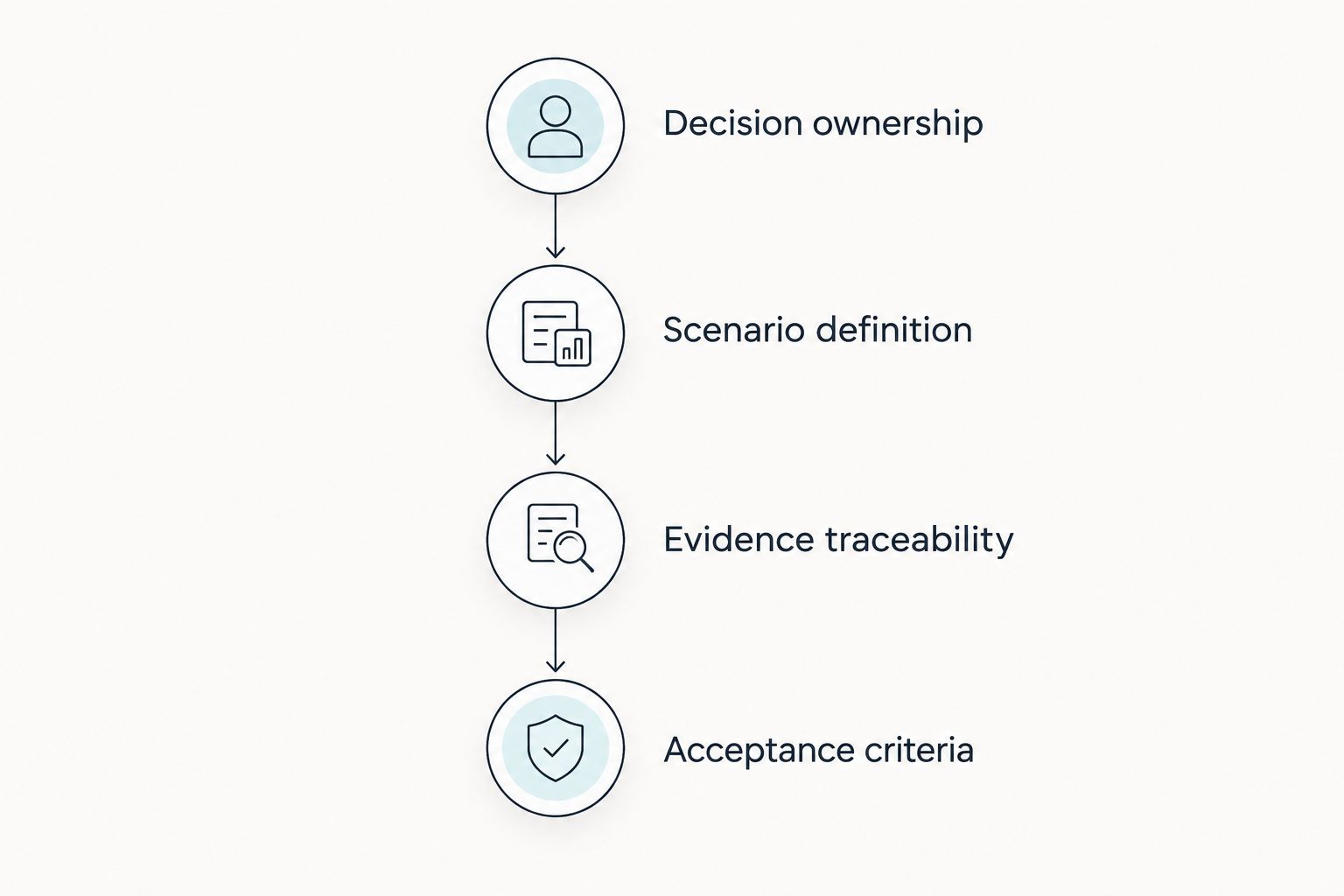
A useful evaluation follows a decision from its business question to its evidence and outcome. Use cyber risk quantification for CISOs to frame the financial-analysis side before you compare it with operational exposure requirements.
Decision ownership
Bring 2 teams into the evaluation: the security team responsible for action and the business or risk team responsible for interpreting financial consequences. This is an evaluation recommendation, not a staffing benchmark.
Ask each team to write the decision it expects the selected approach to support. Resolve conflicting expectations before vendor demonstrations begin.
Scenario definition
Use 3 scenarios in your evaluation: a technical remediation decision, a security investment decision, and a risk acceptance decision. These are suggested test cases, not a claim about any vendor’s capabilities.
Define the expected output for each. A remediation decision needs actionable technical evidence; an investment decision needs an explanation of consequences and assumptions.
Evidence traceability
Require 1 traceable decision record for each scenario. It should identify the inputs, assumptions, responsible owner, conclusion, and evidence needed to revisit the decision.
Ask vendors to demonstrate the record rather than merely describe it. For an internal approach, have your analysts produce the same artifact.
Acceptance criteria
Write acceptance criteria before you see the final demonstration. Separate mandatory requirements from useful extras, and judge each entry against the job it is intended to perform.
An attractive report does not compensate for an unanswered buying requirement. Neither does a long feature list.
When staying with Safe Security is the right call
Stay with Safe Security when cyber risk quantification remains your main requirement and your current analysis supports the decisions you need to make. A new shortlist is not a reason to replace a working process.
The advantage of staying is continuity in an established analysis workflow. The limitation is that a quantification-led process still needs to be assessed separately against operational exposure-management requirements.
In 2026, judge the current platform and alternatives against the same acceptance criteria. If the actual gap is a separate operational workflow, evaluate that gap before treating it as a replacement project.
FAQ
What's the best Safe Security alternative in 2026?
The best alternative depends on whether you need financial risk quantification or vulnerability and exposure management. Brinqa fits a vulnerability and exposure management shortlist; Axio fits a quantification-focused shortlist.
Is exposure management the same as cyber risk quantification?
No. Exposure management addresses technical weaknesses and exposures, while cyber risk quantification estimates the financial consequences of defined cyber scenarios.
Is Axio an alternative to Safe Security?
Yes, Axio belongs in a cyber risk quantification comparison. Evaluate both against the same scenario, evidence, assumptions, and business decision.
Can FAIR replace a cyber risk quantification platform?
An internal FAIR-based approach is an alternative way to conduct financial risk analysis, not an equivalent software replacement. Your team must own the analysis process and its maintenance.
Should I replace Safe Security to improve vulnerability management?
Evaluate the vulnerability-management requirement separately before deciding to replace Safe Security. A gap in operational security work does not automatically invalidate an existing financial risk analysis process.
What should I ask during a cyber risk quantification demo?
Ask the vendor to trace a defined scenario from evidence and assumptions to the resulting decision. Require an explanation of uncertainty and what would change the conclusion.
When should I stay with Safe Security?
Stay when its quantification process supports your required business decisions and meets your acceptance criteria. Compare alternatives only against a defined gap or changed requirement.
One last thing
Ask every vendor to show what happens when a material assumption changes. Then ask who owns updating it.
That demonstration connects the model to the operating process. For your 2026 selection, prefer a defensible decision trail over an unexplained score.