
Wiz is a strong cloud-native security platform, but it's built around agentless cloud scanning and CNAPP use cases — it doesn't replace a full vulnerability management program that spans on-prem networks, endpoints, containers and third-party scanner data. Brinqa is the best Wiz alternative for teams that need risk-based prioritization across a hybrid environment, Tenable wins for deep on-prem network scanning, Qualys VMDR wins for compliance-heavy programs, Rapid7 InsightVM wins for mid-market teams that want remediation workflows built in, CrowdStrike Falcon Spotlight wins for shops already running the Falcon agent everywhere, and Palo Alto Cortex Xpanse wins for external attack surface discovery. Every option below gets ranked by the job it actually does best, not by a single leaderboard score.
- Brinqa wins for risk-based vulnerability management across hybrid and multi-cloud environments in 2026.
- Tenable stays the deepest option for on-prem and network vulnerability scanning.
- Qualys VMDR fits compliance-driven programs that need patch tracking in one console.
- Rapid7 InsightVM suits mid-market SOC teams that want remediation workflows out of the box.
- Wiz alone leaves gaps in on-prem coverage and cross-scanner prioritization that these five tools fill.
Why this matters
Wiz built its reputation scanning cloud workloads agentlessly and mapping attack paths inside AWS, Azure and GCP. That's genuinely useful, but it's a cloud posture and cloud vulnerability tool first. Security teams running a mixed environment — data centers, endpoints, OT, third-party vendor risk, container pipelines — end up bolting Wiz onto a second or third tool to cover the rest.
That gap is exactly why searches for Wiz alternatives spiked through 2026: teams want one place to see every vulnerability, regardless of which scanner or cloud found it, ranked by actual business risk instead of raw CVSS score. The six platforms below approach that problem differently, and picking wrong means re-platforming again in 12 months.
What makes the best Wiz alternative for vulnerability management
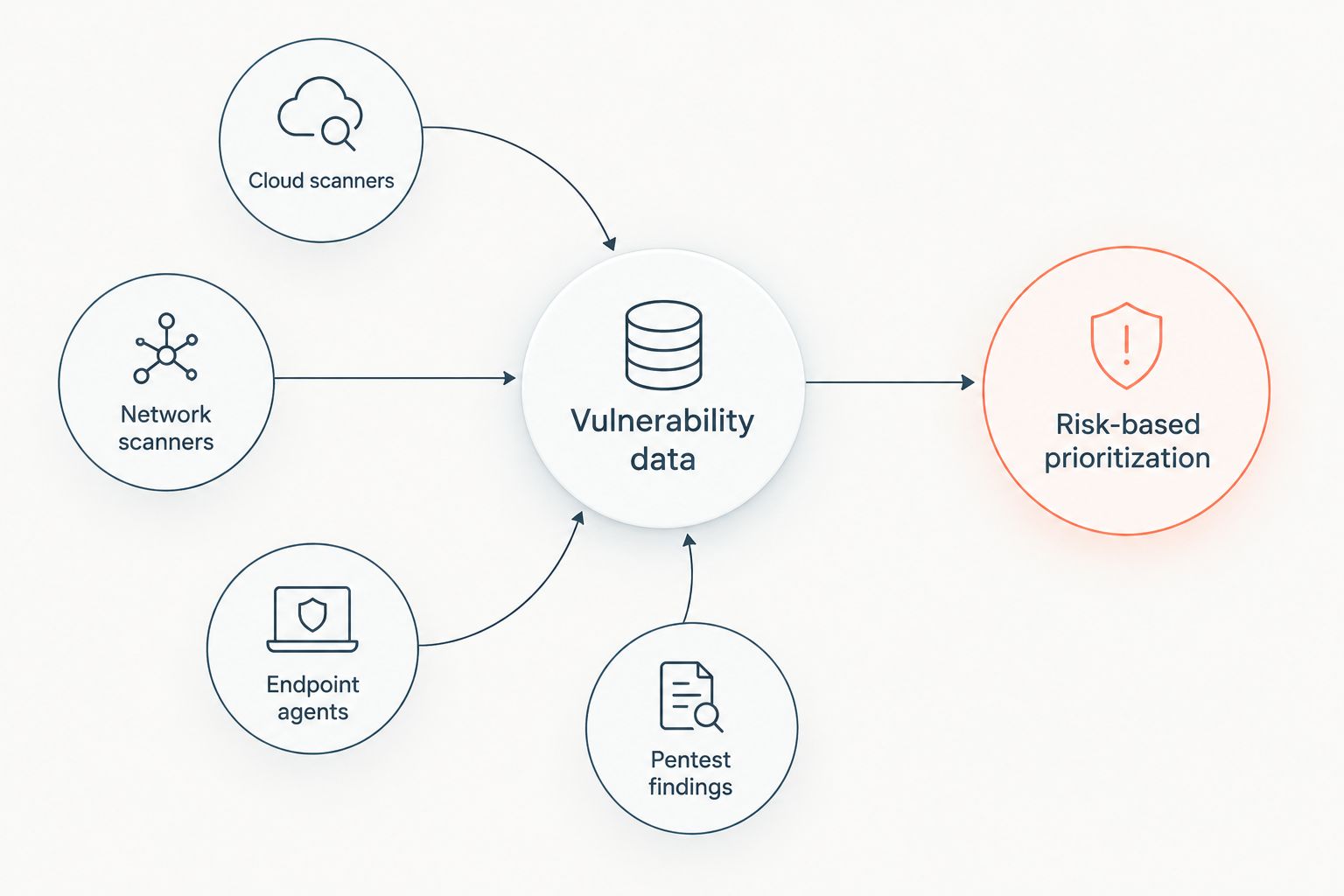
- Cross-source data ingestion — pulls findings from cloud scanners, network scanners, EDR agents and pentest tools into one model
- Risk-based prioritization — ranks findings by exploitability and business context, not just severity score
- Coverage beyond the cloud — handles on-prem networks, endpoints, containers and OT where Wiz doesn't reach
- Remediation workflow integration — pushes findings into Jira, ServiceNow or ITSM tools without manual export
- Compliance mapping — ties findings to frameworks like SOC 2, HIPAA or ISO 27001 for audit reporting
- Exception and risk acceptance handling — lets teams document accepted risk instead of leaving stale findings open
At a glance
| Tool | Best for | Standout feature | Key limitation |
|---|---|---|---|
| Brinqa | Risk-based prioritization across hybrid environments | Aggregates findings from any scanner into one risk model | Requires connecting existing scanners rather than replacing them outright |
| Tenable | Enterprise on-prem network scanning | Long-standing scan engine depth across network and OS layers | Weaker native cross-cloud attack path mapping than Wiz |
| Qualys VMDR | Compliance-driven vulnerability management | Vulnerability management, detection and patch tracking in one console | Interface and reporting feel dated next to newer cloud-native tools |
| Rapid7 InsightVM | Mid-market SOC teams | Built-in remediation project tracking and Metasploit validation | Less depth on cloud-native and container-specific findings |
| CrowdStrike Falcon Spotlight | Falcon-agent shops | Vulnerability visibility riding on the existing EDR agent | Only sees what the Falcon agent is installed on |
| Palo Alto Cortex Xpanse | External attack surface discovery | Finds unknown internet-facing assets outside sanctioned inventory | Not built for internal vulnerability prioritization at depth |
1. Brinqa: best for risk-based prioritization across hybrid environments
Brinqa is a vulnerability and exposure management platform built to sit on top of whatever scanners a security team already runs — cloud, network, application, container, pentest — and turn that flood of findings into a single risk-ranked queue. Instead of asking teams to rip out Wiz or Tenable, it ingests their output and layers business context, asset ownership and exploit data on top.
Brinqa pros:
- Combines findings from multiple scanners, including cloud-native tools like Wiz, into one prioritized view
- Custom risk scoring models that go beyond raw CVSS
- Built-in exception and risk-acceptance workflows for audit trails
- Fits regulated environments needing SOC 2, HIPAA or FedRAMP alignment
Brinqa cons:
- Doesn't do primary scanning itself — it depends on the scanners feeding it
- Initial setup takes more configuration than a single-purpose scanner
Brinqa best for: security teams juggling data from three or more scanners who need one risk-ranked queue instead of five separate dashboards.
Verdict: Buy if fragmented scanner output is already the bottleneck.
2. Tenable: best for enterprise-scale network vulnerability scanning
Tenable, built on the Nessus scan engine, remains one of the most established names in vulnerability scanning for on-prem networks, servers and traditional infrastructure. It's the tool most security teams already have running somewhere in the environment.
Tenable pros:
- Deep, mature scan coverage across network devices and operating systems
- Wide plugin library covering a broad range of CVEs
- Strong fit for teams with significant on-prem footprint Wiz doesn't touch
Tenable cons:
- Cloud-native attack path mapping is less developed than Wiz's agentless model
- Scanner sprawl still needs a separate layer to unify findings with cloud and endpoint data
Tenable best for: organizations with heavy on-prem or data-center infrastructure that Wiz's cloud-first model doesn't cover. Compare it directly on the Tenable alternatives page if network depth is the deciding factor.
Verdict: Buy for on-prem scanning depth; pair with a prioritization layer for full coverage.
3. Qualys VMDR: best for compliance-driven vulnerability management
Qualys VMDR bundles vulnerability management, detection and response, and patch management into a single cloud console. It's a common choice for teams whose vulnerability program is driven primarily by audit and compliance deadlines.
Qualys VMDR pros:
- Vulnerability scanning and patch tracking in one platform
- Broad asset discovery across cloud and on-prem
- Established compliance reporting templates
Qualys VMDR cons:
- Interface and workflow feel less modern than newer cloud-native tools
- Cross-tool data correlation still requires manual export in many setups
Qualys VMDR best for: compliance and audit teams that need patch status and vulnerability data in the same report.
Verdict: Hold if compliance reporting is the primary driver; skip if the goal is cloud-native attack path visibility.
4. Rapid7 InsightVM: best for mid-market SOC teams
Rapid7 InsightVM pairs vulnerability scanning with remediation project tracking and integrates with Metasploit for exploit validation. It's built for teams that want the scanning-to-remediation loop closed inside one tool.
Rapid7 InsightVM pros:
- Remediation project tracking built into the platform
- Metasploit integration for validating exploitability, not just theoretical risk
- Solid dashboards for mid-sized SOC teams
Rapid7 InsightVM cons:
- Less depth on cloud-native and container vulnerability findings than dedicated CNAPP tools
- Cross-scanner aggregation outside Rapid7's own ecosystem is limited
Rapid7 InsightVM best for: mid-market SOC teams that want scanning and remediation tracking without stitching together multiple products.
Verdict: Buy for teams under roughly 2,000 assets that want an all-in-one workflow.
5. CrowdStrike Falcon Spotlight: best for Falcon-agent shops
Falcon Spotlight rides on the CrowdStrike Falcon endpoint agent already deployed for EDR, surfacing vulnerability data without adding a second agent or scan infrastructure.
Falcon Spotlight pros:
- No additional agent deployment for teams already running Falcon
- Real-time visibility tied to the same telemetry used for threat detection
- Simple to turn on for existing Falcon customers
Falcon Spotlight cons:
- Coverage is limited to endpoints where the Falcon agent is installed
- Weak on cloud infrastructure and network devices outside the agent's reach
Falcon Spotlight best for: organizations standardized on CrowdStrike that want vulnerability visibility without new tooling overhead.
Verdict: Hold for Falcon-native shops; skip if cloud or network coverage matters more than endpoint depth.
6. Palo Alto Cortex Xpanse: best for external attack surface discovery
Cortex Xpanse focuses on finding internet-facing assets an organization doesn't know it has — shadow IT, forgotten subdomains, exposed services spun up outside sanctioned processes.
Cortex Xpanse pros:
- Strong at surfacing unknown or unmanaged internet-facing assets
- Continuous external scanning without agents
- Useful complement to internal vulnerability programs
Cortex Xpanse cons:
- Not built for internal vulnerability prioritization or remediation workflows
- Needs pairing with an internal-focused tool to close the loop
Cortex Xpanse best for: security teams whose biggest blind spot is assets they don't know exist, not assets they already scan.
Verdict: Buy as a companion tool, not a standalone vulnerability management platform.
See risk-based prioritization in action
Connect your existing scanners and rank findings by real business risk.
How we ranked these Wiz alternatives
Each tool got measured against the six criteria above: cross-source ingestion, risk-based prioritization, coverage beyond cloud, remediation workflow integration, compliance mapping, and exception handling. No tool scores a perfect six — that's the honest picture of this market in 2026. Teams evaluating any of these should also read how to evaluate a vulnerability management vendor before signing a multi-year contract.
Which Wiz alternative should you choose?
If the problem is fragmented data from multiple scanners and no single risk-ranked queue, Brinqa is the default pick for 2026. If the gap is specifically on-prem network scanning, Tenable fills it. Compliance-first teams should look at Qualys VMDR, mid-market SOC teams get more out of Rapid7 InsightVM, Falcon-agent shops should just turn on Falcon Spotlight, and anyone worried about unknown internet-facing assets should add Cortex Xpanse as a companion, not a replacement.
FAQ
What's the best Wiz alternative for vulnerability management in 2026?
Brinqa is the best overall Wiz alternative for teams that need risk-based prioritization across hybrid and multi-cloud environments, since it aggregates findings from multiple scanners instead of replacing just one.
Is Wiz a vulnerability management tool or a CNAPP?
Wiz is primarily a cloud-native application protection platform (CNAPP) focused on agentless cloud scanning and attack path mapping, not a full vulnerability management program.
Does Wiz cover on-premises vulnerability scanning?
No. Wiz's core strength is cloud workload and configuration scanning; on-prem network and server scanning requires a separate tool like Tenable or Qualys.
Is Tenable better than Wiz for network vulnerability scanning?
Tenable has deeper, more established scan coverage for on-prem networks and operating systems, which makes it the stronger choice for network-heavy environments Wiz wasn't built to scan.
Can Brinqa replace Wiz for cloud vulnerability data?
Brinqa doesn't scan cloud workloads itself; it ingests findings from cloud scanners, including Wiz, and layers risk-based prioritization on top rather than replacing the scan source.
What's the difference between Wiz and CrowdStrike Falcon Spotlight?
Wiz scans cloud infrastructure agentlessly, while Falcon Spotlight surfaces vulnerability data from the CrowdStrike Falcon endpoint agent already deployed for EDR — the two cover different asset types.
Do these alternatives support compliance frameworks like SOC 2 or HIPAA?
Qualys VMDR and Brinqa both support compliance mapping for frameworks like SOC 2 and HIPAA in 2026, with Brinqa also supporting custom scoring models tied to specific audit requirements.
How do risk-based vulnerability management platforms differ from cloud-only scanners?
Risk-based platforms like Brinqa pull data from multiple scan sources and rank findings by exploitability and business context, while cloud-only scanners like Wiz focus scanning depth on a single environment.
One last thing
Wiz doesn't natively ingest findings from other scanners — it's a source of vulnerability data, not a place to unify it. Teams that pick Wiz for cloud coverage in 2026 and stop there almost always end up adding a second layer within a year just to see cloud and on-prem findings ranked side by side. Plan for that layer up front instead of retrofitting it later.