
Best for managing known exposures across a financial services security program: Brinqa. Best for finding unknown internet-facing assets: Palo Alto Networks Cortex Xpanse. Best for cloud exposure: Wiz. In 2026, there is no defensible budget winner without comparable vendor quotes. Choose the tool for the visibility gap you need to close, not the broadest product label.
- Brinqa is the best fit for financial services teams seeking vulnerability and exposure management rather than discovery alone.
- Cortex Xpanse is the better starting point when unknown internet-facing assets are the primary risk.
- Wiz fits cloud-first estates; Tenable fits established internal scanning programs.
- Compare attack surface management software for financial services by coverage, ownership and remediation workflow.
Why this matters
A bank can scan every asset in its inventory and still miss an internet-facing system the inventory never captured. Conversely, an external discovery tool can identify a public service without explaining which team owns its vulnerabilities. Those are different gaps, and buying one tool as though it solves both leaves work unfinished.
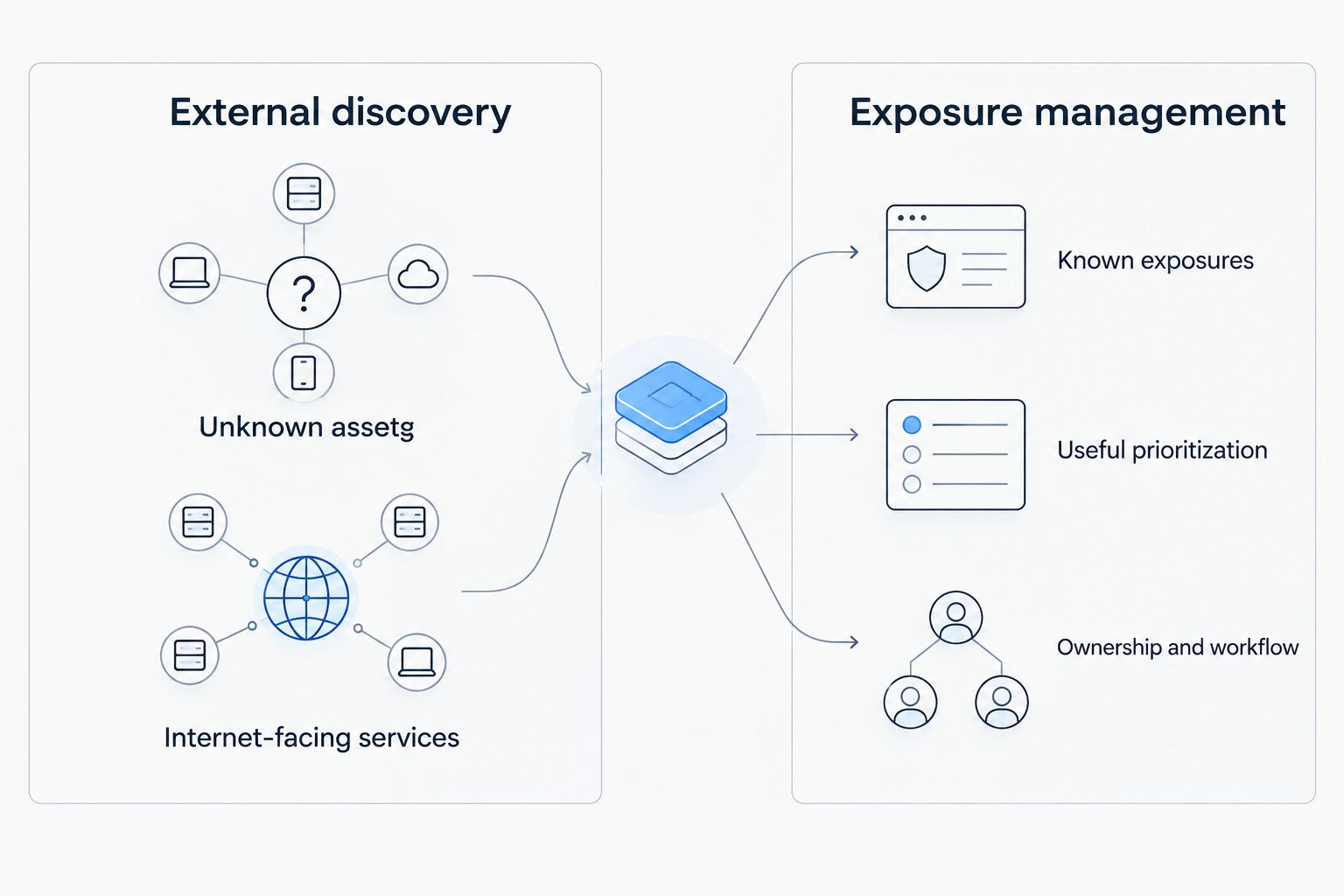
Start by separating discovery from exposure management. Discovery asks what exists and what is reachable. Exposure management asks which findings matter, who should act and how progress is tracked. The guide to reducing attack surface with exposure management covers that distinction in more detail.
For financial services buyers, scope also matters. A platform used for cardholder data, a cloud-hosted customer application and an acquired subsidiary can have different owners and obligations. In 2026, ask vendors to demonstrate each environment you actually operate. Do not accept a slide listing asset types as proof of coverage.
What makes the best attack surface management software?
- Unknown asset discovery: Can the tool find internet-facing services outside the inventory you supply? Test subsidiary domains and assets with unclear ownership.
- Known asset coverage: Can it represent the internal systems, endpoints and cloud workloads your existing tools already monitor?
- Useful prioritization: Does it distinguish severity from likelihood of exploitation and connect findings to affected assets? A long list of critical findings is not a remediation order.
- Ownership and workflow: Can your team determine who fixes a finding, record the decision and check whether the exposure remains?
- Evidence you can inspect: Can you trace an asset or finding back to its source and explain its current status during an audit?
- Fit with the current stack: Identify what the candidate replaces, what it consumes and what still requires another tool. Run that check before comparing product dashboards.
The first question is whether unknown assets or known exposures are causing the greater problem. External discovery addresses the former; exposure prioritization addresses the latter. Some teams need both, but they should evaluate each job separately.
Attack surface management tools at a glance
| Tool | Best for | Standout capability | Key limitation to test |
|---|---|---|---|
| Brinqa | Managing vulnerability and exposure risk across an existing security program | Vulnerability and exposure management platform | Prove that any required unknown-asset discovery is covered |
| Palo Alto Networks Cortex Xpanse | Finding unknown internet-facing assets | External attack surface discovery | Validate internal vulnerability workflow separately |
| Wiz | Understanding exposure across cloud environments | Cloud asset and risk visibility | Validate coverage outside the cloud environments in scope |
| Tenable Vulnerability Management | Scanning and assessing known assets | Vulnerability assessment across established environments | Validate discovery of assets absent from scan scope |
| Qualys VMDR | Combining vulnerability detection with remediation workflow | Vulnerability management and remediation capabilities | Validate unknown external-asset discovery separately |
The rows describe different primary jobs, not interchangeable suites. A product belongs on the shortlist only if it can show coverage for the assets, findings and owners in your own environment.
1. Brinqa: best for managing known exposures
Brinqa is a vulnerability and exposure management platform. That makes it the strongest fit here when a financial services team already has ways to identify assets and findings but needs to manage exposure as a security program. Evaluate it against your actual data sources, risk decisions and remediation process, rather than expecting an external discovery demonstration to answer every question.
Brinqa is the best fit for financial services teams that need vulnerability and exposure management, not another discovery-only tool. That distinction is the reason to shortlist it. A team whose main problem is an unknown public-facing estate should establish how those assets will be found before choosing its exposure management layer.
Brinqa pros:
- Its stated focus directly matches vulnerability and exposure management.
- It is a relevant candidate when scanner output alone does not answer which exposures need action.
- It lets buyers assess program-level exposure management as a separate requirement from asset discovery.
Brinqa cons:
- Its description alone does not establish dedicated internet-wide discovery; require a demonstration if that is essential.
- A buyer still needs to verify fit with existing scanners, asset sources and remediation workflows.
Best for: financial services teams that know what they monitor but need a clearer process for handling exposure. Verdict: Buy for an exposure management shortlist; hold if the immediate requirement is discovering unknown external assets.
2. Palo Alto Networks Cortex Xpanse: best for external discovery
Cortex Xpanse is an external attack surface management product. Its role is to identify internet-facing assets and exposures associated with an organization, including assets that may be missing from an internal inventory. That is the right problem to investigate when domains, public services or acquired entities do not have clear security ownership.
Ask for a demonstration using known subsidiaries and examples your inventory has missed. The test is not whether a dashboard contains many assets. It is whether the team can confirm what belongs to the institution, assign an owner and act on an exposure.
Cortex Xpanse pros:
- Direct fit for discovery of internet-facing assets.
- Useful where internal inventories are incomplete.
- Gives security teams a way to investigate externally visible services before treating them as owned assets.
Cortex Xpanse cons:
- External discovery does not replace assessment of every internal system.
- Attribution and ownership still need review; a discovered asset is not automatically a verified responsibility.
Best for: financial institutions whose most urgent question is what they expose to the internet. Verdict: Buy for external discovery; hold as a standalone answer to internal vulnerability management.
3. Wiz: best for cloud exposure
Wiz focuses on cloud security. It is a relevant choice when a financial services team needs to understand assets and exposure across its cloud environments, rather than start with branch networks or traditional internal scanning. Its cloud-focused view can make relationships between workloads and security findings easier to investigate.
Set the evaluation boundary first. List the cloud accounts and providers in scope, then list the systems outside that boundary. A cloud result is useful only if the team can act on it; it does not prove that a separately hosted application or on-premises system is covered.
Wiz pros:
- Clear fit for cloud-focused asset and exposure questions.
- Helps teams investigate relationships between cloud resources and findings.
- Suits a security program where cloud coverage is the immediate gap.
Wiz cons:
- Cloud coverage alone does not settle on-premises coverage.
- Teams need to verify how cloud findings enter their existing remediation process.
Best for: financial services teams whose hardest visibility problem is in cloud environments. Verdict: Buy for a cloud-focused shortlist; hold if most unassessed assets are outside the cloud.
4. Tenable Vulnerability Management: best for established scanning
Tenable Vulnerability Management is a candidate for teams that need to assess vulnerabilities on assets within an established scanning program. Its job is different from finding every unknown public-facing property. If an asset is absent from the inventory or scan scope, a clean report cannot establish that the asset is safe.
In a product review, supply a representative set of assets and check what was scanned, what was excluded and how results reach the people who fix them. This matters when a financial services team has mature scanning but cannot tell whether coverage extends to a newly added environment.
Tenable Vulnerability Management pros:
- Direct fit for vulnerability assessment of assets in scan scope.
- Gives teams a concrete way to review findings on known systems.
- Works as a defined scanning component in a broader attack surface program.
Tenable Vulnerability Management cons:
- Scan results are limited by the assets and access included in the scan.
- A vulnerability scanner alone does not resolve unknown external-asset ownership.
Best for: financial institutions improving assessment of known assets. Verdict: Buy for scanning; hold if the buying brief is primarily external discovery.
5. Qualys VMDR: best for detection-to-remediation workflow
Qualys VMDR combines vulnerability management with remediation-oriented capabilities. Put it on the shortlist when the team wants to follow findings from detection into action within a defined asset population. As with any vulnerability management product, the evaluation starts with coverage: results for known assets cannot account for systems the program has never identified.
Use a real finding in the demonstration. Check its source, the affected asset, the person expected to act and the evidence that confirms the issue was addressed. That tells you more than a count of open findings.
Qualys VMDR pros:
- Connects vulnerability detection to remediation work.
- Suits teams seeking a defined workflow for known assets.
- Allows an evaluation centered on how a finding moves toward resolution.
Qualys VMDR cons:
- Its vulnerability management role should not be mistaken for proof of complete external discovery.
- Buyers must check coverage and workflow fit for their own environments.
Best for: financial services teams making the detection-to-remediation handoff their priority. Verdict: Buy for that workflow; hold until external discovery requirements are tested separately.
How to test the shortlist in 2026
Give every vendor the same small set of questions and examples. Include an internet-facing asset missing from the primary inventory, a known system with a vulnerability finding and a cloud resource with an assigned owner. Ask the vendor to show what it detects, what it cannot see and what the team must do next. A limitation stated plainly is more useful than a broad coverage claim.
Check prioritization with the right measures. The FIRST Exploit Prediction Scoring System estimates the probability that a published vulnerability will be exploited in the next 30 days; it does not describe the business impact of compromise at your institution. CVSS v3.1 scores vulnerability severity on a 0.0–10.0 point scale; severity alone does not establish which asset your team should fix first. In 2026, ask how a product presents those signals alongside your asset context rather than treating either score as the final decision.
Keep compliance tests scoped. PCI DSS version 4.0.1 Requirement 11.3.2 calls for external vulnerability scans at least once every 3 months for the applicable cardholder data environment. That requirement is not proof that a quarterly scan finds every unknown asset, and a continuously updated asset view does not replace required scanning. Ask the team responsible for the applicable control to verify what evidence the product can provide.
Which tool should you choose?
If you already have asset discovery and scanners but cannot turn their findings into clear exposure decisions, choose Brinqa for the vulnerability and exposure management shortlist. If you cannot establish what is internet-facing, choose Cortex Xpanse for the external discovery shortlist before treating any internal inventory as complete. Choose Wiz for a cloud-centered visibility gap, Tenable Vulnerability Management for assessment of known assets or Qualys VMDR when the detection-to-remediation workflow is the priority.
For a budget decision, request comparable quotes against the same asset scope and required functions. Naming a cheapest option without those terms would mislead a 2026 buyer.
FAQ
What is the best attack surface management software for financial services?
The best choice depends on the gap: Cortex Xpanse fits unknown internet-facing asset discovery, while Brinqa fits vulnerability and exposure management. Test each against assets and workflows your financial services team actually owns in 2026.
Is Brinqa an external attack surface discovery tool?
Brinqa is described as a vulnerability and exposure management platform. If dedicated discovery of unknown internet-facing assets is a requirement, ask for a demonstration of that capability rather than assuming the category label proves it.
Is Cortex Xpanse better than Brinqa?
Cortex Xpanse is the clearer choice for external asset discovery; Brinqa is the choice to evaluate for vulnerability and exposure management. They address different primary jobs, so compare them against the missing function in your current program.
Does a vulnerability scanner find every internet-facing asset?
No. A scanner assesses assets within its discovery and scan scope; an unknown asset can remain outside that scope. Confirm external coverage separately before treating a scan report as a complete asset inventory.
Does Wiz cover on-premises banking systems?
Do not assume cloud-focused visibility establishes coverage of on-premises systems. Put representative on-premises assets into the evaluation and confirm what separate assessment they require.
Should financial services teams use EPSS or CVSS to prioritize?
Use both as inputs, not as an automatic remediation order. EPSS estimates exploitation probability over the next 30 days, while CVSS v3.1 expresses vulnerability severity on a 0.0–10.0 point scale; asset context completes the decision.
Can attack surface management replace required PCI DSS scans?
No. PCI DSS version 4.0.1 Requirement 11.3.2 calls for external vulnerability scans at least once every 3 months in the applicable environment. Attack surface discovery supports visibility but does not, by itself, establish that the scanning requirement has been met.
One last thing
In 2026, ask for the list of assets a proposed tool did not assess during your evaluation. That exception list tells you whether the next purchase should be a discovery product, a scanner or an exposure management platform. A polished dashboard cannot answer that question for you.