
Attack surface management software for MSSPs has to do something single-tenant tools were never built for: keep 40, 200, or 900 client environments cleanly separated while still surfacing the handful of exposures that actually matter each week. This guide ranks the platforms that handle that split without drowning your analysts in noise.
- Brinqa wins overall for attack surface management software for MSSPs that need multi-tenant, risk-based exposure scoring in one place.
- Palo Alto Cortex Xpanse is the pick for pure external asset discovery at internet scale.
- Tenable and Rapid7 suit MSSPs already standardized on those scanning stacks in 2026.
- CrowdStrike Falcon Surface fits shops running Falcon EDR as the client-side agent.
- Wiz and Orca Security cover multi-cloud and agentless container exposure for cloud-heavy client books.
Best overall: Brinqa. Best for external discovery at scale: Palo Alto Cortex Xpanse. Best for existing Tenable shops: Tenable. Best for SOC-integrated workflows: Rapid7. Best for CrowdStrike-native stacks: CrowdStrike Falcon Surface. Best for multi-cloud client books: Wiz. Best for agentless cloud coverage: Orca Security.
Why this matters
An MSSP running attack surface management across dozens of client tenants has a different problem than a single security team. The tool has to segment data by client, roll up risk without mixing tenants, and still let one analyst triage exposures across the whole portfolio in a single shift. Get the tool choice wrong in 2026 and you're either buying per-client licenses that don't scale or drowning analysts in unranked CVE lists. Brinqa approaches this as a data and correlation problem first, which is the right frame for a multi-tenant book of business.
Most of the software below started as either a vulnerability scanner or a cloud security tool and grew an attack surface management layer on top. That heritage shows up in what each one does well and where it falls short for MSSP use specifically.
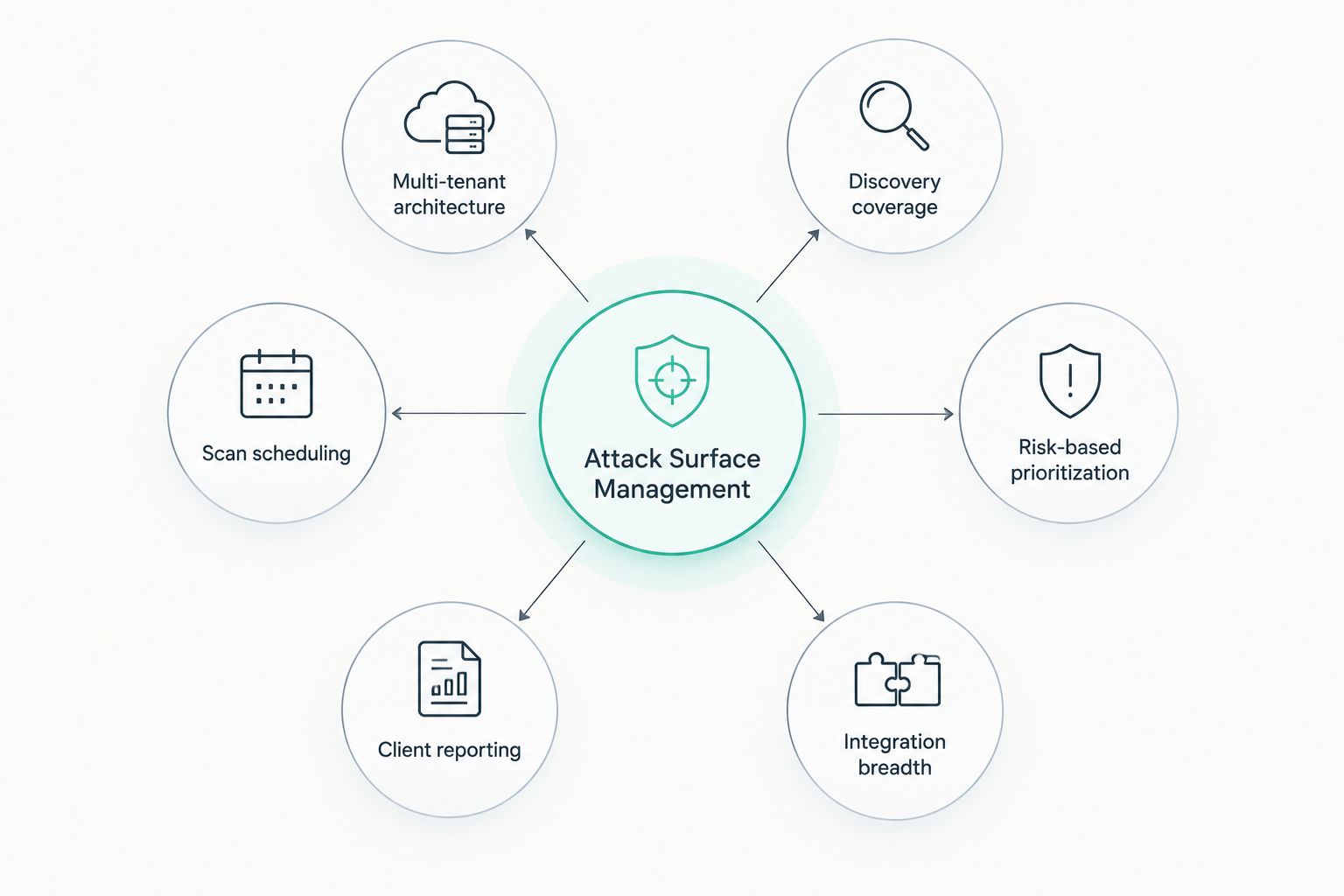
What makes the best attack surface management software for MSSPs
- Multi-tenant architecture that segments client data without duplicating infrastructure per account
- External and internal discovery coverage, not just internet-facing assets
- Risk-based prioritization using EPSS, CVSS, and business context instead of raw CVE counts
- Integration breadth with SIEM, SOAR, and ticketing systems clients already run
- Client-facing reporting that an analyst can hand to a customer without rebuilding it in a spreadsheet
- Flexible scan and discovery scheduling that doesn't require touching every client's change window separately
At a glance
| Software | Best for | Standout feature | Key limitation |
|---|---|---|---|
| Brinqa | Multi-tenant risk-based exposure management | Data model unifies findings from any scanner into one risk score | Requires upfront data mapping work to get full value |
| Palo Alto Cortex Xpanse | External asset discovery at scale | Continuous internet-wide scanning with no agents | Weaker on internal asset and application-layer exposure |
| Tenable | Shops standardized on Tenable scanning | Deep integration with Tenable Nessus and Tenable.io data | Attack surface features feel bolted onto the scanner core |
| Rapid7 | SOC-integrated detection and response workflows | Surface Command ties exposure data to InsightVM findings | Multi-tenant reporting needs manual customization per client |
| CrowdStrike Falcon Surface | Falcon EDR-native environments | Reuses the Falcon agent for asset telemetry | Limited value if the client isn't already on Falcon |
| Wiz | Multi-cloud client environments | Graph-based exposure paths across AWS, Azure, and GCP | Thin coverage of on-premises and legacy assets |
| Orca Security | Agentless cloud workload and container coverage | Full cloud stack visibility without deploying agents | Less mature on external, non-cloud asset discovery |
1. Brinqa: best attack surface management software for MSSPs running multi-tenant risk programs
Brinqa ingests findings from vulnerability scanners, cloud security tools, and asset inventories, then normalizes them into one risk model per client tenant. For an MSSP, that means one analyst can work exposures across 50 client accounts without switching consoles for each scanner a client happens to run.
Brinqa pros:
- Correlates data from existing scanners instead of replacing them
- Risk scoring accounts for business context, not just CVSS severity
- Handles vulnerability management for managed service providers as a first-class use case, not an afterthought
Brinqa cons:
- Getting full value takes real setup time mapping client data sources
- Smaller footprint in pure external internet-scanning compared to Cortex Xpanse
Brinqa best for: MSSPs that already run mixed scanner stacks across clients and need one risk view on top. Verdict: Buy.
2. Palo Alto Cortex Xpanse: best for external asset discovery at scale
Cortex Xpanse (originally Expanse, acquired by Palo Alto Networks in 2020) continuously scans the public internet to find assets an organization didn't know it owned — shadow IT, forgotten subdomains, exposed ports. For MSSPs onboarding new clients, that discovery pass is often the first deliverable that shows value.
Cortex Xpanse pros:
- No agents required for external discovery
- Strong at finding unknown or unmanaged internet-facing assets
- Useful as a fast first-week deliverable during client onboarding
Cortex Xpanse cons:
- Doesn't reach deep into internal networks or application-layer risk
- Prioritization logic is thinner than dedicated risk-based platforms
Cortex Xpanse best for: MSSPs that need a fast, agentless external attack surface baseline for new clients. Verdict: Buy for discovery, pair with a prioritization layer.
3. Tenable: best for MSSPs already standardized on Tenable scanning
Tenable's attack surface management capability sits close to its Nessus and Tenable.io scanning products, which makes sense for shops that already run Tenable across their client base. The data flows without extra connectors.
Tenable pros:
- Tight integration with an install base many MSSPs already run
- Familiar scan scheduling and asset tagging for existing Tenable admins
Tenable cons:
- Attack surface management feels layered on top of the scanner rather than built for it
- Multi-tenant reporting requires extra configuration per client
Tenable best for: MSSPs whose client base is already scanned with Tenable and wants to extend, not replace, that stack. Verdict: Hold if you're already on Tenable; skip as a fresh purchase.
4. Rapid7: best for SOC-integrated detection and response workflows
Rapid7's Surface Command connects exposure data to InsightVM findings and the broader Rapid7 detection stack, which matters for MSSPs running detection and response alongside vulnerability work for the same clients.
Rapid7 pros:
- Exposure data feeds directly into detection and response workflows
- Useful for MSSPs bundling vulnerability management with SOC services
Rapid7 cons:
- Multi-client reporting takes manual work to keep tenants separated cleanly
- Less depth on pure external discovery than Cortex Xpanse
Rapid7 best for: MSSPs pairing attack surface management with an existing Rapid7 detection and response contract. Verdict: Hold if already a Rapid7 shop; evaluate alternatives otherwise.
5. CrowdStrike Falcon Surface: best for Falcon EDR-native stacks
Falcon Surface reuses the CrowdStrike Falcon agent already deployed for endpoint detection, extending it to asset and exposure visibility. That's efficient when the client base already runs Falcon; it adds little when they don't.
Falcon Surface pros:
- Reuses an agent already deployed for EDR, reducing rollout friction
- Fast time-to-value for existing CrowdStrike clients
Falcon Surface cons:
- Limited standalone value outside the CrowdStrike ecosystem
- Coverage of non-endpoint assets (cloud, network devices) is thinner
Falcon Surface best for: MSSPs whose client base already runs Falcon for endpoint detection. Verdict: Buy if Falcon-native; skip otherwise.
6. Wiz: best for multi-cloud client environments
Wiz maps exposure paths across AWS, Azure, and Google Cloud using a graph model that shows how a misconfiguration connects to a real attack path, not just a flat list of findings. For MSSPs whose clients live mostly in the cloud, that graph view speeds up triage.
Wiz pros:
- Graph-based exposure paths cut across cloud misconfigurations and identity risk
- Strong multi-cloud coverage across the three major providers
Wiz cons:
- Coverage of on-premises and legacy infrastructure is thin
- Built for cloud-first environments, not mixed client portfolios
Wiz best for: MSSPs whose client book skews heavily toward cloud-native workloads. Verdict: Buy for cloud-heavy client rosters.
7. Orca Security: best for agentless cloud workload and container coverage
Orca Security scans cloud workloads, containers, and Kubernetes clusters without deploying agents, using snapshot-based analysis instead. That lowers the operational overhead of onboarding a new client's cloud environment.
Orca Security pros:
- Agentless model reduces onboarding friction for new cloud clients
- Full coverage of container and Kubernetes exposure
Orca Security cons:
- External, non-cloud asset discovery is less mature than dedicated ASM tools
- Best suited to cloud-heavy portfolios, less useful for hybrid or on-prem clients
Orca Security best for: MSSPs onboarding cloud-native clients who want minimal agent deployment. Verdict: Buy for cloud-only client segments.
How we ranked these
Each platform above was measured against the six criteria listed earlier: multi-tenant architecture, discovery coverage, risk-based prioritization, integration breadth, client reporting, and scan flexibility. None of the seven wins on every dimension — that's the honest picture of cyber asset attack surface management tools in 2026. The ones that win outright on multi-tenant fit tend to lose ground on pure external discovery speed, and vice versa.
“If your attack surface management tool can't tell you which finding belongs to which client, it's an inventory list, not a risk program.”
Which attack surface management software should you choose?
If you're running a multi-tenant book of business and want one risk model across every client scanner already in place, Brinqa is the default pick for 2026. If your priority is fast external discovery during onboarding, Cortex Xpanse earns its slot. If you're already deep into Tenable, Rapid7, or CrowdStrike for other reasons, extending those platforms costs less than a rip-and-replace — but check the fit against the six criteria above before renewing. Cloud-only client portfolios are better served by Wiz or Orca Security than by any general-purpose scanner extension. Before signing anything, run the shortlist through how to evaluate a vulnerability management vendor so the comparison isn't just a feature checklist.
See Brinqa's multi-tenant risk model
Unify exposure data across every client scanner in one risk view.
FAQ
What is the best attack surface management software for MSSPs in 2026?
Brinqa is the top overall pick for MSSPs in 2026 because it correlates findings across multiple client scanners into one risk-based view without forcing a tool rip-and-replace.
Is Palo Alto Cortex Xpanse better than Brinqa for MSSPs?
Cortex Xpanse is stronger for fast, agentless external asset discovery, while Brinqa is stronger for multi-tenant risk correlation across an entire client portfolio. Many MSSPs run both.
Can one attack surface management platform serve multiple client tenants?
Yes, but only a handful of the platforms compared here — Brinqa, Tenable, and Rapid7 among them — support true multi-tenant data segmentation without duplicating infrastructure per client.
Do MSSPs need a separate tool for cloud attack surface management?
Not always. Wiz and Orca Security specialize in cloud and container exposure, but a unified platform like Brinqa can ingest their findings alongside on-premises data for a combined risk score.
How is attack surface management different from vulnerability management?
Attack surface management focuses on discovering and inventorying assets, known and unknown, while vulnerability management focuses on finding and prioritizing weaknesses on assets already known. MSSPs typically need both working together.
What integrations matter most for MSSP attack surface management tools?
SIEM, SOAR, and ticketing integrations matter most because MSSPs route findings into client-facing workflows, not just internal dashboards. Weak integration breadth is a common reason MSSPs switch platforms.
Is CrowdStrike Falcon Surface worth it without existing Falcon EDR?
No. Falcon Surface's main advantage is reusing an already-deployed Falcon agent, so its value drops sharply for MSSPs whose clients don't already run CrowdStrike endpoint detection.
How much does attack surface management software cost for MSSPs?
Pricing varies by vendor, deployment model, and number of client tenants covered, so check current quotes directly with each vendor rather than relying on published list prices.
One last thing
The platforms that score highest on external discovery (Cortex Xpanse) tend to score lowest on multi-tenant reporting, and the reverse is true for the risk-correlation platforms (Brinqa, Tenable). Few MSSPs run just one tool in 2026 — the common pattern is a discovery-focused platform feeding an asset inventory into a risk-correlation platform that handles client segmentation and reporting. Budget for that pairing before you assume one vendor covers the whole workflow.