
Breach and attack simulation (BAS) tools run continuous, automated attacks against your own environment so you find out whether your controls actually catch anything, instead of waiting for a real incident to tell you. Best overall: AttackIQ. Best for lean teams: Cymulate. Best free and open-source option: Caldera.
- AttackIQ wins for structured, MITRE ATT&CK-aligned adversary emulation programs run on a schedule.
- Cymulate is the fastest SaaS deployment for lean teams testing email, web, endpoint and network vectors.
- Caldera, MITRE's open-source framework, is the best breach and attack simulation tool with zero license cost.
- XM Cyber and Pentera go further than classic BAS, tying results to exposure and real exploitability.
- A BAS finding that never reaches a remediation queue is a wasted test, no matter which tool ran it.
Why this matters
A vulnerability scanner tells you what's exposed. A breach and attack simulation tool tells you whether your detection and prevention stack would actually stop someone from exploiting it. Those are two different questions, and in 2026 most security programs still only answer the first one.
The pipeline that matters looks like this: simulate the attack, validate whether detection fired, prioritize the exposure that let the simulation succeed, then remediate the gap. Skip any step and the exercise is theater. BAS output that never gets triaged against actual asset risk sits in a report nobody reads.
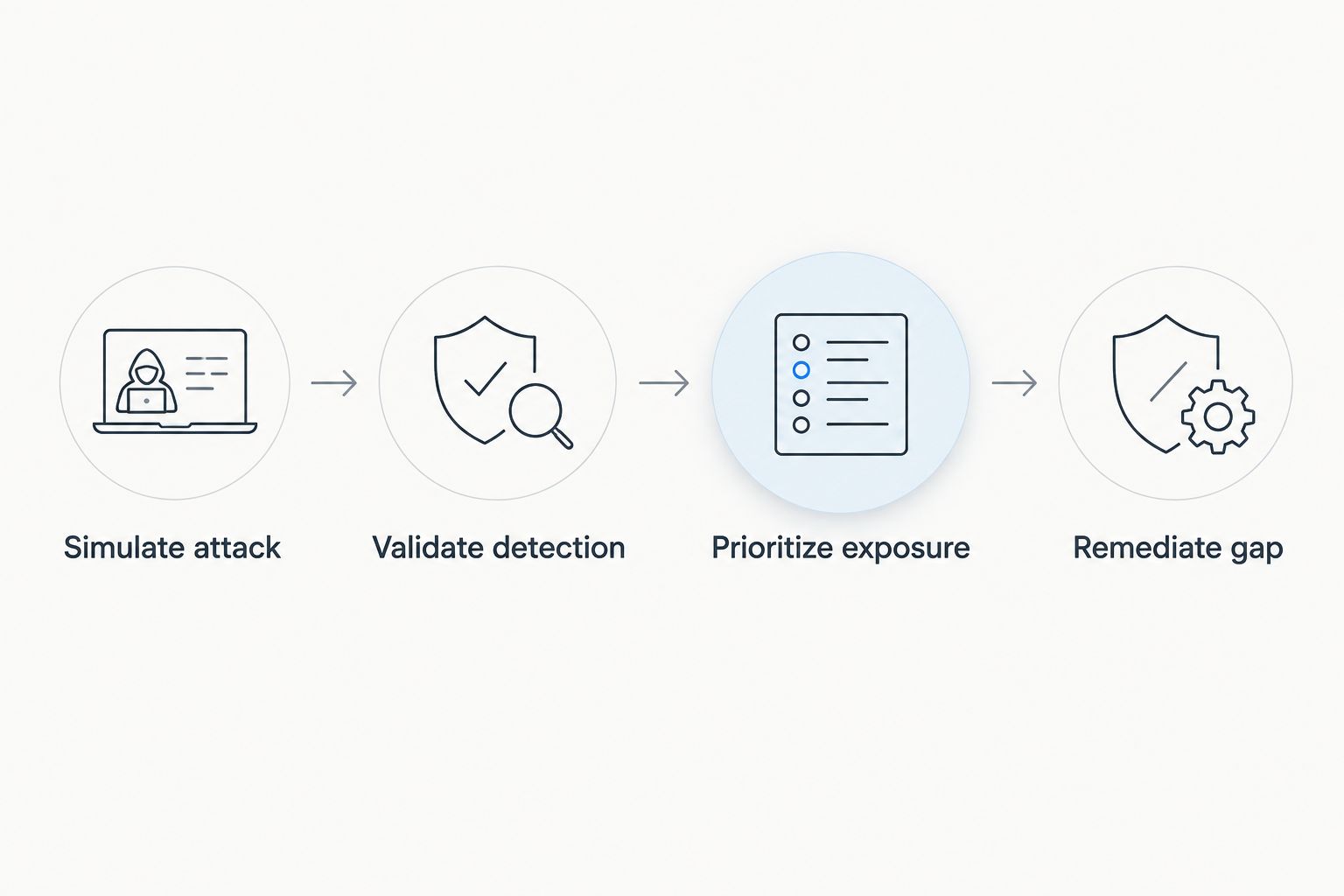
A simulation that never gets remediated is just an expensive fire drill. That's the filter to run every BAS finding through before you count it as a win.
What makes the best breach and attack simulation tool
- MITRE ATT&CK technique coverage, and how often the library gets updated against new threat activity
- Detection and control validation, not just execution — does it tell you if your SIEM or EDR actually fired
- Integration depth with SIEM, EDR, and exposure or vulnerability management platforms
- Deployment model: agent-based simulators inside every segment versus agentless, cloud-only testing
- Reporting that maps a failed simulation back to a specific control gap, not a generic score
- Support for cloud, on-prem, hybrid, and OT/ICS attack scenarios where relevant
Best breach and attack simulation tools at a glance
| Tool | Best for | Standout feature | Key limitation |
|---|---|---|---|
| Picus Security | Continuous control validation | Prevention scoring tied to specific SIEM/EDR rules | Value depends on how many layers you connect |
| AttackIQ | MITRE ATT&CK-aligned adversary emulation | Scenario library mapped to named threat groups | Custom scenario building takes analyst time |
| SafeBreach | Attack path visibility across hybrid environments | Full lateral-movement path simulation | Needs simulators across every segment tested |
| Cymulate | Fast SaaS deployment for lean teams | Modular vectors: email, web, endpoint, network | Less depth per vector than dedicated point tools |
| XM Cyber | Linking simulation results to exposure and asset risk | Graph-based attack chain prioritization | Scope overlaps into exposure management |
| Pentera | Agentless exploitability validation | Automated, safe-by-design live attacks | Bounded by what agentless testing can reach |
| Caldera | Free, open-source ATT&CK automation | MITRE-maintained, no license cost | No vendor support line, manual reporting |
1. Picus Security: best breach and attack simulation tool for continuous control validation
Picus Security runs automated attacks against production security controls and scores whether each one detected or blocked the technique. It's built around continuous validation of controls you already own, not a one-time assessment.
Picus Security pros:
- Large, frequently updated attack technique library mapped to MITRE ATT&CK
- Focuses on validating existing SIEM and EDR rules, not just proving a gap exists
- Remediation guidance tied to the specific control vendor that failed
Picus Security cons:
- Value scales with how many security layers you actually connect it to
- Teams without a mature SOC can struggle to work through finding volume
Best for: teams that already run SIEM and EDR and need to know whether the rules actually fire. Verdict: Buy for programs optimizing detection coverage.
2. AttackIQ: best breach and attack simulation tool for MITRE ATT&CK-aligned emulation
AttackIQ builds structured adversary emulation scenarios modeled on named MITRE ATT&CK groups and schedules them as recurring campaigns across the environment. It tests specific threat-actor behavior instead of a generic technique checklist.
AttackIQ pros:
- Deep alignment with MITRE ATT&CK Evaluations methodology
- Scenario library mapped to named threat groups, not just isolated techniques
- Strong scheduling and reporting built for recurring, ongoing validation programs
AttackIQ cons:
- Custom scenario building for non-standard threat models takes real analyst time
- Agent deployment across a hybrid estate adds operational overhead
Best for: programs that report maturity against specific adversary groups, not generic coverage percentages. Verdict: Buy for structured, recurring adversary emulation.
3. SafeBreach: best breach and attack simulation tool for attack path visibility
SafeBreach maps how an attacker could move from an initial foothold to a target asset across cloud, on-prem, and hybrid infrastructure, then simulates every step of that path. The unit of analysis is the full path, not a single technique.
SafeBreach pros:
- Attack path visualization surfaces lateral-movement risk, not just point-in-time gaps
- Simulator network scales across large hybrid estates
- Strong library of publicly known breach methods, kept current
SafeBreach cons:
- Full path modeling needs simulators deployed in every segment you want visibility into
- Initial setup on a large hybrid network takes longer than single-technique tools
Best for: security teams worried about lateral movement across a mixed cloud and on-prem footprint. Verdict: Buy for organizations prioritizing attack path risk over isolated control checks.
4. Cymulate: best breach and attack simulation tool for lean teams
Cymulate runs as a SaaS platform with modular testing across email, web, endpoint, and network vectors, aimed at teams that want a BAS program without standing up dedicated infrastructure.
Cymulate pros:
- SaaS delivery gets a first assessment running fast
- Modular vectors let a small team start with one area, like phishing, and expand
- Built-in purple-team style exercises for joint red/blue testing
Cymulate cons:
- Depth per module is lighter than a dedicated point tool for that same vector
- Larger enterprises with complex segmentation may need more customization than the SaaS model gives out of the box
Best for: lean security teams starting a breach and attack simulation program without a long deployment project. Verdict: Buy for small-to-mid security teams.
5. XM Cyber: best breach and attack simulation tool for connecting results to exposure
XM Cyber runs continuous attack path simulations and ties each finding back to the specific exposures and assets that make the path possible, sitting closer to exposure management than classic BAS.
XM Cyber pros:
- Findings ranked by the actual business impact of the exposed asset, not just success or failure
- Strong graph-based visualization of full attack chains
- Overlaps usefully with attack surface and exposure management work already underway
XM Cyber cons:
- The exposure-management framing blurs scope for teams that just want control validation
- Graph output takes training to read well
Best for: teams that want simulation output prioritized by which exposed asset actually matters. Verdict: Buy for teams already thinking in exposure-management terms.
6. Pentera: best breach and attack simulation tool for agentless exploitability testing
Pentera runs agentless, automated attacks against the live environment to validate exploitability rather than simulate known technique signatures, closer to continuous automated penetration testing.
Pentera pros:
- Agentless deployment lowers setup overhead
- Validates actual exploitability instead of a theoretical technique score
- Safe-by-design controls limit production impact during testing
Pentera cons:
- Agentless scope is bounded by what it can reach without credentials or deeper integration
- Less useful than SIEM/EDR-integrated tools when detection tuning, not exploitability, is the goal
Best for: teams that want proof of exploitability, not just a simulated technique score. Verdict: Buy for validating real exposure, Hold if detection tuning is the specific priority.
7. Caldera: best free and open-source breach and attack simulation tool
Caldera is MITRE's own open-source automated adversary emulation framework, built directly on the ATT&CK knowledge base with a plugin architecture for custom scenarios.
Caldera pros:
- No license cost
- Direct ATT&CK alignment since MITRE maintains both the framework and the technique base
- Active open-source community and plugin ecosystem
Caldera cons:
- No vendor support line, so setup and scenario tuning depend on in-house skill
- Reporting requires far more manual work than any commercial option on this list to be executive-ready
Best for: teams with red-team engineering skill who want ATT&CK-based automation without a subscription. Verdict: Buy for technically strong teams on a tight budget, Skip if you need packaged reporting for leadership.
Turn BAS findings into a remediation plan
See how exposure data gets prioritized once a simulation finds a gap.
How we ranked these tools
Each tool is scored against the six criteria above: ATT&CK coverage, detection validation depth, integration reach, deployment model, gap-mapping in reporting, and environment support. No entry gets a pass on cons — every tool here, including the free one, has a real limitation stated plainly next to its strengths.
Which breach and attack simulation tool should you choose?
If your SOC already has SIEM and EDR tuned and you want recurring, structured proof it's working, AttackIQ is the default pick for 2026. If you're a small team without a dedicated BAS budget line, start with Cymulate's SaaS deployment. If you have red-team engineering skill and zero budget, Caldera gets you real ATT&CK-based testing for the cost of setup time. Whichever tool you pick, the test only matters once its output reaches a remediation workflow tied to real exposure, not a slide deck.
FAQ
What's the best breach and attack simulation tool for 2026?
AttackIQ is the strongest overall pick for 2026 because of its MITRE ATT&CK-aligned, recurring adversary emulation model. Cymulate wins for lean teams needing fast SaaS deployment, and Caldera is the best free option for technically strong red teams.
Is Picus Security better than AttackIQ?
Picus Security focuses more on continuous control validation and prevention scoring against your existing SIEM and EDR, while AttackIQ leans toward structured, named-threat-group adversary emulation. Pick Picus for control tuning, AttackIQ for adversary-specific reporting.
How much does breach and attack simulation cost?
Pricing varies by vendor, deployment scope, and number of environments tested, so check current quotes directly with each vendor rather than relying on a published range. SaaS-delivered tools like Cymulate typically have a lower setup cost than agent-heavy platforms.
Is Caldera good enough to skip a paid BAS tool?
Caldera gives you real ATT&CK-based automated testing at no license cost, which is enough for teams with in-house red-team skill. It lacks vendor support and polished executive reporting, so teams needing packaged output for leadership usually still need a commercial tool.
What's the difference between breach and attack simulation and penetration testing?
Breach and attack simulation runs automated, repeatable attacks continuously to test specific controls, while penetration testing is typically a manual, point-in-time engagement testing broader exploitability. Pentera sits closest to automated penetration testing among BAS tools.
Does breach and attack simulation replace vulnerability management?
No. BAS tests whether your controls detect or block known attack techniques, while vulnerability management finds and prioritizes the underlying exposures those techniques exploit. The two work together in a full exposure management program.
Can BAS tools test cloud environments?
Yes, most tools on this list including SafeBreach, XM Cyber, and Cymulate support cloud and hybrid attack path testing alongside on-prem. Coverage depth for cloud-native attack paths varies by vendor, so check current scenario libraries before buying.
How often should you run breach and attack simulations?
Continuous or weekly runs are standard for 2026 programs using tools like Picus Security or AttackIQ, since controls and configurations change constantly. Quarterly or one-off testing catches far less drift between assessments.
One last thing
The tools that separate themselves in 2026 aren't the ones with the biggest technique library — they're the ones that map a failed simulation directly to a control, an asset, and an owner. A BAS report with a hundred findings and no clear next action gets shelved by week two. Pick the tool whose output your team will actually act on, not the one with the longest feature list.