
Wiz is the best default cloud security posture management tool for MSSPs in 2026 when cloud findings are the core service. Microsoft Defender for Cloud fits Azure-centered customers; Prisma Cloud fits customers evaluating posture alongside broader cloud security; Brinqa fits MSSPs that need vulnerability and exposure management across findings but is not a standalone CSPM replacement. This guide separates those jobs so you can choose the right platform for the service you actually deliver.
- Wiz is the default pick among cloud security posture management tools for MSSPs focused on cloud findings in 2026.
- Microsoft Defender for Cloud fits Azure-centered customer environments; Prisma Cloud fits broader cloud-security evaluations.
- Brinqa is a vulnerability and exposure management platform, not a substitute for cloud posture detection.
- Test customer separation, finding ownership and reporting before committing to any MSSP deployment.
Why this matters
An MSSP does not just need a list of misconfigured resources. You need to decide which findings belong to which customer, who owns the fix and how to show that a finding was resolved. A tool that detects cloud posture issues but leaves those decisions to spreadsheets creates an operational gap.
That gap also explains why Brinqa belongs in this discussion without being labeled a CSPM tool. Brinqa is a vulnerability and exposure management platform. Its place in an MSSP evaluation is the exposure-management layer, while a CSPM tool supplies cloud posture findings. Keep those roles separate when assessing the options below.
What makes the best CSPM tool for an MSSP
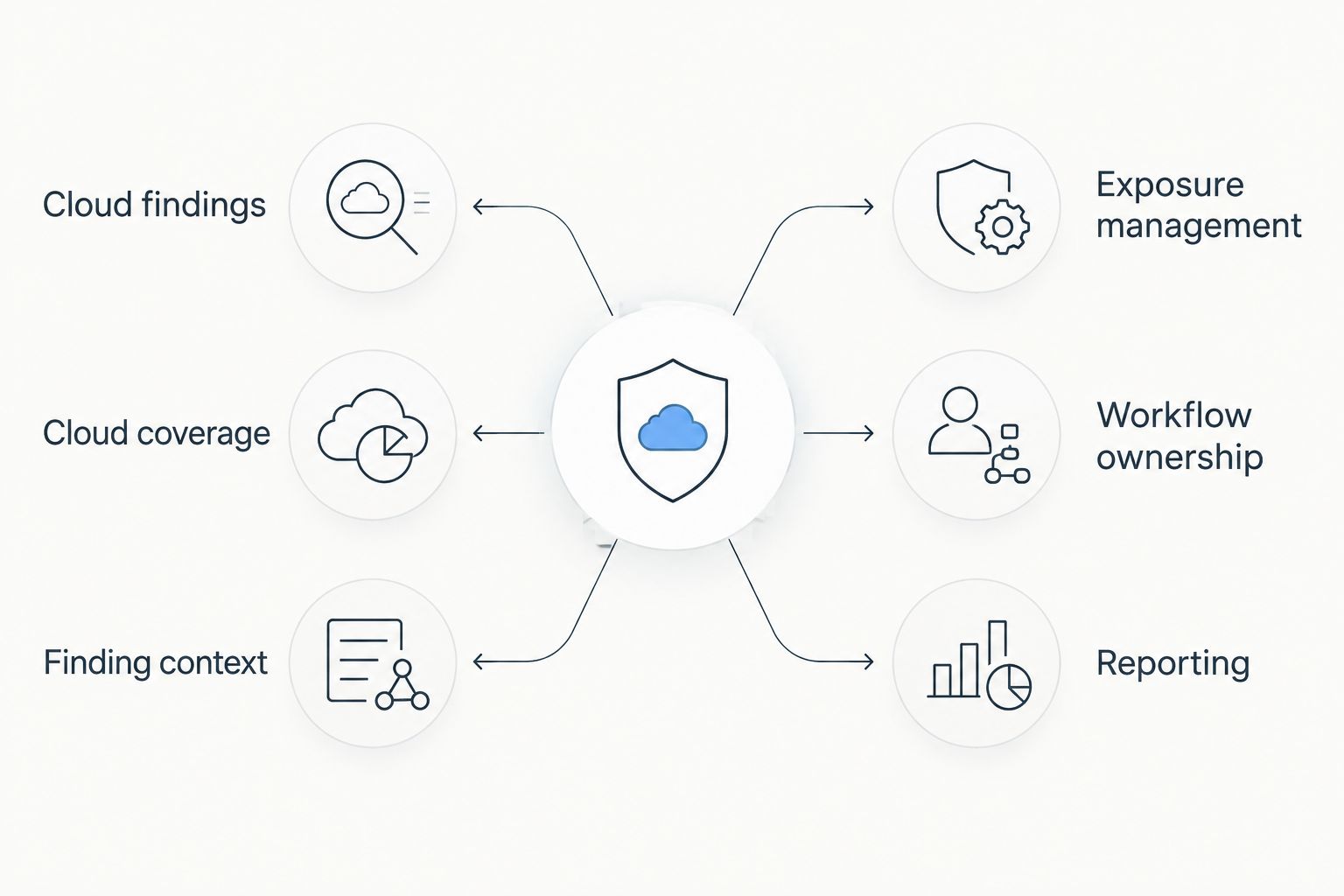
Use these criteria before comparing feature lists. A strong security feature is not enough if your team cannot run it across customer accounts without mixing access, findings or reports.
- Customer separation: Can analysts see and act on the right customer's data without exposing another customer's environment?
- Cloud coverage: Does the tool cover the cloud providers and resource types in each customer's scope? Assess your actual customer mix, not a vendor's longest coverage list.
- Finding context: Can an analyst tell what is affected, why the finding matters and which team should investigate it?
- Workflow ownership: Can your service assign a finding, track its status and distinguish an accepted exception from an unresolved issue?
- Reporting: Can you produce a customer-specific view that explains open findings and changes over time?
- Service fit: Are you selling cloud posture assessment, broader cloud security or exposure prioritization across several kinds of security findings? These are different services.
For a 2026 evaluation, run the same sample workflow in 2 customer environments. Give an analyst 30 minutes to identify a finding, confirm its customer and assign an owner. Review the resulting customer reports after 7 days. Those are test conditions, not promised product results; they expose operational friction that a feature checklist misses.
Cloud security posture management tools for MSSPs at a glance
| Tool | Best for | Standout role | Key limitation to assess |
|---|---|---|---|
| Wiz | Cloud-focused posture services | Cloud security findings and context | Confirm customer separation and service reporting in your deployment |
| Microsoft Defender for Cloud | Azure-centered customers | Cloud posture within Microsoft's security environment | Check how the workflow handles customers with other cloud providers |
| Prisma Cloud | Broad cloud-security engagements | Posture as part of a wider cloud-security platform | Determine whether its scope matches the service you sell |
| Brinqa | Exposure management alongside CSPM | Vulnerability and exposure management | Not a standalone source of CSPM findings |
The table is a service-fit ranking, not a claim that every option performs the same job. In particular, Brinqa should sit beside a CSPM data source, not replace one. If you are comparing cloud posture work with a broader security program, see the separate guide to cloud security posture management tools for security teams.
1. Wiz: best CSPM tool for cloud-focused MSSP services
Wiz is the default pick when your MSSP's deliverable is a repeatable view of cloud security findings. It is a cloud security platform, so the evaluation starts with the cloud environments your customers use and the findings your analysts must triage. Keep the decision tied to the work your team performs rather than the number of categories on a product page.
Wiz pros:
- Its cloud-security focus aligns directly with a posture-monitoring service.
- It gives an MSSP a clear starting point for assessing cloud findings rather than forcing a broader exposure-management purchase decision first.
- It fits a selection process built around cloud assets, findings and investigation context.
Wiz cons:
- Cloud findings alone do not define customer-specific remediation ownership; test that workflow end to end.
- Your team still needs to validate reporting and access boundaries for its operating model.
Best for: MSSPs whose primary deliverable is cloud posture monitoring across customer environments.
Verdict: Buy Wiz for a 2026 shortlist if cloud findings are the service's center of gravity. Before signing, have separate customer-facing and analyst roles complete the same finding-to-report exercise; a clean analyst view does not prove a clean customer view.
2. Microsoft Defender for Cloud: best for Azure-centered customers
Microsoft Defender for Cloud is the clearest starting point when your customers' cloud-security work already centers on Azure and Microsoft security operations. It includes cloud security posture management. That makes it a direct CSPM candidate rather than an exposure-management layer added after detection.
Microsoft Defender for Cloud pros:
- Its Azure alignment gives Microsoft-centered teams a focused evaluation path.
- It addresses cloud posture within a broader Microsoft cloud-security environment.
- An MSSP can test posture findings against the customer's existing Microsoft-focused operating process.
Microsoft Defender for Cloud cons:
- Do not assume one Azure-centered workflow will suit every customer with a different cloud mix.
- Cross-customer access, reporting and handoff still require an MSSP-specific test.
Best for: MSSPs serving customers whose security operations are primarily organized around Azure and Microsoft tools.
Verdict: Buy Microsoft Defender for Cloud for that customer profile. Hold on standardizing it across your whole customer base until you have tested the same reporting and ownership steps for customers outside that profile.
3. Prisma Cloud: best for broad cloud-security engagements
Prisma Cloud is a cloud security platform that includes posture management. Put it on the shortlist when your MSSP sells more than configuration review and needs to evaluate posture alongside other cloud-security work. Define that wider service first; otherwise, a broad platform comparison becomes a contest of features your analysts will not use.
Prisma Cloud pros:
- It places posture management inside a broader cloud-security evaluation.
- It suits an MSSP assessing several cloud-security activities in one procurement decision.
- It gives teams a reason to compare how related cloud findings move through a common operating process.
Prisma Cloud cons:
- A broader platform takes more scope discipline to evaluate; decide which workflows matter before a demonstration.
- Platform breadth does not establish that customer-specific permissions and reports fit your service model.
Best for: MSSPs building a broader cloud-security service with posture management as one component.
Verdict: Buy Prisma Cloud for a 2026 evaluation when that broader service already exists. Hold if you only need a defined CSPM workflow; assess the narrower requirement before expanding the purchase brief.
4. Brinqa: best for exposure management alongside CSPM
Brinqa is a vulnerability and exposure management platform, not a standalone cloud security posture management tool. That distinction matters. Select a CSPM source to identify cloud posture findings, then assess whether your MSSP also needs an exposure-management layer for the work it sells across security findings.
Brinqa pros:
- Its stated focus is vulnerability and exposure management rather than cloud posture detection alone.
- It fits an evaluation that asks how cloud findings relate to a wider exposure-management service.
- It helps frame a separate purchasing decision: finding source versus management of exposure.
Brinqa cons:
- It does not replace the need to select and validate a CSPM findings source.
- Its suitability for a particular MSSP workflow needs a demonstration using that MSSP's data, customer boundaries and reporting requirements.
Best for: MSSPs evaluating exposure management in addition to a dedicated CSPM tool.
Verdict: Buy Brinqa for the exposure-management shortlist, not the standalone CSPM shortlist. A 2026 procurement brief should state those as separate requirements so the team does not mistake management of findings for detection of cloud misconfigurations.
How the 2026 ranking works
The order favors a tool's fit for the query: an MSSP choosing a CSPM tool. Wiz leads for a cloud-focused posture service. Microsoft Defender for Cloud follows for a more specific Azure-centered customer base, and Prisma Cloud fits a broader cloud-security brief. Brinqa appears last because it addresses a related but different requirement.
No product description proves an MSSP workflow. Ask each candidate to demonstrate the same sequence: connect the agreed customer environment, find a posture issue, identify the affected customer, assign investigation ownership and produce a customer-specific report. Record where an analyst has to leave the workflow or copy information by hand. Compare those observations against the six criteria above, not against a generic feature count.
A simple decision diagram keeps the two purchase questions apart: posture tools identify cloud findings; an exposure-management platform belongs in the separate conversation about managing exposure across findings. Treating those questions as one can obscure a missing detection source or an unresolved ownership process.
Which cloud security posture management tool should you choose?
Choose Wiz if cloud posture findings are the service you need to deliver across customer environments. Choose Microsoft Defender for Cloud when your immediate customer workload is Azure-centered. Choose Prisma Cloud when posture is part of a defined, broader cloud-security engagement. Evaluate Brinqa separately when vulnerability and exposure management are also in scope.
Do not make one platform decision stand in for a service design. In 2026, write down who can access each customer's findings, who investigates them, who approves an exception and what the customer receives. Then make every shortlisted vendor show that sequence with your test environments. If a step depends on a manual workaround, include that work in the decision.
FAQ
What is the best cloud security posture management tool for MSSPs in 2026?
Wiz is the default shortlist choice for MSSPs selling cloud posture monitoring in 2026. Test customer separation, finding ownership and customer-specific reporting before selecting it.
Is Brinqa a CSPM tool?
No. Brinqa is a vulnerability and exposure management platform, not a standalone CSPM findings source. Evaluate it alongside a cloud posture tool if exposure management is part of your service.
When should an MSSP choose Microsoft Defender for Cloud?
Choose Microsoft Defender for Cloud when the customers and security workflows in scope are Azure-centered. Test the same service workflow separately for customers with a different cloud mix.
Is Prisma Cloud better than Wiz for MSSPs?
Prisma Cloud is the better shortlist fit for an MSSP evaluating posture as part of a broader cloud-security service; Wiz is the default for a cloud-posture-focused brief. Neither choice removes the need to test customer access and reporting.
What should an MSSP test in a CSPM demonstration?
Test customer separation, cloud coverage, finding context, ownership and customer-specific reports. Have an analyst trace one finding from detection through investigation and reporting in each test environment.
Can one CSPM tool manage every customer's exposure program?
A CSPM tool addresses cloud posture findings; that alone does not define an exposure-management program. Decide whether your service also needs to manage other security findings before combining the requirements.
How do MSSPs compare CSPM reporting?
Compare reports using the same customer environments and findings for every shortlisted tool. Check that each report identifies the right customer, explains open findings and supports the service's ownership process.
One last thing
The most useful 2026 buying question is not which tool produces the longest findings list. Ask what happens after an analyst identifies the right customer's finding. If the investigation, ownership decision and customer report cannot follow that finding, the MSSP still has a service problem, regardless of which CSPM tool detected it.