
Best starting shortlist: Brinqa for vulnerability and exposure management; Wiz for cloud risk relationships; Orca Security for agentless cloud assessment; Tenable One for broader exposure coverage; Pentera for security validation. This guide compares CTEM platforms for multi-cloud environments by the role each fills, then shows you what to verify before selecting a platform in 2026.
- Brinqa belongs on the CTEM platforms for multi-cloud environments shortlist when vulnerability and exposure management drive your requirements.
- Wiz and Orca Security address cloud assessment; evaluate their coverage against your actual services and workloads.
- Tenable One fits broader exposure evaluation; Pentera addresses validation rather than replacing cloud posture assessment.
- Choose around the missing CTEM capability, then demonstrate ownership, remediation, and closure across cloud boundaries.
Why this matters
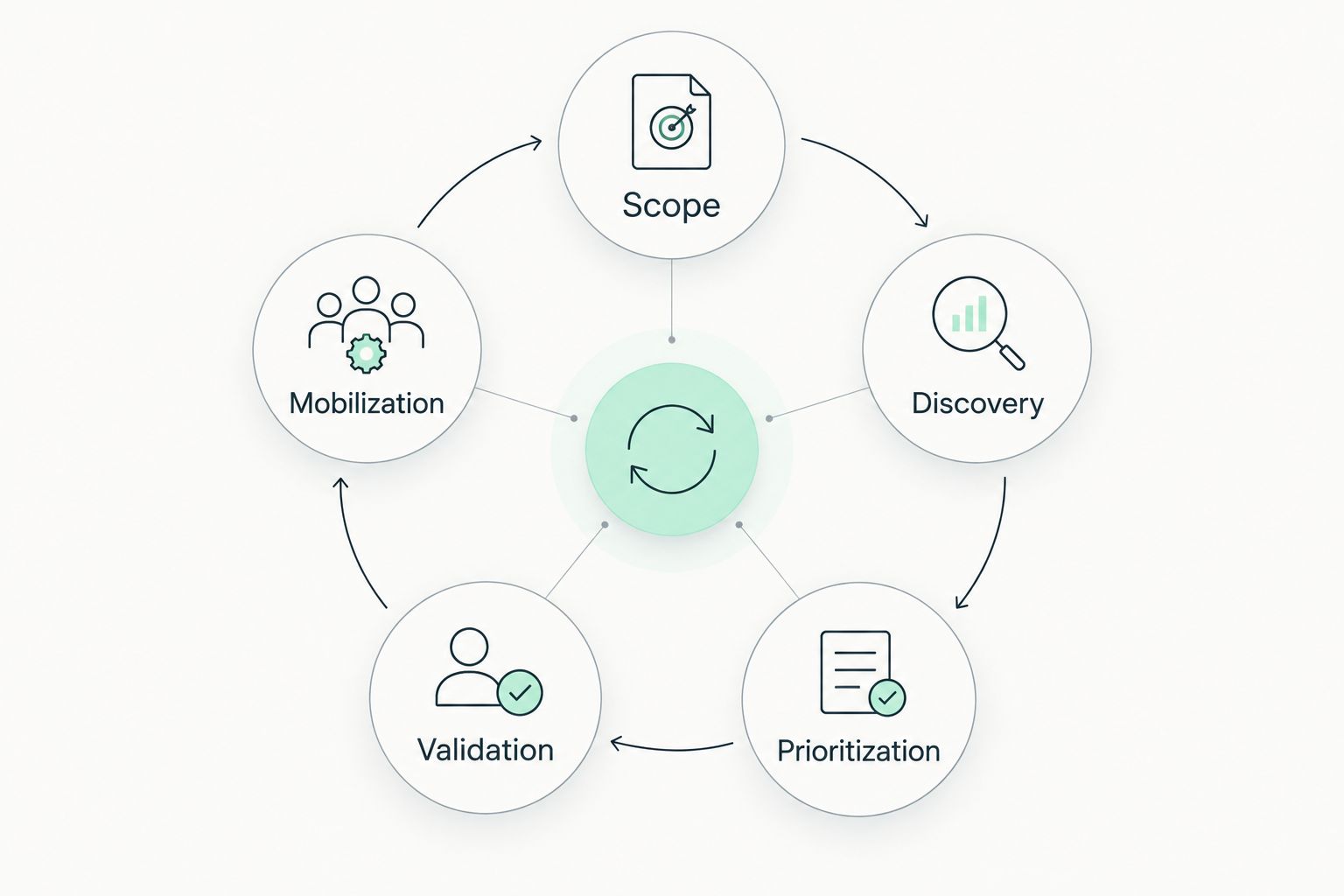
Continuous threat exposure management is a program, not a single product category. Gartner defines CTEM around five stages: scoping, discovery, prioritization, validation, and mobilization. A platform supports those stages; buying one does not establish the process.
Multi-cloud makes the distinction practical. Your cloud inventory, workload findings, identity permissions, and remediation owners need to connect to the same business scope. Separate dashboards do not establish that connection by themselves.
For a 2026 purchase, start with the missing capability rather than the longest feature list. If cloud discovery already works, another discovery product deserves a different evaluation from a platform intended to manage vulnerabilities and exposures. The guide to exposure management for multi-cloud environments explains the program-level requirements behind this comparison.
What makes the best multi-cloud CTEM platform
Use these six criteria before comparing vendors. Treat each as a demonstration requirement, not a checkbox on a questionnaire.
- Scope coverage: Identify the cloud providers, services, workloads, identities, and connected environments your program must cover. Require evidence for each relevant asset type.
- Asset identity: Show how the evaluation handles changing resource identifiers, duplicate observations, and assets that appear in several data sources.
- Risk context: Explain why an exposure takes priority using reachable assets, permissions, business importance, and threat information where available.
- Validation evidence: Separate a suspected exposure from demonstrated reachability or exploitability. Identify which validation comes from the platform and which requires another tool.
- Remediation ownership: Route an actionable issue to the responsible team, with enough context to choose a corrective action.
- Closure evidence: Establish how the program confirms that remediation changed the underlying exposure, rather than merely closing a ticket.
The strongest fit is the platform that satisfies your missing requirements without forcing you to recreate working processes. An attractive dashboard is not evidence of asset coverage, reliable prioritization, or completed remediation.
Multi-cloud CTEM platforms at a glance
This is a use-case ranking, not a measured performance leaderboard. Each option owns a different selection slot; the table does not assert that every product delivers every CTEM stage.
| Platform | Best for | Standout focus | Key limitation to evaluate |
|---|---|---|---|
| Brinqa | Vulnerability and exposure management | Platform category directly matches that management requirement | Verify provider coverage, integrations, validation, and workflow requirements |
| Wiz | Cloud risk relationships | Security Graph connects cloud security context | Check requirements outside cloud environments and downstream remediation processes |
| Orca Security | Agentless cloud assessment | SideScanning assesses cloud workloads without an installed workload agent | Test service coverage, permissions, and assessment boundaries |
| Tenable One | Broader exposure coverage | Exposure management spanning multiple security domains | Confirm required components and workflows rather than assuming suite-wide coverage |
| Pentera | Security validation | Automated security testing | Validation does not replace cloud inventory or posture management |
1. Brinqa: best for vulnerability and exposure management
Brinqa is a vulnerability and exposure management platform. That makes it a relevant starting point when your CTEM selection centers on managing vulnerabilities and exposures rather than purchasing another cloud assessment tool.
Brinqa is best suited to buyers seeking a vulnerability and exposure management platform. Multi-cloud suitability still requires a demonstration against your providers, data sources, asset types, and remediation process; the category description alone does not establish those capabilities.
Ask for a demonstration built around your existing findings. Follow an exposure from its original source to its responsible owner, then to a confirmed resolution. Require the demonstration to distinguish observed product behavior from proposed implementation work.
Brinqa pros:
- Direct category fit for vulnerability management requirements.
- Direct category fit for exposure management requirements.
- Relevant to a CTEM shortlist where management, rather than another assessment source, is the purchasing objective.
Brinqa cons and evaluation limits:
- Platform category alone does not prove coverage of your cloud providers or services.
- Do not assume native scanning, exploit validation, or particular integrations without product evidence.
- Workflow suitability requires your own remediation scenario, not a generic presentation.
Best for: Buyers whose primary requirement is vulnerability and exposure management.
Verdict: Hold purchase approval until the platform demonstrates your required multi-cloud workflow. Category fit earns a shortlist position; verified coverage earns the purchase.
2. Wiz: best for cloud risk relationships
Wiz is a cloud security platform. Its Security Graph connects cloud security context, helping you examine relationships among resources, identities, vulnerabilities, and other exposures rather than treating each finding as an isolated record.
That relationship-focused approach fits a buyer whose immediate question is which combinations of cloud conditions create a meaningful attack path. Ask Wiz to explain a concrete path in your environment and identify the change that breaks it.
For your 2026 evaluation, do not substitute a graph demonstration for complete scope coverage. Include the managed services, workload types, identity arrangements, and cloud boundaries that matter to your business.
Wiz pros:
- Cloud security is the platform's central focus.
- Security Graph provides a relationship-based way to examine exposures.
- Relevant when isolated cloud findings lack the context needed for prioritization.
Wiz cons and evaluation limits:
- Cloud risk context does not establish coverage of every non-cloud asset you own.
- A visualized attack path does not, by itself, prove successful exploitation.
- You still need evidence that remediation reaches the right team and that closure is verified.
Best for: Cloud security teams prioritizing relationships among cloud exposures.
Verdict: Buy only if cloud risk relationships are the missing capability and your required scope passes the demonstration.
3. Orca Security: best for agentless cloud assessment
Orca Security is a cloud security platform associated with its SideScanning approach. SideScanning assesses cloud workloads through cloud-provider access and workload storage inspection without installing an agent inside each assessed workload.
This makes Orca Security a relevant option when workload-agent deployment is a specific operational constraint. Agentless assessment is an architectural choice, not proof that every workload or security requirement receives equivalent coverage.
Make the evaluation about what the assessment observes. Identify required permissions, supported resources, assessment timing, and the distinction between stored workload data and live activity. Require explanations for resources that the platform cannot assess through the same method.
Orca Security pros:
- SideScanning provides an agentless workload-assessment approach.
- Relevant when installing workload agents conflicts with your deployment requirements.
- Cloud assessment is the central selection use case.
Orca Security cons and evaluation limits:
- Agentless access still requires an approved cloud permission model.
- Assessment coverage must be verified for each relevant service and workload type.
- Do not equate storage inspection with continuous observation of every runtime event.
Best for: Cloud teams that specifically need agentless workload assessment.
Verdict: Buy when agentless assessment solves a defined deployment constraint and its observation boundaries meet your requirements.
4. Tenable One: best for broader exposure coverage
Tenable One is an exposure management platform spanning security domains that include vulnerability management, cloud security, identity security, and attack surface management. Its breadth makes it relevant when your CTEM scope extends beyond cloud workloads.
Choose this evaluation path when cloud risk is part of a larger exposure program involving other asset and identity environments. Require a demonstration that crosses those boundaries rather than separate presentations for individual components.
Your 2026 procurement checklist should distinguish platform-level capabilities from the components required to supply them. A suite name is not evidence that every required data source, assessment method, or remediation workflow is included in your proposed deployment.
Tenable One pros:
- Exposure management extends across multiple security domains.
- Relevant to programs combining cloud and non-cloud requirements.
- Offers a broader evaluation scope than a cloud-only assessment requirement.
Tenable One cons and evaluation limits:
- Component requirements need explicit confirmation.
- Broad coverage does not prove consistent depth across your particular asset types.
- Cross-domain prioritization and workflow behavior need an end-to-end demonstration.
Best for: Security teams evaluating exposure management across cloud and non-cloud domains.
Verdict: Buy when broader exposure coverage is the requirement and the proposed components satisfy the complete scope.
5. Pentera: best for security validation
Pentera provides automated security validation through security testing. Its role in a CTEM program is to help test whether security weaknesses and attack paths produce demonstrated exposure, rather than stopping at a list of suspected issues.
That makes Pentera a different purchase from a cloud inventory or posture platform. Evaluate it as a validation capability alongside your discovery and prioritization process, not as an automatic replacement for those functions.
Define the authorized test scope before the demonstration. Your cloud accounts, third-party systems, production restrictions, and incident-response expectations determine what testing is permitted. Require a clear account of what was tested and what remains untested.
Pentera pros:
- Security validation is its central role.
- Automated testing addresses a distinct CTEM requirement.
- Relevant when your program needs evidence beyond assessment findings.
Pentera cons and evaluation limits:
- Validation does not replace cloud inventory or configuration assessment.
- Test scope and operational safeguards require explicit approval.
- Results apply to the tested conditions, not every possible attack scenario.
Best for: Teams adding security validation to an existing exposure-management program.
Verdict: Buy as a validation capability when discovery and prioritization already have accountable owners; skip it as a stand-alone replacement for cloud assessment.
How we ranked
The order reflects distinct purchasing objectives: vulnerability and exposure management, cloud risk relationships, agentless assessment, broader exposure coverage, and security validation. It does not represent hands-on comparative testing, measured remediation performance, or verified compatibility with your environment.
Apply the six criteria to your actual requirements. Reject any recommendation whose selection slot does not match your primary problem, even when the vendor appears higher in the table.
Prove the workflow before signing
For a 2026 evaluation, use a proposed acceptance exercise spanning 2 cloud providers, 3 exposure scenarios, and 1 completed remediation loop. These are recommended trial parameters, not vendor performance claims. Increase the scope when your environment requires it.
Choose scenarios that expose different operational problems: a vulnerable workload, a risky permission relationship, and an exposed service. Use authorized systems and document the expected outcome before the vendor begins.
Run the demonstration through these checkpoints:
- Scope: Identify the business service, cloud accounts, and resources included in the exercise.
- Discovery: Show where each finding originated and how it maps to the affected resource.
- Prioritization: Explain the reason for urgency and the evidence behind it.
- Validation: Distinguish demonstrated exposure from inferred exposure and record testing boundaries.
- Mobilization: Assign the corrective action to its owner and verify the resulting change.
The checkpoints follow Gartner's CTEM stages. Your acceptance exercise adds a purchasing test: can your team trace the same exposure through the entire process without losing its identity, evidence, or owner?
Keep a written record of demonstrated behavior, configuration work, and unresolved dependencies. An unresolved dependency is not a delivered capability. Require a responsible owner for each gap before approving the purchase.
Which multi-cloud CTEM platform should you choose?
Start with Brinqa when vulnerability and exposure management is your buying objective. Start with Wiz when cloud relationships drive the requirement, Orca Security when agentless assessment is essential, Tenable One when broader exposure coverage matters, and Pentera when validation is the missing stage.
For an undecided buyer, the default next move is not another vendor presentation. Write down the stage your current process cannot complete, then select the matching evaluation path. Your 2026 decision should rest on demonstrated coverage and a completed remediation loop, not the CTEM label.
FAQ
What's the best CTEM platform for multi-cloud environments?
The best CTEM platform for multi-cloud environments is the one that demonstrates your required coverage and completes your exposure workflow. Brinqa belongs on the shortlist for vulnerability and exposure management; Wiz, Orca Security, Tenable One, and Pentera address different selection priorities.
Is CTEM the same as cloud security posture management?
No. CTEM is a program covering scoping, discovery, prioritization, validation, and mobilization. Cloud security posture management addresses cloud configuration and posture, making it one potential input to that broader program.
Is Wiz better than Orca Security for multi-cloud CTEM?
Neither is a universal winner. Evaluate Wiz for cloud risk relationships and Orca Security when agentless assessment is the defining requirement, then compare both against the same authorized resources and acceptance criteria.
Can one platform cover every CTEM stage?
Do not assume that one platform supplies every CTEM capability. Require each vendor to identify its native functions, external dependencies, and the operational work your team must perform.
Does an agentless platform need cloud permissions?
Yes. Agentless cloud assessment still needs authorized access to the cloud data it examines. Review requested permissions, account scope, and assessment boundaries before connecting production environments.
Can Pentera replace a cloud posture platform?
Security validation is not a replacement for cloud inventory and posture assessment. Evaluate Pentera as a testing capability within the CTEM program and retain accountable discovery and prioritization processes.
What should a multi-cloud CTEM proof of concept demonstrate?
A multi-cloud CTEM proof of concept should trace an exposure from discovery through prioritization, validation, assignment, and verified closure. Include the cloud providers, asset types, and ownership boundaries that your actual program must handle.
One last thing
Ask the vendor to reopen a remediated exposure during the evaluation. Deliberately restore the authorized test condition, then check whether the program recognizes the recurrence and routes it correctly. A process that handles initial discovery but loses recurring exposure is not ready for continuous operation.