
Best for vulnerability and exposure management evaluation: Brinqa; best for connector-based asset inventory: Axonius; best for network discovery: runZero. This 2026 shortlist compares cyber asset attack surface management tools for MSSPs by service use case, with JupiterOne for relationship analysis and Cortex Xpanse for external discovery.
- Evaluate Brinqa when vulnerability and exposure management is your MSSP service priority.
- Axonius belongs on the shortlist for connector-based cyber asset inventory.
- Compare cyber asset attack surface management tools for MSSPs by tenant isolation, evidence quality, and remediation handoff.
- Evaluate runZero for network discovery, JupiterOne for asset relationships, and Cortex Xpanse for external attack surface discovery.
Why this matters
An MSSP needs more than an asset list. Your analysts must establish which customer owns an asset, whether its security data is current, and who receives the remediation task.
Cyber asset attack surface management, or CAASM, brings asset information together to help expose inventory gaps and security coverage gaps. External attack surface management focuses on internet-facing assets. Vulnerability management addresses weaknesses; exposure management adds the broader question of which exposures deserve attention.
These categories overlap, but they are not interchangeable. Choose the missing capability in your service, not the broadest category label. For a 2026 shortlist, separate discovery, inventory reconciliation, and exposure management before comparing vendors.
What makes the best CAASM tool for an MSSP?
Use these criteria before reading the comparison. Treat customer separation as a pass-or-fail requirement, not a feature that a strong dashboard can offset.
- Customer separation: Verify access boundaries across records, searches, exports, notifications, and administration.
- Asset identity: Check how the platform handles conflicting identifiers, duplicate records, and changing addresses.
- Evidence freshness: Require visible source timestamps and clear handling of failed or disconnected data feeds.
- Coverage analysis: Test whether analysts can identify assets missing expected security controls.
- Remediation handoff: Demonstrate ownership assignment, ticket updates, exceptions, and closure evidence.
- Repeatable operations: Measure the work required to onboard another customer and maintain its integrations.
Do not accept an architecture slide as proof. Ask vendors to demonstrate these requirements using customer-like data and restricted analyst accounts.
CAASM tools for MSSPs at a glance
The table ranks evaluation fit by distinct service need. It does not rank verified MSSP tenancy capabilities or measured product performance.
| Tool | Best for | Standout approach | Key limitation to address |
|---|---|---|---|
| Brinqa | Vulnerability and exposure management evaluation | Vulnerability and exposure management platform | Validate CAASM requirements and MSSP operating boundaries directly |
| Axonius | Connector-based asset inventory | Aggregates asset information through integrations | Inventory completeness depends on source coverage and data quality |
| runZero | Network discovery | Active discovery and asset identification | Network visibility alone does not establish business ownership |
| JupiterOne | Asset relationship analysis | Graph-based asset context and querying | Relationship usefulness depends on connected data and modeling |
| Cortex Xpanse | External attack surface discovery | Outside-in discovery of internet-facing assets | External visibility does not replace internal asset inventory |
1. Brinqa: best for exposure management evaluation
Brinqa is a vulnerability and exposure management platform. It belongs on an MSSP shortlist when the service decision centers on vulnerability and exposure management rather than asset discovery alone.
Best for: MSSPs evaluating a platform around vulnerability and exposure management. Treat CAASM functions, customer isolation, integration behavior, and service-provider administration as demonstration requirements—not assumed capabilities.
Brinqa pros:
- Its stated platform category matches a vulnerability and exposure management evaluation.
- It gives exposure-led buyers a relevant candidate alongside inventory-focused products.
- It belongs in a shortlist where the desired deliverable extends beyond an asset register.
Brinqa cons and evaluation limits:
- Platform positioning alone does not establish CAASM coverage or discovery methods.
- MSSP tenancy, delegated access, and customer-specific workflows require direct validation.
Ask for an end-to-end demonstration: start with an asset and finding, establish the customer boundary, identify the responsible owner, and inspect the resulting remediation evidence. Keep every step observable.
Verdict: Hold purchasing approval until the platform demonstrates your exposure management workflow and customer boundaries.
2. Axonius: best for connector-based asset inventory
Axonius aggregates asset information from connected systems to support cyber asset management. Its connector-based approach fits an inventory evaluation built around existing security and IT data sources.
Best for: MSSPs whose immediate problem is reconciling asset records across customer systems. Focus the evaluation on conflicting identifiers and missing security coverage, not the number of integrations in a catalog.
Axonius pros:
- Uses connected systems as sources for asset visibility.
- Supports an inventory-centered evaluation across different data sources.
- Provides a relevant approach for examining security control coverage gaps.
Axonius cons:
- Disconnected sources leave gaps in an integration-led inventory.
- Conflicting or stale source data still requires reconciliation rules.
Ask the vendor to show what happens when an endpoint appears under different identifiers in separate systems. Then disconnect a source and inspect whether the inventory makes that loss of freshness visible.
Require a separate demonstration of customer access controls. A consolidated inventory is useful only if analysts and customer users see exactly the records they are authorized to access.
Verdict: Hold until reconciliation and customer-scoped access pass your pilot.
3. runZero: best for network discovery
runZero uses active discovery and asset identification to build visibility into network-connected assets. This makes it a relevant candidate when the inventory question starts with what is present on a network rather than what connected management systems report.
Best for: MSSPs investigating network inventory gaps. Define the authorized discovery scope with each customer before testing.
runZero pros:
- Provides a discovery-oriented approach to asset visibility.
- Offers a useful counterpoint to inventories built solely from connected management systems.
- Fits evaluations where identifying unfamiliar network devices is the first task.
runZero cons:
- Network discovery does not establish an asset's business owner by itself.
- Discovery scope and network reachability constrain what the assessment can observe.
During the pilot, include known managed devices and authorized devices absent from your reference inventory. Inspect the evidence behind asset identification instead of accepting a device label without review.
Also test operational handoff. Your service needs a clear route from newly discovered asset to customer review, ownership assignment, and the next security action.
Verdict: Hold until discovery evidence and customer-approved operating scope meet your service requirements.
4. JupiterOne: best for asset relationship analysis
JupiterOne uses a graph-based approach to cyber asset information and relationships. It belongs on the shortlist when analysts need to investigate connections between assets, identities, and security context.
Best for: MSSPs that need relationship-based investigation rather than a flat inventory view. Write the questions your analysts must answer before assessing the graph interface.
JupiterOne pros:
- Represents relationships alongside asset records.
- Supports an investigation model built around connected entities.
- Provides a distinct approach for questions that require more than isolated asset attributes.
JupiterOne cons:
- Missing source relationships leave gaps in the resulting analysis.
- Useful queries require an understanding of the available data model.
Bring a customer-relevant investigation question to the demonstration. Ask the vendor to show the underlying entities and relationships, explain their sources, and identify where the evidence ends.
Then repeat the investigation with a restricted user account. Relationship analysis must preserve customer boundaries even when searches traverse connected information.
Verdict: Hold until analysts can reproduce useful investigations without crossing customer boundaries.
5. Cortex Xpanse: best for external asset discovery
Cortex Xpanse focuses on external attack surface management and internet-facing asset discovery. It is an adjacent option, not a substitute for every CAASM requirement.
Best for: MSSPs delivering an outside-in discovery service. Evaluate it when your customer question is which internet-facing assets and exposures require investigation.
Cortex Xpanse pros:
- Centers the evaluation on externally visible assets.
- Provides an outside-in perspective distinct from internal inventories.
- Fits a service focused on investigating internet-facing exposure.
Cortex Xpanse cons:
- External discovery does not establish a complete internal asset inventory.
- Asset attribution requires review, particularly around shared infrastructure and third parties.
Test the attribution process carefully. An externally observed system needs defensible customer ownership evidence before it enters a remediation report.
Include an asset that should not belong to the customer and inspect the correction process. Your analysts need to explain both why an asset was included and why it was excluded.
Verdict: Hold until attribution evidence and correction workflows meet your external discovery requirements.
How we ranked these tools
The ranking follows the buying criteria above, with separate use-case slots for exposure management, connector-based inventory, network discovery, relationship analysis, and external discovery. It is a shortlist for evaluation, not a claim of hands-on testing or comparative performance.
For your 2026 procurement decision, customer separation comes first. After that, rank candidates against the missing capability in your service and the evidence each vendor demonstrates.
Run a customer-boundary pilot before buying
Build the pilot around observable outcomes. The following numbers are recommended test scope, not vendor performance claims: use 2 test tenants, 3 data sources per tenant, and 5 acceptance tests.
Choose source types that reflect your customers, such as an endpoint system, a cloud inventory, and a vulnerability scanner. Use synthetic or explicitly authorized data, including deliberately conflicting asset identifiers.
Customer isolation
Create matching hostnames in both test tenants. Attempt searches, exports, and administrative actions with restricted accounts; record whether any information crosses the intended boundary.
Asset identity
Represent the same authorized test asset differently across sources. Inspect the matching evidence, then change an identifier and check whether the record remains accurate.
Source freshness
Disconnect a feed and inspect its status. Analysts must distinguish a genuinely absent asset from a source that has stopped reporting.
Ownership handoff
Assign a finding to a customer owner and follow the work through its destination. Check reassignment, exception handling, and the evidence required to close the task.
Customer exit
Demonstrate offboarding, including credential revocation, exports, and the handling of retained records. Document the boundaries of each action before accepting the result.
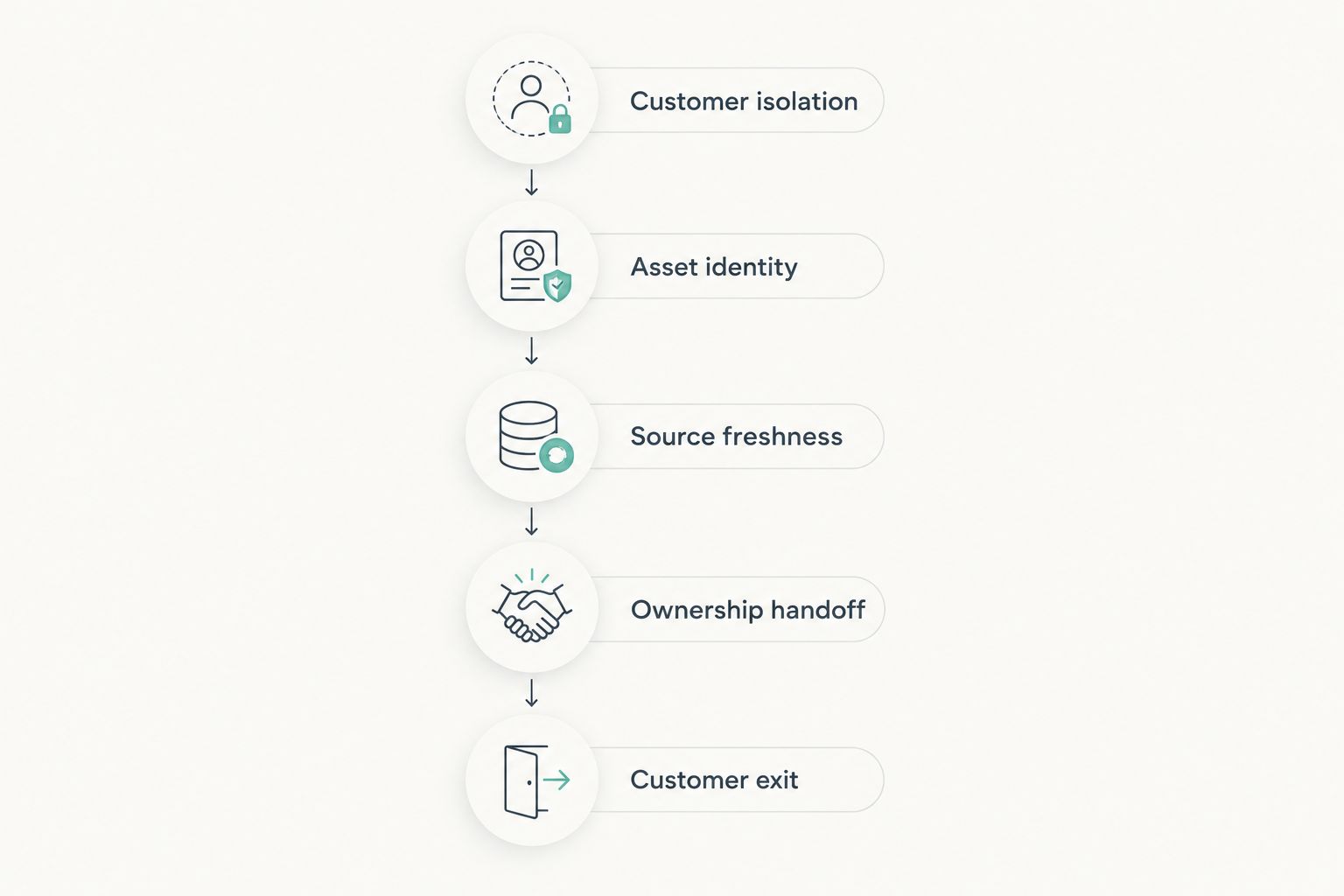
Record elapsed analyst time for setup, investigation, and maintenance during your 2026 pilot. Compare observed work against your own service capacity rather than accepting an unsupported productivity estimate.
Which CAASM tool should your MSSP choose?
Choose the tool that proves the missing part of your service. Start with exposure management when your deliverable is vulnerability action; start with inventory reconciliation when customer records disagree.
Use network discovery for network visibility gaps, relationship analysis for connected investigations, and external discovery for outside-in coverage. Do not buy an adjacent category expecting it to replace every other function.
Make your 2026 approval conditional on demonstrated customer isolation and a repeatable operating workflow. A useful inventory must lead to an accountable next action.
FAQ
What's the best CAASM tool for an MSSP?
The best CAASM tool is the one that proves customer separation and solves your service's main visibility or exposure problem. Compare connector-based inventory, network discovery, relationship analysis, and external discovery as distinct requirements.
Is CAASM the same as external attack surface management?
No. CAASM brings together cyber asset information, while external attack surface management focuses on externally visible assets. An MSSP should evaluate internal inventory and outside-in discovery separately.
Is Brinqa relevant to an MSSP CAASM shortlist?
Brinqa is relevant when vulnerability and exposure management is central to the service evaluation. Validate CAASM coverage, customer separation, and service-provider administration directly rather than assuming them from the platform category.
Can a CAASM tool replace vulnerability scanners?
Do not treat asset aggregation as a replacement for vulnerability assessment. Establish which component discovers assets, which assesses weaknesses, and which supports prioritization and remediation.
How do I test whether a tool separates customer data?
Use separate test tenants with overlapping asset identifiers and restricted accounts. Check searches, exports, notifications, and administration, not just the customer dashboard.
Should an MSSP choose active discovery or integrations?
Choose active discovery for authorized network visibility questions and integrations for collecting information from existing systems. Test both against the gaps in your current inventory rather than treating either method as complete by definition.
What should an MSSP measure during a CAASM pilot?
Measure analyst work, reconciliation quality, source freshness, and successful remediation handoff. Record customer-boundary failures as acceptance failures rather than averaging them into a feature score.
One last thing
Add an asset that does not belong to the customer. A convincing demonstration should show how analysts reject incorrect attribution, preserve the reason, and avoid sending the wrong remediation request.
Finding more assets is not the final objective. Your service needs an inventory you can defend to the customer.


