
Best for financial-loss scenarios: RiskLens; best for exposure-led board reporting: Brinqa; best for insurance decisions: Axio. This 2026 guide compares cyber risk quantification software for board reporting by the decisions each option helps you make.
- RiskLens is the best fit for FAIR-based financial-loss scenarios presented to a board.
- Brinqa is the exposure-management choice when board reporting must start with vulnerability and asset data.
- SAFE Security suits teams seeking a cyber risk quantification platform rather than an exposure-management foundation.
- Axio fits board decisions about cyber insurance and retained risk.
Why this matters
A list of critical vulnerabilities does not tell directors what is at stake. Neither does a dollar figure with no explanation of the assets, loss scenario or assumptions behind it. Effective board reporting connects a business decision to evidence the security team can defend.
That connection starts before you select software. Use board-level vulnerability reporting to distinguish measures of security work, such as remediation progress, from estimates of financial loss. The former shows what teams are doing; the latter helps directors decide how much risk to accept.
In 2026, the choice is not simply which dashboard looks clearest. It is whether you need a financial scenario model, a reliable view of underlying exposures, a broader quantification platform or support for a risk-transfer decision. Those are different jobs, and no single score answers all of them.
What makes the best cyber risk quantification software for board reporting
- A clear decision: The report identifies what directors need to approve, fund, accept or monitor.
- Traceable inputs: You can identify the assets, vulnerabilities, threat assumptions and business context behind a result.
- An appropriate method: Financial-loss estimates explain both how often a loss event might occur and what its impact would be.
- An honest uncertainty range: A modeled loss is not a known future expense. The report shows assumptions instead of hiding them behind a precise-looking number.
- Useful segmentation: You can separate a business unit, application or scenario when an organization-wide figure conceals the decision at hand.
- Repeatable reporting: The next board report uses comparable definitions, so a change in the result has an explanation.
A useful distinction in 2026: exposure prioritization and financial quantification are related, but they are not interchangeable. CVSS scores describe technical severity on a 0–10-point scale; they do not state the financial loss your organization will incur. A quantification model needs additional assumptions about the event and its consequences.
At a glance: which option fits your board question?
| Option | Best for | Standout approach | Key limitation |
|---|---|---|---|
| RiskLens | FAIR-based financial-loss scenarios | Models risk as financial loss | Scenario assumptions require careful review |
| Brinqa | Exposure-led board reporting | Vulnerability and exposure management foundation | Exposure measures alone are not a dollar-loss estimate |
| SAFE Security | A dedicated cyber risk quantification platform | Cyber-risk-focused assessment and reporting | Validate how its outputs trace to your own inputs |
| Axio | Cyber insurance and risk-transfer decisions | Frames risk in financial terms | An insurance-focused decision still needs current exposure evidence |
These options do not occupy identical categories. That is the point: choose the approach that answers the board question rather than buying a financial dashboard to solve an asset-data problem.
1. RiskLens: best for FAIR-based financial-loss scenarios
RiskLens is the clearest choice when directors ask what a defined cyber event could cost. Its approach centers on FAIR, a published model that separates loss event frequency from loss magnitude. That structure makes it easier to explain which assumptions drive an estimate than a score with no visible financial model.
Pick a scenario before you assess the product. A ransomware disruption to a specific business process is a different question from enterprise-wide exposure, and the inputs must reflect that distinction. During a demonstration, ask the team to change one assumption and show how the output changes. If the change cannot be explained, the finished board report will be hard to defend.
RiskLens pros:
- A named methodology gives analysts a common way to discuss assumptions.
- Scenario analysis fits a specific investment or risk-acceptance decision.
- Financial-loss framing speaks directly to finance and board audiences.
RiskLens cons:
- A scenario result is only as credible as its frequency and impact assumptions.
- Modeling one event does not, by itself, establish complete visibility across assets.
- Teams seeking only an operational remediation queue need a different primary tool.
Best for: security and risk leaders presenting a defined loss scenario with assumptions the board can challenge. Verdict: Buy for financial scenario analysis. For a 2026 shortlist focused on dollar-denominated board decisions, RiskLens is the default starting point.
2. Brinqa: best for exposure-led board reporting
Brinqa is a vulnerability and exposure management platform, not a substitute for a documented financial-loss model. Its place on this list is the question that comes before quantification: which exposures exist, where they sit and which ones deserve attention? If that evidence is unreliable, adding a dollar sign does not make the board report better.
A Brinqa evaluation should therefore begin with your exposure-reporting problem, not an assumed monetary output. Identify the asset and vulnerability data you need to discuss at board level. Then ask for a demonstration of how the resulting report distinguishes an underlying finding from the business decision it informs. Treat any financial estimate as a separate claim that needs its own method and assumptions.
Brinqa pros:
- A vulnerability and exposure management focus fits teams whose immediate problem is understanding technical risk.
- Exposure-led reporting can give directors context for remediation decisions.
- It addresses the evidence layer that financial modeling depends on.
Brinqa cons:
- Exposure prioritization is not automatically a financial-loss calculation.
- Buyers seeking a standalone FAIR scenario model should assess that requirement separately.
- A board report still needs business context and an explicit decision, not just technical findings.
Best for: security teams that need a defensible view of vulnerabilities and exposures before presenting risk to directors. Verdict: Buy for the exposure foundation; do not treat an exposure score as a loss estimate.
3. SAFE Security: best for a dedicated quantification-platform evaluation
SAFE Security belongs on the shortlist when the buying brief specifically calls for a cyber risk quantification platform. Its positioning is different from selecting an exposure-management foundation or commissioning a single FAIR scenario. The evaluation question is whether its assessment process gives your team an output it can explain and update.
Bring a real board question to the demonstration. Ask which inputs are required, which assumptions your analysts can inspect and what happens when an input changes. Request a report that separates the modeled result from the evidence supporting it. Those checks matter more than whether the headline number fits neatly on a slide.
SAFE Security pros:
- A dedicated quantification focus aligns with a board-reporting purchase brief.
- One evaluation can test both the risk output and how it is communicated.
- It offers an alternative to building every scenario presentation manually.
SAFE Security cons:
- Confirm the calculation method before relying on its output in a board deck.
- Confirm which of your data sources are required for the proposed use case.
- A platform score can obscure an urgent, narrowly defined decision unless you examine the underlying scenario.
Best for: teams comparing dedicated quantification platforms and willing to test method transparency against their own data. Verdict: Hold until the vendor demonstrates traceable inputs and assumptions.
4. Axio: best for cyber insurance and risk-transfer decisions
Axio is the most relevant choice here when the board question is how much cyber risk to retain and how much to transfer. That conversation requires financial framing: a coverage decision cannot be made from a vulnerability count alone. It also requires clarity about which loss scenarios the organization is discussing.
Keep the decision narrow. Ask the security and finance teams to name the event, the affected business activity and the assumptions used to assess its impact. Then evaluate whether the resulting analysis helps directors compare retention and transfer choices. A useful insurance discussion does not replace the work of identifying and reducing exposures.
Axio pros:
- Financial framing fits insurance and retention discussions.
- Scenario-based analysis can make a risk-transfer decision more specific.
- It creates a reason for security and finance teams to examine the same assumptions.
Axio cons:
- An insurance decision does not establish that vulnerabilities are being remediated.
- The outcome depends on the quality of the chosen loss scenarios.
- Teams primarily seeking an exposure inventory need a different starting point.
Best for: boards deciding how to frame cyber insurance coverage and retained risk. Verdict: Buy for a defined risk-transfer decision, not as your sole exposure-management system.
How to build a board report from the chosen approach
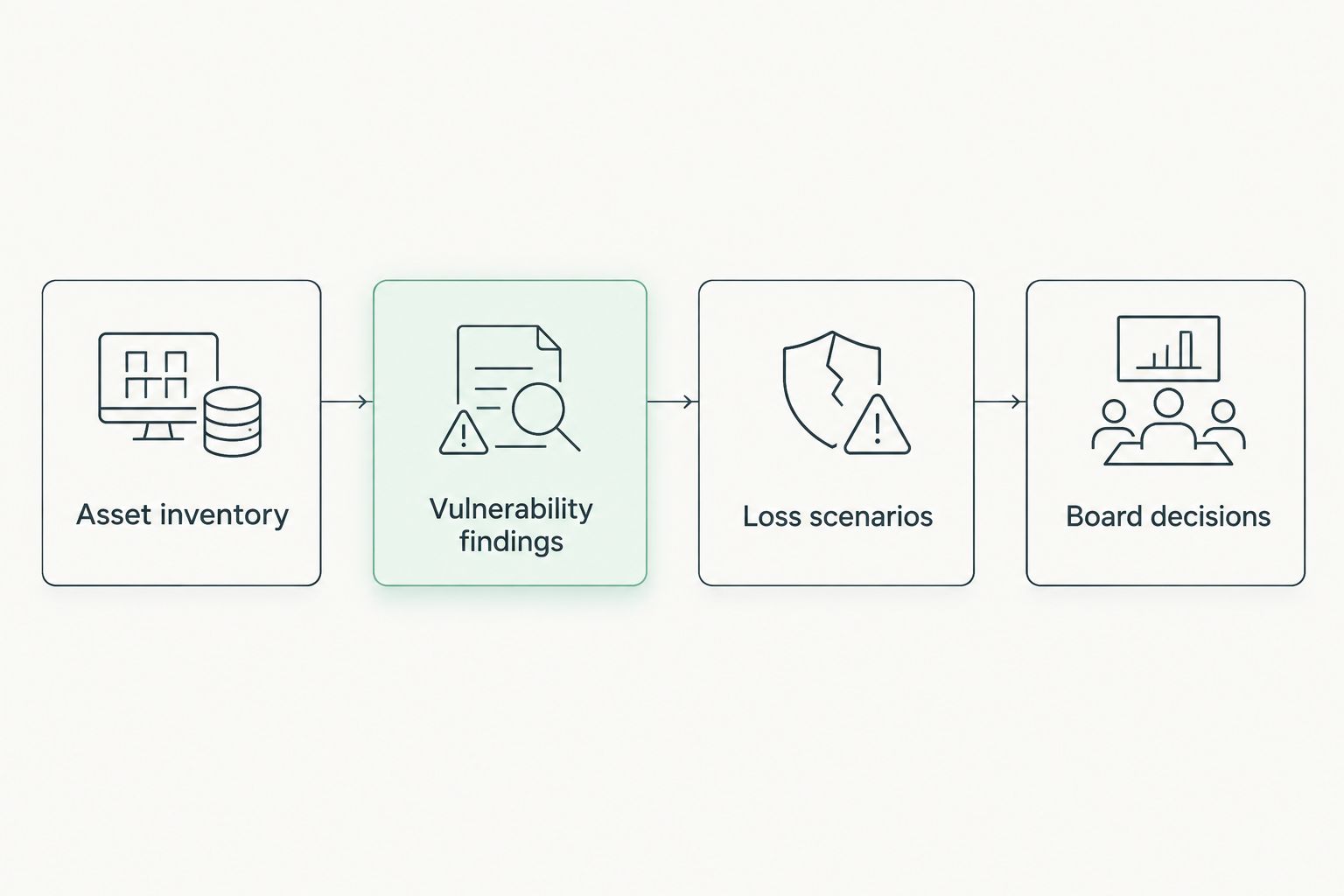
The software selection matters less if the report cannot connect evidence to action. Build the 2026 report around four named elements:
- Asset inventory: Identify the systems and business activities within scope. State what is outside scope rather than letting directors assume the figure covers everything.
- Vulnerability findings: Show the exposures relevant to that scope, not an undifferentiated count from every scanning tool.
- Loss scenarios: If you present financial risk, define the event, the possible consequence and the assumptions used in the calculation.
- Board decisions: State whether the requested action is investment, acceptance, further analysis or a change in risk transfer.
Do not silently turn a severity score into a financial figure. FIRST defines CVSS severity on a 0–10-point scale, while its EPSS model expresses the probability of observed exploitation activity as a value from 0% to 100%. Neither number states your organization's expected loss in dollars. For a financial estimate, document the additional assumptions about event frequency and impact.
Set a 12-month reporting horizon when you want directors to compare annual risk decisions, and use that same horizon across scenarios. This is a reporting choice, not a claim that an event will happen within 12 months. Label it so readers know what the estimate covers.
How we ranked these options
The ranking favors the tool closest to the board's requested decision. RiskLens comes first for explicit financial-loss scenarios; Brinqa follows when the missing piece is trustworthy exposure evidence. SAFE Security earns a separate slot for a dedicated platform evaluation, while Axio has a distinct role in insurance decisions. A change in the question changes the right answer.
That distinction is especially important in 2026 procurement. Ask each vendor to work through the same defined question, using the same scope, and show which assumptions are supplied by the product and which your team must provide. Record where the output cannot be independently explained. A polished chart does not resolve a missing asset, an undefined loss event or an unsupported impact estimate.
Which cyber risk quantification software should you choose?
Choose RiskLens if the board expects a defensible financial-loss scenario. Choose Brinqa when the immediate blocker is a reliable vulnerability and exposure view. Put SAFE Security through an input-to-output demonstration if you want a dedicated quantification platform. Choose Axio when the decision centers on insurance and retained risk.
For most buyers comparing cyber risk quantification software for board reporting in 2026, start by writing the board question in one sentence. If the question is about potential financial loss, begin with a scenario model. If it is about which exposures require action, fix the exposure evidence first. Buying in the opposite order adds presentation polish before it fixes the underlying answer.
FAQ
What is the best cyber risk quantification software for board reporting in 2026?
RiskLens is the best starting point for a board that needs a FAIR-based financial-loss scenario. If the immediate need is trustworthy vulnerability and exposure evidence, evaluate Brinqa for that different job.
Is a vulnerability severity score the same as quantified cyber risk?
No. A vulnerability severity score describes technical characteristics, while financial quantification estimates the consequences of a defined loss scenario. The second requires business context and documented assumptions.
Can Brinqa replace a financial-loss model?
Brinqa is a vulnerability and exposure management platform; do not assume an exposure score is a financial-loss estimate. Evaluate any monetary reporting against its stated method and inputs.
What should directors see in a cyber risk report?
Directors should see the decision requested, the risk scenario, the evidence supporting it and the assumptions behind any financial figure. A technical finding without business context does not answer a board question.
Does CVSS show the financial cost of a cyber incident?
No. CVSS expresses technical vulnerability severity on a 0–10-point scale, not the financial impact on a particular organization. Loss estimates need additional scenario and business-impact information.
How should a team compare quantification platforms?
Give each vendor the same board question and ask it to identify the inputs, assumptions and calculation method behind the output. Prefer the result your team can explain and reproduce.
Should cyber insurance determine the quantification tool?
Yes, if the specific board decision concerns risk transfer or retained loss. Axio fits that use case, while exposure management remains a separate requirement.
One last thing
Ask the vendor to explain why a reported risk figure changes when one underlying assumption changes. If the team cannot trace that movement from evidence to calculation to board decision, leave the number out of the 2026 deck. An explainable estimate is more useful than an unexplained precise figure.