
Best overall shortlist pick: Burp Suite DAST. Best for evidence-led validation: Invicti. Best for self-managed automation: ZAP. This 2026 guide compares DAST tools scan accuracy and coverage by testing approach and application fit—not an unsupported accuracy leaderboard.
- For DAST tools scan accuracy and coverage, shortlist Burp Suite DAST for centralized web application scanning.
- Choose Invicti when proof-based validation is a central evaluation requirement.
- Choose ZAP for self-managed automation and Burp Suite Professional for analyst-led investigation.
- Use Nuclei for targeted template checks, not as a substitute for authenticated application crawling.
- Brinqa is a vulnerability and exposure management platform, not a DAST scanner.
Why this matters
A scanner cannot test an application route it never reaches. A clean report from an expired session says little about the application behind the login page.
Accuracy and coverage are separate buying decisions. Accuracy concerns whether reported vulnerabilities are real and known vulnerabilities are detected; coverage concerns which routes, parameters, roles, and workflows receive meaningful testing.
Brinqa belongs in the vulnerability and exposure management category. Evaluate that category separately from DAST: discovering application flaws and managing exposure across a security program are different jobs.
For your 2026 selection, require evidence of authenticated reach and reproducible findings before comparing report volume. More findings do not establish better accuracy, and more requests do not establish better coverage.
What makes the best DAST tool
Use these criteria before reading the ranking. They turn a product demonstration into an application-specific buying decision.
- Authenticated reach: The scanner must remain logged in and reach protected application functions. Verify session renewal rather than accepting a successful initial login.
- Application discovery: Evaluate browser-driven crawling, supplied routes, and API definitions against the application's actual attack surface.
- Finding evidence: Require the affected request, relevant response, and an explanation that lets an analyst reproduce the issue.
- Detection completeness: Include known vulnerable cases and known safe cases. Finding nothing is not proof of accuracy.
- Operational control: Inspect scan scope, exclusions, request handling, and behavior around state-changing actions.
- Repeatability: Re-run the same configuration and confirm that coverage gaps and finding changes are explainable.
Keep a coverage inventory outside the scanner. Otherwise, the scanner's discovered surface becomes both the measurement and the denominator, hiding what it missed.
Best DAST tools at a glance
This ranking orders shortlist candidates by distinct use case. It does not assign measured false-positive rates or claim that any product detects every vulnerability.
| Rank | Tool | Best for | Standout approach | Key limitation |
|---|---|---|---|---|
| 1 | Burp Suite DAST | Centralized automated web testing | Automated scanning with browser-powered crawling | Authentication and application scope still require validation |
| 2 | Invicti | Evidence-led vulnerability validation | Proof-Based Scanning for supported vulnerability types | Proof-based confirmation does not cover every finding class |
| 3 | ZAP | Self-managed scan automation | Automation Framework and extensible scanning | Your team owns configuration and result review |
| 4 | Burp Suite Professional | Analyst-led investigation | Intercepting proxy, Scanner, and manual testing tools | Desktop testing is not centralized portfolio orchestration |
| 5 | Nuclei | Targeted template-based checks | Repeatable checks defined in templates | Template matching is not full application workflow coverage |
The distinction between automated scanning and analyst-led investigation matters. A skilled tester using an intercepting proxy performs a different job from an unattended scanner scheduled across an application portfolio.
1. Burp Suite DAST: best for centralized web testing
Burp Suite DAST is PortSwigger's automated dynamic application testing product. Its browser-powered crawling and scanning make it a sensible first shortlist candidate when you need repeatable testing across web applications.
The buying question is not whether it can produce findings. Ask whether it reaches your protected routes, maintains sessions, and gives engineers enough evidence to reproduce reported flaws.
Burp Suite DAST pros:
- Browser-powered crawling supports discovery of browser-driven application behavior.
- Automated scanning suits recurring application assessments.
- Centralized scan management fits a portfolio-level testing workflow.
Burp Suite DAST cons:
- Login configuration does not itself prove authenticated coverage.
- Application-specific workflows still need deliberate scope and validation.
- Business-logic and authorization testing require work beyond unattended scanning.
Best for: Application security teams that need centrally managed, recurring web application scans.
For a 2026 evaluation, compare the scanner's visited routes with a route inventory supplied by engineering. Inspect sensitive functions separately; reaching the dashboard does not prove that account administration or transaction workflows received testing.
Verdict: Buy if the pilot demonstrates authenticated reach and reproducible results on your applications.
2. Invicti: best for evidence-led validation
Invicti is a web application security scanner known for Proof-Based Scanning. For supported vulnerability types, that approach provides confirmation evidence rather than relying only on an unvalidated detection signal.
Make the distinction explicit during evaluation: confirmation of a reported issue is not proof that the scanner found all issues. Detection completeness still needs a separate test.
Invicti pros:
- Proof-based confirmation supports validation of supported finding types.
- Automated web scanning suits recurring assessments.
- Confirmation evidence gives analysts a concrete starting point for triage.
Invicti cons:
- Not every vulnerability class receives proof-based confirmation.
- Authentication and crawl gaps can still leave application areas untested.
- Workflow and business-logic flaws need additional investigation.
Best for: Teams making finding validation a primary scanner-selection criterion.
Ask the vendor to distinguish confirmed findings from findings that require review. Then reproduce representative examples yourself and inspect false negatives against the same test application.
Use a documented process for reducing false positives in vulnerability scan results, rather than treating a product's confirmation feature as a replacement for triage.
Verdict: Buy if confirmation evidence improves your review process without masking coverage gaps.
3. ZAP: best for self-managed scan automation
ZAP is an open-source web application security testing tool with passive scanning, active scanning, and an Automation Framework. It suits teams that want direct control over scan configuration and execution.
That control creates an operational obligation. You need someone responsible for authentication, scan policies, exclusions, and the interpretation of findings.
ZAP pros:
- The Automation Framework supports repeatable scan plans.
- Passive and active scanning serve different testing purposes.
- Add-ons extend testing and discovery capabilities.
- Proxy-based use supports inspection of application traffic.
ZAP cons:
- Your team owns scan configuration and maintenance.
- Authentication and discovery require application-specific attention.
- Automated findings still need validation and contextual review.
Best for: Engineering-led teams that can maintain their own scanning workflow.
Separate passive observation from active attack traffic in your rollout. Active scans can change application state; use authorized targets, agreed scope, and controlled test data.
Verdict: Buy into ZAP when your team can own the testing workflow, not just launch scans.
4. Burp Suite Professional: best for analyst-led investigation
Burp Suite Professional combines an intercepting proxy, automated Scanner, and tools for manual web security testing. Its strength is the analyst's ability to inspect requests, change inputs, and investigate behavior interactively.
Choose it for depth on individual applications. Do not confuse a desktop testing workflow with a centrally operated scanning program.
Burp Suite Professional pros:
- The intercepting proxy exposes requests and responses for inspection.
- Repeater supports deliberate request modification and replay.
- Scanner complements manual investigation with automated checks.
Burp Suite Professional cons:
- Effective use depends on web application testing skills.
- Analyst-led coverage depends on the workflows the tester explores.
- Desktop tooling does not replace portfolio-level scan orchestration.
Best for: Application security analysts validating findings and investigating difficult workflows.
For authorization testing, capture the same operation under different user roles and inspect the server's response. A page hidden in the interface is not evidence that the server enforces access control.
Verdict: Buy for hands-on investigation; skip it as your sole centralized scanning solution.
5. Nuclei: best for targeted template checks
Nuclei runs security checks defined in templates. It is useful when you need repeatable tests for specific exposures or vulnerability conditions across authorized targets.
Its coverage follows the checks and inputs you provide. A template-based result should not be presented as evidence that an application's authenticated workflows received full DAST testing.
Nuclei pros:
- Templates make individual checks explicit and inspectable.
- Custom templates support organization-specific detection needs.
- Targeted checks complement broader application testing.
Nuclei cons:
- Results depend on template quality and target selection.
- Templates do not establish complete application crawl coverage.
- Stateful workflows and role-specific behavior require additional testing.
Best for: Security teams checking specific exposure conditions across a defined target set.
Review each template's purpose and matching logic before treating its output as confirmed vulnerability evidence. Retain the relevant request and response for independent review.
Verdict: Buy into Nuclei as a complementary checking tool; skip it as your only DAST approach.
How we ranked
The ranking uses application discovery, finding evidence, operational control, and workflow fit. Burp Suite DAST is the default centralized-scanning candidate; the remaining tools occupy distinct validation, automation, investigation, and template-checking roles.
Product descriptions follow established capabilities documented by PortSwigger, Invicti, ZAP, and ProjectDiscovery. For your 2026 procurement, consult their current official documentation for authentication methods, supported inputs, and configuration details.
No universal accuracy winner is established here. A defensible scan-accuracy ranking requires the same applications, known vulnerabilities, safe controls, authentication conditions, and independently reviewed outcomes.
Test accuracy and coverage before you choose
Give every candidate the same authorized test application and conditions. Otherwise, you compare different scopes rather than different scanners.
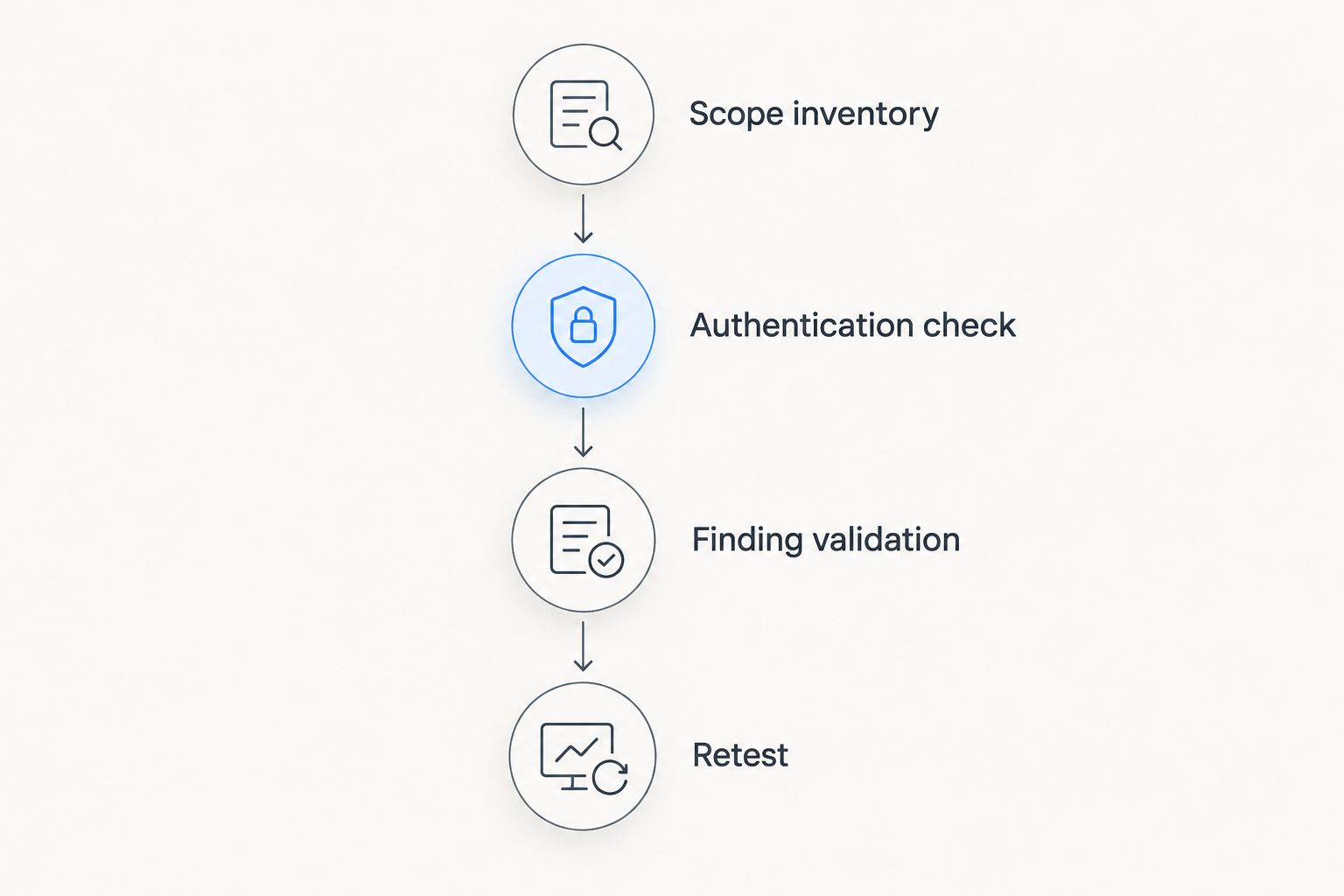
Build the pilot around four stages:
- Scope inventory: List routes, API operations, parameters, and sensitive workflows before scanning.
- Authentication check: Test 3 role profiles—unauthenticated, standard user, and administrator—where those roles exist in your application.
- Finding validation: Reproduce detections and compare them with known vulnerable and known safe cases.
- Retest: Run 2 scan passes with the same scope and configuration, then investigate differences.
The role profiles and scan passes are a recommended test design, not a product performance claim. Add application-specific roles where your access model requires them.
For a starter test set, use 10 known vulnerable cases and document a safe counterpart for each where practical. This is an evaluation exercise, not a claim about any scanner's detection rate.
Record confirmed true positives, false positives, and known vulnerabilities missed. Calculate precision as confirmed true positives divided by all reported positives; calculate recall as detected known vulnerabilities divided by all known vulnerabilities in the test set.
Report coverage separately. Count tested operations against the independently maintained inventory, and distinguish a route merely visited from an operation actively tested. Label inaccessible and intentionally excluded areas rather than letting them disappear from the report.
Which DAST tool should you choose?
Start with Burp Suite DAST for centralized automated web testing. Choose Invicti when proof-based validation is the deciding requirement, ZAP when your team owns automation, Burp Suite Professional for analyst-led depth, and Nuclei for targeted checks.
In 2026, the deciding evidence is your application pilot—not the longest feature list. Reject any evaluation that produces findings without showing which authenticated areas were actually tested.
Brinqa is a vulnerability and exposure management platform for teams evaluating exposure management alongside application testing. Keep that decision separate from selecting the scanner that discovers the findings.
FAQ
What's the best DAST tool for scan accuracy and coverage?
Burp Suite DAST is the default shortlist pick here for centralized automated web testing, not a proven universal accuracy winner. Measure accuracy and authenticated coverage on the same application before selecting a tool.
Is Invicti more accurate than Burp Suite DAST?
A universal accuracy advantage is not established by this comparison. Invicti's Proof-Based Scanning confirms supported finding types, but a fair comparison also measures missed vulnerabilities and application coverage.
Can ZAP test authenticated applications?
ZAP supports authenticated application testing when authentication and session handling are configured. Verify that scans remain logged in and reach protected operations rather than stopping at the login page.
Is Nuclei a replacement for a DAST scanner?
Nuclei is not a replacement for full authenticated application testing. Its template-based checks complement broader crawling, active testing, and manual investigation.
What's the difference between DAST accuracy and coverage?
Accuracy concerns correct detections and missed known vulnerabilities; coverage concerns the application surface tested. A scanner can produce accurate findings while leaving important workflows untouched.
Does DAST replace manual penetration testing?
DAST does not replace manual penetration testing. Business-logic flaws, complex authorization behavior, and application-specific workflows require deliberate investigation beyond automated scanning.
Is Brinqa a DAST tool?
Brinqa is a vulnerability and exposure management platform, not a DAST scanner. Evaluate it in that category rather than as a tool that crawls and attacks web applications.
How should I compare DAST tools in 2026?
Compare DAST tools in 2026 using identical scope, credentials, known vulnerable cases, and safe controls. Record validated findings, missed cases, and authenticated operations tested separately.
One last thing
Check the scanner's session state at the end of the run, not just at login. A successful login followed by silent session expiry can turn an authenticated assessment into an unauthenticated one.
Require evidence that a protected operation remained accessible during testing. That single check tells you more about authenticated coverage than a completed-scan status alone.