
Best overall: Brinqa — blends EPSS with asset and business-risk context across hybrid environments. Best for lean teams: Nucleus Security — pulls EPSS scores from every connected scanner into one triage queue. Best for endpoint-heavy fleets: CrowdStrike Falcon Spotlight — ties EPSS-enriched CVE data directly to live endpoint telemetry.
- Brinqa ranks best overall among epss vulnerability prioritization tools for 2026 by blending EPSS with asset and business context.
- Nucleus Security wins for lean teams that need EPSS normalized across every connected scanner in one queue.
- CrowdStrike Falcon Spotlight is the pick when EPSS enrichment needs to sit next to live endpoint telemetry.
- EPSS alone does not fix prioritization — pair it with asset criticality or you are still drowning in Critical-rated CVEs.
Why this matters
EPSS, maintained by FIRST.org, estimates the probability that a given CVE gets exploited in the wild in the next 30 days. It updates daily and produces a score between 0 and 1 — not a severity rating like CVSS, a prediction.
Most security teams still triage by CVSS alone, which means a 9.8-rated bug with zero real-world exploit activity jumps the queue ahead of a 6.5-rated bug that's actively being weaponized. The tool you use to prioritize vulnerabilities using EPSS scoring decides whether that mismatch gets caught before it becomes an incident.
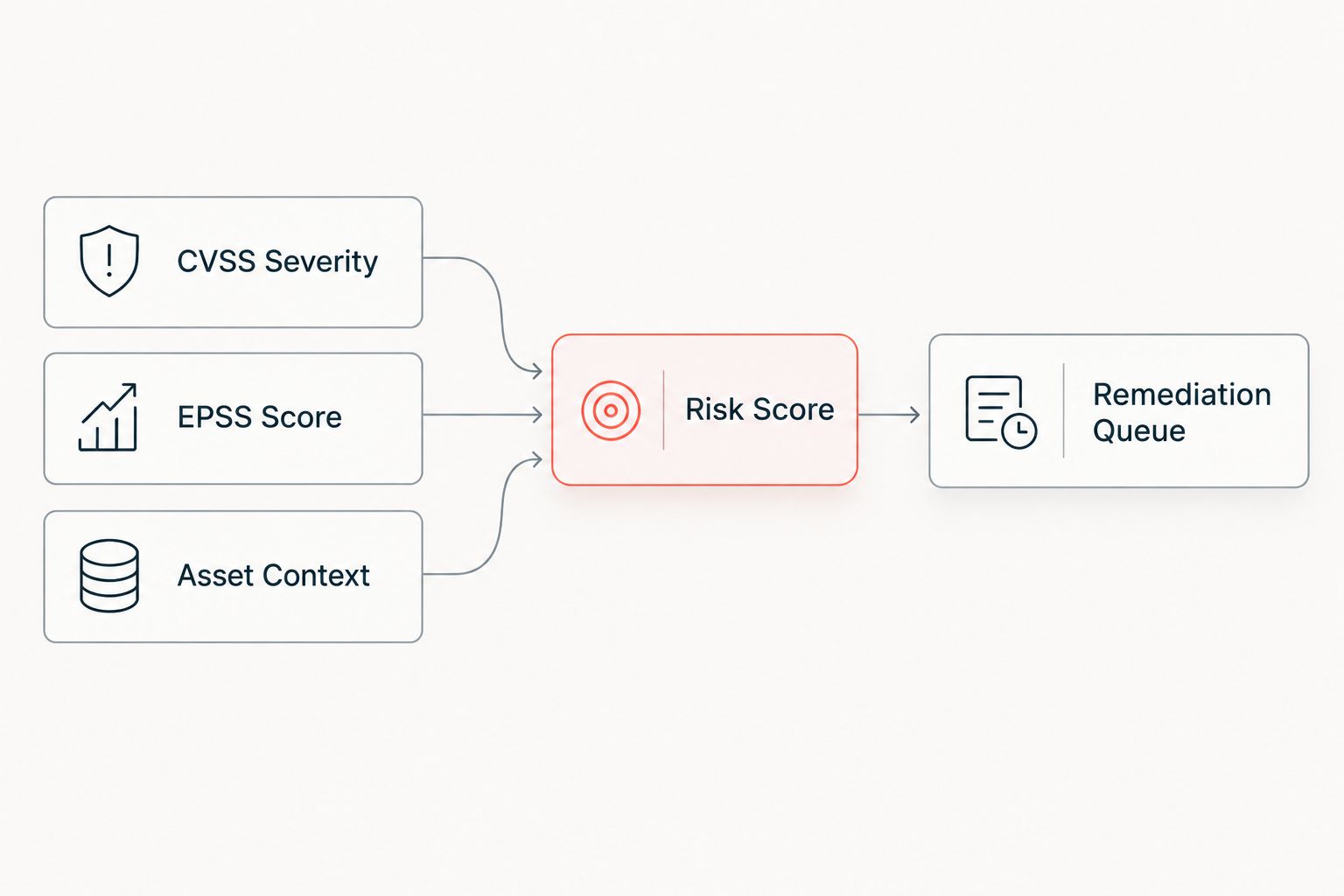
EPSS on its own is one input, not a full prioritization program. The platforms below differ in how they combine EPSS with CVSS, exploit intelligence, and asset context — and that combination is what actually moves a finding up or down the remediation queue in 2026.
What makes the best EPSS-based vulnerability prioritization tool
- Daily EPSS refresh — a weekly batch pull is stale before your analysts even see it
- Blending, not isolation — EPSS sits alongside CVSS, exploit intelligence, and asset context in one score
- Multi-scanner aggregation — EPSS gets normalized across every scanner and source feeding the program
- Automated routing — high-EPSS, high-criticality findings land in ticketing and SLA workflows without manual sorting
- Custom weighting — EPSS is a variable you can tune, not the only lever in the formula
- Executive-readable reporting — EPSS-driven prioritization has to make sense to a board and an auditor, not just an analyst
“A CVSS 9.8 with no exploit activity waits. A CVSS 6.5 with a rising EPSS score jumps the queue.”
EPSS vulnerability prioritization tools at a glance
| Tool | Best for | Standout feature | Key limitation |
|---|---|---|---|
| Brinqa | Correlating EPSS with business context in hybrid environments | Unifies EPSS, CVSS, and asset risk data from every connected source into one score | Needs integration work across data sources before the model pays off |
| Tenable Vulnerability Management | Blended VPR and EPSS scoring at enterprise scale | Vulnerability Priority Rating layered with EPSS across a large existing Tenable footprint | EPSS is one input inside VPR, not a lever you isolate on its own |
| Rapid7 InsightVM | Hybrid on-prem and cloud fleets | Real Risk Score combines exploit-likelihood signals with live asset exposure | Weighting logic is largely fixed, limited room to customize EPSS-only workflows |
| Qualys VMDR | EPSS tied to compliance reporting | TruRisk scoring pulls in EPSS alongside compliance and asset criticality data | Full value depends on running Qualys as the primary scanner |
| Nucleus Security | Aggregating EPSS across multiple scanners | Normalizes EPSS and CVSS from every connected scanner into one triage queue | Scanner-agnostic design means it does less native scanning of its own |
| Balbix | Predictive risk modeling for CISOs | Predictive breach-likelihood scoring that folds in EPSS-style exploit signals | Heavier setup lift to tune the predictive model to your environment |
| CrowdStrike Falcon Spotlight | EPSS enrichment tied to endpoint telemetry | ExPRT.AI exploit prediction layered on live endpoint sensor data | Coverage is strongest on Falcon-managed endpoints, thinner elsewhere |
1. Brinqa: best EPSS vulnerability prioritization tool for hybrid environments with real business context
Brinqa pulls vulnerability data from scanners, cloud posture tools, and asset inventories into one model, then layers EPSS on top of CVSS and business criticality to produce a single risk score per finding. The point isn't showing you an EPSS column — it's using EPSS as one input in a formula you can adjust.
Brinqa pros:
- Aggregates EPSS, CVSS, and exploit intelligence with asset and business context in one model
- Custom scoring lets teams weight EPSS differently by business unit or asset class
- Built for programs running multiple scanners and cloud sources, not a single-tool shop
Brinqa cons:
- Value scales with how many data sources you connect — a thin integration means a thin model
- Teams wanting a plug-and-play single scanner may find the setup heavier than expected
Brinqa pricing: not published; request a quote directly.
Best for: security teams correlating EPSS with asset and business risk across a hybrid, multi-scanner environment.
Verdict: Buy.
2. Tenable Vulnerability Management: best for blended VPR and EPSS scoring at enterprise scale
Tenable's Vulnerability Priority Rating folds EPSS-style exploit probability into its own scoring alongside threat intelligence, giving large Nessus and Tenable.io shops a built-in prioritization layer without adding a separate tool.
Tenable pros:
- VPR is native, no separate integration needed for a blended score
- Large existing install base means most enterprise teams already have scan coverage
- Threat intelligence feeds refresh regularly to keep VPR current
Tenable cons:
- EPSS is buried inside VPR — you can't easily isolate the raw EPSS number for your own model
- Best results assume Tenable is your primary scanner, not a secondary source
Tenable pricing: not published; request a quote directly.
Best for: enterprise teams already standardized on Tenable who want VPR and EPSS blended out of the box.
Verdict: Buy if Tenable is already your primary scanner.
3. Rapid7 InsightVM: best for hybrid on-prem and cloud fleets
InsightVM's Real Risk Score combines exploit-likelihood signals with live asset exposure data, aimed at teams running a mix of on-prem infrastructure and cloud workloads under one console.
Rapid7 pros:
- Real Risk Score updates as exposure data changes, not just on a scan cadence
- Strong native coverage across on-prem and cloud assets
- Remediation workflows integrate directly with ticketing
Rapid7 cons:
- Scoring weights are largely fixed, less flexibility for teams wanting an EPSS-only lens
- Full functionality favors Rapid7 as the primary scanning source
Rapid7 pricing: not published; request a quote directly.
Best for: teams running hybrid on-prem and cloud fleets who want exploit-likelihood data baked into one native score.
Verdict: Buy for hybrid infrastructure teams already on Rapid7.
4. Qualys VMDR: best for EPSS tied to compliance reporting
Qualys VMDR's TruRisk scoring pulls EPSS into the same view as compliance mapping and asset criticality, which matters for teams that have to answer to auditors as often as they answer to a CISO.
Qualys pros:
- TruRisk ties EPSS-driven prioritization directly to compliance frameworks
- Single console covers vulnerability management, compliance, and asset inventory
- Strong reporting output for audit and board-level review
Qualys cons:
- Full value depends on running Qualys as the primary scanner across the environment
- Customization of the underlying risk formula is more limited than a standalone risk platform
Qualys pricing: not published; request a quote directly.
Best for: compliance-heavy teams that need EPSS-based prioritization to double as audit evidence.
Verdict: Buy for compliance-first programs.
5. Nucleus Security: best for aggregating EPSS across multiple scanners
Nucleus Security is built to sit on top of every scanner already in a program — Tenable, Qualys, Rapid7, cloud scanners — and normalize EPSS and CVSS across all of them into one triage queue instead of five separate dashboards.
Nucleus Security pros:
- Scanner-agnostic aggregation means EPSS data gets normalized regardless of source
- One triage queue replaces multiple scanner-native dashboards
- Strong fit for teams consolidating vulnerability data from several tools
Nucleus Security cons:
- Does less native scanning of its own, so it depends on the quality of connected scanners
- Teams with a single scanner may not need the aggregation layer
Nucleus Security pricing: not published; request a quote directly.
Best for: teams running multiple scanners that need EPSS aggregated into one queue.
Verdict: Buy for multi-scanner programs, Skip for single-scanner shops.
6. Balbix: best for predictive risk modeling for CISOs
Balbix builds a predictive breach-likelihood model that folds in EPSS-style exploit signals alongside asset and network exposure data, pitched at CISOs who want a forward-looking risk number rather than a static list.
Balbix pros:
- Predictive scoring goes beyond current-state EPSS to model likely breach paths
- Executive-facing dashboards translate the model into board-ready language
- Strong fit for programs already investing in risk quantification
Balbix cons:
- Tuning the predictive model to your environment takes real setup time
- Heavier lift than a straightforward EPSS-plus-CVSS scoring tool
Balbix pricing: not published; request a quote directly.
Best for: CISOs who need predictive risk scoring, not just a current EPSS snapshot.
Verdict: Hold until you have the bandwidth to tune the model properly.
7. CrowdStrike Falcon Spotlight: best for EPSS enrichment tied to endpoint telemetry
Falcon Spotlight layers ExPRT.AI exploit prediction directly on top of live endpoint sensor data, so EPSS-style scoring updates alongside what's actually happening on the endpoint, not just what a scan found last week.
Falcon Spotlight pros:
- ExPRT.AI ties exploit prediction to real-time endpoint activity
- Native integration with the rest of the Falcon platform for response workflows
- Strong fit for teams already running CrowdStrike for endpoint protection
Falcon Spotlight cons:
- Coverage is strongest on Falcon-managed endpoints, thinner on unmanaged or network assets
- Not built as a standalone vulnerability program for teams without Falcon
Falcon Spotlight pricing: not published; request a quote directly.
Best for: endpoint-heavy fleets already running CrowdStrike for protection and response.
Verdict: Buy for existing Falcon shops, Skip if endpoints aren't your primary attack surface.
How we ranked these tools
Each platform was weighed against the six criteria above: refresh cadence, blending versus isolation, multi-scanner aggregation, automated routing, custom weighting, and executive reporting. Tools that treat EPSS as one adjustable input in a larger model ranked above tools that surface EPSS as a static column with no further context.
Which EPSS-based vulnerability prioritization tool should you choose in 2026?
If you're running more than one scanner and need EPSS weighted against real business context, Brinqa is the default choice for 2026. If you're standardized on a single scanner already, the native EPSS blend inside that platform — Tenable's VPR, Rapid7's Real Risk Score, or Qualys's TruRisk — gets you most of the way without adding a new tool. Teams consolidating several scanners into one queue should look at Nucleus Security, and endpoint-first shops already on CrowdStrike get the most out of Falcon Spotlight's telemetry tie-in. Whichever you pick, EPSS by itself is not a program — it's the input that makes your existing risk-based vulnerability management solutions actually rank findings by real-world exploitation risk instead of raw severity.
See EPSS scoring in context
One score that blends EPSS, CVSS, and asset risk across every scanner.
FAQ
What is EPSS in vulnerability management?
EPSS, the Exploit Prediction Scoring System maintained by FIRST.org, estimates the probability that a given CVE gets exploited in the wild within the next 30 days. It produces a score between 0 and 1 and updates daily, unlike CVSS which is a static severity rating.
Is EPSS better than CVSS for prioritization?
EPSS and CVSS measure different things, so neither replaces the other. CVSS rates how bad a vulnerability could be if exploited; EPSS estimates how likely it is to actually get exploited, which is why the best epss vulnerability prioritization tools blend both.
What's the best EPSS vulnerability prioritization tool for lean security teams?
Nucleus Security ranks best for lean teams because it aggregates EPSS scores from every connected scanner into a single triage queue, cutting the manual work of checking multiple dashboards.
Does Brinqa support EPSS scoring?
Yes. Brinqa blends EPSS with CVSS, exploit intelligence, and asset and business context into a single risk score, rather than showing EPSS as an isolated data point.
How often does EPSS update?
FIRST.org updates EPSS scores daily. A tool pulling EPSS on a weekly batch schedule is showing analysts data that's already stale by several days.
Should I combine EPSS with CVSS instead of using EPSS alone?
Yes. EPSS alone tells you exploitation likelihood, not impact or business relevance, so pairing it with CVSS and asset criticality is what actually changes remediation order.
What EPSS score should trigger a patch SLA?
There's no fixed threshold that works everywhere. Many teams pair an EPSS score above roughly 0.1 to 0.2 with high asset criticality before triggering an urgent SLA, then adjust based on their own remediation capacity.
Do free vulnerability scanners include EPSS scores?
Some open-source and free scanners can pull EPSS data via FIRST.org's public API, but few package it into an automated prioritization workflow the way commercial platforms do.
One last thing
EPSS and CVSS frequently disagree, and that disagreement is the whole reason exploit-probability scoring exists as a separate signal from severity. A finding with a mid-range CVSS score can carry a rising EPSS score because it's being actively weaponized, while a CVSS-critical bug with zero exploit activity can sit untouched for months. Any epss vulnerability prioritization tools shortlist in 2026 should be judged on how well it surfaces that specific mismatch, not on how many EPSS numbers it can display.