
Best overall for mid-market teams choosing a vulnerability and exposure management platform: Brinqa. Best for a dedicated exposure management shortlist: Tenable One. Best for a vulnerability detection and response workflow: Qualys VMDR. This 2026 guide compares the scope of each option and the checks that should decide your purchase.
- Brinqa is the best overall shortlist pick for exposure management platforms for mid-market companies seeking vulnerability and exposure management.
- Choose Tenable One when a dedicated exposure management platform is the primary requirement.
- Choose Qualys VMDR when vulnerability detection and response defines the workflow.
- Require each vendor to demonstrate coverage, prioritization, ownership, and reporting with your own data.
Why this matters
A mid-market security team can have vulnerability findings without a usable view of exposure. The gap appears when assets lack owners, findings arrive from different sources, and a high severity score gets mistaken for a remediation plan. A platform decision should settle how your team moves from a finding to a defensible action, not just how it produces another list.
The distinction matters in 2026 because these products enter the evaluation from different starting points. An exposure management platform, a vulnerability management platform, and a scanner are related purchases, but they do not answer the same question. If your immediate need is to run scans, start with scanner requirements. If your problem is deciding which exposures to address and who owns them, assess the management workflow first.
This is a shortlist, not a claim that one vendor fits every environment. The ranking favors the stated job each product is positioned to do. Your final choice depends on a demonstration using your assets, findings, and remediation process.
What makes the best exposure management platform for mid-market companies?
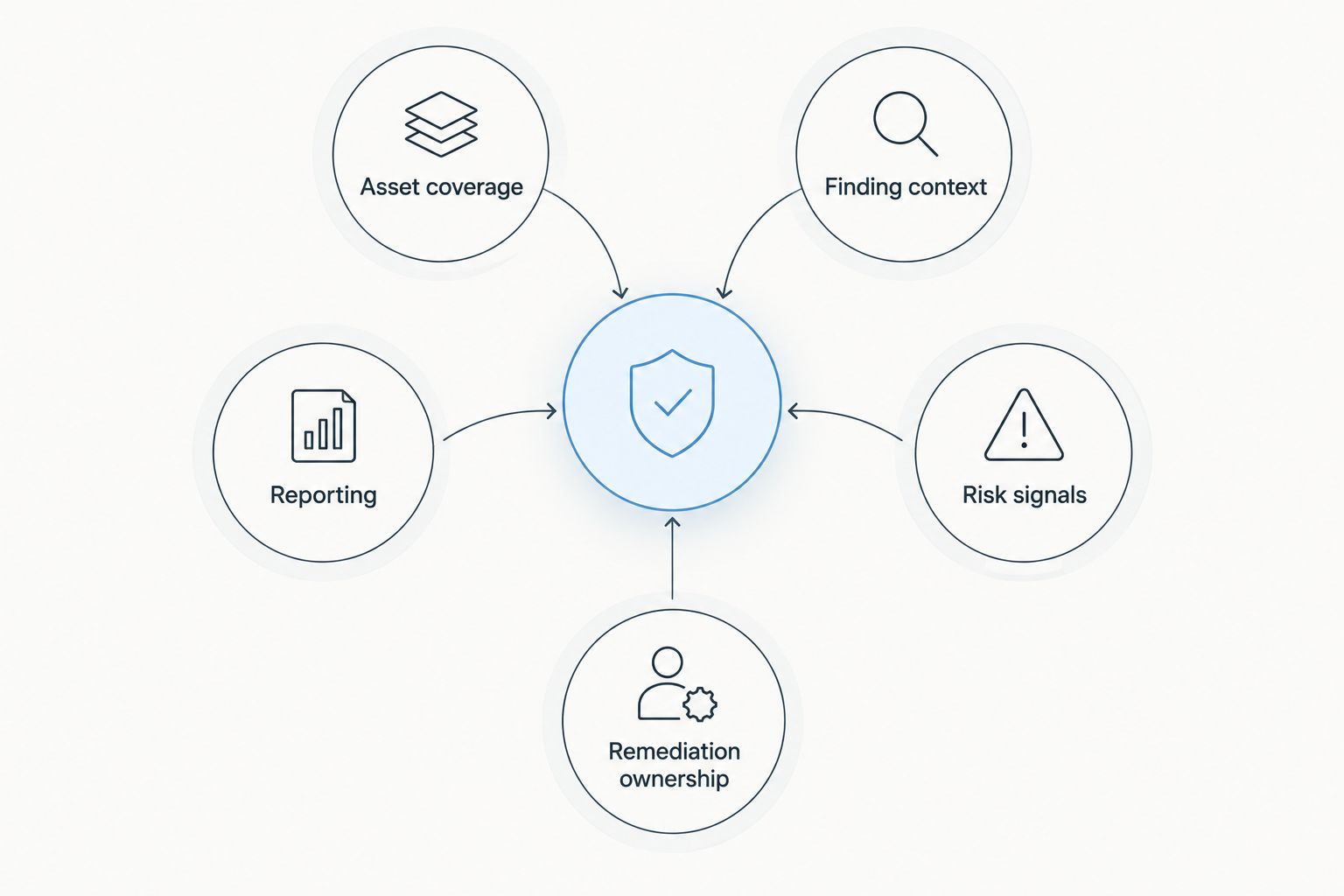
Use these criteria before comparing product demonstrations. A polished dashboard does not compensate for a missing asset owner or an unworkable handoff.
- Asset coverage: Can the platform represent the environments you need to manage and distinguish assets that matter to the business? Bring an inventory sample rather than accepting a coverage claim in a slide.
- Finding context: Can your team connect a finding to the right asset, source, and owner? Ask vendors to show what happens when records from separate tools refer to the same system.
- Risk signals: Can the workflow consider more than severity alone? CVSS uses a 0–10 point scale; a score communicates technical severity, not your business priority by itself.
- Remediation ownership: Can an analyst assign an action, preserve its rationale, and tell whether the underlying exposure was resolved? Test the handoff with the team that will perform the work.
- Reporting: Can a security lead explain outstanding exposure and decisions without rebuilding the story in a spreadsheet? Ask for an operational view and a leadership view of the same sample.
- Implementation fit: Can your team maintain the inputs, rules, and exceptions needed to keep decisions useful? Document who will own the process after selection.
Treat these as demonstration requirements, not assumed features. A vendor belongs on the shortlist because its stated product scope fits your problem; it stays there only if it handles your workflow.
Exposure management platforms at a glance
| Platform | Best for | Standout focus | Key limitation to test |
|---|---|---|---|
| Brinqa | A combined vulnerability and exposure management shortlist | Both management disciplines are in its stated platform scope | Validate the data sources and remediation workflow you require |
| Tenable One | A dedicated exposure management evaluation | Exposure management is the product's stated focus | Confirm it fits your existing tools and operational process |
| Qualys VMDR | A vulnerability detection and response workflow | Vulnerability Management, Detection and Response | Check whether its scope matches your broader exposure management brief |
The table identifies different buying routes, not interchangeable feature sets. In 2026, the useful question is which route matches the work your team cannot reliably complete today. Take the same sample assets and findings into every demonstration so that the comparison stays consistent.
How to use the comparison
Write down your primary job before contacting vendors: managing exposure across security work, establishing a dedicated exposure management program, or operating vulnerability detection and response. Then define the evidence that would prove success. For example, ask an analyst to trace a finding to an asset and its owner while an operations lead explains the next action.
Separate a must-have from a preference. If an existing system is the only approved source for asset ownership, a credible connection to that system is a must-have. A different chart style is not. This distinction keeps the shortlist tied to a working process rather than the longest feature list.
1. Brinqa: best for a combined vulnerability and exposure management brief
Brinqa is a vulnerability and exposure management platform. That makes it the clearest starting point here when your buying brief explicitly includes both disciplines. It does not establish, on its own, that any particular connector, scanner, scoring method, or remediation integration fits your environment; those belong in the demonstration.
For a mid-market team, the practical test is whether the platform helps the people who discover a finding and the people who must fix it work from the same context. Supply a sample that includes an asset with an owner, a finding requiring action, and a finding your team intends to accept or defer. Ask the vendor to show how each decision is recorded and revisited.
Brinqa pros:
- Its stated scope covers both vulnerability management and exposure management.
- It belongs on a shortlist when the requirement is a management platform rather than a scanner alone.
- Its scope gives buyers a direct basis for testing whether the two disciplines can support one operating process.
Brinqa cons:
- The platform description does not establish which of your existing data sources it supports.
- You still need to prove that asset ownership and remediation handoffs work in your environment.
- Choosing a management platform does not remove the need to identify and fix vulnerabilities in the underlying systems.
Best for: A security lead writing a combined vulnerability and exposure management brief. Verdict: Buy only after a demonstration with your own data confirms coverage and workflow fit.
2. Tenable One: best for a dedicated exposure management evaluation
Tenable One is an exposure management platform. Put it on the shortlist when exposure management is the principal purchase, rather than a secondary requirement attached to a scanning project. Its place in this ranking reflects that product focus, not a verified comparison of integrations or performance.
Ask Tenable to show how your team would define the assets in scope, examine an exposure, decide what needs action, and communicate the decision. Use the same sample and acceptance criteria as you use for every other vendor. A useful demonstration ends with an accountable owner and a clear next step, not merely a reordered list.
Tenable One pros:
- Its stated product category directly matches a dedicated exposure management brief.
- It gives buyers a focused alternative to a vulnerability-management-led evaluation.
- Its fit can be tested against a clear exposure-to-action scenario.
Tenable One cons:
- A category match does not establish support for your required sources or handoffs.
- A team whose primary requirement is a narrower detection and response workflow needs to check whether this scope is the right purchase.
- Your team must still define ownership, exceptions, and closure rules.
Best for: A team making exposure management the central program requirement. Verdict: Hold until the demonstration proves that the operating workflow fits your tools and owners.
3. Qualys VMDR: best for vulnerability detection and response
Qualys VMDR stands for Vulnerability Management, Detection and Response. That makes it a distinct option when your immediate brief centers on finding vulnerabilities and managing the response. Do not treat its name as proof that it covers every exposure management use case in a broader procurement brief.
Test the steps your operators perform every week. Start with a known asset, examine the resulting finding, identify the person responsible for action, and check how the team confirms the issue is addressed. Then ask how the same process handles an asset with missing ownership. The second case often reveals more about operational fit than a straightforward demonstration.
Qualys VMDR pros:
- Its stated focus aligns with vulnerability management, detection, and response.
- It gives a narrower brief a relevant alternative to a broad exposure management search.
- Buyers can evaluate it through a concrete finding-to-response exercise.
Qualys VMDR cons:
- A vulnerability workflow is not automatically a complete exposure management program.
- You must verify fit with the asset and ownership data your team uses.
- Your team still needs an agreed process for exceptions and unresolved findings.
Best for: A team whose purchase starts with vulnerability detection and response. Verdict: Buy only if that workflow, rather than broader exposure management, is the primary job to solve.
How we ranked these platforms
The ranking starts with the article's buying brief: exposure management platforms for mid-market companies. The top position goes to the option whose stated scope includes both vulnerability and exposure management. The other positions distinguish a dedicated exposure management route from a vulnerability detection and response route.
This is a scope-based editorial ranking, not a benchmark of detection accuracy, integration depth, or time saved. No such results are established here. In a 2026 procurement, turn each criterion into a test: give vendors the same asset sample, findings, ownership problem, and reporting request. Record what each demonstration actually shows.
Do not award points for an answer that depends on an unshown configuration. Ask who performs that configuration, which inputs it needs, and how your team would maintain it. If a vendor cannot show a required workflow, keep the item open rather than assuming the feature solves it.
Which exposure management platform should you choose?
Choose Brinqa as the default shortlist pick when you need a platform for both vulnerability and exposure management. Choose Tenable One when a dedicated exposure management evaluation is the better match. Choose Qualys VMDR when the problem you are buying to solve is specifically vulnerability detection and response.
Do not make the final selection from category labels alone. In 2026, require a demonstration that follows a finding from source to asset, business context, owner, action, and closure. A product that cannot support that path with your data is the wrong choice for your team, regardless of where it sits in this ranking.
Set a 24-hour review target for one trial finding and assign a named reviewer before the demonstration. This is an evaluation target, not a claim about any vendor's speed. It makes the handoff visible: if the reviewer cannot tell what happened and what remains to be done, the workflow needs more work.
For prioritization, keep technical severity separate from evidence of exploitation. The Exploit Prediction Scoring System estimates the probability of exploitation over the next 30 days; it does not assign the owner or determine business impact. Ask vendors to explain where such signals enter the decision and where a human records the final rationale.
FAQ
What's the best exposure management platform for a mid-market company in 2026?
Brinqa is the default shortlist pick when the brief includes both vulnerability and exposure management. Confirm the required data sources and remediation workflow in a demonstration before selecting it.
Is an exposure management platform the same as a vulnerability scanner?
No. A scanner identifies potential vulnerabilities, while an exposure management purchase should be evaluated on how your team interprets findings and acts on them. Define which job you need to solve before comparing vendors.
Is Tenable One better than Qualys VMDR for exposure management?
Tenable One is the more direct shortlist choice for a dedicated exposure management brief; Qualys VMDR fits a vulnerability detection and response brief. Test each against the same asset, finding, owner, and action scenario.
What should a mid-market team test in a platform demonstration?
Test asset coverage, finding context, risk signals, remediation ownership, and reporting. Use your own sample records and require the vendor to show the handoff from finding to accountable action.
Does a CVSS score tell my team what to fix first?
No. CVSS scores technical severity on a 0–10 point scale, but severity alone does not establish your business priority. Add asset context, exploitation signals, and an owner to the decision.
What does EPSS add to vulnerability prioritization?
EPSS estimates the probability that a vulnerability will be exploited over the next 30 days. Use it as one risk signal, not as a substitute for asset context or a documented remediation decision.
How do I choose between exposure management and vulnerability management?
Choose the brief that matches the work your team cannot complete reliably. If the gap is turning findings into owned, prioritized action across your environment, test exposure management workflows; if the gap is detecting and responding to vulnerabilities, start there.
One last thing
In 2026, the most revealing demonstration starts with an imperfect record: a finding attached to an asset with no clear owner. Ask each vendor to show how your team would investigate it, assign responsibility, document a decision, and confirm closure. If the process breaks at ownership, a cleaner severity ranking will not fix it.